What Exercise Programs Are Evidence Based?
 Reading Time: 13 minutes
 Evidence-based exercise programs are becoming increasingly popular, but the term is often misunderstood.
Many workout programs claim to be “science-backed,” yet few explain what that actually means or how to recognize a program that is truly built on research rather than marketing.
As a professional basketball player and with a master’s degree in nutrition education, I’ve spent years comparing exercise science with what actually works in the real world.
One lesson has become clear: the best training programs are rarely the most complicated.
The best workout plans consistently apply proven principles such as progressive overload, adequate exercise recovery, exercise specificity, and long-term consistency to help people build strength, develop cardiovascular fitness, improve body composition, and stay healthy over time.
The truth is that there isn’t one evidence-based exercise program that’s best for everyone.
Instead, the strongest programs share common characteristics that have repeatedly been shown to improve health and performance across different populations.
Whether your goal is building muscle, losing fat, improving athletic performance, or simply living a healthier life, understanding these principles will help you choose a workout plan that delivers lasting results instead of temporary motivation.
What Exercise Programs are Evidence-Based?
An evidence-based exercise program is not defined by a brand name, celebrity trainer, or viral social media challenge.
Instead, it is defined by whether its structure aligns with principles that exercise science has repeatedly shown improve health and performance.
That usually means the program incorporates progressive overload, an appropriate weekly training volume, exercise selection that matches the intended goal, and enough recovery to allow the body to adapt.
Effective programs are also individualized.
A training plan that helps an experienced athlete reach peak performance may overwhelm a beginner, someone recovering from an injury, or a busy parent trying to fit in three workouts each week.
Importantly, there is no single “best” evidence-based workout program.
Many different training systems have earned scientific support because they consistently apply proven physiological principles.
For example, the Tabata Workout Protocol is one of the most well-known research-backed interval training methods.
Originally developed by Izumi Tabata and colleagues for Olympic speed skaters, the protocol consists of 20 seconds of maximal effort followed by 10 seconds of rest, repeated for eight rounds.
Research has shown that this style of high-intensity interval training (HIIT) can substantially improve both aerobic and anaerobic fitness when appropriately programmed (Tabata et al., 1996).
Likewise, many well-designed full-body strength programs, such as Starting Strength, StrongLifts 5×5, and periodized resistance-training models used by collegiate and professional athletes, are supported because they emphasize progressive overload, compound exercises, and adequate recovery.
While the specific exercises differ, these programs follow the same evidence-based principles that consistently improve strength, muscle mass, and physical function (American College of Sports Medicine, 2026).
By comparison, viral routines like the “One Punch Man Workout” (100 push-ups, 100 sit-ups, 100 squats, and a 10-kilometer run every day) may be entertaining, but they are not evidence-based programming.
They lack progressive overload, offer little opportunity for recovery, overemphasize repetitive movement patterns, and fail to adjust training to individual fitness levels or goals.
Although someone who is initially sedentary may see short-term improvements simply by becoming more active, the workout itself does not align with decades of exercise science recommendations for long-term strength, fitness, or injury prevention.
Ultimately, evidence-based exercise programs are successful because they apply proven training principles, not because they have a recognizable name.
Whether the program is built around resistance training, aerobic exercise, HIIT, or a combination of all three, its effectiveness depends far more on thoughtful programming and long-term consistency than on clever marketing or internet popularity.
The Most Effective Types of Exercise for Adults
For most adults, the best-supported exercise programs fall into a few major categories.
Progressive Resistance Training
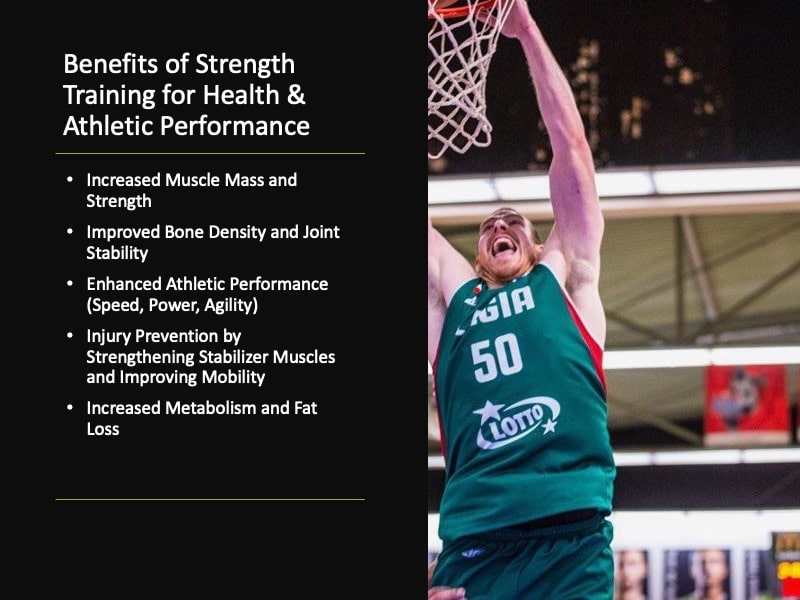
Strength training has some of the strongest evidence in all of fitness.
It improves muscle mass, strength, insulin sensitivity, bone health, physical function, and body composition. It also helps protect against the decline in muscle and mobility that tends to happen with age.
A good resistance program usually trains major movement patterns at least two times per week. That can include squats or leg presses, hinges like deadlift variations, presses, rows, carries, and core training. The exact exercises matter less than the quality of execution and whether the program gradually becomes more challenging.
Research consistently supports moderate training volumes for most people.
You do not need marathon gym sessions to build strength or muscle.
For most healthy adults, 2 to 4 well-designed resistance-training sessions per week, combined with sufficient effort, progressive overload, and adequate recovery, are enough to produce significant improvements in muscle strength, hypertrophy, and overall health (Schoenfeld et al., 2019).
Aerobic Training
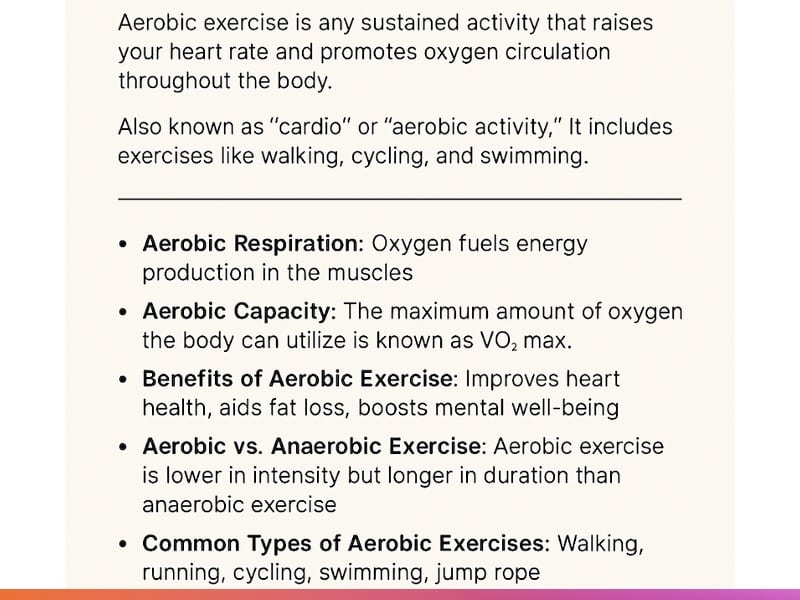
Cardio exercises are not just for burning calories.
Evidence strongly supports aerobic exercise for heart health, blood pressure, endurance, recovery capacity, and overall longevity (Nystoriak & Bhatnagar, 2018).
Walking, jogging, cycling, swimming, rowing, and other rhythmic activities can all work.
Moderate-intensity steady-state cardio has strong support, especially for general health and beginners.
It is sustainable, easier to recover from, and effective when done consistently.
Brisk walking is one of the most underrated evidence-based programs available because it is accessible, low-impact, and realistic for busy adults.
High-intensity Interval Training
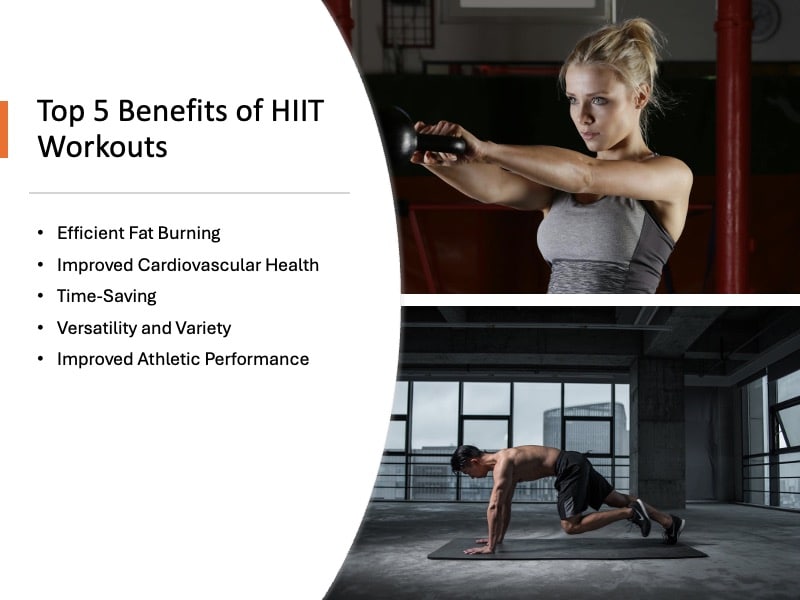
High-intensity interval training (HIIT) is one of the most extensively studied exercise methods and is supported by a large body of research.
By alternating short bursts of vigorous exercise with periods of active recovery or rest, HIIT can significantly improve cardiorespiratory fitness (VO₂max), insulin sensitivity, and several markers of metabolic health while requiring less total training time than traditional moderate-intensity continuous exercise (Weston et al., 2014).
However, HIIT is often misunderstood because its effectiveness depends on the intensity of the work intervals.
The same intensity that makes HIIT such a powerful training stimulus also creates greater physiological stress and demands on recovery.
More HIIT is not necessarily better.
For athletes and experienced exercisers, strategically programmed HIIT can be an excellent way to improve conditioning and sport-specific performance.
For beginners, individuals experiencing high levels of life stress, or those with inadequate sleep and recovery habits, excessive HIIT can increase fatigue, reduce workout quality, and make long-term consistency more difficult.
In many cases, combining one or two HIIT sessions per week with regular strength training and moderate-intensity aerobic exercise provides a more sustainable and evidence-based approach than relying on HIIT alone.
Combined Strength and Cardio Programs
For overall health, body recomposition, and long-term physical function, programs that combine resistance training with aerobic exercise offer some of the strongest evidence in exercise science.
Known as concurrent training, this approach improves muscular strength, cardiovascular fitness, metabolic health, and functional capacity while reducing the risk of many chronic diseases (Wilson et al., 2012).
A well-balanced weekly routine that includes both strength training and cardiovascular exercise provides benefits that neither training style can deliver on its own.
Resistance training helps build and preserve lean muscle mass, increases strength, and supports bone health, while aerobic exercise improves heart and lung function, endurance, blood pressure, and recovery capacity.
This is one reason the most effective real-world exercise programs are rarely extreme.
Unless you’re training for a specific athletic event or competition, you do not need to choose between being “a runner” or “a lifter.”
Most adults achieve better long-term results by performing enough resistance training to maintain muscle and functional strength while incorporating regular aerobic exercise to support cardiovascular health, energy levels, and overall fitness.
The key is finding the right balance for your goals and lifestyle.
Whether your objective is to lose body fat, improve athletic performance, or age well, a thoughtfully designed combination of strength and cardio training is one of the most consistently supported approaches in the scientific literature.
Mobility and Balance Training
Mobility-focused exercise programs are sometimes marketed as complete fitness solutions, but the evidence suggests they are most effective when used to support (not replace) a well-rounded training program.
Structured mobility, flexibility, and balance training can improve joint range of motion, movement quality, postural control, and functional independence, particularly in older adults, individuals recovering from injury, and athletes with specific movement limitations (Behm et al., 2016).
For example, balance training has consistently been shown to reduce fall risk in older adults, while targeted mobility exercises can help restore normal movement patterns following injury or prolonged inactivity.
For athletes, improving mobility in areas with genuine restrictions may also enhance exercise technique and reduce compensatory movement patterns, although mobility alone is unlikely to improve strength or athletic performance without accompanying resistance training.
That said, mobility should complement your primary training goal rather than become the goal itself.
If your objective is to build muscle, lose body fat, improve cardiovascular fitness, or increase strength, resistance training and aerobic exercise should remain the foundation of your program.
Mobility exercises are most valuable when they help you move better, recover effectively, and perform those foundational exercises with better technique and less discomfort.
What Evidence-Based Training Is Not
A program is not evidence-based simply because it uses scientific terminology or references research studies.
Terms like heart rate zones, biohacking, functional movement, muscle activation, or periodization may sound impressive, but they do not automatically make a workout effective.
If the program lacks progressive overload, appropriate recovery, and a logical progression, the science-inspired language is little more than marketing.
Likewise, evidence-based training does not require expensive equipment, complex workout splits, or constantly changing exercises.
In many cases, a straightforward program built around fundamental movement patterns, such as squats, hinges, presses, rows, carries, and regular walking, will produce better long-term results than a highly complicated routine that is difficult to follow consistently.
It is also important to understand that evidence-based training is not the same as research-only training.
High-quality scientific research provides the foundation for effective programming, but it is only one part of the decision-making process.
The best coaches also consider their practical experience and the individual needs of the person in front of them, including their goals, injury history, training age, lifestyle, preferences, and recovery capacity.
This is why two people following the same evidence-based principles may end up with very different workout programs.
The principles remain the same, but their application should always be individualized.
In the end, the best exercise program is the one that consistently helps you make measurable progress while fitting your body, your schedule, and your life.
How to Judge Whether an Exercise Program Really Works
If you want to know whether an exercise program is truly evidence-based, look beyond the branding, promises, and before-and-after photos.
Instead, evaluate whether the program follows the principles that consistently produce long-term results.
Does the program include progressive overload?
An effective workout plan should gradually become more challenging over time.
Whether you’re increasing the weight you lift, the number of repetitions you perform, the distance you walk or run, your training volume, or the complexity of an exercise, your body needs an ongoing stimulus to continue adapting.
Does it match your specific goal?
The best training programs begin with goals that are Specific, Measurable, Achievable, Relevant, and Time-bound (SMART).
Rather than saying, “I want to get in shape,” a SMART goal might be to increase your squat by 25 pounds over the next 12 weeks, lower your resting blood pressure, complete a 5K without stopping, or perform 10 consecutive pull-ups.

Clear goals make it easier to choose the right exercises, stay motivated, and evaluate whether your program is actually working.
Then, you can ensure your program matches your goals.
A fat-loss program should prioritize preserving lean muscle while increasing energy expenditure.
A strength program should emphasize compound resistance exercises and adequate recovery.
An endurance program should progressively improve aerobic capacity, while an athletic performance program should reflect the specific demands of the sport.
Is the Weekly Workload Realistic?
Even the best-designed workout plan is ineffective if you cannot follow it consistently.
A program that fits your schedule, recovery capacity, and lifestyle is far more valuable than an overly ambitious plan that leads to missed workouts, overtraining, or burnout.
Long-term adherence is one of the strongest predictors of exercise success.
Does the Program Manage Fatigue?
Effective training challenges your body while allowing adequate time for recovery and adaptation.
If every workout is an all-out effort, fatigue accumulates faster than fitness, increasing the likelihood of stalled progress, reduced performance, or overuse injuries.
Well-designed programs strategically balance hard training with easier sessions and planned recovery.
Can You Objectively Track Your Progress?
Evidence-based programs rely on measurable outcomes rather than guesswork.
Tracking metrics in a workout logbook, such as strength, workout performance, body composition, waist circumference, blood pressure, resting heart rate, VO₂max, daily step count, or energy levels, helps determine whether your training is moving you toward your goals.
Monitoring your progress also makes it easier to identify when your program should be adjusted rather than abandoned.
The Best Evidence-Based Exercise Programs for Common Goals
The best exercise program depends on what you’re trying to accomplish.
Although the underlying principles remain the same, an evidence-based program should prioritize the adaptations that matter most for your specific goal.
Building Muscle and Strength
If your goal is increasing muscle mass or strength, progressive resistance training should be the foundation of your program.
Most adults can make excellent progress by performing 3 to 4 resistance-training sessions per week, focusing primarily on compound exercises such as squats, presses, rows, deadlifts, and pull-ups while including accessory exercises where appropriate.
Success also depends on more than the workouts themselves.
Adequate protein intake, sufficient calories, quality sleep, and progressive overload all work together to maximize strength and muscle growth.
Losing Body Fat
For fat loss, the strongest evidence supports combining resistance training, moderate cardiovascular exercise, increased daily physical activity, and sustainable nutrition habits.
While exercise increases energy expenditure, preserving lean muscle through strength training helps maintain metabolic health during weight loss.
Rather than relying on endless cardio sessions or extreme workout challenges, most people achieve better long-term body composition by lifting weights consistently, walking more throughout the day, and following a nutrition plan they can realistically maintain.
Supporting Overall Health
For general health and longevity, it is difficult to improve upon the recommendations from the American College of Sports Medicine and the World Health Organization: perform regular resistance training while accumulating at least 150 minutes of moderate-intensity aerobic activity each week.
A simple program consisting of two or three full-body strength workouts combined with regular walking, cycling, swimming, or other aerobic exercise provides substantial benefits for cardiovascular health, blood pressure, bone density, metabolic function, and overall quality of life.
Improving Athletic Performance
Athletic performance requires a more individualized approach.
Evidence-based sports performance programs are designed around the specific demands of the athlete’s sport, position, competitive season, injury history, and performance goals.
As someone who has spent more than a decade competing as a professional basketball player, I’ve learned that the goal is to train intelligently enough that you continue improving while staying healthy enough to compete.
The highest-performing athletes are often the ones who balance strength, power, conditioning, mobility, recovery, and skill practice most effectively.
Why Simple Exercise Programs Often Outperform Trendy Ones
One of the biggest lessons I’ve learned from both research and professional basketball is that effective training usually looks surprisingly ordinary.
The methods with the strongest scientific support are rarely revolutionary.
They emphasize progressive overload, consistent movement, appropriate recovery, and patience.
While social media often rewards novelty, the human body continues responding to the same physiological principles that have worked for decades.
This is one reason I appreciate Amoila Cesar’s 645 program on the BODi (formerly Beachbody On Demand) platform.
When I’m not following a personalized basketball performance program or designing my own workouts, 645 is one of the few commercial fitness programs I genuinely enjoy because it emphasizes movement quality, progressive overload, balanced strength training, mobility, recovery, and sustainable progression, rather than simply trying to leave you exhausted every day.
However, that certainly doesn’t mean 645 is the only evidence-based strength training program.
Well-designed science-based fitness programs like Couch to 5K, Starting Strength, StrongLifts 5×5, and properly structured HIIT programs based on the Tabata Protocol also apply many of the same scientific principles.
Although each uses different exercises and targets different goals, they all succeed because they respect how the body actually adapts to training.
By comparison, many viral fitness challenges promise dramatic transformations through extreme volume or unnecessary complexity.
They may generate millions of views, but they often ignore recovery, progression, and long-term sustainability, which are the very factors that determine whether a program actually works.
Final Thoughts: A Better Standard for Choosing Your Next Exercise Program

You do not need to find the “perfect” workout program.
Instead, look for a program built on proven training principles, aligned with your goals, and realistic enough to follow consistently for months rather than just a few highly motivated weeks.
Ask yourself a few simple questions:
- Does it include progressive overload?
- Does it match my current fitness level and goals?
- Can I realistically follow it every week?
- Does it allow enough recovery?
- Can I objectively measure my progress?
If the answer to those questions is yes, you’re probably looking at a well-designed program.
As I’ve said a few times, the best evidence-based training program is the one that helps you train consistently, recover effectively, and make measurable progress over time.
Science provides the blueprint, but your long-term success depends on applying those principles in a way that fits your lifestyle.
Stay patient, trust the process, and let consistent effort determine your results.
This website does not provide medical advice. This website site does contain affiliate links, and purchases may earn a commission.
Read my Medical Disclaimer, Review Disclaimer, and Publishing Policies for more details. Use of this site indicates acceptance of these terms.