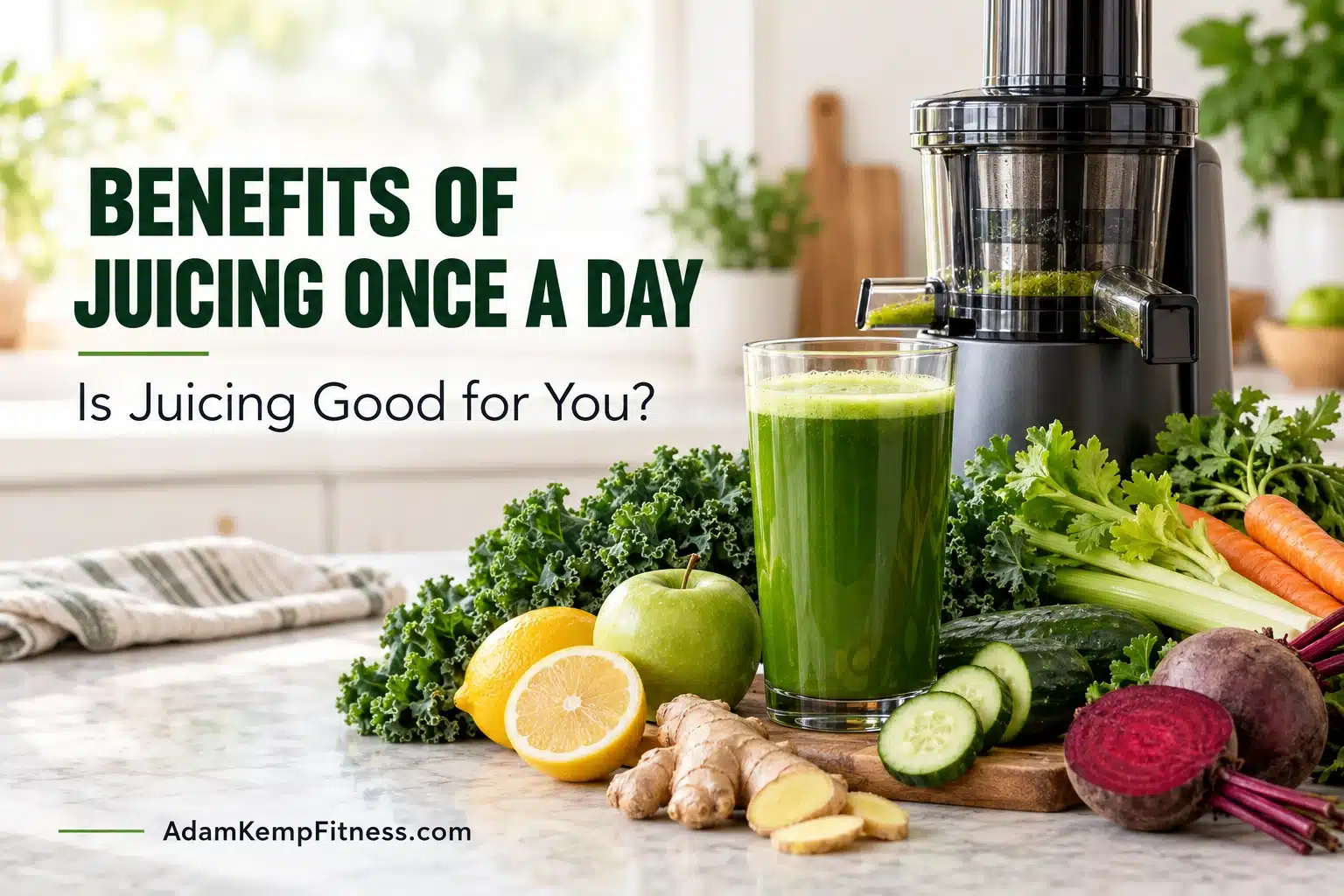
Benefits of Juicing Once a Day: Is Juicing Good for You?
 Reading Time: 9 minutes
Juicing every day is a great way to add a ton of vitamins and minerals to your daily diet in a quick, refreshing, enjoyable way.
Although “juicing” might sound like a diet fad, drinking fresh-pressed fruit and vegetable juice is a legitimate way to increase your vitamin and mineral intake and can play a significant role in a healthy diet plan.
However, there are some negatives to juicing as well.
For example, when you make juice out of fruits and vegetables instead of eating them whole, you lose almost all of the fiber and some of the unique phytonutrients fruits and vegetables contain.
Regardless, juicing once a day is a great addition to a healthy dietary strategy, and it can help you improve your health in a variety of ways!
If I convince you that you should try juicing once a day and you don’t have a juicer yet, I think the best affordable juicer for juicing each day is the AMZCHEF Cold Press Juicer:
No products found.
Whether your goal is to lose weight, gain muscle, or just become a healthier person, juicing fresh fruits and vegetables once a day can make achieving your goals easier!
What Is Juicing?
Juicing is the process of extracting the liquid from fresh fruits and vegetables while separating most of the solid pulp.
Depending on the ingredients, the resulting drink may provide concentrated amounts of vitamins, minerals, carotenoids, polyphenols, and other beneficial plant compounds.
Juicing is different from blending.
A juicer removes much of the insoluble fiber found in the skin, seeds, and pulp, while a blender generally retains the entire edible portion of the produce.
Removing the pulp makes juice easy to drink and allows you to consume nutrients from several fruits and vegetables in one serving.
However, it also makes juice less filling than whole produce and easier to consume quickly, especially when the recipe contains a large amount of fruit.
Juicing once a day is not the same as following a juice cleanse or juice fast.
It simply means incorporating a moderate serving of fresh fruit and vegetable juice into an otherwise balanced diet.
Although 100% juice can contribute valuable nutrients, it should complement, not replace, whole fruits and vegetables.
Whole produce remains important because it provides more dietary fiber, supports fullness, and requires more time to eat (U.S. Department of Agriculture & U.S. Department of Health and Human Services, 2020).
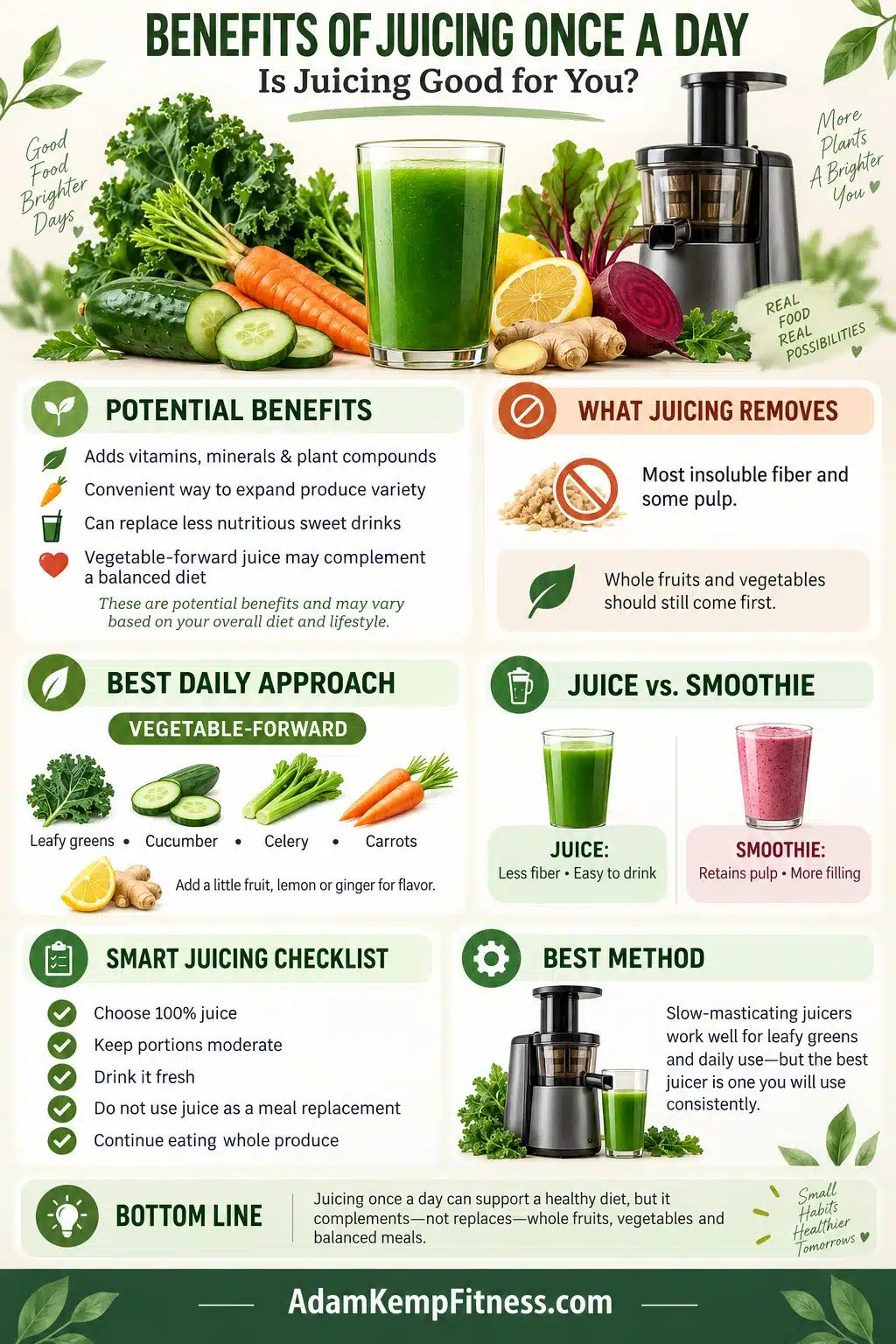
For most people, a vegetable-forward juice containing ingredients such as leafy greens, cucumber, celery, carrots, ginger, or lemon is a more balanced everyday option than a large juice made primarily from sweet fruits.
What Type of Juicing is the Best?
For most people, the best approach is vegetable-forward juicing with a smaller amount of fruit for sweetness.
This produces a nutrient-rich drink without concentrating as much natural sugar as a juice made primarily from apples, grapes, oranges, or pineapple.
A practical daily juice might combine leafy greens, cucumber, celery, carrots, beets, or tomatoes with a smaller portion of lemon, berries, green apple, or another fruit.
Rotating ingredients throughout the week can also provide a broader variety of vitamins, minerals, and plant compounds.
When choosing a juicing method, the main options are:
- Cold-press or masticating juicers: Slowly crush and press produce. They generally produce a high juice yield, handle leafy greens well, and operate relatively quietly.
- Centrifugal juicers: Shred produce at high speed. They are usually faster and less expensive, although they can be louder and may produce wetter pulp.
- Citrus juicers: Extract juice from oranges, lemons, grapefruits, and similar fruits but cannot process most vegetables.
- Blenders: Retain the pulp and fiber, producing a smoothie rather than true juice.
A slow-masticating juicer is often the most practical option for someone planning to juice once a day, especially when using leafy greens and firm vegetables.
However, claims that cold-pressed juice is always substantially more nutritious than centrifugally extracted juice are not supported by the available evidence.
Regardless, the best juicer is the one you can afford, clean easily, and use consistently.
A more expensive machine offers little benefit if its complicated cleanup prevents you from juicing regularly.
No matter the machine, use 100% fruit and vegetable juice without added sugar, keep portions moderate, and continue eating whole produce throughout the day.
Current dietary guidance recommends obtaining at least half of total fruit intake from whole fruit rather than juice because whole fruit retains more fiber and is generally more filling (U.S. Department of Agriculture & U.S. Department of Health and Human Services, 2020).
For daily use, my preferred combination is a vegetable-forward juice made with a slow-masticating juicer, served alongside a balanced meal rather than as a meal replacement.
Is Juicing Good for You?
Yes, juicing can be good for you when it adds nutrients and variety to an otherwise balanced diet.
Fresh fruit and vegetable juice can provide vitamins, minerals, carotenoids, polyphenols, and other plant compounds in a convenient form.
However, juice is not nutritionally equivalent to whole produce.
Juicing removes most insoluble fiber, making it easier to consume the natural sugars and calories from several pieces of fruit in a short time.
This does not mean that the natural sugar in 100% juice is automatically harmful.
However, regularly drinking large portions, especially fruit-dominant juice, may add substantial calories without the fullness of eating whole fruit.
Research presents a similarly balanced picture.
Controlled trials in adults have not shown that moderate consumption of 100% fruit juice necessarily causes weight gain, but observational evidence suggests that larger daily servings may contribute to small increases over time (Nguyen et al., 2024).
The health value of juicing therefore depends on what the juice contains, how much you drink, and what it replaces.
A moderate vegetable-forward juice is more likely to improve your diet when it replaces soda or another nutrient-poor beverage than when it replaces whole produce, protein-rich food, or a complete meal.
For most people, the healthiest approach is to use leafy greens, cucumber, celery, carrots, beets, or tomatoes as the foundation and add a smaller amount of fruit, lemon, or ginger for flavor.
Continue eating whole fruits and vegetables so that juicing complements your fiber intake rather than displacing it.
People with diabetes, kidney disease, digestive conditions, or medications affected by foods such as grapefruit should discuss regular juicing with a qualified healthcare professional.
Individual ingredients can influence blood glucose, potassium intake, digestion, or medication metabolism.
Overall, juicing once a day can be good for you, but it is best viewed as a convenient dietary addition, not a detoxification treatment, a meal replacement, or a substitute for whole fruits and vegetables.
Health Benefits of Juicing Fruits & Vegetables
There are several key benefits of juicing once a day.
I don’t believe that you should consume too much fruit or vegetable juice per day because you should strive to eat whole fruits and vegetables instead of only juicing them, but juicing once a day can be great for your health!
Many people might say, “why don’t you just eat more fruits and vegetables?”
Eating a lot of fruits and vegetables daily is great. However, some people may not have the time each day to sit and cook a full meal with a large variety of vegetables and fruits.
Furthermore, some people do not enjoy the taste enough to put these foods into their diet consistently!
Keep reading below to learn more about the health benefits of drinking fruit and vegetable juice.
Provides Valuable Nutrients for Overall Health

As I mentioned, you lose some key nutrients when you drink fruit or vegetable juice compared to when you eat whole fruits and vegetables.
However, juicing fruits and vegetables are still a great source of vitamins, minerals, and other phytonutrients.
Research indicates that drinking 100% fruit and vegetable juice provides excellent amounts of bioavailable micronutrients like vitamins, minerals, and other plant bioactives that have numerous health benefits.
Furthermore, research indicates that 100% fruit and vegetable juice consumption may be equal to whole fruit and vegetable consumption to reduce chronic disease development risk.
Additionally, fruit and vegetable juice consumption has demonstrated positive impacts on the gut microbiome, and “juice fasting” or a short-term juice-based diet has demonstrated positive health benefits for weight loss and other health indicators.
Can Help Reduce Cravings for Sweets
Drinking fresh fruit and vegetable juice can help reduce cravings for sweets such as soda, sugar-sweetened beverages, baked goods, and more!
Drinking juice every day can provide a naturally sweet substitute for other unhealthy sweets, which will help with weight management goals and much more for your overall health.
Can Reduce the Risk of Alzheimer’s Disease
A unique benefit of juicing once a day is that research indicates drinking fruit and vegetable juice correlates with delaying Alzheimer’s disease onset.
Negatives of Juicing
The primary negative of juicing instead of eating whole fruits and vegetables is that whole fruits and vegetables are a better source of prebiotic fiber and a few other micronutrients.
The increased fiber content of whole fruits and vegetables provides increased benefits for the gut microbiome and your overall health.
However, research does indicate that drinking fruit and vegetable juice also provides numerous bioavailable vitamins and minerals.
There are a few other negatives of juicing as well, as fruit and vegetable juices can react negatively with some people’s digestive systems. Simply, some people don’t tolerate fruit and vegetable juices well.
In my opinion, there are not many negatives of juicing once a day.
Is Juice Fasting Healthy?

Juice fasting, also known as juice cleansing or a juice-based diet, is a diet in which people abstain from conventional foods and consume only fruit or vegetable juice for a set period.
Interestingly, juice fasting actually has some evidence-based benefits.
For example, in one study, a 3-day juice-based diet of six 16-ounce bottles of fruit-and-vegetable juice blends led to significant weight loss, which was maintained for two weeks after the juice fast.
The weight loss is believed to have resulted from positive gut microbiome changes due to beneficial compounds in fruit and vegetable juice.
If you try juice fasting, I suggest you keep the juice cleansing period short, followed by a recovery period where principles of a healthy diet are followed.
Another form of fasting, known as intermittent fasting, has also demonstrated many potential health benefits.
Juice fasting can play a role in developing good health.
Still, it should not be used as a disguise for having an unhealthy relationship with foods, a constant desire to try fad diets, or an unhealthy type of detoxification.
What Is the Best Juicer to Buy for Juicing Every Day?
A critical part of juicing every day is the juicer you are using.
There are a few distinct types of juicers, but using a slow-masticating cold-pressed juicer is the best. Cold-pressed juicers are the most efficient form of juicing for retaining the most vitamins, minerals, and other micronutrients and reign king amongst all juicers.
If you are interested in buying a juicer for yourself, I suggest the AMZCHEF Slow Masticating Juicer.
Compared to other cold-pressed slow-masticating juicers, the AMZCHEF Slow Juicer is affordable and top-quality.

Last update on 2026-11-04 / This article includes affiliate links/Images via Amazon Product Advertising API. I may earn commissions on purchases made through these links.
Final Thoughts: Is Juicing Once a Day Good for You?

Juicing every day has many benefits for your overall health.
With the advantages of juicing listed above, you can now stock your refrigerator with fruits and vegetables and find the best juicer for your kitchen!
With a basic slow speed masticating juicer, like those listed by Juicer Cruiser, you can make your own juice daily and improve your health in various ways.
This website does not provide medical advice. This website site does contain affiliate links, and purchases may earn a commission.
Read my Medical Disclaimer, Review Disclaimer, and Publishing Policies for more details. Use of this site indicates acceptance of these terms.
Check Out Some of My YouTube Videos Below, and Please Follow on YouTube for More Educational Health and Fitness Content!