How to Improve Sleep Quality Naturally
 Reading Time: 13 minutes
 “How to improve sleep quality naturally” is one of the most important questions you can ask if you want better health, stronger athletic performance, faster recovery, and more consistent energy.
You can train hard, eat well, and follow the perfect workout plan, but if your sleep is poor, your progress often stalls because recovery is where your body repairs, adapts, and grows.
As a professional basketball player, I learned this lesson through years of late-night games, international travel, time zone changes, and high-pressure competition.
There were seasons when getting quality sleep felt harder than completing the toughest workout, and I realized there was no miracle supplement or viral sleep hack that consistently fixed the problem.
Instead, I found that people who commonly sleep well are usually the ones who build simple, repeatable habits that help their bodies feel safe, regulated, and ready to rest.
Key Point: Whether your goal is better recovery, improved mental clarity, or simply waking up feeling refreshed, learning how to improve sleep quality naturally starts with understanding the daily routines that influence sleep long before your head reaches the pillow.
Optimize Your Sleep.
Improve Your Performance.
Learn the exact sleep strategies I use as a professional athlete to improve recovery, boost energy, and perform at a higher level every day.
Improving Sleep Quality Naturally Starts with Your Circadian Rhythm

If you want to improve sleep naturally, one of the best places to start is by supporting your circadian rhythm.
Often called your body’s internal clock, the circadian rhythm regulates when you feel awake or sleepy and influences hormone production, body temperature, metabolism, digestion, and countless other biological processes.
When this system stays synchronized, falling asleep and staying asleep become much easier.
When it is disrupted, your body has to work harder to do something that should feel automatic.
The most effective way to reinforce your circadian rhythm is by maintaining a consistent wake-up time.
While going to bed at the same time each night is helpful, waking up at a similar time every morning often has an even greater impact because it anchors your body’s entire daily schedule.
Sleeping until 10:30 a.m. on weekends after waking at 6:00 a.m. during the week creates a form of “social jet lag” that can make Sunday nights and Monday mornings noticeably more difficult (Roenneberg et al., 2012).
Morning sunlight is another powerful signal for your internal clock.
Getting outside within the first hour after waking exposes your eyes to natural light, which suppresses melatonin production, increases alertness, and helps your brain recognize that the day has begun.
This early light exposure strengthens your natural sleep-wake cycle and promotes a more predictable release of melatonin later that evening.
Even 10 to 20 minutes outdoors can make a meaningful difference, especially when the sky is clear (Khalsa et al., 2003; Czeisler et al., 1986).
If your schedule is busy, avoid overcomplicating the process.
Waking up at roughly the same time every day, getting outside soon after you wake, and resisting the urge to completely reset your sleep schedule on weekends are three of the simplest and most effective ways to naturally improve sleep over time.
How to Build a Nighttime Routine That Prepares Your Body for Sleep

One of the best ways to improve sleep naturally is to create a consistent nighttime routine that signals to your body that it is safe to relax.
A predictable wind-down routine helps shift your nervous system from an alert, “go mode” state into one that supports deep, restorative sleep.
A healthy evening routine should focus on:
- Reducing mental and physical stimulation during the last 30 to 60 minutes before bed.
- Repeating calming habits consistently so your brain begins associating them with sleep.
- Limiting screen time and digital distractions that keep your mind engaged.
- Creating a relaxing transition between your busy day and bedtime.
You do not need an elaborate routine. The most effective nighttime habits are usually the simplest ones that you can repeat nearly every evening.
1.) Create a Routine Your Brain Recognizes
Consistency is one of the most overlooked sleep strategies.
When you perform the same sequence of calming activities each evening, your brain begins forming a conditioned association between those behaviors and bedtime. Eventually, those cues alone can help you feel sleepy.
As an athlete, I often compare this to a pregame routine.
Performing the same warm-up before every game helps prepare your body for competition.
A bedtime routine works the same way, as it prepares your body for recovery.
2.) Reduce Stimulation Before Bed
Many adults do not actually have a sleep problem; they have a wind-down problem.
Going directly from work emails, social media, television, intense workouts, or household responsibilities into bed leaves your brain in an alert state when it should be slowing down.
Instead, spend the final hour before bed intentionally lowering both physical and mental stimulation.
Simple activities such as reading a physical book, gentle stretching, foam rolling, taking a warm shower, listening to calming music, or practicing breathing exercises can help prepare your body for sleep.
For many people, including myself prayer can be a meaningful way to quiet the mind before sleep.
Taking a few minutes to pray can help shift your attention away from the day’s worries and responsibilities, developing a greater sense of peace, gratitude, and trust.
Research has found that spiritual practices such as prayer are associated with lower stress levels, reduced anxiety, and better overall sleep quality in many individuals, likely because they promote relaxation and decrease cognitive arousal before bedtime (Ellison & Bradshaw, 2014; Rosmarin et al., 2016).
Whether your prayer is formal or simply a quiet conversation with God, ending the day with gratitude, reflection, and surrender can be a powerful addition to a healthy nighttime routine.
Put Your Phone Away Earlier
Although blue light receives much of the attention, mental stimulation is often the bigger issue.
Scrolling through news, emails, social media, videos, or online arguments keeps your brain solving problems and processing new information when it should be slowing down.
Even content that feels relaxing can delay your transition into sleep.
A practical goal is to create 30 to 60 minutes of low-stimulation time before bed and keep your phone off your mattress and out of arm’s reach.
Try the Therabody Smart Goggles
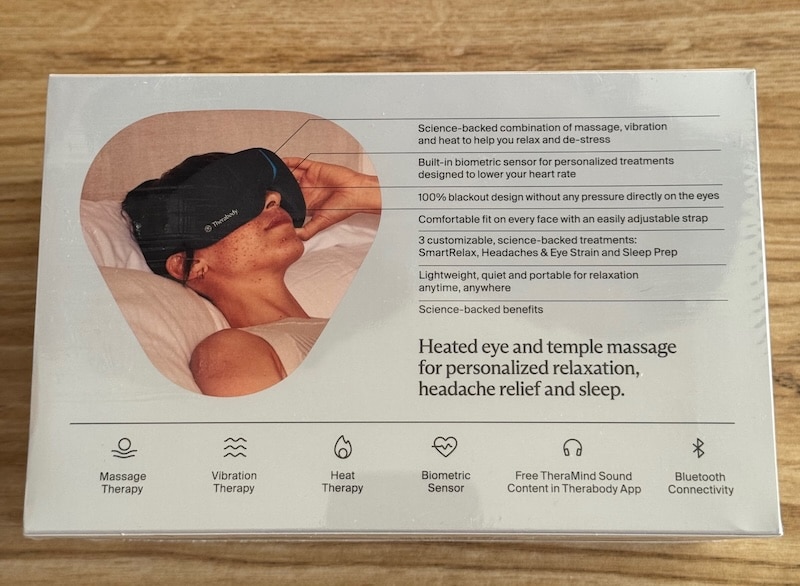
The Therabody Smart Goggles can help naturally improve sleep quality by helping calm the nervous system, reduce eye and head tension, and improve sleep readiness before bed.
By combining gentle vibration, heat, and full blackout coverage, the Therabody Smart Goggles address common barriers to quality sleep such as mental overstimulation and screen-related eye strain.
I’ve used them for about a year and they are one of my favorite purchases ever, due the nighttime relaxation and improved sleep quality they provide.

Last update on 2026-10-17 / This article includes affiliate links/Images via Amazon Product Advertising API. I may earn commissions on purchases made through these links.
3.) Create a Bedroom That Supports Deep, Restorative Sleep
Even excellent sleep habits can be undermined by a poor sleep environment.
Your bedroom should remove distractions instead of creating them.
Small improvements to your environment often produce surprisingly meaningful improvements in sleep quality.
Aim to optimize:
- Temperature: Keep your room cool, ideally around 60–67°F (16–19°C) for most people.
- Light: Make your bedroom as dark as possible using blackout curtains or an eye mask if needed.
- Noise: Reduce sudden interruptions with earplugs, white noise, or a fan.
- Comfort: Choose a supportive mattress and pillow that fit your sleeping position.
- Purpose: Reserve your bed primarily for sleep and intimacy.
Why You Should Keep Your Bedroom Cool and Dark
Your body naturally lowers its core temperature before sleep. A slightly cooler bedroom supports this process, making it easier to fall asleep and stay asleep.
Darkness is equally important because even small amounts of light can suppress melatonin production in sensitive individuals. Cover bright electronics, close curtains, or wear an eye mask if outside light is unavoidable.
Minimize Noise and Interruptions
Sleep becomes lighter when your brain continually monitors unexpected sounds.
If you cannot eliminate outside noise, consider using a fan, white noise machine, calming nature sounds, or earplugs to create a more consistent sleep environment.
Reserve Your Bed for Sleep
Your brain forms powerful associations with places.
If you routinely answer emails, watch television, eat meals, or scroll social media in bed, your brain begins associating your bed with wakefulness instead of sleep.
Whenever possible, reserve your bed for sleeping and intimacy so it becomes a stronger cue for rest.
4.) Manage Food, Caffeine, and Alcohol Consumption to Support Better Sleep
What you consume during the day influences how well you sleep that night.
Rather than focusing only on foods or supplements that supposedly make you sleepy, pay attention to habits that quietly reduce sleep quality without you realizing it.
Consider these three areas:
- Caffeine timing
- Alcohol consumption
- Evening meal size and timing
Be Smart About Caffeine
Caffeine can remain active in your body for many hours.
Even if you fall asleep easily after an afternoon coffee, caffeine may reduce deep sleep or increase nighttime awakenings.
If sleep quality is inconsistent, try avoiding caffeine after late morning or around noon and see whether your sleep improves.
Remember That Alcohol Disrupts Sleep
Alcohol often helps people fall asleep faster, but it commonly decreases overall sleep quality.
As your body metabolizes alcohol throughout the night, sleep becomes more fragmented, REM sleep is reduced, and many people wake feeling less refreshed despite sleeping for an adequate number of hours.
Related Reading: Alcohol And Sleep: How Drinking Wrecks Your Rest & Recovery
Find the Right Evening Meal
Going to bed overly full can increase discomfort, reflux, and nighttime awakenings.
On the other hand, going to bed hungry can also delay sleep.
Most people benefit from a balanced evening meal followed, if needed, by a light snack containing protein and complex carbohydrates if hunger develops before bedtime.
5.) Take the Right Supplements to Naturally Support Sleep Quality
While healthy sleep habits should always come first, the right supplements can provide additional support for people looking to improve sleep naturally.
Rather than forcing your body to sleep, many natural sleep aids and adaptogens for sleep work by supporting your nervous system, reducing stress, or reinforcing your body’s natural sleep-wake cycle.
Some of the most well-researched natural sleep supplements include:
- Magnesium: One of the best-studied minerals for sleep, magnesium supports relaxation by helping regulate the neurotransmitter GABA, which quiets nervous system activity. Magnesium glycinate is an excellent all-around option for promoting relaxation, while magnesium L-threonate may be especially helpful for people whose sleep is disrupted by a racing mind or chronic stress (Arab et al., 2023; Slutsky et al., 2010).
- Melatonin: Melatonin is the hormone that regulates your circadian rhythm. Supplementing with low doses can help reduce the time it takes to fall asleep, particularly for people dealing with jet lag, shift work, or temporary disruptions to their sleep schedule (Ferracioli-Oda et al., 2013).
- Tart Cherry: Naturally rich in melatonin and antioxidant polyphenols, tart cherry juice and concentrates have been shown to modestly improve both sleep duration and overall sleep quality in some adults (Howatson et al., 2012).
- Ashwagandha: This adaptogenic herb helps lower perceived stress and cortisol levels, making it a valuable option for individuals whose sleep problems are driven by anxiety or chronic stress. Several clinical trials have reported improvements in both sleep onset and overall sleep quality with regular supplementation (Cheah et al., 2021).
- Zinc: Zinc plays an important role in nervous system function and may contribute to deeper, more restorative sleep, particularly when combined with magnesium and melatonin. Research suggests these nutrients may work synergistically to improve sleep quality in people with insomnia (Rondanelli et al., 2011).
Other natural ingredients, including glycine, L-theanine, chamomile, passionflower, reishi mushroom, CBD, and CBN, also show promise for promoting relaxation and improving sleep, although the evidence supporting them is generally less robust or more individualized.
Qunol Magnesium Glycinate: Qunol Magnesium Glycinate is my favorite magnesium glycinate supplement because it combines excellent absorption with a gentle formula that’s easy on the stomach. I recommend it for anyone looking to support relaxation, muscle recovery, and better sleep with a high-quality daily magnesium supplement.
Last update on 2026-10-16 / This article includes affiliate links/Images via Amazon Product Advertising API. I may earn commissions on purchases made through these links.
Life Extension Neuro-Mag Magnesium L-Threonate: Life Extension Neuro-Mag is my go-to magnesium supplement when stress or a racing mind makes it difficult to unwind. As a professional athlete, I use it most evenings because I find it helps me relax mentally, supports cognitive health, and prepares me for a restful night’s sleep.
Last update on 2026-10-16 / This article includes affiliate links/Images via Amazon Product Advertising API. I may earn commissions on purchases made through these links.


Remember, supplements can’t replace consistent sleep habits, but when combined with a regular sleep schedule, morning sunlight exposure, regular exercise, and a calming bedtime routine, these natural sleep-aid supplements may help you fall asleep faster, stay asleep longer, and wake up feeling more refreshed.
6.) Exercise Improves Sleep, But Recovery Matters Too
Regular physical activity consistently ranks among the most effective ways to naturally improve sleep.
Exercise reduces stress, improves mood, strengthens circadian rhythms, and increases your body’s natural drive for restorative sleep.
To maximize those benefits:
- Exercise consistently throughout the week.
- Finish intense workouts at least a few hours before bedtime when possible.
- Prioritize a gradual cooldown after evening training.
- Avoid replacing post-workout recovery with additional stimulation.
If You Train at Night, Focus on Cooling Down and Recovery
Many athletes and busy professionals have no choice but to exercise in the evening.
If that’s your situation, the solution doesn’t necessarily involve changing your workout.
Instead, improve the transition afterward by lowering your heart rate, hydrating, eating an appropriate recovery meal, dimming the lights, and avoiding unnecessary screen time or stressful activities.
A calm nervous system often matters just as much as the workout itself.
7.) Manage Stress Before It Manages Your Sleep
Stress is one of the most common reasons people struggle to sleep despite feeling exhausted.
When your brain perceives ongoing physical or emotional stress, it keeps your nervous system in a heightened state of alertness. Falling asleep becomes more difficult, sleep becomes lighter, and nighttime awakenings become more common.
Helpful ways to calm your mind include:
- Journaling or writing tomorrow’s priorities
- Slow diaphragmatic breathing
- Prayer or meditation
- Gratitude journaling
- Gentle stretching
- Quiet reading
Give Your Mind Somewhere to Put Tomorrow
Many people stay awake because they continue mentally rehearsing tomorrow’s responsibilities.
Taking five minutes to write down unfinished tasks or tomorrow’s priorities gives your brain permission to stop holding onto them overnight.
Sleeping Requires Letting Go
As someone who has spent years competing professionally, I have learned that high performers often struggle to slow down.
Discipline helps you succeed during the day, but quality sleep requires something different.
At bedtime, the goal is no longer to push harder; it is to create enough calm for your body to feel safe enough to recover.
Final Thoughts: How to Improve Sleep Quality Naturally Without Chasing Gimmicks
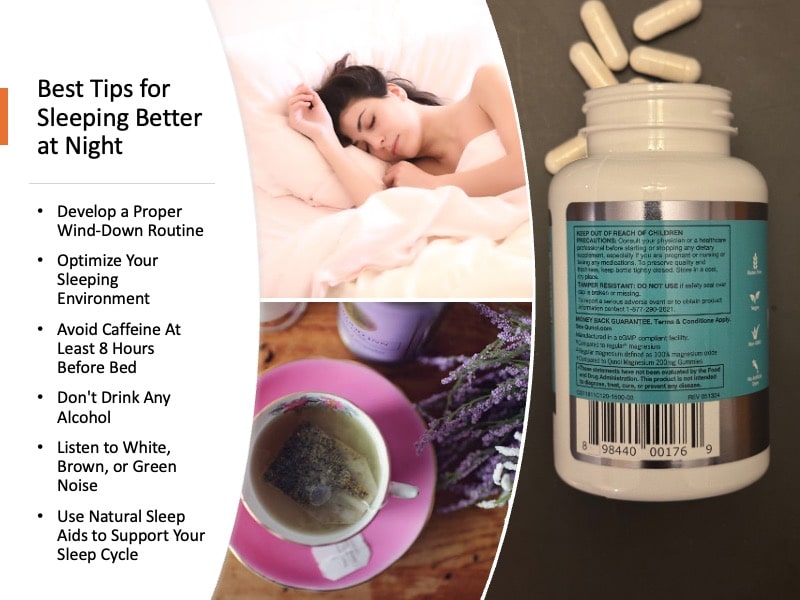
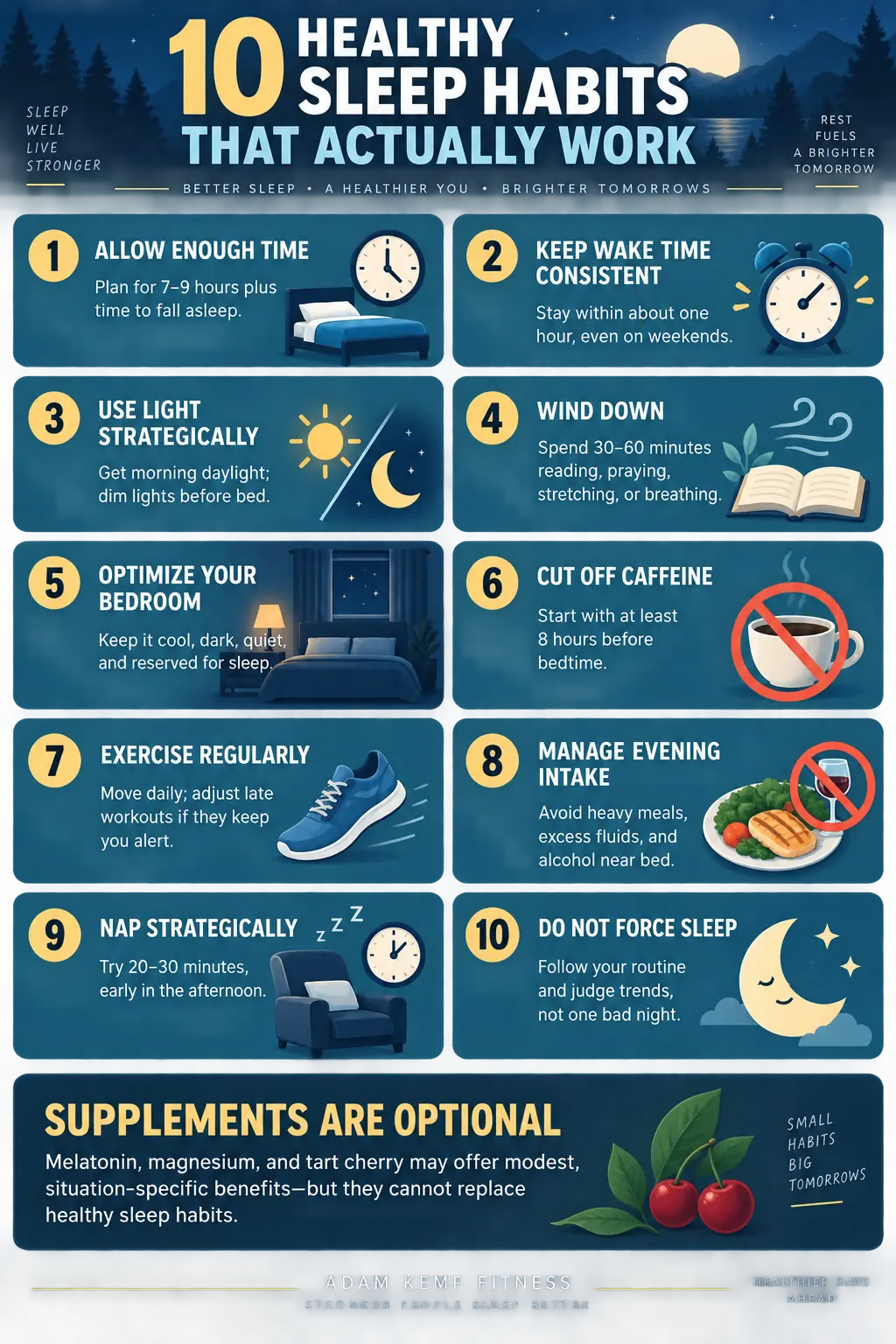
Learning how to improve sleep naturally does not require an expensive mattress, the latest sleep gadget, or a cabinet full of supplements.
While some products can be helpful, many people overlook the daily habits that have the greatest impact on sleep quality and instead search for shortcuts that rarely address the real problem.
If you want the biggest return on your effort, start with the fundamentals.
Maintain a consistent wake-up time, get natural sunlight early in the day, exercise regularly, reduce stimulation before bed, be mindful of your caffeine intake, and create a bedroom that supports deep, uninterrupted sleep.
These habits may not be exciting, but they work because they strengthen your body’s natural sleep processes rather than trying to override them.
Natural supplements can certainly play a supportive role for some people.
Magnesium, glycine, L-theanine, tart cherry, and certain herbal ingredients have research suggesting they may improve sleep quality in specific situations.
However, even the best supplement cannot compensate for chronic stress, an inconsistent sleep schedule, excessive evening screen time, or poor sleep hygiene.
Think of supplements as the finishing touch to a strong foundation, not the foundation itself.
It is equally important to recognize when lifestyle changes alone may not be enough.
Loud snoring, gasping for air during sleep, persistent insomnia, frequent nighttime awakenings, excessive daytime sleepiness, or waking up feeling unrefreshed despite spending enough time in bed may signal an underlying medical condition such as obstructive sleep apnea, restless legs syndrome, anxiety, or another sleep disorder.
If these symptoms persist, speaking with a qualified healthcare professional is an important step toward identifying and treating the underlying cause.
In general, the best way to naturally improve sleep is to build habits that remain realistic even during life’s busiest seasons.
You do not need to change everything overnight. Start with one or two small improvements, stay consistent, and allow those habits to compound over time.
Better sleep is rarely the result of one perfect night; it is the product of thousands of small decisions that align with your body’s natural rhythms.
This website does not provide medical advice. This website site does contain affiliate links, and purchases may earn a commission.
Read my Medical Disclaimer, Review Disclaimer, and Publishing Policies for more details. Use of this site indicates acceptance of these terms.
Check Out Some of My YouTube Videos Below, and Please Follow on YouTube for More Educational Health and Fitness Content!
![Subscribe to @AdamKempFitness for more training, general health, recovery, and nutrition tips from a professional basketball player with a master’s degree in Nutrition Education! 🏀💪
Seated Max Vertical Jumps From a Box are one way I train explosive takeoff power with maximum intent on every rep.
Starting seated, with a pause and minimal rocking or dipping, reduces the contribution of a quick countermovement and emphasizes producing force from a relatively static position (National Strength and Conditioning Association [NSCA], 2020).
For athletes, the training goal is explosive lower-body force production and coordinated extension through the hips, knees, and ankles. I use this variation to practice driving hard into the floor and accelerating my body upward.
My preferred setup: 3 sets of 3 reps or 4 sets of 2 reps, supersetted with a strength or power exercise.
I keep the reps low, reset between jumps, and take longer rest periods so I’m ready to attack every takeoff. Even when pairing exercises, I give myself enough recovery to keep the jumps sharp.
Every rep has one goal: jump as high as possible. I focus on an explosive takeoff, a controlled landing, and consistent quality throughout the session.
Save this for your next power workout! 🚀
Reference: NSCA. (2020). Stretch-shortening cycle.
#VerticalJump #JumpTraining #ExplosivePower #AthleticPerformance #BasketballTraining](https://www.adamkempfitness.com/wp-content/plugins/feeds-for-youtube/img/placeholder.png)