A Guide to Basketball Conditioning for Better Stamina
 Reading Time: 21 minutes
 The hardest basketball conditioning drill I have ever completed is called “20-20s”: 20 full-court “suicides” in 20 minutes.
At The Winchendon School and later at Marist College, we had to finish every suicide in under 40 seconds, then use whatever remained of that minute to recover before starting again.
Both coaching staffs traced the drill back to John Calipari’s program at UMass in the 1990s.
Although I could not verify that Calipari literally invented 20-20s, he has described using the drill with Marcus Camby at UMass, and he later carried it into his programs at Memphis and Kentucky (Bleacher Report, 2017).
Twenty minutes does not sound intimidating until the clock starts.
The early repetitions feel manageable, but the accumulated sprinting, turning, braking, and accelerating eventually make every trip down the court a physical and mental battle.
Although 20-20s helped shape my understanding of high-level conditioning, basketball stamina is not built by one brutally difficult drill or by simply running until you are exhausted.
Basketball is an intermittent sport that requires repeated bursts of acceleration, deceleration, lateral movement, jumping, and physical contact, followed by brief and often incomplete recovery periods (Glaister, 2005).
A complete, science-based basketball training plan for improving basketball-specific stamina must therefore focus on more than just cardiovascular endurance.
It should improve aerobic fitness, repeat-sprint ability, lower-body strength, movement efficiency, and the capacity to preserve shooting mechanics, defensive positioning, and decision-making while fatigued.
Over more than a decade as a professional basketball player, I have used 20-20s, 17s, full-court sprints, shuttle runs, tempo intervals, court circuits, metabolic conditioning programs, aerobic recovery sessions, and many other basketball conditioning drills.
Important: The most valuable lesson has been that running hard and becoming tired are not the same as becoming better conditioned.
This basketball conditioning training guide explains how to progressively build stamina, select drills that translate to the game, organize conditioning around basketball and strength training, and measure improvement without unnecessarily wearing down your knees, shins, or Achilles tendons.
The objective is not merely to survive a difficult workout; it is to help you remain explosive, composed, and technically sound when the fourth quarter exposes everyone who trained only to feel tired.
What Is Conditioning in Basketball?
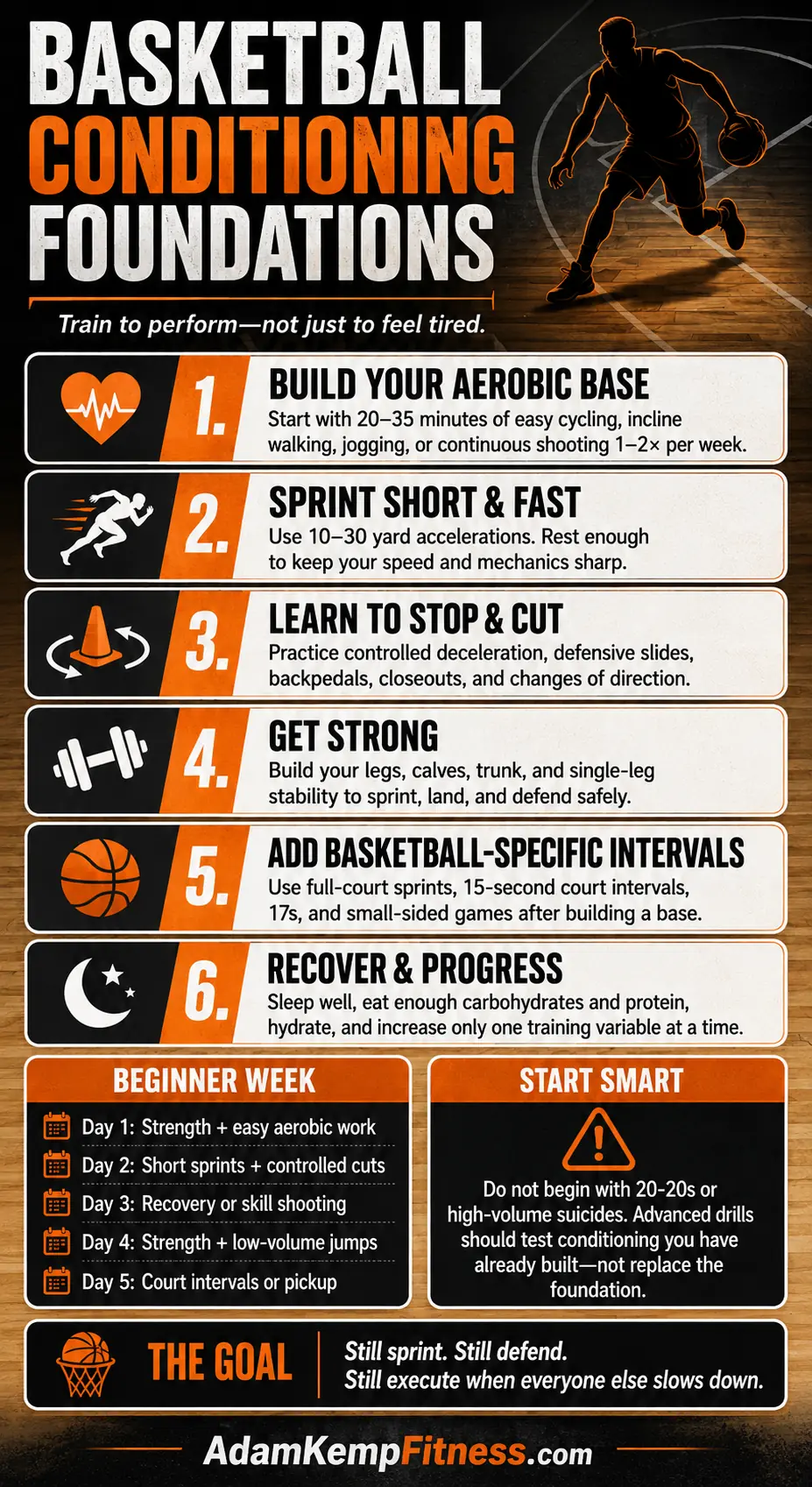
Basketball conditioning is the process of developing enough sport-specific fitness to repeatedly sprint, stop, change direction, jump, defend, and execute skills throughout a game.
It includes aerobic fitness, anaerobic power, repeat-sprint ability, muscular strength, movement efficiency, and recovery between demanding efforts.
Conditioning is sometimes treated as a synonym for cardiovascular endurance, but that definition is incomplete.
A player may be able to run several miles and still struggle with repeated accelerations, defensive slides, physical contact, and explosive transitions.
Basketball is an intermittent sport composed of frequent changes between lower-intensity movement and short, demanding actions.
These repeated efforts create fatigue through several overlapping muscular, metabolic, and neurological mechanisms rather than through a single energy system (Glaister, 2005; Girard et al., 2011).
That is why basketball conditioning should prepare you for the game instead of simply making you good at running conditioning drills.
Why Is Conditioning Important in Basketball?
Conditioning helps you preserve speed, power, technique, and decision-making as fatigue accumulates.
The practical goal is to prevent your physical decline from becoming a basketball problem.
Poor conditioning can appear in several ways:
- You are slow getting back in transition.
- Your defensive stance becomes too upright.
- Your closeouts become uncontrolled.
- You stop cutting or moving without the ball.
- Your jump height declines.
- Your shooting mechanics become inconsistent.
- You commit avoidable fouls because your feet stop moving.
- You make rushed decisions because you cannot recover your breathing.
Conditioning also affects how much quality basketball work you can tolerate.
Better aerobic fitness may also improve recovery between high-intensity efforts, allowing you to complete more useful practice without every drill turning into survival mode (Tomlin & Wenger, 2001).
The best-conditioned player is not necessarily the one who wins every distance run, but the one who can repeatedly execute effective basketball actions without losing control of movement or skill.
The Energy Systems Used in Basketball
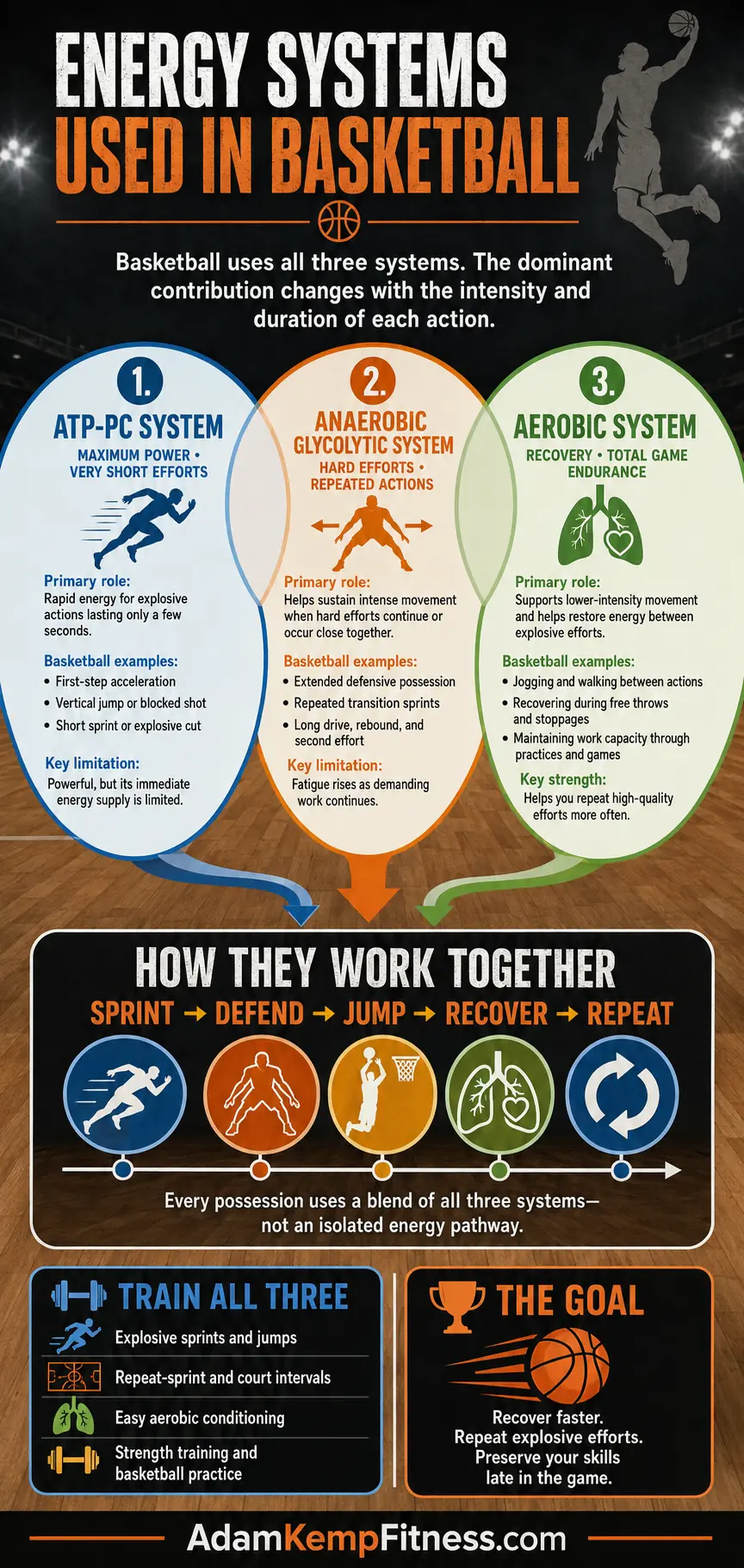
All three major energy systems contribute during basketball, and they work together rather than switching on and off independently.
The ATP-PC System
The phosphagen, or ATP-PC, system supplies rapid energy for extremely short explosive actions.
Accelerating to the rim, jumping for a rebound, blocking a shot, and making an aggressive closeout depend heavily on this system.
Its energy supply is powerful but limited. Partial recovery occurs during lower-intensity movement and stoppages, which helps explain why aerobic fitness still matters to explosive players.
The Anaerobic Glycolytic System
Anaerobic glycolysis contributes more as a hard effort continues or several explosive movements occur close together.
A long transition sequence, extended defensive possession, or repeated full-court sprints may place greater demand on this system.
This energy pathway helps you sustain high-intensity movement, but it is also associated with accumulating fatigue.
Training should improve your ability to tolerate and recover from these demanding sequences without constantly turning every workout into an all-out glycolytic test.
The Aerobic System
The aerobic system supports lower-intensity movement and helps restore energy between harder actions.
It also contributes substantially across the full duration of practices and games.
A strong aerobic base does not make you less explosive.
When developed appropriately, it helps you recover so that you can express your speed and power more often.
How to Prepare for Basketball Conditioning
If you are returning after an offseason, injury, or long break, do not begin with maximal speed suicides and high-volume jumping.
Spend approximately two to four weeks rebuilding your tolerance for running, cutting, landing, and repeated practice.
Start with two or three weekly sessions of easy cycling, incline walking, light jogging, or continuously moving shooting drills.
Twenty to 35 minutes at a conversational pace is a reasonable starting range for many healthy players, although your fitness level and medical history should guide the exact duration.
Gradually reintroduce court movement through controlled accelerations, backpedaling, lateral shuffles, and submaximal tempo runs.
This allows your muscles and cardiovascular system to improve while your feet, calves, shins, knees, and tendons readjust to impact.
Strength training should remain part of the plan.
Squats, split squats, Romanian deadlifts, step-ups, calf raises, rows, presses, and trunk-stability exercises can improve the physical qualities that support sprinting, landing, and change-of-direction performance.
Greater muscular strength is furthermore associated with numerous athletic qualities, including sprinting, jumping, and change-of-direction ability (Suchomel et al., 2016).
Conditioning cannot fully compensate for insufficient strength or poor control of your body.
How to Improve Conditioning for Basketball
The most effective approach combines a general aerobic foundation with progressive basketball-specific intervals.
Your program should move from controlled work toward faster, more reactive, and more competitive drills as your body becomes prepared.
A well-rounded basketball conditioning plan should include the following components.
1.) Build an Aerobic Base
Easy aerobic work is useful because it provides conditioning without adding the mechanical stress of another hard court session.
Cycling, incline walking, pool running, light jogging, and continuous shooting are all reasonable options.
Most players can begin with 20 to 35 minutes once or twice per week.
The effort should remain controlled enough that you could speak in short sentences and finish feeling as though you had more available.
This work is especially helpful during the beginning of an offseason program, on recovery days, or when joint stress needs to be limited.
However, it should support basketball-specific conditioning rather than replace it.
2.) Train Short Accelerations
Most basketball sprints are shorter than traditional track sprints.
Players repeatedly accelerate over several yards while closing out, cutting, chasing a loose ball, or transitioning between offense and defense.
Train accelerations over approximately 10 to 30 yards, with an emphasis on forceful first steps and efficient body position.
A practical starting session is eight to 12 sprints of 15 to 20 yards with 30 to 60 seconds of recovery.
Longer rest periods preserve speed and are appropriate when the primary goal is acceleration quality.
Shorter rest periods create a greater conditioning challenge, but they should not cause your mechanics to collapse.
3.) Practice Deceleration
Basketball conditioning is not just about how quickly you can run.
You must also absorb force, lower your center of mass, stop under control, and transition into the next action.
Sprint toward a cone, gradually lower your hips, and use several controlled steps to stop.
Avoid reaching too far forward with one leg or trying to absorb all your momentum through a rigid knee.
Deceleration training should initially be practiced while relatively fresh.
Once you demonstrate control, it can be incorporated into more demanding drills involving sprints, cuts, defensive slides, and closeouts.
4.) Train Change of Direction
Planned change-of-direction drills teach useful positions and allow you to develop speed without the unpredictability of live basketball.
Effective options include lateral shuffles, backpedals, crossover runs, closeouts, and angled cuts.
Set up three cones approximately five yards apart.
Slide between the first two cones, sprint toward the third, backpedal, and finish with a controlled closeout.
Work for 10 to 20 seconds, then rest for 40 to 60 seconds.
Complete six to 10 rounds while keeping your chest controlled, hips lowered, and knees aligned with the direction of your feet.
Planned drills should eventually progress to reactive work.
A partner, coach, colored cone, or visual signal can determine the direction so that you must perceive, decide, and move rather than memorize a pattern.
The Best Basketball Conditioning Drills
No single drill can develop every aspect of basketball conditioning.
The best program uses several drills for distinct purposes and progresses them according to your training phase.
Full-Court Sprint and Back
Sprint from one baseline to the other, and then back. Complete six to 10 repetitions while recording your times.
This drill is simple, but it reveals whether you can preserve speed across repeated efforts.
End the set when your times decline substantially or your running mechanics noticeably deteriorate.
Sprint–Closeout–Slide Drill
Begin on the baseline, sprint to half court, turn and sprint toward the three-point line, then perform a controlled closeout.
Finish with two or three defensive slides in either direction.
Work for approximately 10 to 15 seconds and recover for 30 to 60 seconds.
This sequence combines acceleration, braking, defensive footwork, and movement transitions that resemble basketball.
Tempo Court Runs
Run the length of the court at approximately 65% to 75% of maximum speed and walk back.
Repeat for 10 to 20 minutes without turning the session into a sprint workout.
Tempo runs can bridge the gap between easy aerobic conditioning and high-intensity intervals.
They are also easier to recover from than repeated all-out suicides.
17s
A 17 requires running from sideline to sideline 17 times, commonly within 60 to 70 seconds, followed by one to three minutes of recovery.
Teams often complete two or three rounds, although standards should reflect the player’s age, position, fitness, and existing workload.
Seventeens train repeated acceleration, braking, and turning, but they do not reproduce basketball’s reactive or skill-based demands.
Use them as a measurable conditioning tool rather than a complete program.
20-20s
The 20-20s drill requires completing 20 full-court suicides in 20 minutes, with one repetition beginning every minute.
At The Winchendon School and Marist College, I had to finish each suicide in under 40 seconds and recover for the remainder of the minute.
John Calipari has described using 20-20s with Marcus Camby at UMass, and he later used the drill at Kentucky (Calipari, 2017).
It is an exceptionally difficult test of repeated acceleration, deceleration, pacing, and mental resilience.
But remember, 20-20s are an advanced test, not a beginner workout.
Build toward them through aerobic development, lower-volume suicides, repeat sprints, and progressive change-of-direction training.
Small-Sided Basketball Games
One-on-one, two-on-two, and three-on-three games can provide meaningful conditioning while developing actual basketball skills.
Reduced player numbers generally create more frequent involvement, accelerations, defensive actions, and decisions for each participant.
Research suggests that small-sided basketball games and traditional high-intensity intervals can both improve aerobic and anaerobic fitness (Delextrat et al., 2018).
Small-sided games may offer better skill transfer, while structured running intervals are easier to standardize and measure.
The limitation is that competitive drills are harder to control.
Players may avoid movement, dominate the ball, or receive very different workloads depending on ability and position.
Skill Work Under Fatigue
Basketball conditioning should eventually test whether you can execute skills after demanding movement.
Sprinting into a jump shot, finishing after contact, or making reads during a small-sided game can reveal problems that running times alone cannot show.
Do not perform every shooting session while exhausted.
Develop your mechanics while fresh first, then strategically practice maintaining them under realistic fatigue.
How to Combine Vertical Jump Training in a Basketball Conditioning Program
Jumping is part of basketball, but vertical jump training should primarily develop power, coordination, landing ability, and elastic strength.
It should not be used merely to make your legs tired.
Plyometric training can improve jumping, sprinting, balance, strength, and change-of-direction performance in basketball players (Ramirez-Campillo et al., 2022).
Those benefits are more likely when repetitions remain explosive and technically controlled.
Begin with approximately three sets of three to five high-quality jumps once or twice per week.
Broad jumps, vertical jumps, low pogo hops, and controlled landing drills are reasonable options when they match your experience and physical readiness.
Perform demanding jumps early in the session, while your legs and nervous system are relatively fresh.
High-volume jumps at the end of an exhausting conditioning workout may reinforce poor landings while adding unnecessary tendon stress.
Stop or reduce the session if jump height declines noticeably, landings become loud or unstable, or tendon pain increases.
Important: Persistent knee, Achilles, or foot pain deserves assessment from a qualified healthcare professional.
How to Get Better Conditioning for Basketball Without Losing Explosiveness
The concern that aerobic exercise automatically makes players slow is too simplistic. Problems are more likely when players perform excessive endurance volume, recover poorly, or replace strength and speed training with long-distance running.
Use low-impact aerobic work to build general fitness while preserving dedicated sprint, strength, and jump exposures. Hard court conditioning should be intense enough to stimulate improvement but limited enough that you can still move explosively.
Separate demanding endurance and strength sessions when possible. When they must occur in the same workout, prioritize the quality that matters most during that training phase.
For most basketball players, strength, speed, power, skills, and conditioning should coexist. The relative emphasis changes throughout the year, but none should be neglected for long periods.
A Progressive Four-Week Basketball Conditioning Plan
This sample progression is designed for a healthy player who already has some training experience. It should be adjusted around practices, pickup games, strength sessions, injury history, and current fitness.
Week 1: Establish Quality
Complete two conditioning sessions separated by at least 48 hours.
Session 1
- Six 15-yard accelerations
- Six controlled sprint-and-stop repetitions
- Six rounds of 10 seconds of change-of-direction work and 50 seconds of rest
- 15 to 25 minutes of easy aerobic exercise
Session 2
- Eight tempo court runs with a walk-back recovery
- Six rounds of 15 seconds of hard movement and 45 seconds of rest
- Light shooting after each interval
The goal is to finish both sessions with consistent mechanics and no major increase in joint or tendon discomfort.
Week 2: Add Repetitions
Keep the same basic structure, but add one or two repetitions to the acceleration and interval drills.
Avoid adding repetitions, speed, and reduced recovery simultaneously.
One session can include two sets of four full-court sprints, with walk-back recovery between repetitions and two or three minutes between sets.
Record times and look for consistency rather than one heroic first sprint.
Week 3: Increase Basketball Specificity
Replace some planned movement with reactive drills or small-sided games.
For example, complete six to eight rounds of 15 seconds of one-on-one or two-on-two action followed by 45 seconds of rest.
Your second session can include one or two sets of 17s if you are prepared for repeated direction changes.
Use a realistic time standard and allow enough recovery to preserve safe turning mechanics.
Week 4: Consolidate and Evaluate
Reduce overall volume slightly while maintaining intensity.
This gives your body an opportunity to absorb the previous three weeks instead of continuously accumulating fatigue.
Near the end of the week, repeat one benchmark from Week 1.
Compare sprint consistency, recovery, perceived effort, and skill execution rather than judging improvement only by your fastest time.
After this phase, you can progress toward more demanding intervals or an advanced test such as 20-20s.
You do not need to perform the hardest possible drill to confirm that your conditioning is improving.
A Practical Weekly Basketball Conditioning Schedule
A balanced offseason basketball conditioning program week might look like this:
| Day | Training Focus |
|---|---|
| Monday | Lower-body strength and easy aerobic conditioning |
| Tuesday | Acceleration, deceleration, change of direction, and repeat sprints |
| Wednesday | Recovery, mobility, walking, light cycling, or skill shooting |
| Thursday | Full-body strength and low-volume jump training |
| Friday | Small-sided games, basketball intervals, or full-court play |
| Saturday | Light aerobic work, shooting, or rest |
| Sunday | Complete rest |
Full-court practices and pickup games count as conditioning.
If you already play hard basketball two or three times per week, adding several running sessions may create more fatigue without improving performance.
During the season, one short supplemental conditioning session may be enough for players receiving substantial game and practice minutes.
Players with limited minutes may need additional conditioning after games or on designated training days.
Avoid placing the most demanding conditioning session immediately before a game, intense scrimmage, or important lower-body strength session.
The weekly plan should protect the activities that matter most.
How to Measure Basketball Conditioning Progress
Feeling tired is not an objective measure of improvement.
A useful conditioning program for basketball players should produce observable changes in performance and recovery.
Track one or two repeatable benchmarks every three to four weeks:
- Time six full-court sprints using the same recovery period.
- Record your fastest sprint and average sprint time.
- Calculate the difference between your fastest and slowest repetitions.
- Test one or two rounds of 17s under consistent conditions.
- Monitor how quickly your breathing or heart rate recovers.
- Record how many quality intervals you complete before your technique declines.
- Evaluate shooting accuracy after a standardized court circuit.
- Note your perceived effort at the same workload.
Your average time and ability to limit performance decline may be more informative than your single fastest repetition.
Basketball rewards the ability to repeat effective efforts, not merely produce one fast sprint.
Keep the testing conditions similar.
The court surface, footwear, warm-up, previous training, temperature, nutrition, and recovery period can all affect the result.
How to Get Through Basketball Conditioning (Mentally & Physically)
Preparation begins before the workout.
Arrive hydrated, eat enough carbohydrates to support demanding movement, and complete a progressive warm-up instead of beginning with maximal running.
During the session, concentrate on one repetition at a time.
Efficient turns, controlled breathing, relaxed shoulders, and purposeful arm action can prevent wasted energy.
Do not sprint the first repetition so aggressively that every later effort falls apart.
The goal in repeated-sprint work is usually to maintain high output across the set, not win the opening repetition.
Learn the required time and recovery structure before starting.
A drill becomes much easier to pace when you know whether you need one maximal effort, six repetitions, three rounds of 17s, or 20 consecutive minutes of suicides.
Most importantly, prepare for hard conditioning through consistent training.
There is no mental trick that can fully replace the aerobic fitness, strength, movement skill, and repeated-sprint exposure required to perform well.
Nutrition and Hydration Strategies for Basketball Conditioning Programs
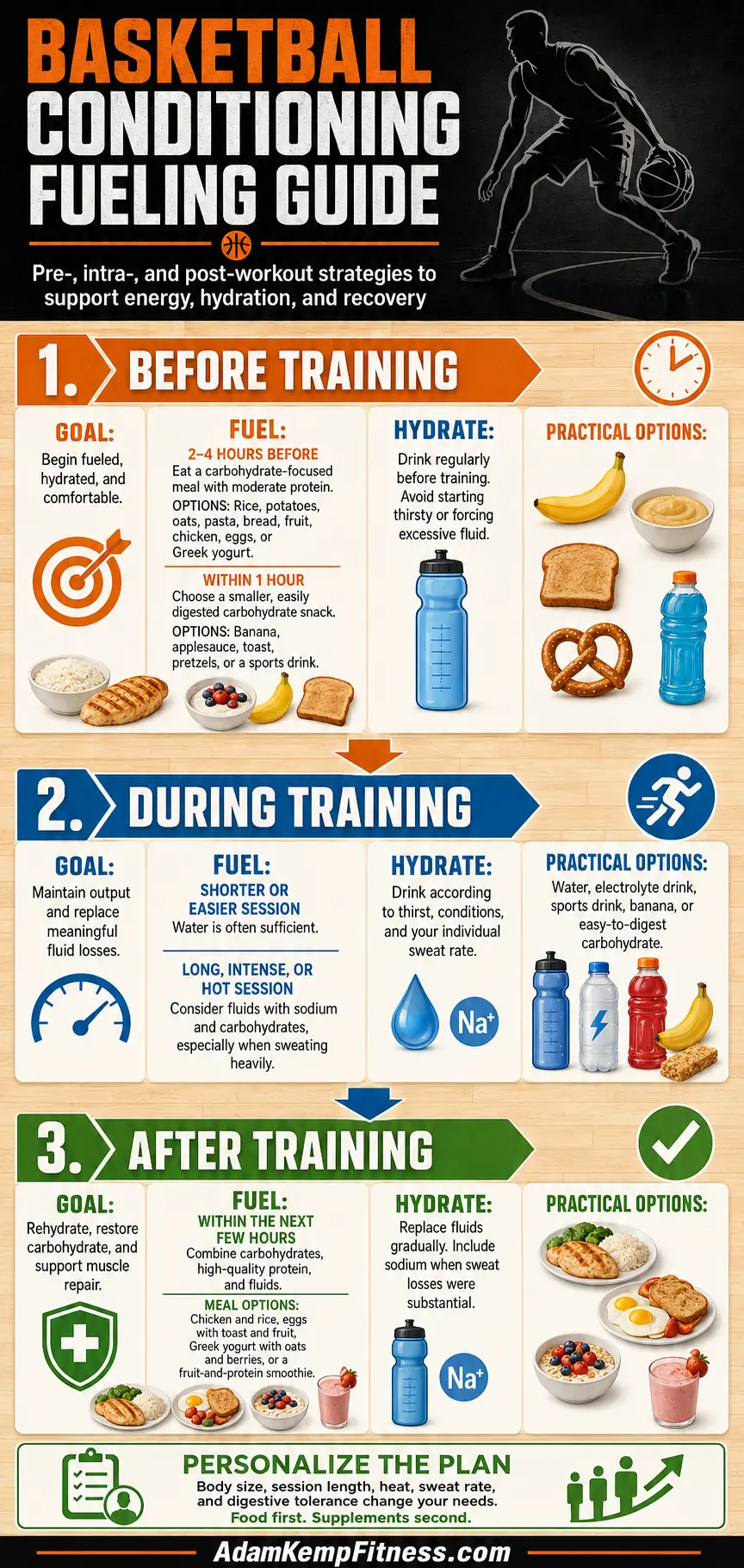
Basketball conditioning places a high demand on muscle glycogen, particularly during repeated sprints, defensive sequences, and full-court drills.
Eating enough carbohydrates before and after demanding sessions helps support high-intensity performance and replenish the fuel used during training (Williams & Rollo, 2015).
Two to four hours before training, build your meal around an easily digested carbohydrate source such as rice, potatoes, oats, pasta, bread, or fruit.
Add a moderate serving of lean protein and limit excessive fat or fiber if those foods make you feel heavy during intense movement.
When training begins within an hour, choose a smaller option such as a banana, applesauce, toast, pretzels, or a sports drink.
In my experience, the best pre-training meal is not only the “healthiest” but also the one that provides useful fuel without causing digestive discomfort.
As a drink, water is usually sufficient for shorter sessions performed in comfortable conditions.
During long practices, intense conditioning, hot-gym workouts, or double-session days, a sports drink containing sodium and carbohydrates may help replace sweat losses while supplying additional energy (Sawka et al., 2007).
Hydration requirements vary considerably, so avoid copying another player’s drinking plan.
Weighing yourself before and after several representative sessions can help estimate your personal sweat losses, although the objective is to replace fluids gradually rather than forcing yourself to drink enough to gain weight during exercise.
After training, you should combine high-quality carbohydrates and protein to begin restoring glycogen and repairing muscle tissue.
Good options include a rice bowl with chicken and eggs, toast with fruit, Greek yogurt with oats and berries, or a smoothie with milk, fruit, oats, and protein.
Key Point: Your total daily intake matters more than any single sports drink, supplement, or precisely timed snack.
Build your basketball nutrition plan around sufficient calories, carbohydrates, protein, fluids, and electrolytes before looking for products marketed as conditioning enhancers (Thomas et al., 2016).
Recovery Is Part of Basketball Conditioning
Training creates the stimulus, but a proper basketball recovery routine allows the body to adapt.
Consistently poor sleep, inadequate food, dehydration, and excessive training can make a well-designed program appear ineffective.
Monitor your energy, soreness, sleep quality, motivation, resting heart rate, and willingness to move explosively.
One difficult day is normal, but several negative markers trending together may indicate that the workload needs adjustment.
Light walking, easy cycling, mobility work, and relaxed shooting can support recovery without adding another demanding session.
Complete rest is also appropriate when fatigue, pain, or life stress is unusually high.

Common Basketball Conditioning Mistakes
Basketball conditioning should help you perform better, but poorly planned workouts can leave you slower, excessively sore, or too fatigued to improve your basketball skills.
Most conditioning mistakes come from chasing exhaustion instead of developing repeatable speed, efficient movement, and the ability to recover between demanding efforts.
Working harder is not always the solution.
Avoiding the following mistakes can help you build basketball stamina without sacrificing explosiveness, movement quality, or joint health.
Frequently Asked Questions About Basketball Conditioning
Basketball conditioning can be confusing because the best approach depends on your age, playing level, position, current fitness, injury history, and weekly basketball schedule.
The following answers address common questions about conditioning frequency, running, suicides, court access, and how quickly you can expect to improve.
Use these recommendations as a practical starting point rather than rigid rules.
Your conditioning plan should prepare you to repeat explosive efforts and execute basketball skills under fatigue without creating so much soreness that it interferes with practice, strength training, or games.
Final Thoughts: Train to Perform, Not Just to Survive
The most demanding basketball conditioning drills can build confidence and reveal what you are capable of enduring.
I will never forget completing 20-20s, but the hardest workout I experienced was not necessarily the right one for every player or every stage of preparation.
Effective basketball conditioning develops an aerobic foundation, repeated-sprint ability, acceleration, deceleration, change-of-direction skill, strength, and the capacity to execute basketball movements under fatigue.
Those qualities should be progressed deliberately rather than tested randomly.
You do not need to finish every session lying on the floor. You need to become the player who can still sprint back, contain the ball, rebound through contact, communicate, and make the right decision when the fourth quarter becomes uncomfortable.
This website does not provide medical advice. This website site does contain affiliate links, and purchases may earn a commission.
Read my Medical Disclaimer, Review Disclaimer, and Publishing Policies for more details. Use of this site indicates acceptance of these terms.