How Evidence Based Fitness Programs Work
 Reading Time: 8 minutes
 Evidence-based fitness programs help remove the guesswork from exercise by combining proven training principles, exercise science, and measurable progress into a structured plan designed for long-term success.
Many people do not struggle because they lack motivation or discipline.
They struggle because they spend months or even years following workouts built around trends, random exercise selection, or social media influencers, rather than methods that consistently produce results.
As a professional basketball player who has spent more than a decade training for elite performance, along with earning a graduate degree in nutrition, I have learned that the most effective programs are rarely the flashiest.
The workouts that produce lasting improvements in strength, muscle growth, athletic performance, and overall health are usually built on simple principles that have been tested in both scientific research and real-world practice.
Rather than chasing whatever workout is trending this month, evidence-based fitness programs provide a structured framework that helps you train with purpose, recover effectively, and make measurable progress toward your goals.
What Evidence-Based Fitness Programs Actually Mean

The phrase “evidence-based fitness program” gets used loosely, so it helps to define it clearly.
Science-based fitness programs are training plans built from three things working together:
- The best available research
- Coaching experience
- The individual needs of the person doing the program.
That last part is important.
Science can tell us what tends to work best on average, but your injury history, schedule, training age, goals, and recovery capacity still matter.
A well-designed program is not just pulled from a study. It uses research to guide decisions while staying realistic for the person following it.
For example, if your goal is muscle growth, the evidence consistently supports sufficient weekly training volume, progressive overload, and sets performed close to failure.
But the exact split, exercise selection, and frequency can vary.

A former athlete with four training days available may do great on an upper-lower split, while a busy parent may get better results from three full-body sessions because that is what they can recover from and sustain.
Core Principles Behind the Better Results From Evidence-Based Fitness Programs

Most effective programs are not complicated.
They are consistent.
What makes them evidence-based is that they rely on principles that consistently appear in both research and practice.
Progressive Overload
Your body adapts when it is challenged beyond its current capacity.
That challenge can come from adding weight, doing more reps, increasing total sets, improving technique, or reducing rest periods in the right context.
Without some form of progression, results eventually stall.
Research consistently identifies progressive overload as one of the primary drivers of long-term improvements in strength and muscle size, regardless of the specific exercises used (American College of Sports Medicine, 2009).
This does not mean every workout must be harder than the last.
Fatigue fluctuates.
Life happens.
But over time, a quality program creates a clear upward trend in performance.
Specificity
You get better at what you train.
If you want to improve maximal strength, your training should include heavy resistance work.
If your goal is muscular endurance, your plan should reflect that.
If you want to run faster, random circuit workouts are not a substitute for structured conditioning.
Many ineffective programs fail here because they promise fat loss, muscle gain, athleticism, and elite conditioning all at once, but they do not prioritize any of it.
Good programming starts by being honest about the primary goal.
Appropriate Volume and Intensity
More is not always better.
Too little training may not stimulate adaptation, but too much can reduce performance, increase soreness, and make consistency harder.
Evidence-based programming looks at how much work you need to improve and how much you can actually recover from.
This is where context matters.
Advanced lifters often need more targeted volume than beginners.
Older adults may need a little more recovery between hard sessions.
Someone in a calorie deficit may not tolerate the same workload they could handle during maintenance or a muscle-building phase.
Recovery as Part of the Program
Training breaks the body down, and exercise recovery is where adaptation happens.
Sleep, nutrition, hydration, stress management, and sensible scheduling are not extras; they are part of the program.
Research shows that inadequate recovery, particularly poor sleep, can impair muscle recovery, reduce performance, and limit training adaptations over time (Fullagar et al., 2015).
This is one reason many popular plans fail in the real world: they may look effective on paper but ignore the recovery demands of normal life.
A program is only effective if you can repeat it long enough to benefit from it.
Why Evidence Based Fitness Programs Outperform Trend-Driven Plans
Trend-driven workouts usually sell excitement.
Evidence-based plans deliver progress.
That difference becomes obvious after a few weeks.
A trend-based plan often relies on novelty.
Every session is different; intensity is the main selling point, and exhaustion is treated as proof of effectiveness.
That can feel productive, but fatigue is not the same thing as adaptation.
Evidence-based exercise programs track meaningful variables.
They consider whether you are getting stronger, recovering well, improving body composition, building work capacity, or moving with less pain.
Instead of asking, Did this workout crush me?” they ask, “Is this moving me closer to my goal?”
That mindset also reduces injury risk.
Not because evidence-based training is easy, but because it avoids unnecessary chaos.
Random programming can overload tissues in ways that look exciting online but make no sense over time.
Structured progression is usually safer and more productive.
What to Look for in an Evidence-Based Training Program

You do not need a graduate degree to spot a quality plan, but you do need to know what matters.
A strong program should explain the goal, outline a progression method, and use exercises that match your needs and skill level.
It should also be realistic.
If a plan demands six hard sessions per week, perfect meal prep, and elite recovery habits, it may not be a good fit for someone with a full-time job and family responsibilities.
The best program is not the one that looks toughest; it is the one you can execute consistently while still improving.
Watch out for red flags.
If a program promises dramatic transformation in a very short time, ignores recovery, or relies on detoxes, sweat levels, and soreness as proof of success, be skeptical.
The same goes for plans that lack a clear progression model or that try to make every workout feel like a test.
Evidence Matters, but Application Matters Too
One mistake people make is assuming research gives one perfect answer.
It usually does not. In fitness, evidence often gives a range of effective options.
That is why coaching judgment still matters.
Take resistance training frequency as an example.
Research suggests multiple frequencies can work if the total weekly volume is appropriate.
This is one of the reasons experienced coaches rarely argue about one “perfect” workout split. Instead, they focus on finding the training frequency that allows each person to recover well, perform consistently, and accumulate enough quality training volume over time.
So the better question is not whether training a muscle one, two, or three times per week is universally best.
The better question is which option helps you perform well, recover well, and stay consistent.
This is where experience becomes valuable.
Good coaches and experienced athletes understand that adherence is one of the strongest predictors of success.
Throughout my basketball career, the best offseason programs were rarely the most exhausting. They were the ones I could recover from consistently while continuing to increase strength, power, and athleticism week after week.
A program that is theoretically ideal but practically unsustainable is not ideal at all.
That balance between science and application is what separates smart programming from rigid programming.
At Adam Kemp Fitness, that blend of research and real-world athletic experience is a big part of what makes practical fitness guidance useful rather than purely academic.
How to Apply the Principles of Evidence-Based Fitness Programs in Your Own Training
If you want better results, start by simplifying your approach.
Pick one primary goal for the next 8 to 12 weeks.
I suggest using the SMART Goals formula.
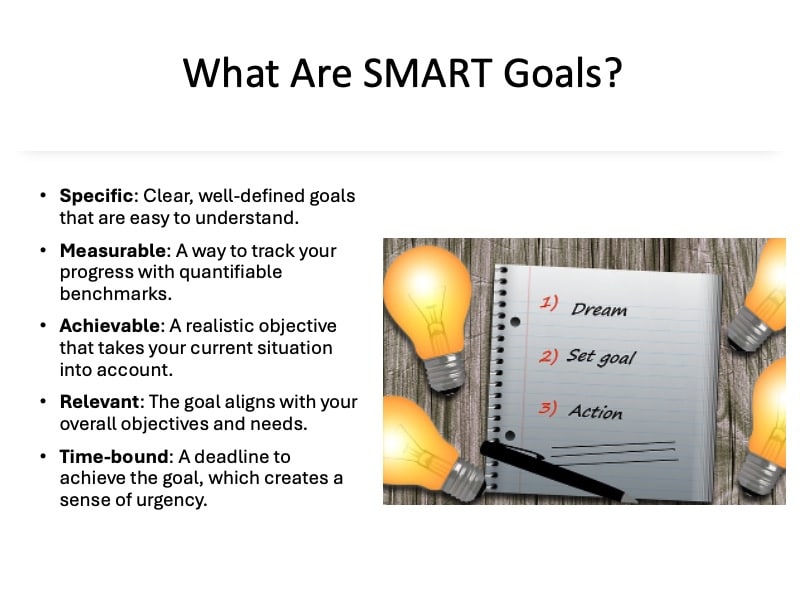
Once you decide, build your training around that goal rather than trying to improve everything at once.
Then make sure your week has structure.
Choose a training frequency you can actually maintain.
Focus on major movement patterns like squatting, hinging, pushing, pulling, carrying, and core stability.
Track a few key lifts or performance markers to see progress over time.
Next, pay attention to dosage.
If you are constantly exhausted, your program may be asking too much.
If nothing is improving, it may not be asking enough.
The right amount is enough to train hard, recover, and come back ready to improve again.
Finally, respect the basics outside the gym.
- Sleep enough.
- Eat enough protein.
- Manage stress as well as you can.
- Stay hydrated.
None of that is glamorous, but it is hard to separate effective training from effective recovery.
Frequently Asked Questions About Evidence Based Fitness Programs
Final Thoughts: The Trade-offs Most People Need to Accept
There is no perfect program.
There is only one program that fits your current goal and season of life.
If you are cutting body fat, do not expect peak strength progress at the same time.
If you are pushing hard for muscle gain, conditioning may need to be managed more carefully.
If you are training around an old injury, some exercise substitutions may be smarter than forcing textbook movements.
Remember, evidence-based training is not about chasing perfection; it is about making better decisions more consistently.
That is how real progress happens.
A helpful way to think about it is this: the best fitness program is not the one with the smartest marketing or the hardest workout.
It is the one built on sound scientific principles, adjusted to your current goals, recovery capacity, and lifestyle, then followed consistently long enough for those principles to produce measurable results.
This website does not provide medical advice. This website site does contain affiliate links, and purchases may earn a commission.
Read my Medical Disclaimer, Review Disclaimer, and Publishing Policies for more details. Use of this site indicates acceptance of these terms.
Check Out Some of My YouTube Videos Below, and Please Follow on YouTube for More Educational Health and Fitness Content!
![Subscribe to @AdamKempFitness for more training, general health, recovery, and nutrition tips from a professional basketball player with a master’s degree in Nutrition Education! 🏀💪
Seated Max Vertical Jumps From a Box are one way I train explosive takeoff power with maximum intent on every rep.
Starting seated, with a pause and minimal rocking or dipping, reduces the contribution of a quick countermovement and emphasizes producing force from a relatively static position (National Strength and Conditioning Association [NSCA], 2020).
For athletes, the training goal is explosive lower-body force production and coordinated extension through the hips, knees, and ankles. I use this variation to practice driving hard into the floor and accelerating my body upward.
My preferred setup: 3 sets of 3 reps or 4 sets of 2 reps, supersetted with a strength or power exercise.
I keep the reps low, reset between jumps, and take longer rest periods so I’m ready to attack every takeoff. Even when pairing exercises, I give myself enough recovery to keep the jumps sharp.
Every rep has one goal: jump as high as possible. I focus on an explosive takeoff, a controlled landing, and consistent quality throughout the session.
Save this for your next power workout! 🚀
Reference: NSCA. (2020). Stretch-shortening cycle.
#VerticalJump #JumpTraining #ExplosivePower #AthleticPerformance #BasketballTraining](https://www.adamkempfitness.com/wp-content/plugins/feeds-for-youtube/img/placeholder.png)