Learn Why Evidence-Based Personal Training Works
 Reading Time: 7 minutes
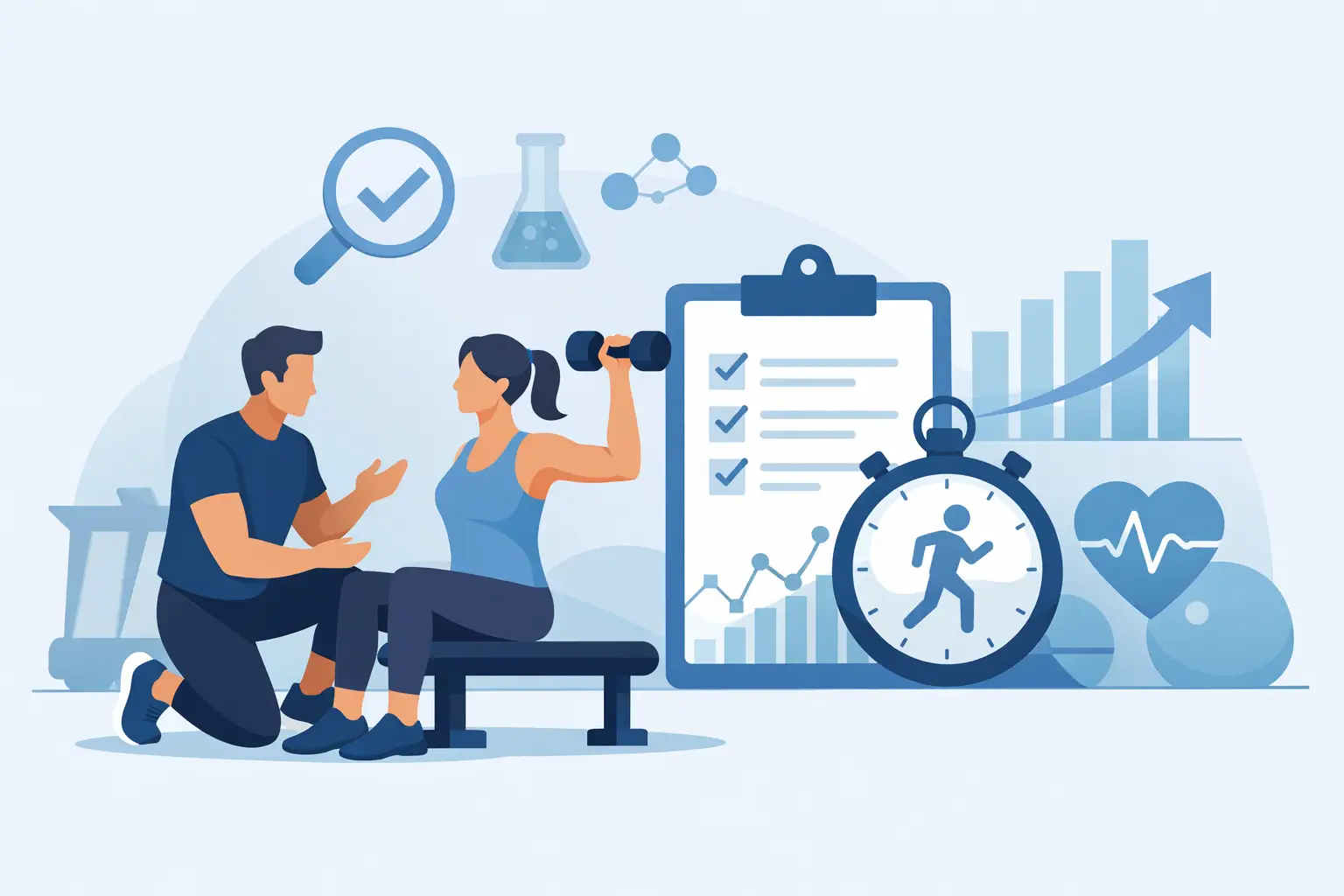
 Evidence-based personal training helps eliminate the guesswork from fitness by using proven exercise science, individualized coaching, and measurable progress instead of trends, gimmicks, or social media hype.
Most people do not struggle because they lack motivation or a work ethic.
They struggle because they invest time and effort into training methods that are poorly matched to their goals, recovery capacity, lifestyle, or experience level.
As a professional basketball player with more than a decade of experience training for elite performance, along with graduate education in nutrition, I have learned that the best results come from combining scientific evidence with practical experience.
When your career depends on staying healthy, strong, and performing at a high level, every training decision matters, and the difference between good and bad programming becomes obvious very quickly.
Rather than chasing the latest fitness trend, evidence-based personal training focuses on principles that consistently produce better long-term results, helping you build strength, muscle, athletic performance, or overall health with a program designed specifically for you.
What Evidence Based Personal Training Really Means
Evidence-based personal training means using the best available research, combining it with coaching experience, and applying it to the individual in front of you.
That last part is what many people miss.
A program can look perfect on paper and still be wrong for your lifestyle, injury history, motivation level, or recovery capacity.
Research gives you the framework.
Coaching experience helps interpret it.
Your progress, preferences, and limitations determine how it should be applied.
That is why evidence-based exercise programs are not cold or mechanical.
This also reflects the evidence-based practice model widely adopted across healthcare and sports science, which emphasizes integrating the best available research with practitioner expertise while accounting for each individual’s needs, preferences, and circumstances (Newhouse, 2008).
Evidence-based personal training is actually more personal than much trend-driven coaching because it forces you to ask better questions.
- What goal matters most right now?
- What training volume can you recover from?
- Which exercises fit your structure and movement quality?
- How consistent can you realistically be for the next three months?
Why Evidence Based Personal Training Gets Better Results
The biggest benefit of evidence based personal training is that it improves your odds of success. Fitness is never fully predictable, but some methods are much more reliable than others.
If your goal is strength, progressive overload matters.
If your goal is muscle growth, total weekly training volume, exercise selection, and intensity all matter.
Multiple systematic reviews have concluded that muscle hypertrophy is primarily influenced by sufficient weekly training volume, progressive overload, and proximity to muscular failure, while a variety of exercises and repetition ranges can be effective when total workload is appropriate (Schoenfeld et al., 2017).
If your goal is fat loss, nutrition and energy balance play a larger role than endless circuit workouts.
These are not opinions.
They are patterns supported by a large body of exercise science and reinforced by what good coaches see every day.
This approach also helps filter out distractions.
- You do not need a new training style every two weeks.
- You do not need to sweat more to prove a workout was effective.
- You do not need to confuse soreness with progress.
Evidence keeps you focused on outcomes that matter, such as improved strength numbers, better body composition, faster recovery, and greater consistency.
Core Principles Behind an Evidence-Based Personal Training Program
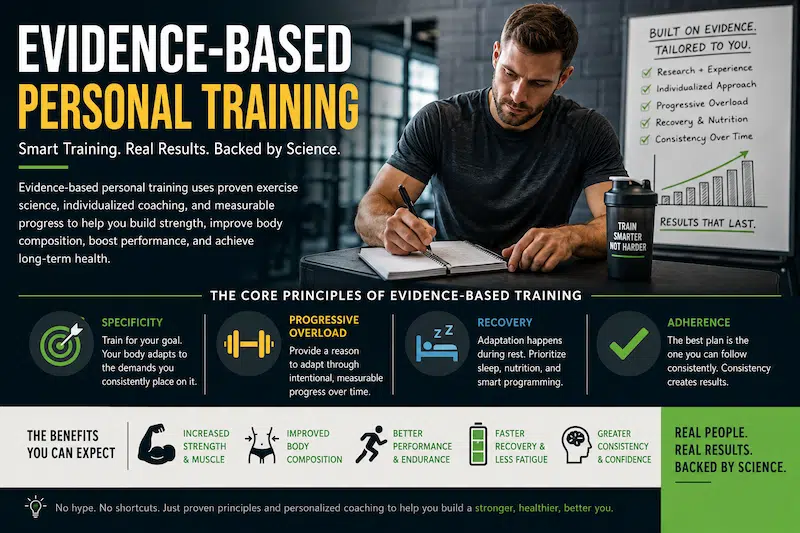
A good evidence-based personal training plan usually starts with a few non-negotiables.
Specificity
The first is specificity.
Your body adapts to the demands you place on it, so your training needs to match your goal.
If you want to get better at sprinting, your program cannot be built entirely around slow cardio.
If you want to build muscle, your plan cannot rely only on light resistance and high-repetition burnout work.
Progressive Overload
The second is progressive overload.
Your body needs a reason to adapt.
That does not always mean adding more weight every session, as it can also mean doing more reps, improving technique, adding sets, increasing range of motion, or managing rest periods more effectively.
Progress has many forms, but it should be intentional.
Recovery
The third is recovery.
Exercise recovery is where many motivated people sabotage themselves.
Adaptation happens when training stress is balanced with sleep, nutrition, hydration, and smart programming.
More is not always better.
Sometimes the most evidence-based decision is to reduce volume, take an extra rest day, or stop chasing fatigue.
Adherence
The fourth and final (on this list of mine) is adherence.
The best plan is not the most advanced one; it is the one you can follow consistently.
A scientifically sound program that does not fit your life is still a bad program.
What Evidence-Based Personal Training Looks Like in Real Life
For a busy professional trying to lose body fat and build some muscle, evidence based personal training might mean three full-body workouts per week, a daily step target, and a nutrition plan centered on adequate protein and calorie control.
That may not sound flashy, but it works.
For an athlete, the plan may include strength work, power development, mobility training, conditioning, and recovery sessions organized around practice and competition demands.
In this case, the evidence matters just as much, but the application becomes more specialized.
For an older adult focused on longevity, the priorities may shift toward maintaining muscle mass, joint function, balance, insulin sensitivity, and cardiovascular health.
The principles stay the same, but exercise choices and weekly structure change.
This is one of the primary reasons personalized coaching still matters.
Research can tell you what tends to work, but a good coach helps determine what will work best for you.
Remember: Good Coaches Use Science Without Hiding Behind It
One of the biggest red flags in fitness is when someone uses the phrase science-based as a marketing shield.
Real evidence-based coaching is not about sounding smarter than everyone else; it is about making better decisions.
A strong coach should be able to explain why an exercise is in your evidence-based fitness program, why your volume is increasing or decreasing, and why your nutrition strategy fits your goal.
They should also be honest when the answer is not absolute.
Exercise science has a strong consensus in some areas, but in others, there is room for variation.
For example, there are multiple effective ways to build muscle.
- Free weights, machines, and bodyweight exercises can all work when programmed well.
- Both higher and lower rep ranges can contribute to hypertrophy.
- Morning and evening training can both be effective.
The best choice often depends on injury history, equipment access, skill level, and personal preference.
That balance matters.
Science gives you direction. Coaching gives you judgment.
Common Fitness Myths That Evidence Helps Eliminate
A lot of bad fitness advice and common fitness myths survive because they sound intense. Evidence tends to expose exaggeration.
The first popular myth you need to watch out for is that you need extreme workouts to get lean.
In reality, sustainable fat loss usually comes from consistent training, controlled nutrition, sufficient protein intake, and enough daily movement.
Punishing workouts may burn calories, but they can also increase fatigue and make adherence harder.
The second myth is that more soreness means more progress.
Muscle soreness is not a reliable marker of training quality.
You can make great progress without feeling destroyed after every session.
Research consistently shows that delayed onset muscle soreness (DOMS) is a poor indicator of long-term muscle growth or strength gains and instead reflects a temporary response to unfamiliar or high-stress exercise (Hyldahl & Hubal, 2014).
The third myth is that there is one best exercise for everyone.
There are great movement patterns, but exercise selection should still account for limb length, injury history, mobility, and comfort.
A barbell back squat is excellent for some people and a poor fit for others.
The fourth myth is that supplements can make up for a poor training plan.
Some supplements are useful, but they are secondary.
If your program lacks progression, your sleep is poor, and your nutrition is inconsistent, supplements will not fix that.
How to Choose an Evidence Based Personal Trainer
If you are hiring a fitness coach, look beyond certifications and social media content.
Ask how they assess progress.
- Ask how they adjust programs when life gets busy.
- Ask what metrics they track besides scale weight.
- Ask how they think about recovery, sleep, and nutrition.
A good trainer should not promise fast results without context.
They should ask detailed questions, set realistic expectations, and explain their process clearly.
They should care more about technique, progress tracking, and long-term adherence than about entertainment value.
It also helps if they can meet you where you are.
A former athlete returning to training, a parent trying to regain health, and a competitive lifter all need different levels of intensity and structure.
Evidence-based coaching is not one-size-fits-all. It is principle-driven and person-specific.
Final Thoughts: The Long-Term Advantage of Evidence-Based Personal Training
The real power of evidence-based personal training is not that it makes fitness complicated; it makes fitness more honest.
It shows you what matters most, what probably does not, and where patience pays off.
That matters if you want lasting results.
You can only rely on motivation for so long.
Systems built on proven methods, realistic recovery, and measurable progress give you something stronger than motivation: they give you momentum.
At Adam Kemp Fitness, that is the standard worth aiming for: practical training and recovery strategies that are backed by research, tested through experience, and realistic enough to use in everyday life.
If you are tired of bouncing between programs, chasing sweat instead of progress, or wondering why your effort is not matching your results, start with a better question.
Not what is popular right now, but what is most likely to work for you consistently over time.
This website does not provide medical advice. This website site does contain affiliate links, and purchases may earn a commission.
Read my Medical Disclaimer, Review Disclaimer, and Publishing Policies for more details. Use of this site indicates acceptance of these terms.
Check Out Some of My YouTube Videos Below, and Please Follow on YouTube for More Educational Health and Fitness Content!
![Subscribe to @AdamKempFitness for more training, general health, recovery, and nutrition tips from a professional basketball player with a master’s degree in Nutrition Education! 🏀💪
Seated Max Vertical Jumps From a Box are one way I train explosive takeoff power with maximum intent on every rep.
Starting seated, with a pause and minimal rocking or dipping, reduces the contribution of a quick countermovement and emphasizes producing force from a relatively static position (National Strength and Conditioning Association [NSCA], 2020).
For athletes, the training goal is explosive lower-body force production and coordinated extension through the hips, knees, and ankles. I use this variation to practice driving hard into the floor and accelerating my body upward.
My preferred setup: 3 sets of 3 reps or 4 sets of 2 reps, supersetted with a strength or power exercise.
I keep the reps low, reset between jumps, and take longer rest periods so I’m ready to attack every takeoff. Even when pairing exercises, I give myself enough recovery to keep the jumps sharp.
Every rep has one goal: jump as high as possible. I focus on an explosive takeoff, a controlled landing, and consistent quality throughout the session.
Save this for your next power workout! 🚀
Reference: NSCA. (2020). Stretch-shortening cycle.
#VerticalJump #JumpTraining #ExplosivePower #AthleticPerformance #BasketballTraining](https://www.adamkempfitness.com/wp-content/plugins/feeds-for-youtube/img/placeholder.png)