Reverse Lunges: Benefits, Muscles Worked, and How to Do
 Reading Time: 8 minutes
 There are several useful lunge variations, but reverse lunges are one of my favorites because they are a simpler option that is kinder on the knees, ankles, hips, and back.
During my basketball career, I’ve relied heavily on lunges to keep my legs strong and balanced, and I’ve found that reverse lunges are particularly beneficial after returning from injuries and allowing me to maintain my strength without putting unnecessary stress on my joints.
Whether you’re a seasoned athlete or just beginning your fitness journey, reverse lunges are one of the best single-leg exercises and can play a pivotal role in improving your lower body strength, stability, and overall athletic performance.
They’ve certainly been a cornerstone in my training, helping me stay competitive on the court as I’ve aged.
This guide to reverse lunges covers everything you need to know, from the muscles they target to their numerous benefits and variations.
What is a Reverse Lunge?

A reverse lunge is a lower-body exercise that primarily targets the quads and glutes.
Unlike the traditional forward lunge, in which you step forward, the reverse lunge involves stepping backward.
This subtle difference in movement direction can reduce the strain on your knees, making it a more joint-friendly option while still providing a challenging workout.
Reverse lunges are favored in functional training because they mimic movements used in daily activities, such as stepping back to avoid obstacles or descending stairs.
Along with many other benefits, reverse lunges improve balance, coordination, and overall lower body strength, making it a valuable addition to any workout routine.
Reverse Lunge Muscles Worked
The reverse lunge primarily targets the glutes, hamstrings, and quadriceps, while also engaging the core for stability.
Here’s a closer look at the muscles worked during reverse lunges:
- Glutes: The reverse lunge places significant emphasis on the gluteus maximus, helping to build strength and size in the buttocks.
- Hamstrings: Located at the back of your thighs, the hamstrings are heavily involved in the bending of the knee and extending the hip, both crucial movements in the reverse lunge.
- Quadriceps: The quads, located at the front of your thighs, work to extend the knee and stabilize your leg as you lunge back.
- Core: Engaging your core is essential for maintaining balance and proper posture during the movement, ensuring that your spine remains neutral.
Secondary muscles, such as the calves and adductors, also come into play to assist with balance and coordination, especially as you lower your body and push back to the starting position.
Benefits of the Reverse Lunge Exercise: Why are Reverse Lunges Good for You?

Reverse lunges offer a blend of strength, stability, and joint-friendly mechanics that make them valuable for athletes and everyday movers alike.
Their backward-stepping pattern distributes force to protect sensitive joints while still recruiting the major muscles of the lower body.
These advantages explain why reverse lunges remain one of the most effective single-leg exercises for building functional strength and long-term durability.
Joint-Friendly Mechanics
Reverse lunges reduce forward shear on the knee, which can lessen joint stress compared to forward lunges.
This makes them a practical option for individuals with knee discomfort or for athletes returning from lower-body injuries.
Clinical research supports the use of backward-stepping variations to reduce patellofemoral loading, which may improve tolerance during rehabilitation or high-volume training sessions (Willy & Meira, 2016).
Improved Balance and Stability
Stepping backward shifts your center of mass in a way that forces the body to stabilize more dynamically.
This increased demand helps train the deep stabilizers of the core and hips, which play a major role in athletic movement and injury prevention.
The improved balance from reverse lunges often transfers to daily tasks, change-of-direction exercises, and sport-specific agility.
Better Muscle Symmetry
Reverse lunges isolate each leg, making it easier to identify and correct left-to-right strength discrepancies.
Single-leg strength training is frequently recommended for athletes because it reduces compensatory movements and supports biomechanics during running, jumping, and deceleration (Bishop et al., 2018).
Balancing both sides improves performance while lowering the risk of overuse injuries.
Increased Glute Activation
Reverse lunges shift more workload to the glutes and hamstrings due to the backward step and hip-dominant movement pattern.
This makes them an effective tool for building a stronger posterior chain without excessive spinal loading.
Greater glute activation also supports hip stability, which is essential for knee alignment and long-term lower-body joint health.
Functional Strength for Real-Life Movement
The movement pattern of the reverse lunge mirrors practical tasks such as stepping backward, lowering into a half-kneeling position, or bracing during quick directional changes.
Training these patterns enhances your ability to move confidently throughout daily life and during athletic activities.
Reverse lunges reinforce coordination, improve motor control, and help prepare the body for more advanced unilateral exercises.
Reverse Lunge Form: How to Do a Reverse Lunge Correctly
Proper form is crucial to maximizing the benefits of the reverse lunge while minimizing the risk of injury.
Follow these steps to perform a reverse lunge with correct form:
- Repeat: Complete the desired number of repetitions on one side before switching to the other leg.
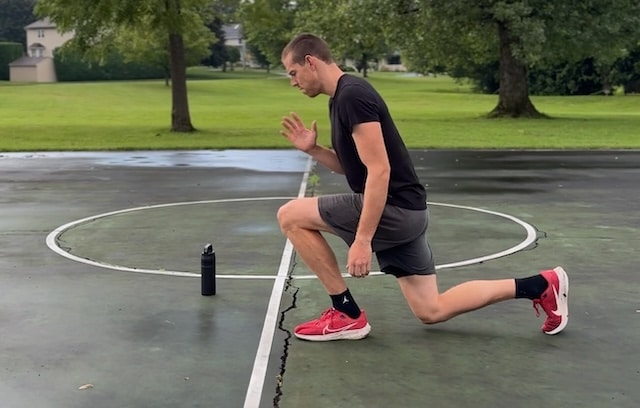
- Start Position: Stand tall with your feet hip-width apart, arms resting at your sides or hands on your hips for balance.
- Step Back: Take a controlled step backward with your right foot, landing on the ball of your foot and keeping your heel off the ground.
- Lower Your Body: As you step back, lower your hips until your left thigh is parallel to the floor and your right knee is hovering just above the ground. Both knees should form 90-degree angles.
- Engage Your Core: Keep your core engaged and your back straight throughout the movement. Avoid leaning forward or arching your back.
- Return to Start: Push through your left heel to rise back up to the starting position, bringing your right foot forward to meet your left.
Here’s a simple guide to help you use the exercise and get the best results:
- Begin with Bodyweight: Start with bodyweight reverse lunges to ensure you’ve nailed the form before adding resistance.
- Incorporate Into Warm-Ups: Use reverse lunges as part of your dynamic warm-up to activate your lower body and prepare for more intense exercises.
- Increase Reps Gradually: Start with lower repetitions and gradually increase as your strength and endurance improve.
- Add Variations: Once comfortable with the basic reverse lunge, try incorporating variations like the landmine or elevated reverse lunge to keep your workouts challenging.
Reverse Lunge Alternatives
If you’re looking to mix up your routine or find exercises that complement the reverse lunge, consider these alternatives:
- Forward Lunges: A traditional lunge where you step forward instead of back, offering a slightly different muscle activation pattern.
- Split Squat: A static version of the lunge where your feet remain in a split stance as you lower and raise your body, providing a more focused workout for the quads and glutes.
- Step-Up: A functional exercise that involves stepping onto a raised platform, simulating a stair-climbing motion that targets similar muscles.
- Reverse Lunge with Knee Drive: After completing the lunge, drive the rear knee up toward your chest to engage the core and improve balance.
- Reverse Slide Lunge: Use a pair of glide discs and slide your foot backward instead of stepping backward.
- Elevated Reverse Lunge: This exercise adds an extra challenge by requiring you to step back onto an elevated surface, such as a step or platform. This variation increases the range of motion and further engages the glutes and hamstrings. When performing the elevated reverse lunge, choose a platform height that allows you to maintain proper form throughout the movement.
- Increased Difficulty: The elevation forces you to work through a greater range of motion, increasing the exercise’s intensity.
- Greater Glute Activation: The deeper lunge position enhances glute engagement, making this an excellent variation for targeting the posterior chain.
- Bulgarian Split Squats: This advanced single-leg exercise elevates the rear foot to increase hip mobility demands, glute activation, and overall lower-body strength. It offers a deeper range of motion than reverse lunges, making it one of the most effective movements for building unilateral power and stability.
Each of these reverse lunge alternatives provides unique benefits, making them excellent options for adding variety to your training regimen.
Reverse Lunge vs. Forward Lunge: Which is Better?
Reverse lunges are an incredibly effective exercise for building lower body strength, improving balance, and enhancing overall athleticism.
By incorporating reverse lunges and their variations into your workout routine, you can achieve more symmetrical muscle development, protect your joints, and take your fitness to the next level.
Whether you’re a beginner or an advanced athlete, the reverse lunge offers a versatile and beneficial addition to any training program.
When comparing the reverse lunge to the forward lunge, it’s essential to consider your fitness goals and any limitations you might have:
- Joint Impact: Reverse lunges place less strain on the knee joint, making them a better option for individuals with knee issues.
- Glute Activation: Reverse lunges engage the glutes more effectively, making them ideal for those focused on building a stronger posterior chain.
- Balance and Coordination: Both exercises require balance, but the reverse lunge’s backward motion adds an extra challenge, potentially leading to greater improvements in coordination.
- Muscle Focus: Forward lunges tend to emphasize the quads more, while reverse lunges target the hamstrings and glutes more intensively.
Ultimately, both variations have their place in a well-rounded workout routine. Choosing between them depends on your specific needs and goals.
Final Thoughts: Should You Do Reverse Lunges?
Reverse lunges are one of the most reliable lower-body exercises for building strength, protecting your joints, and improving functional movement.
Their backward-stepping pattern reduces stress on the knees while enhancing glute activation, balance, and overall stability.
They remain a core exercise in my training program because they deliver measurable results without unnecessary wear and tear, which is essential for longevity in sports and everyday life.
Whether you’re rebuilding strength after an injury or looking to upgrade your athletic performance, reverse lunges are a smart, scalable movement that belongs in nearly every training program.
Related Exercise: Lunge Step-up Exercise
This website does not provide medical advice. This website site does contain affiliate links, and purchases may earn a commission.
Read my Medical Disclaimer, Review Disclaimer, and Publishing Policies for more details. Use of this site indicates acceptance of these terms.