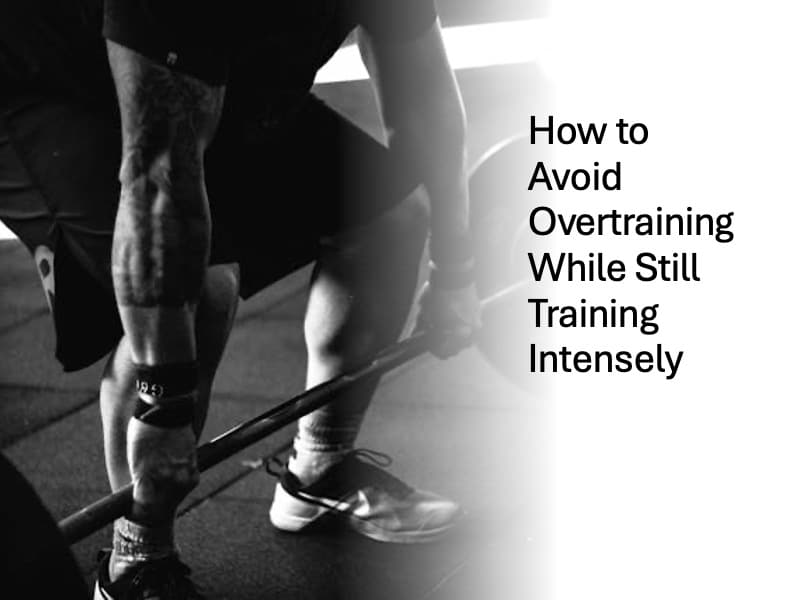
How to Avoid Overtraining While Still Training Intensely
 Reading Time: 6 minutes
 Learning how to avoid overtraining is one of the most underrated skills in fitness.
Many people believe progress depends on pushing harder every day, yet long-term strength comes from balancing effort with intentional recovery.
As someone who has trained and competed professionally for over a decade, I’ve seen how easily even disciplined athletes slip into fatigue, irritability, and performance decline when they confuse intensity with sustainability.
Productive training requires awareness, structure, and habits that support physical and mental resilience.
When you understand what your body needs to stay strong over the long haul, you gain the ability to train intensely without burning out.
These strategies show you how to avoid overtraining while still building meaningful strength and conditioning.
What is Overtraining Syndrome?
Overtraining syndrome is a state of physical and mental breakdown that occurs when training stress consistently exceeds the body’s ability to recover.
It develops gradually and often goes unnoticed until performance drops, motivation declines, and normal workouts start to feel unusually difficult.
Researchers describe it as a maladaptive response to excessive training load combined with inadequate rest, disrupted sleep, poor nutrition, or chronic life stress (Meeusen et al., 2013).
Athletes experiencing overtraining syndrome often report persistent fatigue, reduced strength or speed, increased injury occurrence, irritability, mood changes, and difficulty concentrating.
These symptoms reflect disruptions in the nervous system, immune function, and hormonal balance, which is why recovery feels slow even when training volume is reduced (Kreher & Schwartz, 2012).
It is a clinical issue rather than simple tiredness, and it requires structured rest, improved recovery habits, and sometimes medical evaluation.
By understanding what triggers overtraining syndrome, athletes can build smarter routines that support long-term performance and resilience.
Common Signs of Overtraining Syndrome
Early signs of overtraining often feel subtle, but they usually show up as persistent fatigue, declining performance, or workouts that suddenly feel harder than usual.
Athletes may also notice reduced coordination, slower reaction time, or a loss of “pop” during explosive movements, which reflects nervous system fatigue rather than a lack of effort (Meeusen et al., 2013).
Sleep disruptions are another red flag, including trouble falling asleep or waking up unrefreshed.
Hormonal stress responses can elevate resting heart rate, increase irritability, and produce unusual mood changes such as anxiety, frustration, or a loss of enjoyment in training (Kreher & Schwartz, 2012).
Many athletes also experience frequent colds or minor illnesses because their immune function drops when recovery is insufficient.
Lingering muscle soreness that lasts longer than 72 hours, unexplained joint pain, or a spike in overuse injuries can signal that the body is no longer adapting positively to training stress.
When these symptoms appear together, they suggest that recovery capacity is overwhelmed, not that more training is required.
How to Train Hard Without Overtraining

Training at a high level requires a balance that most athletes underestimate.
After more than a decade competing professionally, I’ve learned that the key to pushing your limits is understanding how much stress your body can tolerate and how quickly it can rebound.
The strategies below make it possible to train with real intensity while still protecting your strength, recovery, and long-term progress.
Learn Your Minimum Effective Dose and Maximal Recoverable Volume
Understanding how much training your body actually needs is one of the smartest ways to prevent overtraining.
The minimum effective dose (MED) is the smallest amount of training required to stimulate progress, while the maximal recoverable volume (MRV) represents the upper limit of stress your body can handle before performance and recovery begin to break down.
Research shows that training adaptations follow a dose–response curve, in which benefits increase up to a point and then decline sharply once recovery capacity is exceeded (Schoenfeld et al., 2021).
Most athletes assume doing more will lead to faster results, yet overshooting your MRV is one of the fastest paths to fatigue, plateau, and injury.
Tracking indicators like workout performance, perceived exertion, sleep quality, and muscle soreness helps reveal where your personal range sits.
When training aligns with your MED, improvements feel steady and sustainable. When you approach your MRV, fatigue grows but remains manageable.
Crossing beyond it often results in noticeable declines in strength, explosiveness, mood, or motivation.
Dialing into these thresholds allows you to train hard with purpose instead of simply training more.
This balance helps you push your limits while still supporting longevity, consistency, and continued progress across your entire training year.
Train Smart, Not Just Hard
Consistency is something that helps to build progress rather than exhaustion.
If every workout leaves you feeling completely spent, then you are eventually going to hit a wall and not want to continue.
Training smarter means knowing when to increase intensity and when to back off.
Track your workouts, focus on good form, and respect rest days.
Overtraining does not make you stronger; it can actually delay your results.
The goal is to have long-term strength rather than short-term burnout.
Small tools can help improve your training quality too; using wrist wraps, for example, can provide extra grip support during heavy lifts like deadlifts or rows.
They reduce strain on your forearms and let you target the muscles you are actually trying to build.
Using fitness equipment like that isn’t cheating; it’s intelligent training.
Make Recovery a Priority
Muscles don’t grow in the gym; they grow when you are resting.
Sleep, nutrition, and hydration play a massive role in how your body adapts to training.
Try to get at least seven hours of sleep most nights if you can.
Keep protein and whole foods in your diet to support muscle repair.
Stretch, walk, or do light mobility work on rest days, and you will start to see the difference.
You’ll be surprised by how much faster your workouts actually improve when you let your body recover.
Rest is progress too.
Build Habits That Support Mental Health
Muscle building and improved aesthetics often starts as a physical goal, but mental balance is also important, and it’s exactly what keeps it sustainable.
Chronic stress, fatigue, and lack of focus can all affect performance.
Start adding in daily routines that support your mental well-being.
This might be gentle meditation or even trying to go for a walk without your phone, as it can help to reset your focus.
A steady mind keeps training purposeful, making it easier to stay consistent without drifting into overtraining.
Remember Why You Started
It’s easy to lose perspective when progress slows or life gets hectic, but you need to remember why you started.
Better health, confidence, or discipline are still important.
Make sure you revisit these goals.
Progress doesn’t happen in perfect lines; some weeks you will find it easier than others, but the commitment is something that will be built over time and shapes everything.
Keep showing up, listen to your body, and give yourself credit for each step forward.
Balance isn’t about doing less; it’s all about making sure you are doing the things that are going to keep you strong, healthy, and motivated in the long term.
Final Thoughts: Keys to Avoiding Overtraining

Avoiding overtraining comes down to balancing ambition with awareness. Intense training is valuable, but it becomes sustainable only when recovery, nutrition, and mental well-being are given equal importance.
Small daily habits like tracking fatigue, honoring rest, and managing stress lay a foundation for long-term strength and resilience.
When you respect the signals your body gives you, you can fight exercise fatigue and continue pushing your limits without sacrificing your health or performance.
This website does not provide medical advice. This website site does contain affiliate links, and purchases may earn a commission.
Read my Medical Disclaimer, Review Disclaimer, and Publishing Policies for more details. Use of this site indicates acceptance of these terms.