Master Your Bodyweight: A Guide to Calisthenics Equipment
 Reading Time: 6 minutes
 Plateaus in bodyweight training are often a sign that your current calisthenics equipment and exercise selection are no longer providing enough stimulus to drive adaptation.
As a professional basketball player who has relied on bodyweight training throughout long seasons, I have found that introducing the right tools at the right time can completely transform strength development, joint health, and overall performance.
Instead of endlessly repeating basic push-ups and squats, strategic use of simple training tools allows you to unlock new movement patterns, increase time under tension, and safely progress toward advanced skills.
Even a minimal setup can expand your exercise library, improve training consistency, and reduce overuse stress by varying movement angles and loading patterns.
With just a few well-chosen tools, you can build a scalable system that supports everything from foundational strength to elite-level control, which is exactly why serious athletes and everyday fitness-goers alike invest in calisthenics equipment.
Why Should You Do Calisthenics?
Calisthenics, derived from the ancient Greek words for “beauty” and “strength,” is a form of resistance training using your body weight.
This training style can help develop body control and strength through bodyweight resistance.
It may also support mobility and flexibility, making it easier for some people to maintain over time.
By training multiple muscle groups together, calisthenics may help improve overall movement awareness and coordination.
Many people choose calisthenics because it can help build strength and muscle definition without relying on heavy gym equipment.
It can also support practical strength that carries over into everyday movement.
Here are three primary reasons to adopt this athlete-inspired approach:
- Improved Proprioception: You develop a heightened awareness of your body’s position in space.
- Enhanced Core Stability: Every movement, from a handstand to a simple plank, recruits your core stabilizers.
- Accessible Progression: You can infinitely adjust the difficulty of an exercise simply by changing your body’s angle.
The Best Calisthenics Equipment You Need to Get Started

If you want to practice these calisthenics exercises consistently, reliable calisthenics equipment can make the process more manageable.
You need reliable, well-crafted gear to support better stability and control during movement.
Let’s break down the essential calisthenics for beginners and pros alike.
Parallettes

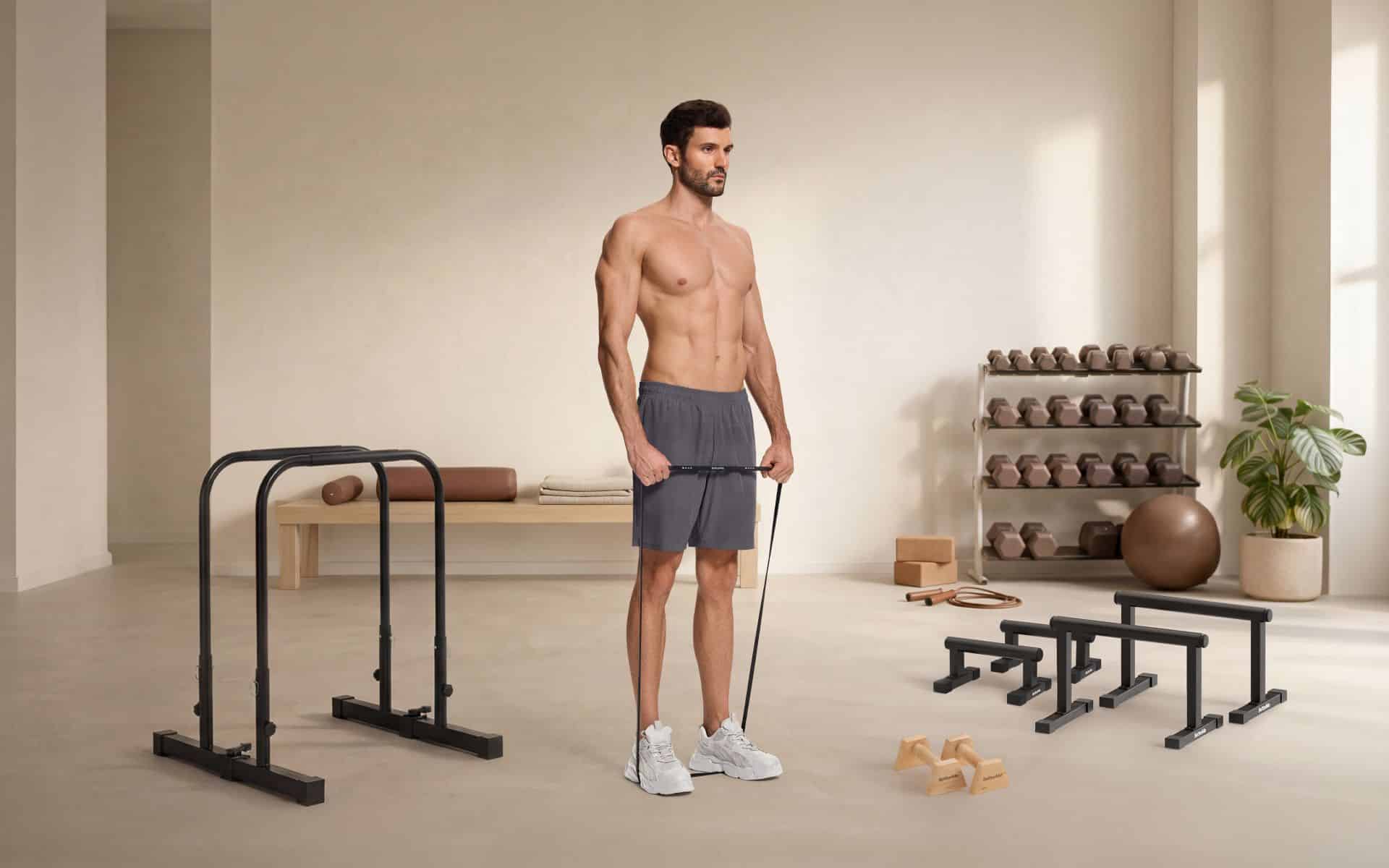
Parallettes are small, parallel bars that sit close to the floor.
They are incredibly valuable because they allow you to maintain a neutral grip (meaning your palms face each other).
This neutral wrist position reduces wrist extension compared with floor push-ups, which some people find more comfortable.
Using parallettes also increases your range of motion.
Because your hands are elevated, you can drop your chest below hand level for much deeper push-ups.
This extended stretch activates your chest and shoulder muscles.
They are one of the most useful tools for practicing static holds like the L-sit or the planche. When choosing your set, look for the following specifications to ensure safety and performance:
- Solid Wooden Construction: Wood absorbs sweat and provides a naturally superior grip compared to metal or plastic.
- Optimal Height: A clearance of around 5 to 7 inches offers enough space for your legs during an L-sit.
- Non-Slip Base: Ensure the feet have rubberized grips to prevent the bars from sliding across your living room floor.
- Ergonomic Grip: A bar diameter of roughly 1.5 inches sits comfortably in the hand, reducing finger fatigue.
Gymnastic Rings
Gymnastic rings are often considered one of the most versatile pieces of bodyweight training equipment.
Unlike a fixed pull-up bar, rings move freely in three dimensions.
The instability encourages your deep upper-body stabilizer muscles to fire up constantly just to keep your hands steady.
Training on rings bridges the gap between basic strength and elite athletic control. They are essential for mastering complex transitional movements, such as the muscle-up or deep ring dips. Because the rings rotate freely, many people find them more natural to move with than fixed bars.
To get the most out of your parallettes and rings, you must prioritize quality materials. A flimsy setup can make training less stable and less consistent. Consider these exact features when adding rings to your home street workout setup:
- Birch Wood Material: Wooden rings offer a chalk-free, secure grip that plastic rings simply cannot match.
- Heavy-Duty Straps: Look for wide nylon straps capable of holding at least 600 to 1,000 pounds of force.
- Numbered Measurements: Straps with numbered markings allow you to adjust both rings to the exact same height in seconds.
- Secure Cam Buckles: High-quality steel buckles ensure the straps will not slip while you are suspended mid-air.
Resistance Bands
Resistance bands are closed-loop elastic bands that provide accommodating resistance.
In the world of bodyweight exercises, they are your best friend for learning difficult vertical pulling movements.
If you cannot perform a strict pull-up yet, a band will give you the precise mechanical assistance you need.
By looping the band over a bar and stepping into it, the band supports some of your body weight.
The band provides the most assistance at the bottom of the movement, which is the hardest part of the pull-up.
As you pull yourself up, the band’s assistance decreases, recruiting your back muscles to do the heavy lifting.
They are also fantastic for mobility work, warm-ups, and adding extra tension to bodyweight squats.
Here is what makes a great set of resistance bands for calisthenics:
- Multiple Tension Levels: You need a variety of bands (e.g., light, medium, heavy) to gradually reduce assistance over time.
- Durable Latex/Fabric: High-quality natural latex ensures the band won’t snap under the load of your body weight.
- Clear Color Coding: Different colors help you quickly identify the exact resistance level you need for a specific set.
How to Set Up Your Space for Calisthenics at Home
Building a functional training zone at home does not require an entire garage or an empty basement.
You simply need a dedicated, safe environment to practice your movements consistently.
A clear area of roughly 6-by-6 feet is generally sufficient for most ground-based exercises and ring workouts.
For an effective home setup, explore specialized calisthenics equipment designed for maximum stability.
Reliable calisthenics equipment matters when training with your own body weight because stability and setup quality affect the overall experience.
A sturdy setup can make it easier to train with more confidence and consistency.
When installing your gear, pay close attention to your anchor points. If you are hanging rings, make sure the ceiling mount or pull-up bar is properly installed and rated for bodyweight training.
Follow this quick safety checklist before every session:
- Test the floor traction beneath your parallettes.
- Double-check the cam buckles on your ring straps to ensure the teeth are securely locked.
- Inspect your resistance bands for any micro-tears or fraying before putting your full weight into them.
- Clear away any coffee tables, chairs, or tripping hazards from your immediate landing zone.
Final Thoughts: Should You Buy Calisthenics Equipment?

With a few basic tools, it becomes easier to progress from foundational movements to more advanced variations.
When you have basic equipment at home, it may be easier to practice more consistently and explore new movement progressions.
You save time, avoid the crowded gyms, and can train effectively regardless of the weather outside.
Start small by mastering the basics on your parallettes, gradually introduce the instability of the rings, and use bands to conquer the pull-up.
With a thoughtful setup, even a small space at home can work well for bodyweight training.
This website does not provide medical advice. This website site does contain affiliate links, and purchases may earn a commission.
Read my Medical Disclaimer, Review Disclaimer, and Publishing Policies for more details. Use of this site indicates acceptance of these terms.