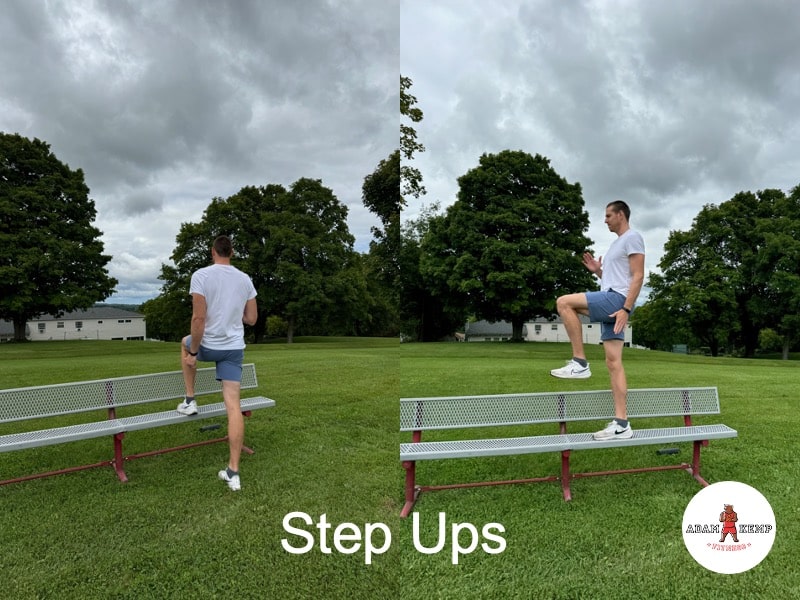
Step Ups Exercise: How to Do, Muscles Worked, Benefits
 Reading Time: 9 minutes
 Step-ups are a simple, powerful exercise that I recommend including in your leg workouts.
Whether you’re aiming to build strong, toned legs or improve your overall balance and coordination, step-ups offer a versatile and effective solution.
Additionally, this simple exercise can be done in many ways and in many places, making it perfect for those looking to stay fit at home or on the go.
You can do them with just your body weight or by adding weights for an extra challenge.
I’ve relied on step-ups for years to maintain knee health, especially throughout my basketball career.
As one of the best single-leg exercises, step-ups are an essential exercise for overall lower body development.
What Is the Step-Up Exercise?
The step-up exercise is a unilateral lower-body movement that mimics the natural action of climbing stairs.
It involves stepping onto an elevated surface with one foot, driving through the heel to lift the body upward, and then returning to the starting position in a controlled manner.
Because the movement requires one leg to support and move the entire body, step-ups place significant demand on the quadriceps, glutes, hamstrings, and calves, while also engaging the core to maintain balance and posture.
This combination makes step-ups one of the most effective single-leg strength exercises for improving lower-body stability and muscular coordination.
Step-ups are widely used in strength training, athletic conditioning, and rehabilitation programs because they closely replicate real-world movement patterns such as climbing stairs, hiking uphill, and accelerating during running or jumping.
Exercises that mirror everyday motions are often categorized as functional training movements, which are known to improve both athletic performance and daily mobility (Behm & Colado, 2012).
Another major benefit of the step-up exercise is its ability to address muscle imbalances between the legs.
Bilateral exercises, such as squats, allow the stronger side of the body to compensate for weaknesses, but unilateral movements, like step-ups, force each leg to work independently, helping develop balanced strength and joint stability.
For athletes, step-ups are particularly valuable because they reinforce single-leg force production, which is essential for sprinting, jumping, cutting, and changing direction.
This makes the step-up exercise a common component of lower-body training programs designed to improve power, coordination, and injury resilience.
How to Do Step Ups
- Start by standing in front of a stable, elevated platform or step, with your feet hip-width apart.
- Place your right foot on the platform, ensuring your entire foot is planted firmly.
- Engage your core and drive through the heel of your right foot to lift your body onto the platform.
- Bring your left foot up to meet the right, standing tall at the top.
- Step back down with your left foot first, followed by your right foot, returning to the starting position.
- Repeat for the desired number of repetitions before switching to the other leg.
👉 For more fitness tips, nutrition advice, supplement breakdowns, and athlete-tested workout plans, please subscribe to me on YouTube, where I share frequent updates and insights as a professional athlete and wellness expert.
Step-Up Exercise Muscles Worked
The step-up exercise activates several major muscle groups throughout the lower body while also challenging the core and stabilizing muscles responsible for balance and joint control.
Because the movement is unilateral, each leg must independently lift and stabilize the body, forcing the muscles to work harder during both the concentric (lifting) and eccentric (lowering) phases of the exercise.
This combination of strength production and stability makes step-ups one of the most effective single-leg lower-body exercises for improving muscular balance, coordination, and athletic performance.
Quadriceps
The quadriceps are the primary knee extensors responsible for lifting the body onto the platform.
As you push through the stepping leg, the quads contract to extend the knee and elevate the body, making step-ups particularly effective for building knee strength and improving performance in movements like running, jumping, and stair climbing.
During the descent, the quadriceps also work eccentrically to control the lowering phase, which strengthens the muscles and helps protect the knee joint from excessive stress.
Glutes
The gluteus maximus plays a major role in driving hip extension as the body rises onto the platform.
This strong hip extension makes step-ups highly effective for developing glute strength, which contributes to sprinting speed, jumping ability, and overall lower-body power.
Additionally, the gluteus medius activates to stabilize the pelvis and prevent the hips from dropping or shifting side to side, which improves hip stability and lower-body alignment.
Hamstrings
The hamstrings assist the glutes in extending the hip and help stabilize the knee throughout the movement.
They are particularly active during the lowering phase, where they help control the descent and maintain smooth, coordinated movement.
This role makes step-ups an effective accessory exercise for strengthening the posterior chain, which supports athletic movements such as sprinting, deceleration, and explosive jumping.
Calves
The calf muscles, including the gastrocnemius and soleus, stabilize the ankle and assist in pushing the body upward during the final portion of the step.
They also help maintain balance and control as the body transitions from the floor to the elevated platform.
Over time, strengthening the calves through movements like step-ups improves ankle stability, lower-leg endurance, and reactive strength, which are critical for jumping and quick directional changes.
Core and Stabilizers
The core muscles, including the abdominals, obliques, and spinal stabilizers, remain active throughout the entire step-up movement.
Their primary role is to keep the torso upright and prevent excessive rotation or lateral shifting while one leg supports the body.
Deep stabilizing muscles around the pelvis and spine also contribute to maintaining proper alignment, which becomes even more important during weighted step-ups or higher platforms.
Improving this single-leg stability supports both everyday movement patterns and athletic skills that rely on balance and coordinated force production.
How to Choose the Right Step Height for Step Ups
Step height determines how challenging the exercise feels, how deeply the muscles work, and how safely you can maintain your form.
Even a small increase in height can significantly change how much the hips, quads, and glutes need to drive the movement.
Choosing the right height ensures you get the benefits of step-ups without overloading the joints.
Most people perform best when the platform sits around knee height, which allows for a full range of motion without compromising balance.
- Higher steps demand greater hip mobility and strength, making them more advanced and better suited for trained individuals.
- Lower steps reduce strain on the joints and allow beginners to learn proper technique before progressing.
A simple guideline is to select a height that lets you step up without leaning forward or pushing off excessively with the trailing leg.
If you cannot maintain control on the way down, the step is likely too high.
As your strength, stability, and confidence improve, gradually increase the height to keep challenging your muscles safely.
Benefits of the Step-Up Exercise
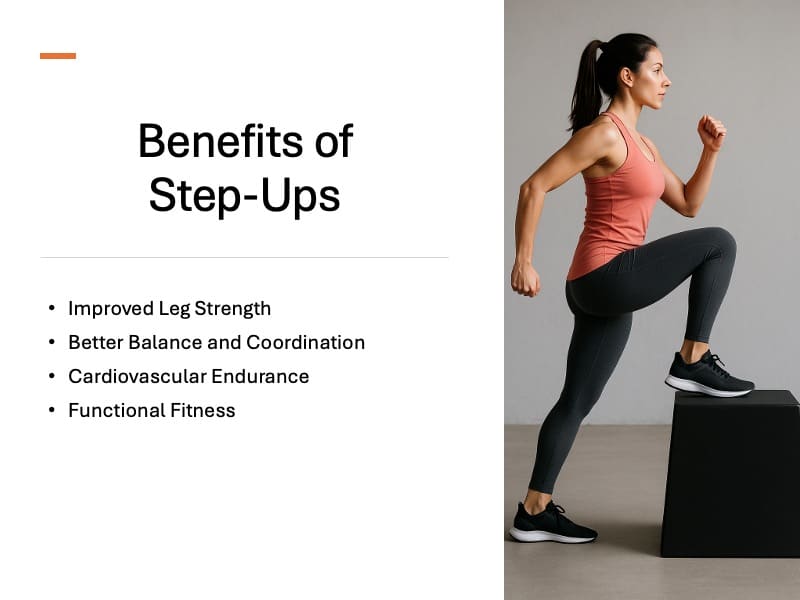
Step-ups provide a rare combination of strength development, athletic carryover, and joint-friendly training.
They work especially well because they challenge each leg independently, forcing the body to stabilize and coordinate through every phase of the movement.
This makes step-ups valuable for athletes, beginners, and anyone rebuilding strength after injuries.
Improved Leg Strength
Step-ups build strength in the quads, glutes, and hamstrings by forcing one leg to lift and lower the body without assistance from the other side (Simenz et al., 2012).
This creates more significant muscular engagement compared to many bilateral lower-body exercises.
Over time, consistent step-up training helps correct strength imbalances that often limit athletic performance.
The movement pattern also reinforces strong hip extension, a key component of speed, jumping, and overall lower-body power.
Better Balance and Coordination
Because step-ups are a unilateral exercise, they require more stability and motor control than movements performed on two legs.
The body must maintain alignment while transitioning from the floor to an elevated surface, which challenges the core and smaller stabilizing muscles around the hip.
This improves proprioception, or the body’s ability to sense position and movement.
Better balance and coordination translate directly to improved performance in sports and daily activities.
Cardiovascular Endurance
Step-ups can elevate the heart rate quickly, especially when performed at a faster tempo or with added resistance.
The movement uses large lower-body muscle groups that demand significant energy, making it an efficient conditioning tool.
For individuals who prefer low-impact cardio, step-ups offer a joint-friendly alternative to running or jumping.
When incorporated into circuits or interval training, they significantly boost aerobic and anaerobic fitness.
Functional Fitness
Step-ups mirror real-life movement patterns like climbing stairs, walking uphill, or rising from a seated position.
This makes them one of the most practical exercises for improving everyday mobility and reducing the risk of injury.
They strengthen muscles and movement patterns the body relies on for balance and stability during daily tasks.
For athletes, step-ups develop transferable skills, such as single-leg force production, which is essential for sprinting, jumping, cutting, and deceleration.
Step-Up Exercise Variations
Step-ups can be adapted in several ways to target different muscles, increase difficulty, and build athletic strength, making them one of the most versatile lower-body exercises.
Weighted Step-Ups
Step-ups are one of the best bodyweight leg exercises, but adding weight to your step-ups is an awesome way to challenge your body.
Adding resistance with dumbbells or a barbell increases the intensity of the movement and significantly boosts strength development.
This variation forces the glutes, quads, and core to work harder to stabilize the body as you step onto the platform.
It is especially useful for athletes who need higher-force single-leg training without the joint stress of heavy bilateral lifts.
Start with light weights to master your balance, then gradually increase the load as your form improves.
Lateral Step-Ups
Lateral step-ups shift the movement pattern sideways, effectively recruiting the hip abductors and adductors more than traditional step-ups.
These muscles are essential for knee stability and athletic movements such as cutting, shuffling, and changing direction.
The side-to-side angle also challenges the core differently because you must resist rotation as you lift and lower the body.
This makes lateral step-ups a valuable tool for building balanced, resilient lower-body strength.
Step-Ups with Knee Raise
This variation adds a dynamic balance component by lifting the opposite knee toward the chest at the top of the movement.
The knee drive increases core activation and simulates running mechanics, which makes it beneficial for athletes looking to improve sprinting or jumping performance.
It also develops hip flexor strength and stability on the standing leg, improving control through the entire range of motion.
Use a controlled tempo to ensure the knee lift is driven by strength rather than momentum.
Lunge Step-Ups
Lunge step-ups blend a lunge with a step-up, creating a challenging variation that strengthens the glutes, quads, and core through a larger range of motion.
Moving from a lunge into a step-up requires the working leg to stabilize, generate power, and control the transition, improving balance and athletic coordination.
This variation also increases time under tension, making it effective for building strength and endurance.
Start with a lower platform to maintain smooth technique, then progress to higher steps or added weight as your stability improves.
Safety Tips
To maximize the effectiveness of step-ups and minimize the risk of injury, avoid common mistakes such as:
- Improper Foot Placement: Ensure your entire foot is on the platform to prevent slipping and maintain stability.
- Using Momentum: Focus on using muscle strength rather than momentum to lift your body onto the platform.
- Leaning Forward: Keep your torso upright and engage your core to maintain proper posture throughout the movement.
- Adaptations for Joint Issues: For individuals with knee, hip, or ankle problems, consider lowering the step height or performing step-ups without weights to reduce joint strain. Alternatively, low-impact exercises like wall sits or seated leg lifts can be used to build strength without aggravating existing conditions.
Final Thoughts: Are Step-Ups a Good Exercise?
Step-ups are one of the most effective lower-body exercises because they build strength, balance, and functional power in a joint-friendly way.
Their unilateral nature helps correct imbalances and reinforces movement patterns that carry over directly to sports, daily life, and long-term joint health.
They can be tailored to any fitness level, whether you are rebuilding strength, training for athletic performance, or simply trying to stay active at home.
With so many variations and progressions available, step-ups remain a reliable and versatile choice for anyone looking to develop strong, resilient legs.
This website does not provide medical advice. This website site does contain affiliate links, and purchases may earn a commission.
Read my Medical Disclaimer, Review Disclaimer, and Publishing Policies for more details. Use of this site indicates acceptance of these terms.