

How to Prevent Sports Injuries: 10 Strategies for Athletes & Trainers
 Reading Time: 12 minutes
 As much as I wish it were true, learning how to prevent sports injuries does not mean finding one perfect exercise, stretch, or recovery tool.
Instead, injury prevention for athletes involves the consistent process of developing a body that can tolerate the forces, movements, and training loads your sport repeatedly demands.
Throughout my professional basketball career, I have learned that injury prevention is not a separate part of training.
Your warm-up, strength program, movement quality, conditioning, nutrition, sleep, and pain response all influence how resilient your body becomes.
No strategy can eliminate injuries completely, and most of the injuries in my career I would consider as “fluke” or “non-preventable” injuries.
Contact, awkward landings, unpredictable competition, and accidents will always create some risk, but intelligent preparation can reduce avoidable injuries and help athletes recover more effectively when problems develop.
What Causes Sports Injuries?
Most common sports injuries develop from either an acute event or repeated stress that gradually exceeds the body’s ability to recover.
An ankle sprain after landing on another player’s foot is an acute injury, while patellar tendinopathy that worsens over several weeks is usually an overuse problem.
Athlete injury risk is rarely explained by one factor.
Previous injuries, sudden changes in training, poor conditioning, inadequate recovery, technical errors, fatigue, playing surfaces, equipment, and the demands of the sport can interact.
This is why effective sports injury prevention requires more than stretching before practice.
Athletes need a complete system that improves physical capacity while managing the stress placed on the body.
Sports Injury Prevention Tips That Actually Make a Difference
As I’ve learned through over a decade of professional basketball and nearly 20 years of experience in elite-level athletics, some sports injury prevention tips and tricks work, while others don’t.
Check out these ten ways you can prevent sports injuries:
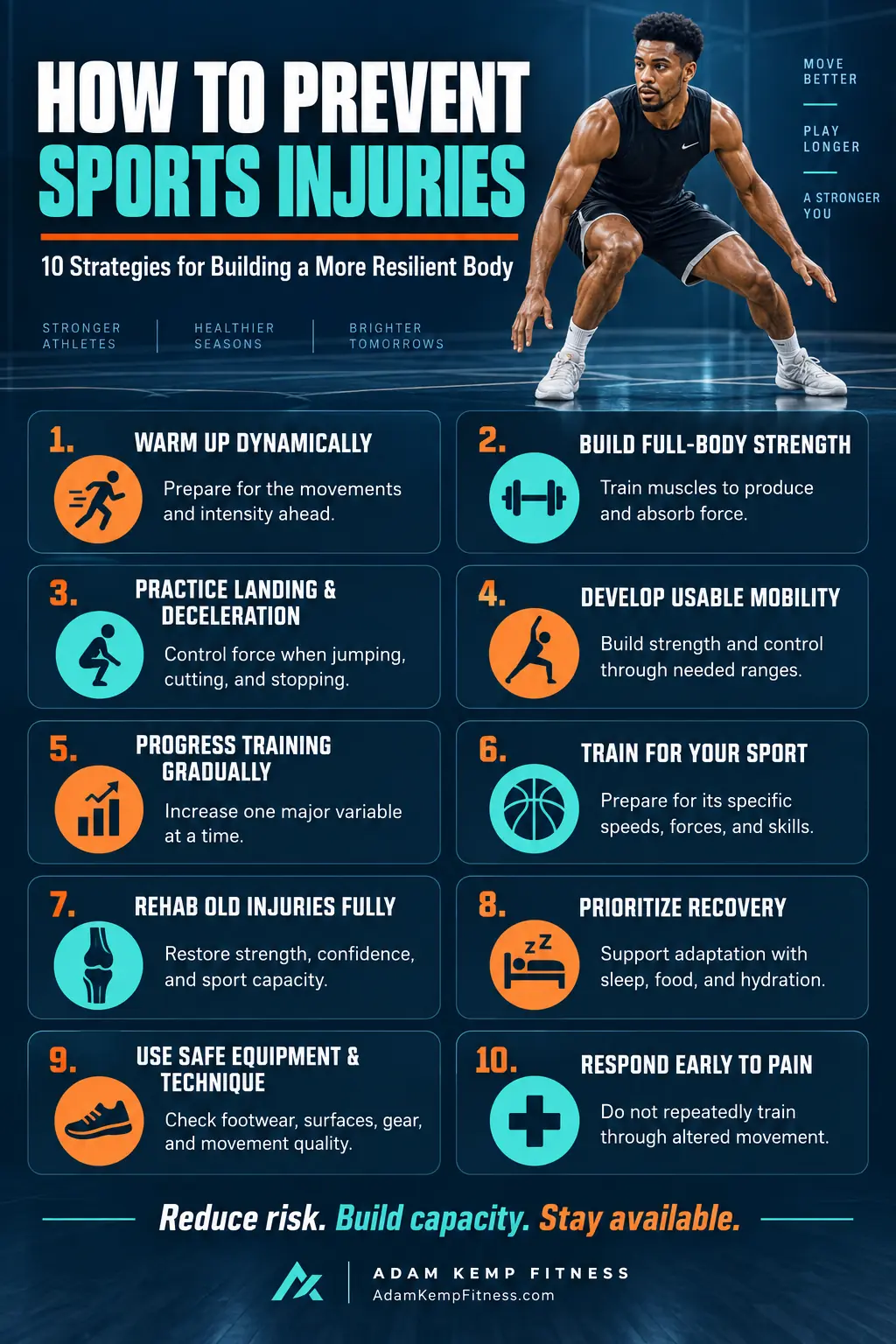
1.) Use a Dynamic Warm-Up Before Training and Competition
A good warm-up prepares you for the specific movements and intensities you are about to encounter.
It should gradually raise body temperature, rehearse key movement patterns, and activate the muscles and nervous system without causing unnecessary fatigue.
Before basketball practices and games, I use movements that prepare my ankles, hips, knees, shoulders, and trunk for sprinting, jumping, landing, cutting, and physical contact.
This is more useful than doing the same generic stretching routine before every workout.
A practical dynamic warm-up can include:
- Light jogging, cycling, or skipping
- Ankle rocks and calf raises
- Leg swings and hip circles
- Walking lunges with rotation
- Lateral lunges
- High knees and butt kicks
- Arm circles and band pull-aparts
- Glute bridges or lateral band walks
- Progressive accelerations
- Low-intensity jumps, landings, or change-of-direction drills

The final portion should resemble your sport.
A basketball player might progress to short accelerations, defensive slides, controlled decelerations, and submaximal jumps, while a lifter should complete lighter exercise-specific sets.
Structured warm-up programs that combine strength, balance, agility, and movement control can reduce injury rates in several sports.
FIFA 11+ is a well-known example, but athletes should choose drills that match their sport rather than copying a soccer program without modification (Sadigursky et al., 2017).
Static stretching is not automatically harmful, but long passive stretches should not be the center of an athletic warm-up.
If you use static stretching before training, keep it brief and follow it with dynamic, sport-specific movements.
2.) Build Strength Around the Joints Most Exposed to Stress
Strength training is one of the most valuable tools for injury prevention because stronger muscles help athletes produce, absorb, and redirect force.
Research has found that strength-based interventions can meaningfully reduce both acute and overuse sports injuries (Lauersen et al., 2014).
The goal isn’t simply to lift the heaviest possible weight; athletes need strength across the positions, speeds, and movement patterns their sport demands.
A balanced strength training program for injury athletes should train:
- Squatting
- Hip hinging
- Lunging and split-stance movements
- Pushing
- Pulling
- Carrying
- Rotating and resisting rotation
- Calf and ankle strength
- Single-leg stability
Compound exercises such as squats, deadlift variations, split squats, rows, presses, and loaded carries establish a strong foundation.
Smaller exercises for the calves, hamstrings, rotator cuff, adductors, feet, and hips can address areas that compound movements may not train sufficiently.
Athletes should also train isometrically, concentrically, and eccentrically.
The body must be able to hold positions, generate force, and absorb force, not just move a weight from one point to another.
3.) Train Balance, Landing, and Deceleration Skills
Many noncontact injuries happen when an athlete cannot control force during a landing, cut, or sudden stop.
Strength is essential, but athletes must also learn how to express that strength during fast, unpredictable movements.
Neuromuscular injury prevention training commonly includes balance, landing mechanics, agility, strength, and sport-specific movement practice.
These programs appear especially useful when completed consistently rather than used only during preseason.
Useful injury prevention exercises may include:
- Single-leg balance variations
- Step-downs
- Single-leg Romanian deadlifts
- Snap-downs into an athletic position
- Low-level pogo hops
- Drop landings
- Lateral bounds with controlled holds
- Deceleration lunges
- Planned cutting drills
- Reactive change-of-direction drills
This video demonstrates two movements to train the vertical jump, but the first is an excellent deceleration exercise to keep your hips, knees, and ankles healthy and ready to absorb impact.
Please subscribe to my YouTube Channel for more helpful health and fitness content!
Start with slow, predictable movements, then progress to faster, reactive tasks.
An athlete should demonstrate control before increasing speed, height, external load, or unpredictability in decision-making.
As a basketball player, I consider deceleration ability just as important as acceleration.
You cannot fully use your speed if your body cannot safely absorb the forces produced when stopping, cutting, or landing.
4.) Improve Mobility Without Chasing Maximum Flexibility
Flexibility describes how far a muscle or tissue can lengthen, while mobility describes how well you can actively control a joint through a usable range of motion.
Athletes need enough of both to reach the positions their sport requires.
More flexibility is not always better.
Excessive flexibility without strength and control can be less useful than a slightly smaller range of motion that an athlete can stabilize.
Mobility workouts should target restrictions that meaningfully affect movement.
For example, limited ankle dorsiflexion may alter squatting and landing mechanics, while restricted hip or thoracic movement can cause an athlete to compensate elsewhere.
In that case, I would focus on ankle mobility exercises, such as these:
My warm-ups often include ankle mobility drills, hip rotations, thoracic rotation, and other movements that target my weak-spots.
The exact mobility exercises and drills should depend on the athlete’s body, injury history, and sport.
Foam rolling may temporarily improve range of motion and help some athletes feel more comfortable, but it doesn’t make the body injury-proof on its own.
Mobility and flexibility work is most valuable when the athlete also develops strength and control within the newly available range.
5.) Increase Training Load Gradually
Athletes become more resilient when they are exposed to enough training stress to create adaptation.
Problems arise when training demands exceed what the body can currently tolerate.
The traditional “10% rule” suggests never increasing training volume by more than 10% per week.
However, research does not support a universal percentage that applies to every athlete, sport, tissue, and training situation (Damsted et al., 2018).
Instead, adjust training progressively while considering:
- Recent training history
- Current conditioning
- Injury history
- Practice and competition schedule
- Exercise intensity
- Total repetitions or distance
- Changes in playing surface
- Sleep and life stress
- Soreness and pain
- Recovery between sessions
Avoid increasing several variables at once.
Adding more practices, heavier lifting, extra sprinting, and more plyometrics during the same week makes it difficult to identify which stressor the athlete is not tolerating.
After an offseason, illness, injury, or extended break, rebuild capacity instead of immediately returning to your previous workload.
The International Olympic Committee emphasizes that load management should consider the individual athlete and both the physical and psychological stressors affecting recovery (Soligard et al., 2016).
6.) Prepare for the Specific Demands of Your Sport
General fitness does not automatically prepare an athlete for every sport.
Running in a straight line may improve conditioning, but it does not fully prepare a basketball player for repeated jumping, lateral movement, contact, and rapid deceleration.
Your training should gradually expose you to the movements and forces you will encounter in competition.
This includes sprinting, jumping, throwing, cutting, tackling, or changing direction when those actions are part of the sport.
The same principle applies when returning from an injury.
Being cleared to jog or lift weights does not necessarily mean an athlete is prepared for unrestricted practice or competition.
A proper return-to-sport progression should bridge the gap between rehabilitation and full competition.
Whenever possible, this process should involve a sports medicine and injury care team that includes a physician, physical therapist, athletic trainer, strength coach, and sport coach communicating with one another.
7.) Take Previous Injuries Seriously
As a professional athlete, I spend huge amounts of time managing my old injuries, while trying to prevent future ones.
A previous injury is one of the most important pieces of information when estimating future injury risk.
The affected area may remain weaker, less coordinated, or less tolerant of sport-specific stress even after pain disappears.
This is why rehabilitation should not end as soon as an athlete feels better.
Pain relief and tissue healing are important, but the athlete must also restore strength, confidence, range of motion, power, and sport-specific capacity.
After injuries and surgeries throughout my career, I have learned that the final part of rehabilitation is often the easiest part to rush.
Athletes naturally want to return, but a few pain-free workouts do not prove that the body is ready for a full practice schedule or competition.
Continue appropriate rehabilitation exercises after returning to sport when advised by your sports medicine clinic.
Maintenance work for previously injured ankles, knees, hamstrings, shoulders, or other vulnerable areas can remain part of your long-term program.
8.) Support Recovery With Sleep and Nutrition
Training creates the stimulus for adaptation, but recovery is when the body responds to that stimulus.
Consistently training without enough sleep, energy, protein, carbohydrates, and micronutrients can reduce an athlete’s capacity to tolerate demanding workloads.
The basics of sports nutrition make it clear that athletes should consume enough total energy to support their training and basic physiological needs.
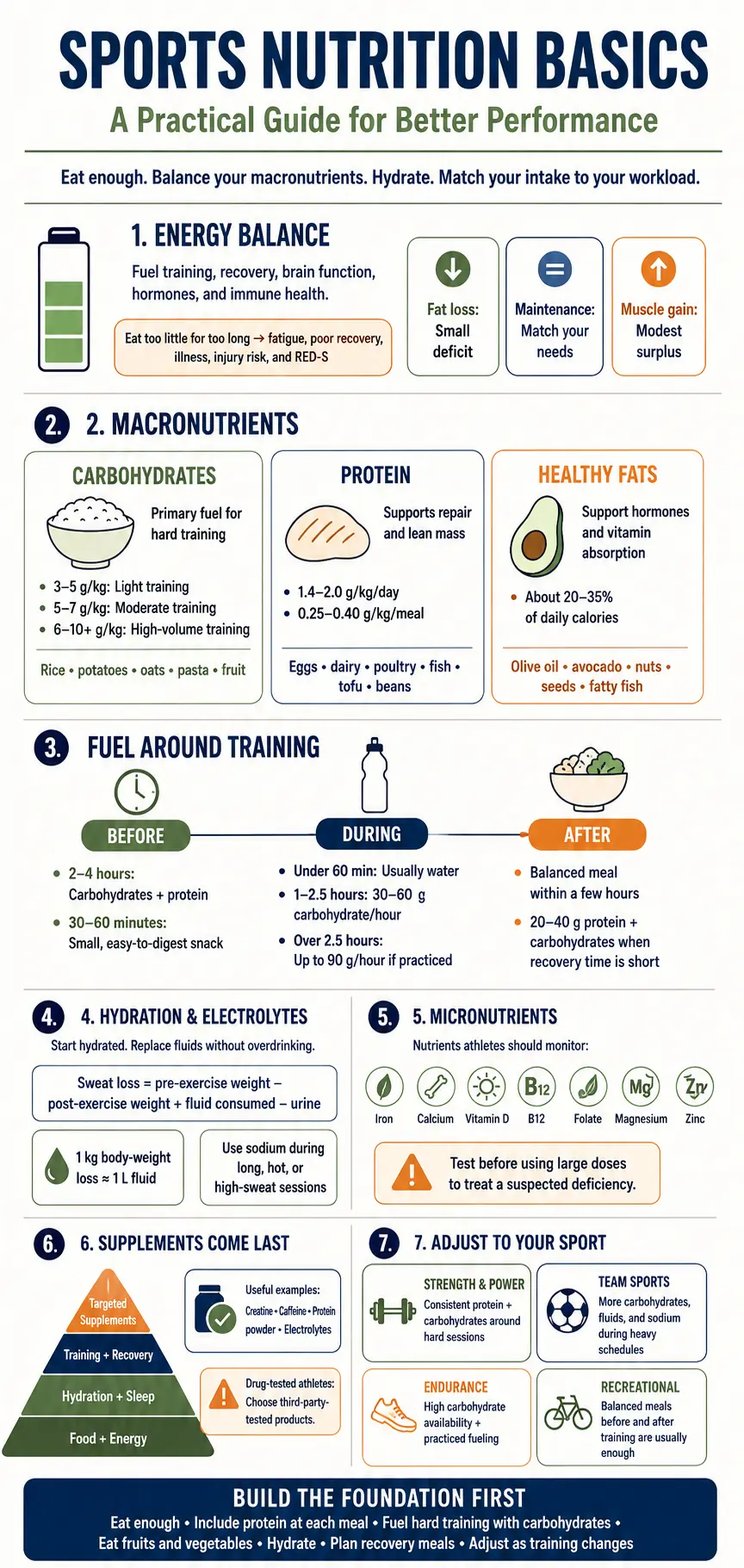
Chronic low energy availability can negatively affect bone health, hormones, immunity, recovery, and performance, potentially increasing susceptibility to illness and certain injuries (Mountjoy et al., 2023).
Protein supports muscle repair and remodeling, while carbohydrates help fuel high-intensity training and restore glycogen.
Calcium, vitamin D, iron, and other micronutrients also deserve attention, but supplements should not replace an adequate diet.
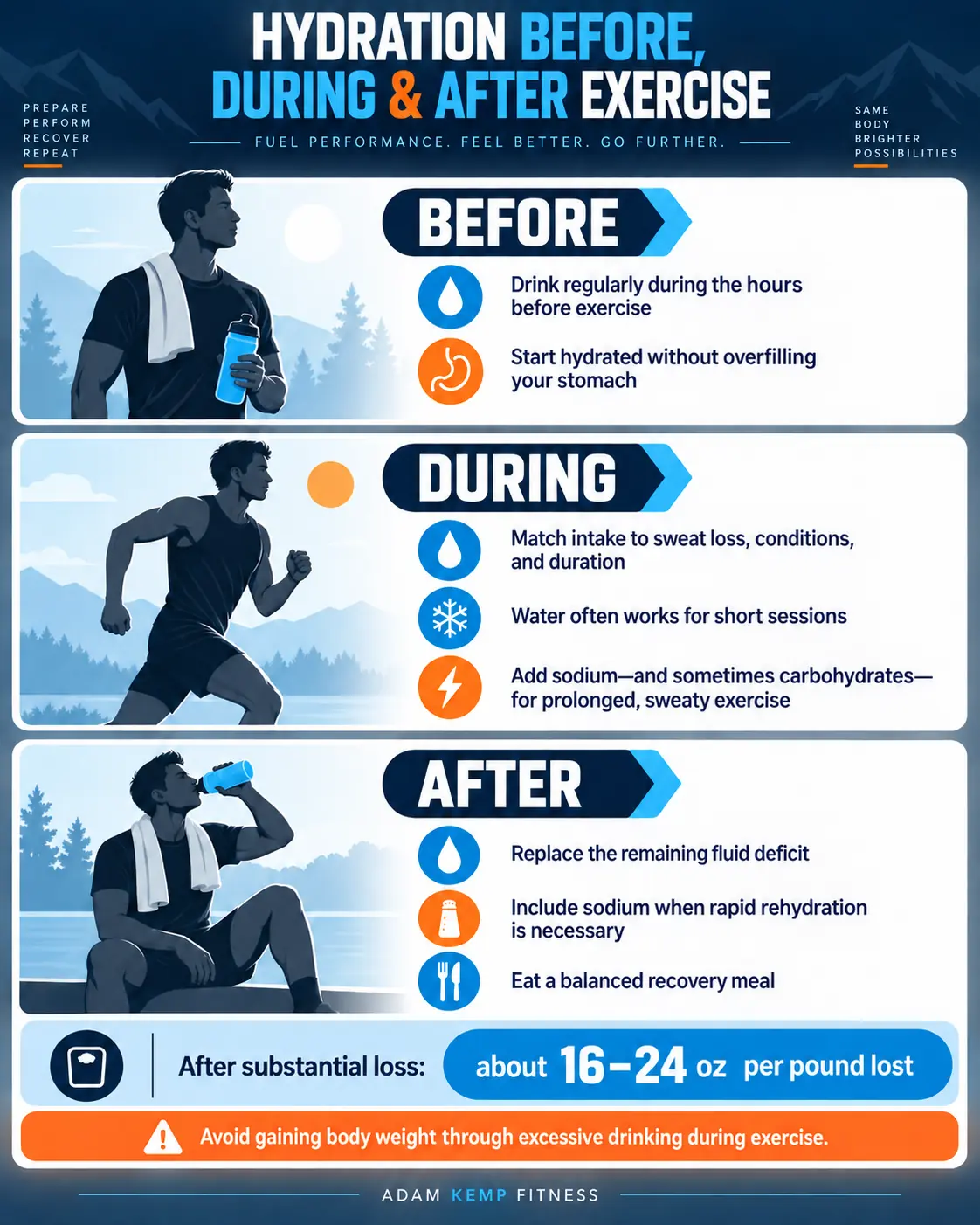
Hydration supports performance and temperature regulation, especially during long sessions or training in hot conditions.
However, it is too simplistic to claim that drinking more water by itself prevents sports injuries.
Sleep should be treated as part of the training program rather than unused time between workouts.
When sleep quality or duration declines, consider reducing unnecessary training stress and addressing the reason instead of relying on stimulants to hide fatigue.
9.) Use Appropriate Equipment, Surfaces, and Technique
Even a well-conditioned body can be exposed to unnecessary risk through damaged equipment, unsuitable footwear, unsafe playing surfaces, or poor exercise technique.
Athletes should check these factors instead of assuming every injury stems from weakness or limited mobility.
Footwear should fit properly and suit the activity and surface.
Even the best workout shoes for your training sessions or competitions cannot prevent every ankle, knee, or foot injury, but worn-out or inappropriate footwear may change traction, comfort, and force distribution.
Protective equipment should fit correctly and meet the requirements of the sport.
Helmets, mouthguards, pads, braces, and tape only work as intended when used properly.
Technique also matters, particularly when training intensity increases.
Athletes should learn how to lift, land, cut, sprint, throw, and absorb contact before attempting those skills under heavy fatigue or maximum competitive pressure.
Following the rules of the sport is another legitimate injury prevention strategy.
Rules regarding dangerous contact, equipment, playing surfaces, and return-to-play decisions exist to reduce avoidable harm.
10.) Respond Early to Pain and Warning Signs
Athletes need to distinguish normal training discomfort from symptoms that may require attention.
Delayed-onset muscle soreness generally develops after unfamiliar or demanding exercise, affects a broader area, and improves over several days.
Potential injury symptoms may include:
- Sudden or sharp pain
- Pain in a precise location
- Rapid swelling
- A joint giving way or locking
- Loss of strength or range of motion
- Numbness or tingling
- Pain that worsens during activity
- Symptoms that change normal movement
- Pain that does not improve with recovery
Pain does not always indicate serious tissue damage, and pain intensity does not always reflect injury severity.
However, repeatedly changing your movement to avoid pain is a reason to stop and investigate rather than continue forcing the same activity.
Seek qualified medical care after a traumatic injury, suspected fracture or concussion, major swelling, neurological symptoms, inability to bear weight, or persistent pain.
Early assessment can prevent a manageable problem from becoming a longer interruption.
Do You Need Injury Prevention Tools?
You do not need expensive recovery equipment or the best muscle recovery tools to reduce your risk of sports injuries, but the right tools can help manage soreness, improve short-term mobility, promote relaxation, and make it easier to maintain movement quality between training sessions.
Foam rollers and massage guns can temporarily reduce muscle tightness and help you move more comfortably.
Massage sticks, mobility balls, and other self-massage tools provide more targeted pressure, while pneumatic compression boots like the TheraGun Jet Boots may help tired legs feel less heavy after demanding practices, games, or travel.
Heat can help stiff muscles feel more relaxed before movement, whereas cold therapy may reduce soreness after unusually demanding training or competition.
These methods can be useful when applied strategically, but feeling temporarily better does not necessarily mean an underlying injury or workload problem has been resolved.
Throughout my professional basketball career, I have used many of these tools, but they have always been secondary to a complete recovery routine built around proper training loads, sufficient sleep, adequate nutrition, hydration, strength, and mobility.
Recovery devices may help manage individual problems, but they cannot compensate for a poor overall system.
If pain persists, changes how you move, or repeatedly returns, another recovery gadget is unlikely to be the complete solution.
A qualified medical professional or physical therapist can help identify the cause and develop a plan that addresses the problem instead of temporarily masking its symptoms.
A Practical Weekly Injury Prevention Checklist
Athletes do not need a separate hour-long injury prevention workout every day. Many of the most useful practices can be built into normal training.
Each week, aim to:
- Complete a dynamic warm-up before demanding activity
- Strength train the major movement patterns
- Train important sport-specific muscles and tissues
- Practice landing, balance, and deceleration
- Include appropriate sprinting, jumping, or throwing exposure
- Adjust workload according to recovery and recent training
- Eat enough energy and protein
- Hydrate appropriately
- Protect sleep
- Monitor persistent pain and changes in movement
- Maintain rehabilitation work for previous injuries
- Schedule easier days when fatigue accumulates
Consistency matters more than creating the most complicated routine. Ten or fifteen minutes of well-designed injury prevention training completed several times per week is generally more valuable than an elaborate program performed occasionally.
Can Every Sports Injury Be Prevented?
No. Even athletes who train intelligently can be injured through contact, falls, collisions, unpredictable landings, or accumulated stress.
The goal of injury prevention for athletes is to reduce risk, not guarantee it.
A good program improves physical capacity, limits avoidable spikes in stress, and helps athletes identify problems before they become more severe.
Final Thoughts: Injury Prevention for Athletes
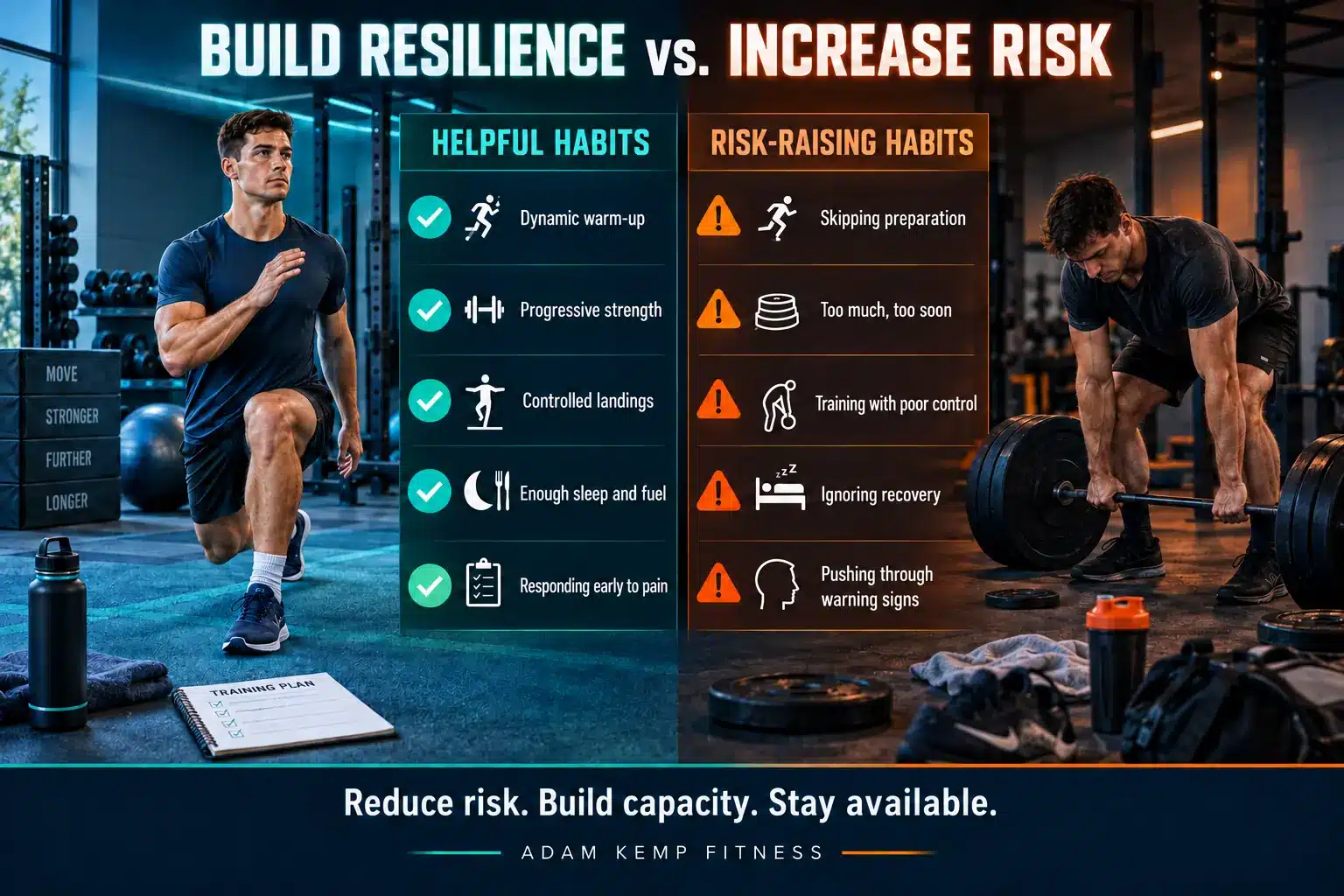
Learning how to prevent sports injuries requires more than just adding extra stretching, wearing a brace, or completing a few corrective exercises.
The most resilient athletes build strength, practice sport-specific skills, progress their workload carefully, recover adequately, and respond early when something changes.
After years of professional basketball and multiple injuries, I know the best ability is availability, and injury resistance is a physical quality worth training.
You may not be able to prevent every injury, but you can build a body better prepared for the demands of your sport and more capable of performing consistently over time.
This website does not provide medical advice. This website site does contain affiliate links, and purchases may earn a commission.
Read my Medical Disclaimer, Review Disclaimer, and Publishing Policies for more details. Use of this site indicates acceptance of these terms.