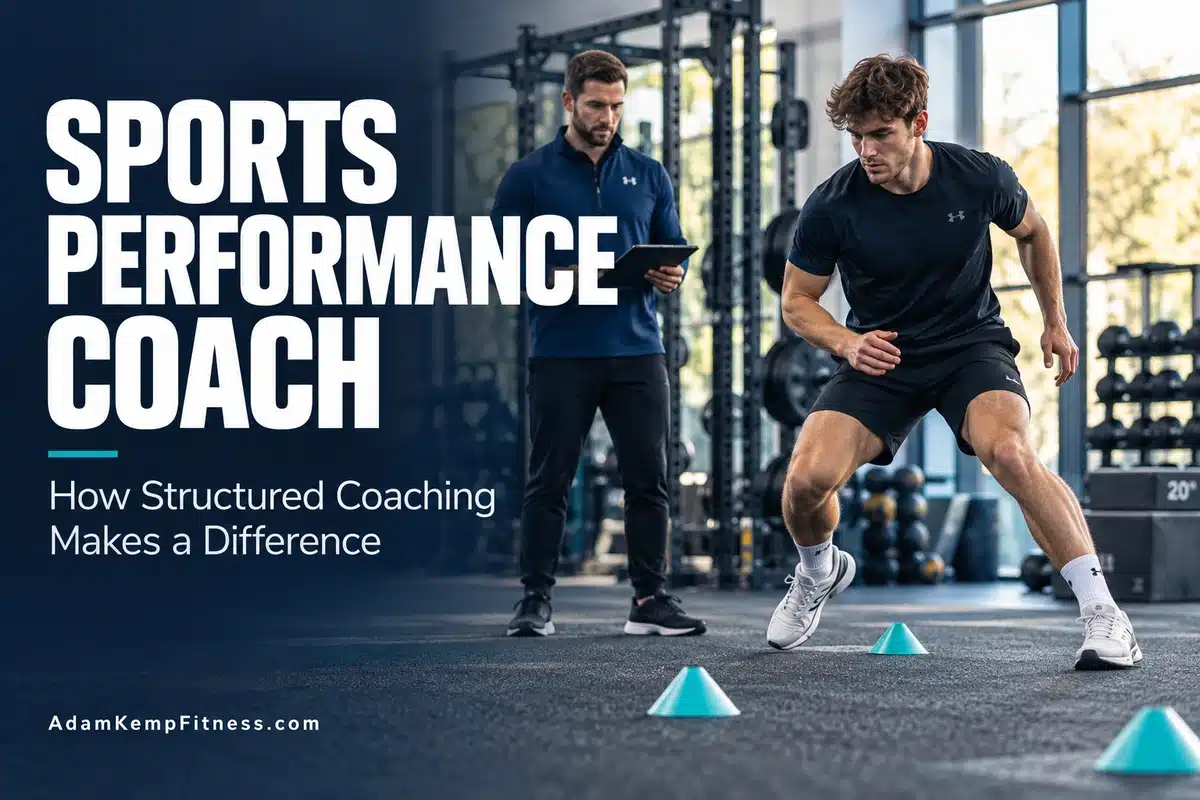
Sports Performance Coaching: What is It & What Does it Do?
 Reading Time: 5 minutes
 A sports performance coach helps athletes give that talent direction through structured training, measurable goals, and consistent feedback.
Raw talent in sports is an incredible starting point, but it rarely wins championships on its own.
Every year, we see gifted athletes who seem destined for greatness fall short.
Sometimes, the missing ingredient is not more practice, but a clearer understanding of what to practice and how to improve.
Structured coaching from a sports performance coach provides a framework for turning natural ability into more consistent performance.
While there are many pathways to success for athletes, and I’m happy to discuss these options with you as part of my Athletic Advisor service, working with a sports performance coach gives athletes a plan to develop the physical qualities their sport demands and makes each training session more purposeful.
Read the rest of the article to learn more about what a sports performance coach does, why you might want to hire a sports performance coach, and how to choose the right sports performance coach for yourself.
What Does a Sports Performance Coach Do?
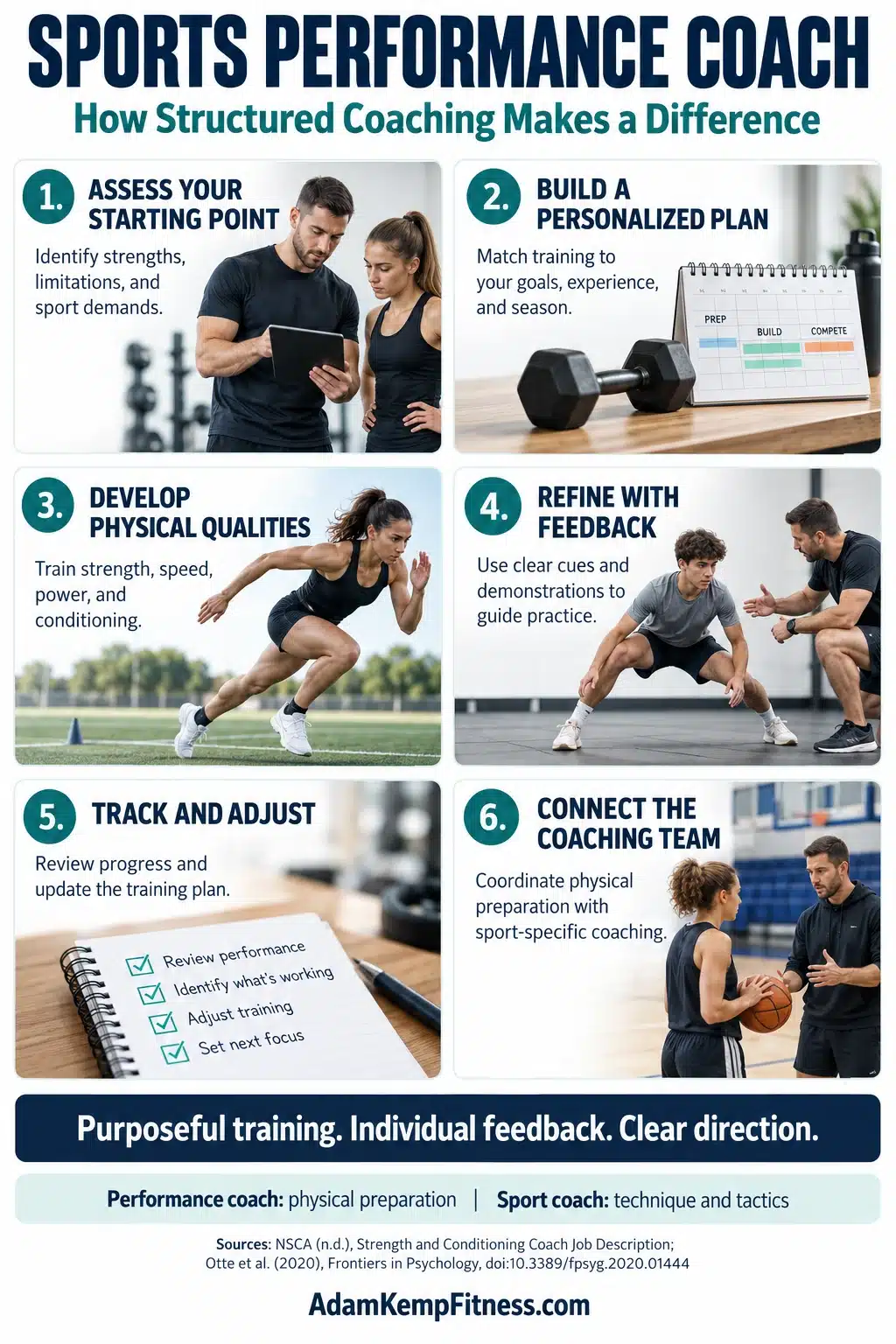
A sports performance coach helps athletes improve their physical preparation for competition through individualized training and ongoing assessment.
In a strength and conditioning setting, this includes designing training plans, supervising sessions, evaluating progress, and coordinating with sport coaches (National Strength and Conditioning Association [NSCA], n.d.).
The exact role depends on the coach’s qualifications and responsibilities. A performance coach may focus on strength, speed, power, and conditioning, while a sport-specific coach leads technical instruction and game strategy.
These roles work best together.
The goal is to connect physical preparation with the skills an athlete needs to perform effectively in competition.
Beyond Raw Talent: The Need for Structured Training
Relying on instinct and natural athleticism can carry a player far, especially early in their career.
But at higher levels of competition, talent alone offers less separation.
Structured coaching from a sports performance coach introduces a system for improvement where there was once just repetition.
Instead of approaching every workout as an isolated challenge, athletes follow a plan with clear priorities and ways to evaluate progress.
Think of it like building a house.
You can have the best materials in the world, but without a blueprint, it is difficult to know how everything should fit together.
A sports performance coach acts as an architect for physical preparation, designing a plan around the athlete’s needs and competitive schedule.
The NSCA describes this planning process as including training across the preseason, competitive season, and offseason, alongside systems for tracking athlete progress (NSCA, n.d.).
For an athlete, the practical value is direction.
You should understand what you are working toward, why an exercise is included, and how your coach will decide when to adjust the plan.
Identifying Weaknesses and Building on Strengths
One of the biggest challenges for any athlete is objectively evaluating themselves.
You might feel like one part of your game is holding you back, when the real issue lies somewhere you haven’t considered.
A sports performance coach provides an outside perspective to help identify areas that deserve attention.
Rather than assuming every weakness needs equal time, the coaching process can start with a more useful question: Which improvement matters most for your sport and current goals?
For example, a golfer might spend hours at the driving range trying to add 20 yards to their tee shot, believing that is the key to lower scores.
However, a golf coach might find that the player is losing more strokes on putts inside 10 feet.
In that situation, Personalized Golf Lessons can provide an opportunity to evaluate technique and direct practice toward the skills that need attention.
Likewise, individual basketball training sessions can point out simple fixes to your shot form or footwork that you might not notice on your own.
A sports performance coach can complement that instruction by addressing the golfer’s physical preparation.
The same principle applies across sports: identify the limiting factor before adding more training.
A useful plan should also preserve and develop the strengths that already make an athlete effective.
The Power of Personalized Feedback
Generic tips from a book or online video can be helpful, but they cannot observe your performance or respond to what happens during a session.
Every athlete brings a different training history, physical capacity, and level of experience.
A great coach adapts instruction accordingly.
They do not simply repeat the same cue to every athlete; they consider what information will help that person complete the task more effectively.
This is a core principle of high-performance sports coaching, where instruction is customized to the individual.
Coaching research emphasizes that the timing, amount, and type of feedback should reflect the athlete’s stage of learning and the demands of the task (Otte et al., 2020).
This personalization also includes communication.
One athlete may appreciate a brief, direct cue, while another may benefit from a demonstration, a question, or time to explore the movement.
The goal is feedback the athlete can use.
Effective instruction should help athletes develop their own understanding instead of becoming dependent on a coach to correct every repetition (Otte et al., 2020).
Supporting Mental Preparation and Game Strategy
Physical preparation is one part of athletic performance, but confidence, focus, resilience, and decision-making also deserve attention within the broader coaching process.
A sports performance coach can make reflection part of training by asking athletes to evaluate a difficult session, identify what they controlled, and set a clear focus for the next workout.
This creates opportunities to practice responding constructively when progress is uneven.
Depending on their training, a sports performance coach may also help athletes develop routines for competition.
More specialized psychological support should involve an appropriately qualified sport psychology professional.
Game strategy is typically led by the sport-specific coach, who helps athletes understand opponents’ tendencies and make decisions during competition.
This remains a key aspect of expert coaching in player development, moving a player from simply executing skills toward understanding when and how to use them.
A coordinated coaching approach connects these responsibilities.
The sports performance coach develops physical preparation, while technical and tactical instruction helps athletes apply their abilities within the game.
Final Thoughts: Should You Work With a Sports Performance Coach?
Talent provides the spark, but purposeful training gives athletes a way to build on it.
Along with that, a clear plan, individualized feedback, and regular evaluation make the improvement process easier to understand and follow.
There are many opportunities when a sports performance coach may be beneficial for you as an athlete, but a sports performance coach may be especially useful when you are training consistently but lack direction or do not know what is limiting your progress.
Look for someone who can explain their approach, measure relevant outcomes, and work with the other professionals supporting your development.
The value of structured coaching is having a reason behind the work.
Each session becomes part of a larger plan to prepare you for the demands of your sport.
This website does not provide medical advice. This website site does contain affiliate links, and purchases may earn a commission.
Read my Medical Disclaimer, Review Disclaimer, and Publishing Policies for more details. Use of this site indicates acceptance of these terms.
Check Out Some of My YouTube Videos Below, and Please Follow on YouTube for More Educational Health and Fitness Content!