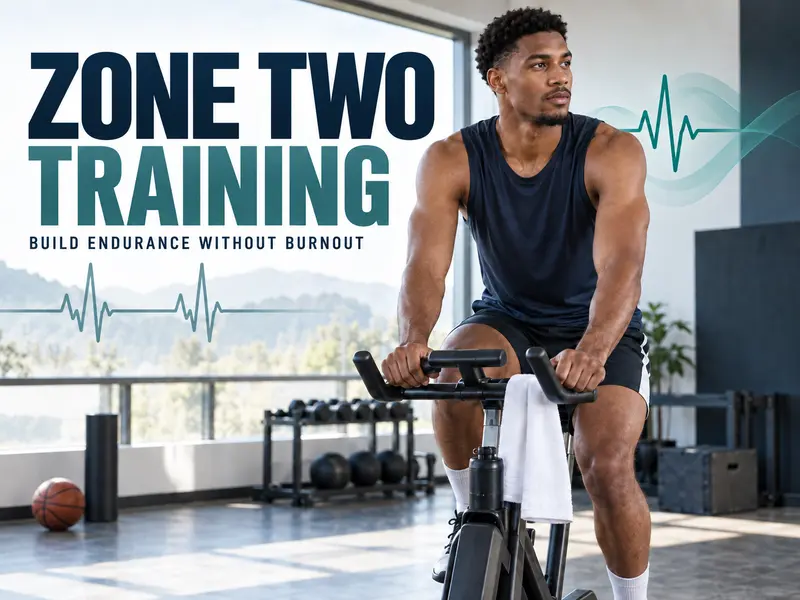
What is Zone Two Training? Build Endurance Without Burnout
 Reading Time: 14 minutes
 Zone two training is a sustainable form of aerobic exercise that helps you build endurance without making every cardio session exhausting.
Instead of leaving you gasping for air, it strengthens the aerobic system that supports longer workouts, faster recovery, and more repeatable performance.
As a professional basketball player, I learned that conditioning isn’t just about surviving brutal intervals; my ability to recover between sprints, practices, lifts, and games depends heavily on the aerobic foundation built through controlled conditioning.
This type of training can benefit competitive athletes, recreational exercisers, and anyone who wants to improve cardiovascular fitness without compromising strength workouts or recovery.
You can explore additional options in my complete guide to cardio exercises and workouts.
What Is Zone Two Training?

Zone two training is continuous aerobic exercise performed at a controlled intensity near, but generally below, your first lactate or ventilatory threshold.
At this effort, breathing is elevated but controlled, and your body can meet most of its energy demands through aerobic metabolism.
You are working hard enough to stimulate adaptation but not so hard that fatigue rapidly accumulates.
Most people can maintain the effort for approximately 30 to 90 minutes once they have developed an appropriate fitness base.
A recent expert consensus defined zone two training as exercise performed immediately below the first lactate or ventilatory threshold.
This physiological definition is more precise than assigning everyone the same percentage of maximum heart rate because people can reach their thresholds at substantially different heart rates (Sitko et al., 2025).
Zone Two Training Is Not Defined the Same Way Everywhere
One reason zone two training can seem confusing is that coaches, researchers, watches, and exercise apps do not always use the same training-zone system.
In a five-zone heart-rate model, zone two is often listed as approximately 60% to 70% of maximum heart rate.
In a three-zone physiological model, however, the lowest zone includes nearly all exercise below the first ventilatory or lactate threshold.
Therefore, the “zone two” displayed on your watch may not perfectly match the physiological zone discussed by an endurance coach or exercise scientist.
Heart rate can provide useful guidance, but your breathing, perceived exertion, and ability to speak should help confirm the intensity.
What Does Zone Two Training Feel Like?
Zone two should feel purposeful but sustainable.
Your breathing becomes deeper and faster than it is during a casual walk, yet it remains controlled enough that you do not feel desperate for air.
You should generally be able to:
- Speak in complete sentences
- Maintain a steady breathing rhythm
- Continue for at least 30 minutes
- Finish without feeling depleted
- Repeat a similar workout within the next day or two
On a perceived-exertion scale from 1 to 10, zone two usually feels like a 3 or 4.
The effort should be more challenging than casual movement but noticeably easier than tempo training or high-intensity intervals.
If you can only say a few words before needing another breath, you are probably working above zone two.
If your breathing has barely changed, you may need slightly more speed, resistance, or incline.
Zone Two Training Benefits
The primary benefit of zone two training is that it allows you to accumulate productive aerobic work with a manageable recovery cost.
That combination can improve fitness while leaving enough energy for strength training, sports practice, and higher-intensity conditioning.
Improves Aerobic Endurance
Zone two training improves your ability to produce energy with oxygen.
Over time, the same walking, running, cycling, or rowing pace may require a lower heart rate and feel easier.
This improved efficiency can help you exercise longer before fatigue becomes limiting.
It can also make everyday activities such as climbing stairs, walking through an airport, or playing with your children feel less demanding.
Supports Mitochondrial Adaptations
Mitochondria help your muscle cells produce aerobic energy.
Repeated endurance training can increase mitochondrial content and improve the enzymes involved in aerobic metabolism, although the size of these changes depends on training status, volume, intensity, and progression.
Zone two is not the only intensity capable of producing mitochondrial adaptations.
Its practical advantage is that you can perform a meaningful amount of it without the fatigue associated with repeatedly training near maximal intensity.
Improves Fat Oxidation Without Guaranteeing Fat Loss
At controlled aerobic intensities, fat contributes a relatively large proportion of the energy used during exercise.
Improving your aerobic fitness can also increase your ability to use both fat and carbohydrates efficiently.
However, burning more fat during one workout does not automatically produce greater long-term body-fat loss.
Your overall calorie balance, diet, strength training, sleep, and weekly activity remain more important than the fuel mixture used during a single session.
If reducing body fat is your primary goal, combine zone two with a sustainable nutrition plan and appropriate resistance training.
My guide to the best cardio workouts for weight loss explains how different forms of cardio can fit into that process.
Helps You Recover Between Hard Efforts
A well-developed aerobic system helps replenish energy between repeated high-intensity efforts.
This is particularly relevant for basketball players and other athletes who alternate between sprinting, jumping, changing direction, and lower-intensity movement.
Zone two training will not directly maximize sprint speed or explosive power.
However, it can improve the foundation that helps you recover between demanding efforts and tolerate a larger overall training load.
Builds Cardiovascular Fitness With Less Fatigue
Intervals can improve aerobic fitness efficiently, but they also create more acute fatigue and may require additional recovery.
Zone two offers a way to develop cardiovascular fitness while keeping most sessions controlled.
This does not mean zone two is automatically “better” than high-intensity exercise.
The two methods offer overlapping but distinct benefits and work best when tailored to your goals, health, and recovery capacity.
Makes Consistent Cardio More Realistic
People often abandon cardio programs because every workout feels like a test.
Zone two changes the objective from proving your fitness during each session to gradually building it.
That makes it easier to combine cardio with work, family responsibilities, recreational sports, and an evidence-based exercise program.
Consistency becomes the main driver of progress, rather than occasional exhausting workouts.
How to Find Your Zone Two Heart Rate
There is no single heart-rate formula that perfectly identifies zone two for everyone.
Laboratory testing with blood lactate or respiratory-gas measurements provides the most precise estimate, but most recreational exercisers do not need that level of testing.
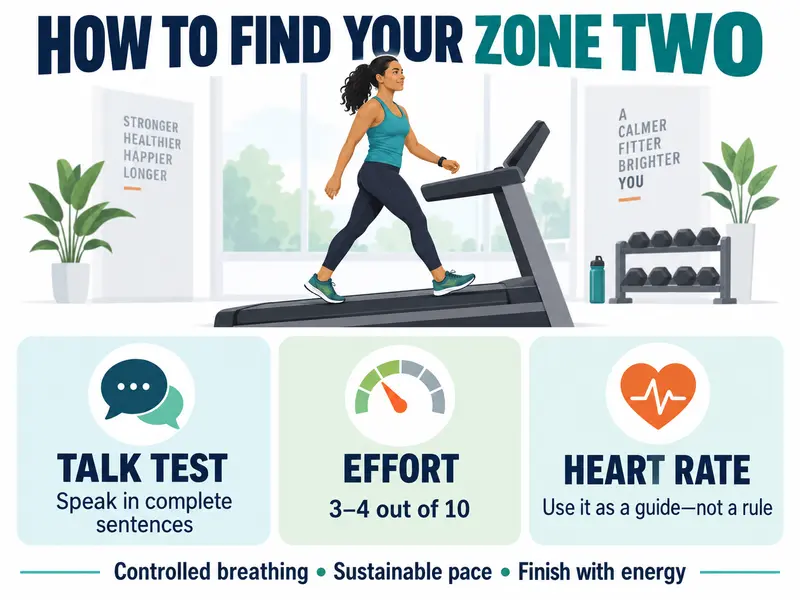
Instead, combine heart rate with the talk test and perceived exertion.
Use Heart Rate as a Starting Point
In a common five-zone model, zone two is approximately 60% to 70% of maximum heart rate.
Someone with a measured maximum heart rate of 180 beats per minute might therefore begin around 108 to 126 beats per minute.
This calculation is only an estimate.
Age-based maximum heart rate formulas can be inaccurate for individuals, while temperature, dehydration, altitude, caffeine, medication, stress, and poor sleep can all alter your heart rate on a given day.
A chest-strap monitor normally responds more reliably than a wrist-based optical sensor, especially while running or performing activities involving substantial arm movement.
Nevertheless, even accurate heart-rate data must be interpreted within the correct training-zone model.
Use the Talk Test
The talk test is one of the simplest ways to regulate aerobic exercise intensity.
Research indicates that the point at which speaking becomes uncomfortable tends to occur near the ventilatory threshold, making conversation a useful real-world intensity check (Reed & Pipe, 2014).
During zone two training, you should be able to speak in complete sentences.
Conversation should require some effort, but you should not need to pause every few words to catch your breath.
Monitor Perceived Exertion
Aim for approximately 3 to 4 out of 10 on a perceived-exertion scale.
You should feel like you are exercising, but you shouldn’t be counting the minutes until the session ends.
Your pace may change from one day to another even when the effort remains the same.
Slowing down during heat, after poor sleep, or during a stressful training week is good autoregulation, not a failed workout.
Best Zone Two Training Exercises
Nearly any rhythmic exercise can become zone two training if it elevates your heart rate while allowing you to maintain a controlled effort.
The best option is one that you can perform consistently without irritating your joints or compromising other training.
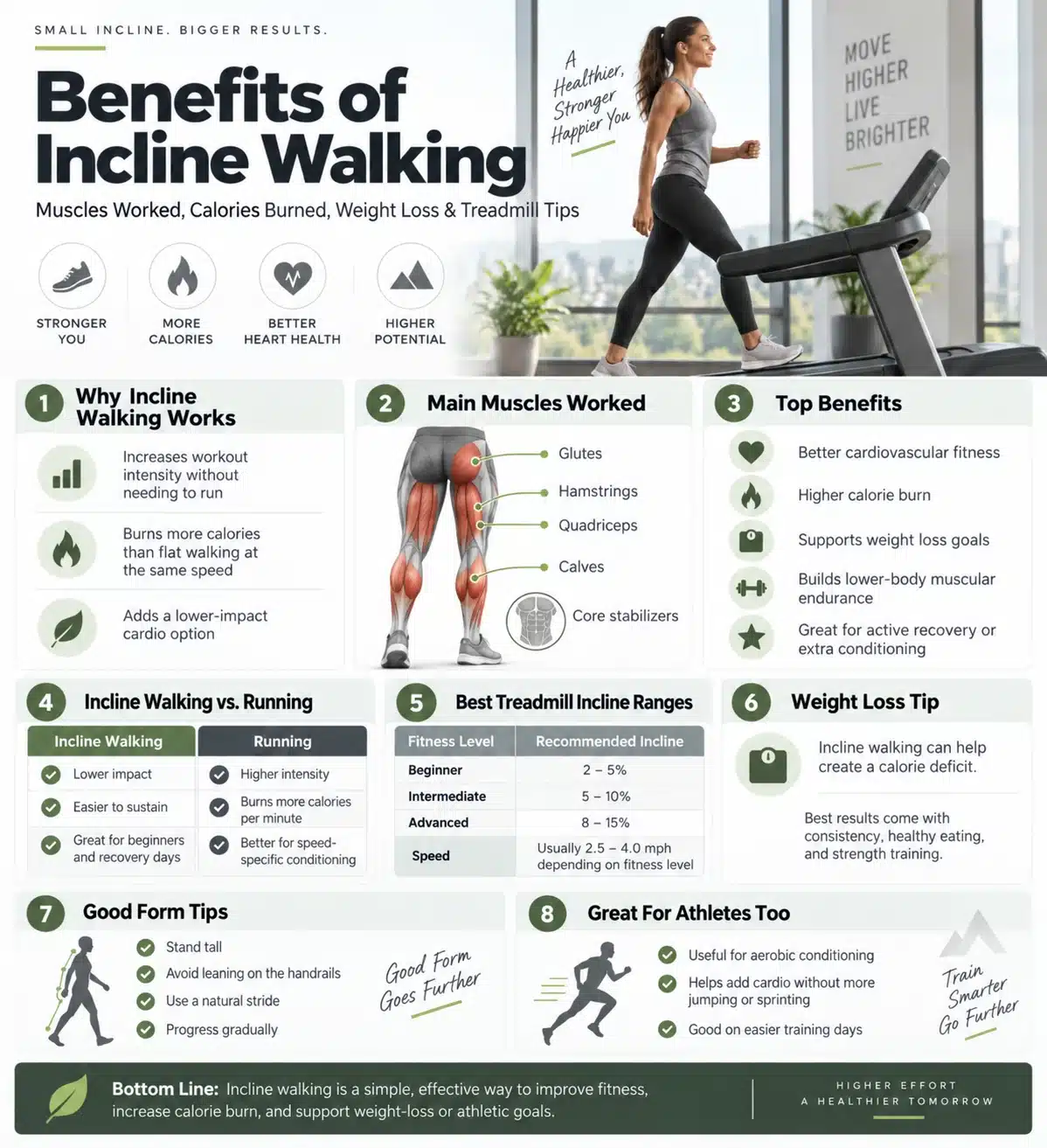
Incline Treadmill Walking
Incline walking is one of the most accessible zone two options because it increases cardiovascular demand without requiring you to run.
Adjust the speed and incline until your breathing is noticeably elevated but still controlled.
Walking also creates less impact than running, which may make it easier to combine with basketball, lower-body lifting, or a return from injury.
Easy Running
Trained runners may need to jog to reach zone two.
However, beginners often run too fast, turning easy aerobic sessions into threshold workouts.
Slowing down, using brief walking intervals, or selecting a flatter route can help keep the effort appropriate.
If running is uncomfortable or difficult to recover from, consider one of these cardio alternatives to running.
Cycling
Indoor or outdoor cycling makes it easy to regulate resistance while minimizing impact.
It is particularly useful for athletes and lifters who want aerobic work without adding substantial landing stress to their legs.
Keep your cadence comfortable and avoid turning every hill or increase in resistance into an interval.
The session should remain smooth rather than becoming a series of surges.
Elliptical Training
An elliptical machine can provide a full-body aerobic workout with less impact than running.
It is also easy to adjust resistance without dramatically changing your movement pattern.
Avoid leaning heavily on the handles or using more resistance than you can control.
Your goal is a repeatable aerobic effort, not the highest calorie number displayed by the machine.
Rowing
Rowing can produce an effective zone two workout, but technique matters.
Poor rowing mechanics may fatigue your lower back or arms before your cardiovascular system receives enough work.
Use moderate resistance and a controlled stroke rate.
If your grip or back becomes the limiting factor, cycling or incline walking may be a better starting option.
Swimming
Swimming provides low-impact aerobic exercise and can work well for people whose joints do not tolerate repetitive running.
The main limitation is that an inefficient technique can make swimming feel anaerobic before the cardiovascular benefits become the primary challenge.
Use relaxed strokes, controlled breathing, and short rests when necessary.
As your technique improves, maintaining a continuous zone two effort should become easier.
Rebounding
A mini-trampoline can provide a low-impact alternative for people who find traditional cardio monotonous.
My guide to the benefits of rebounding explains how it compares with other cardio workouts.
Keep the bounce controlled and rhythmic.
More aggressive jumping can quickly turn the session into higher-intensity conditioning.
How Long Should a Zone Two Workout Be?
Beginners can start with two or three 20-to-30-minute sessions per week.
The immediate goal is to develop a repeatable routine without creating soreness or excessive fatigue.
If you already exercise consistently, aim for two to four sessions totaling approximately 90 to 180 minutes per week.
Endurance athletes may perform much more, but the appropriate amount depends on their sport, training history, schedule, and ability to recover.
Public-health guidelines recommend at least 150 minutes of moderate-intensity aerobic activity per week for most adults, with additional benefits available at higher activity levels (World Health Organization, 2024).
Not every minute must technically qualify as zone two, but these guidelines provide a useful context for total weekly aerobic activity.
Sample Zone Two Training Plan for Beginners
| Day | Training |
|---|---|
| Monday | Strength training |
| Tuesday | 25-minute incline walk |
| Wednesday | Rest or mobility |
| Thursday | Strength training plus 20 minutes of easy cycling |
| Friday | Rest |
| Saturday | 35-minute walk, bike ride, or elliptical session |
| Sunday | Optional recreational activity |
After two or three comfortable weeks, add five to 10 minutes to one or two sessions. Increase duration before trying to increase speed, because faster is not necessarily better for this type of training.
Sample Zone-2 Training Plan for Athletes and Regular Lifters
| Day | Training |
|---|---|
| Monday | Lower-body strength or demanding practice |
| Tuesday | 30–40 minutes of low-impact zone two |
| Wednesday | Upper-body strength |
| Thursday | Intervals, speed work, or sport practice |
| Friday | 30 minutes of easy zone two |
| Saturday | 45–60 minutes of zone two |
| Sunday | Rest or light recovery activity |
This structure is only an example.
Your zone two volume should support the work that matters most rather than making your primary strength, speed, or sport sessions worse.
How to Combine Zone Two Training With Strength Workouts
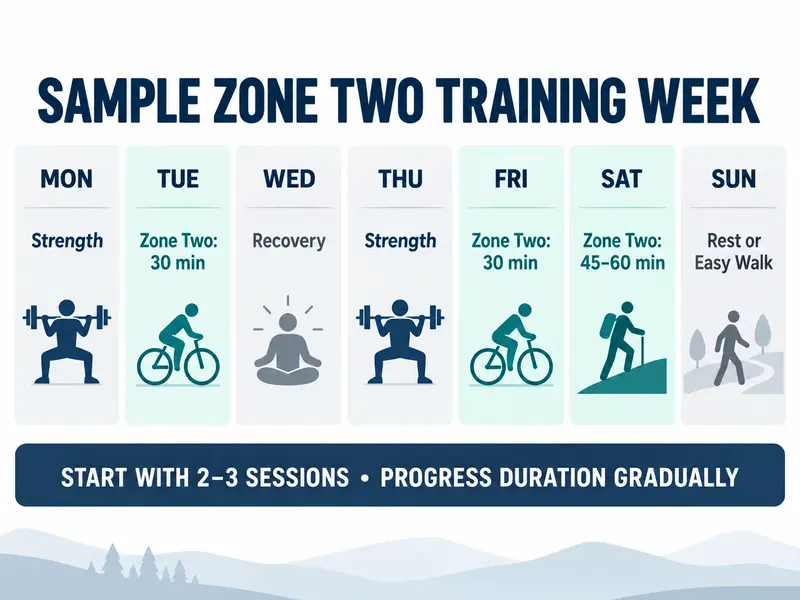
Zone two and strength training can coexist successfully when you manage exercise selection, volume, and timing.
Low-impact options such as cycling, walking, and elliptical training are often easier to recover from than additional running.
You can perform zone two:
- After an upper-body workout
- Following a short full-body strength session
- On a separate low-intensity day
- Several hours before or after strength training
- After practice when consolidating training stress
If maintaining strength and muscle is your priority, protect the quality of your lifting sessions.
Avoid a long or unusually demanding lower-body cardio workout immediately before heavy squats, deadlifts, jumps, or sprints.
The same principle applies to sports training.
If Tuesday is a demanding speed or conditioning day, Monday and Wednesday should not become secretly difficult cardio sessions.
Zone Two Training vs. HIIT
Zone two training uses a sustained, controlled effort, while high-intensity interval training alternates brief, difficult efforts with recovery periods.
Both can improve cardiovascular fitness, but they create different levels of fatigue and prepare you for different demands.
| Zone Two Training | HIIT |
|---|---|
| Controlled and sustainable | Difficult and intermittent |
| Primarily develops aerobic capacity | Strongly challenges high-end aerobic and anaerobic capacity |
| Lower recovery cost | Higher recovery cost |
| Usually lasts 30–90 minutes | Often completed in 10–30 minutes |
| Can be performed more frequently | Usually requires more recovery |
| Supports training volume | Develops tolerance for intense efforts |
Zone two should not completely replace intervals if your goals include sprinting, race performance, or repeated explosive efforts.
Conversely, HIIT should not replace all easier aerobic work simply because it feels more productive.
A balanced plan uses low-intensity work to build capacity and high-intensity sessions to develop qualities that cannot be trained at an easy pace.
Zone Two Training for Weight Loss
Zone two can support weight loss by increasing weekly energy expenditure without creating the recovery demands of daily high-intensity exercise.
It may also be easier to sustain consistently than cardio that leaves you exhausted or unusually hungry.
However, there is nothing metabolically magical about exercising in a “fat-burning zone.”
Fat loss still depends primarily on maintaining an appropriate calorie deficit over time while consuming enough protein and performing resistance training to help preserve lean mass.
You also don’t need to do zone two before breakfast.
My analysis of fasted cardio for fat loss explains why exercising without eating first may suit some schedules but does not appear inherently superior for long-term fat loss.
Common Zone Two Training Mistakes
Going Too Fast
The most common mistake is allowing an easy workout to become moderately hard.
People get bored, increase the speed, and spend most of the session working too hard to recover easily, but not hard enough to obtain the specific stimulus of a well-designed interval workout.
Control the session from the beginning.
If your heart rate and breathing gradually rise, slow down rather than trying to maintain an arbitrary pace.
Relying Only on a Fitness Watch
Wearable technology can be useful, but its zones may be calculated from an estimated maximum heart rate.
That creates the appearance of precision without necessarily identifying your actual physiological thresholds.
Use the watch as one source of information.
Compare its data with your breathing, perceived exertion, pace, and ability to maintain a conversation.
Turning Zone Two Into Recovery From Every Problem
Zone two is relatively manageable, but it is still training.
Adding several hours of cardio to an already demanding schedule can create fatigue, especially if you are under-eating, sleeping poorly, or returning from injury.
Start with a dose that fits your current capacity. More volume is only helpful when you can adapt to it.
Choosing the Wrong Exercise
Running is not mandatory.
If your knees, Achilles tendons, feet, or lower back become irritated, use cycling, incline walking, swimming, rebounding, or an elliptical machine.
Higher-impact options such as running hills or stairs can be valuable for power and conditioning, but they are usually better treated as harder workouts than steady zone two sessions.
Ignoring Hydration and Nutrition
Longer zone two sessions still require adequate hydration and energy availability.
Most workouts under an hour do not require specialized fuel, but athletes training for longer periods may benefit from carbohydrates, fluids, and electrolytes, depending on the environment and total workload.
Eating enough total calories and getting adequate protein will also help you recover when you combine zone two with strength training or sport practice.
Who Should Be Careful With Zone Two Training?
Most healthy adults can begin with controlled walking or another low-impact activity.
However, you should speak with a qualified medical professional before beginning or substantially progressing an exercise program if you have cardiovascular disease, uncontrolled high blood pressure, significant diabetes complications, or another condition that affects exercise tolerance.
Stop exercising and seek appropriate medical care if you experience chest pain, fainting, unusual dizziness, heart palpitations, or shortness of breath that is disproportionate to the effort.
Zone two should feel controlled, not medically distressing.
Frequently Asked Questions About Zone-2 Training
Final Thoughts: Is Zone Two Training Worth Doing?
Zone two training is valuable because it builds fitness you can repeatedly use, not because it makes every workout feel impressive.
It develops the aerobic foundation that helps you sustain activity, recover between harder efforts, and tolerate a more complete training program.
The key is discipline.
Keep easy days genuinely easy, use harder training when intensity serves a clear purpose, and gradually build enough aerobic work to drive adaptation without overwhelming your recovery.
For most people, two or three weekly sessions of walking, cycling, easy running, swimming, rowing, or elliptical training provide a practical starting point.
The best zone two workout is the one you can recover from, repeat, and gradually improve for months.
This website does not provide medical advice. This website site does contain affiliate links, and purchases may earn a commission.
Read my Medical Disclaimer, Review Disclaimer, and Publishing Policies for more details. Use of this site indicates acceptance of these terms.
Check Out Some of My YouTube Videos Below, and Please Follow on YouTube for More Educational Health and Fitness Content!
![Subscribe to @AdamKempFitness for more training, general health, recovery, and nutrition tips from a professional basketball player with a master’s degree in Nutrition Education! 🏀💪
Seated Max Vertical Jumps From a Box are one way I train explosive takeoff power with maximum intent on every rep.
Starting seated, with a pause and minimal rocking or dipping, reduces the contribution of a quick countermovement and emphasizes producing force from a relatively static position (National Strength and Conditioning Association [NSCA], 2020).
For athletes, the training goal is explosive lower-body force production and coordinated extension through the hips, knees, and ankles. I use this variation to practice driving hard into the floor and accelerating my body upward.
My preferred setup: 3 sets of 3 reps or 4 sets of 2 reps, supersetted with a strength or power exercise.
I keep the reps low, reset between jumps, and take longer rest periods so I’m ready to attack every takeoff. Even when pairing exercises, I give myself enough recovery to keep the jumps sharp.
Every rep has one goal: jump as high as possible. I focus on an explosive takeoff, a controlled landing, and consistent quality throughout the session.
Save this for your next power workout! 🚀
Reference: NSCA. (2020). Stretch-shortening cycle.
#VerticalJump #JumpTraining #ExplosivePower #AthleticPerformance #BasketballTraining](https://www.adamkempfitness.com/wp-content/plugins/feeds-for-youtube/img/placeholder.png)