A Pro’s Basketball Training Guide to Actually Getting Better
 Reading Time: 19 minutes
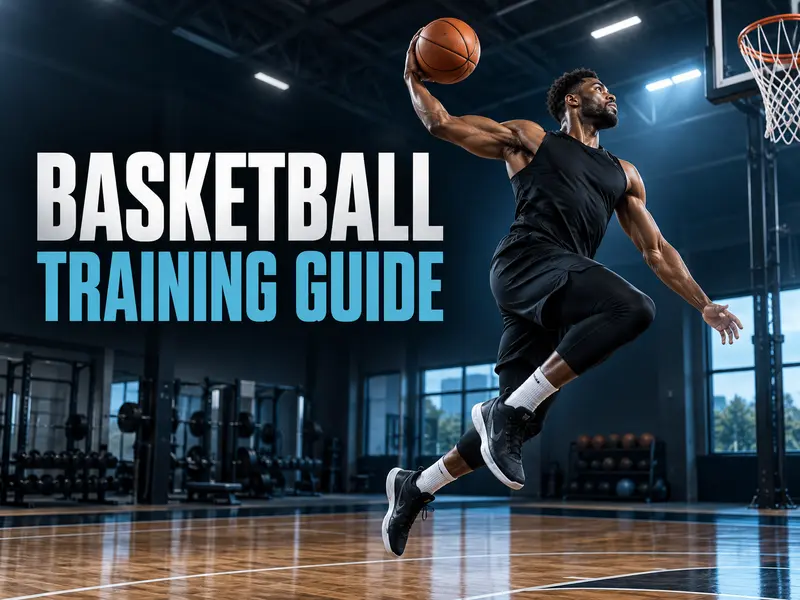
 Effective basketball training is not about collecting difficult drills or leaving every workout exhausted.
In effective basketball training programs, the primary objectives are to improve the physical, technical, and mental qualities that help you perform better in a game that is fast, physical, and unpredictable.
Basketball requires players to accelerate, decelerate, jump, land, change direction, absorb contact, execute skills, and make decisions under fatigue.
A productive training program must prepare you for all of those demands without creating more fatigue than your body can recover from.
I have played professional basketball internationally for more than a decade, but I did not always understand how to train efficiently.
Early in my career, I often assumed that doing more work would automatically produce better results.
Experience gradually taught me that the hardest workout is not always the most effective one.
My best seasons generally occurred when every part of my training had a clear purpose, and I recovered well enough to repeat high-quality work throughout the week.
This basketball training guide explains how to develop strength, power, speed, agility, conditioning, skills, mobility, and durability without wasting energy on random exercises.
Whether you are a youth player, competitive adult, or aspiring professional, the goal is to help you identify what you actually need and train it consistently.
Want to see how I train? Subscribe to my YouTube channel for basketball workouts, strength exercises, plyometrics, mobility routines, and lessons from my professional career.
Basketball Training Quick-Start Guide
You do not need to improve everything simultaneously. Start by identifying the quality that currently limits your performance most.
| If you need to improve… | Start here |
|---|---|
| Total-body basketball strength | Best exercises for basketball players |
| Jumping ability and explosiveness | How to increase your vertical jump |
| Game-ready stamina | Basketball conditioning guide |
| Speed and acceleration | Sprint workouts |
| Elasticity and reactive power | Plyometric exercises |
| Movement efficiency | Movement quality guide |
| Recovery between games and practices | Basketball recovery routine |
| Nutrition and hydration | Sports nutrition basics |
| A career in competitive sports | How to become a professional athlete |
What Effective Basketball Training Actually Means
Effective basketball training improves qualities that transfer to competition.
A drill may look impressive, feel difficult, or receive attention on social media without making you meaningfully stronger, faster, more skilled, or better conditioned.
However, complexity and fatigue are not reliable measurements of training quality.
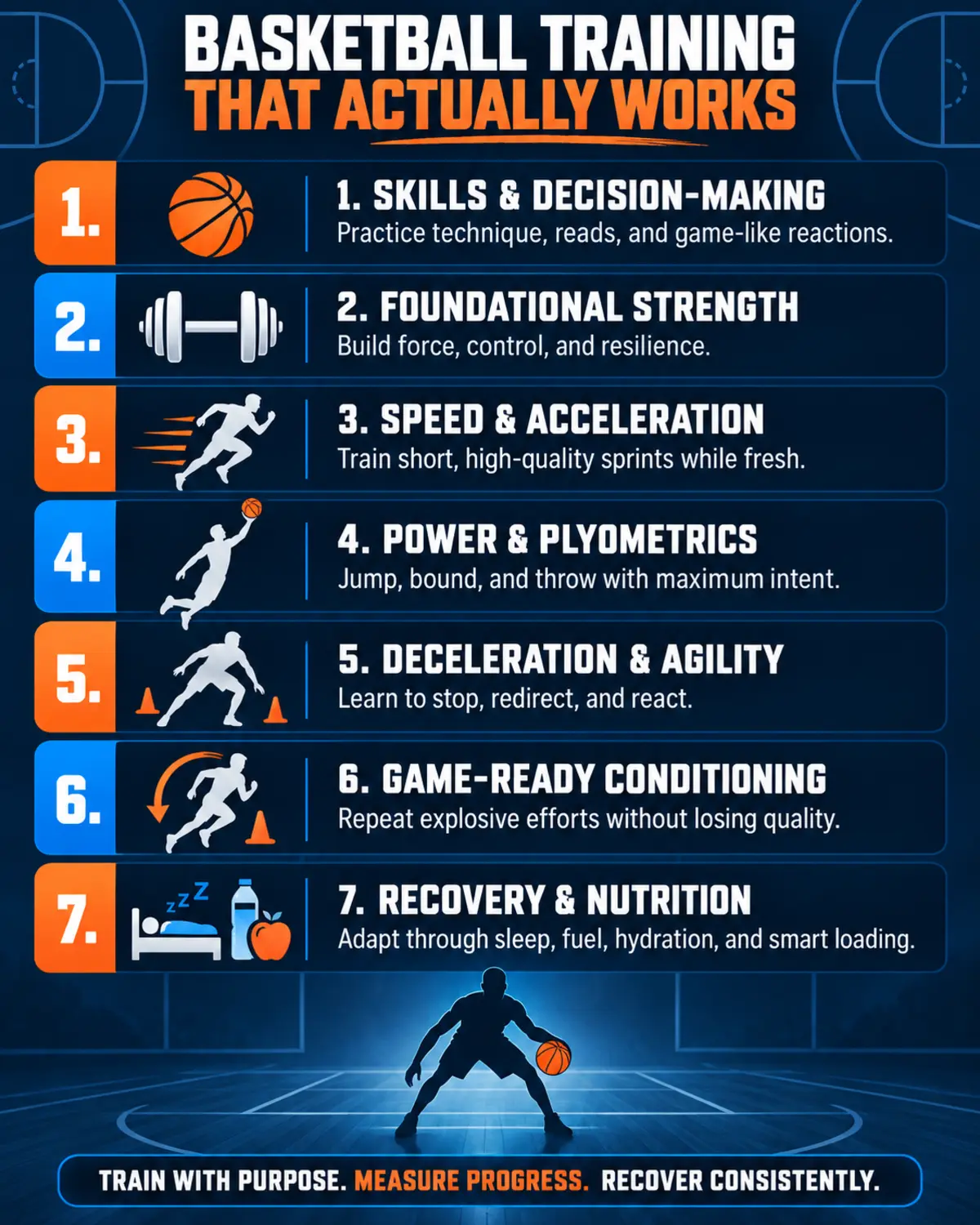
A well-designed basketball training program should address:
- Basketball skills and decision-making
- Strength
- Explosive power
- Speed and acceleration
- Deceleration
- Change-of-direction ability
- Basketball-specific conditioning
- Mobility and movement quality
- Recovery and load management
- Nutrition and hydration
Each workout should have a primary objective.
Before adding an exercise or drill, ask what quality it should improve and whether there is a simpler or more direct way to achieve that adaptation.
The Basketball Training Hierarchy
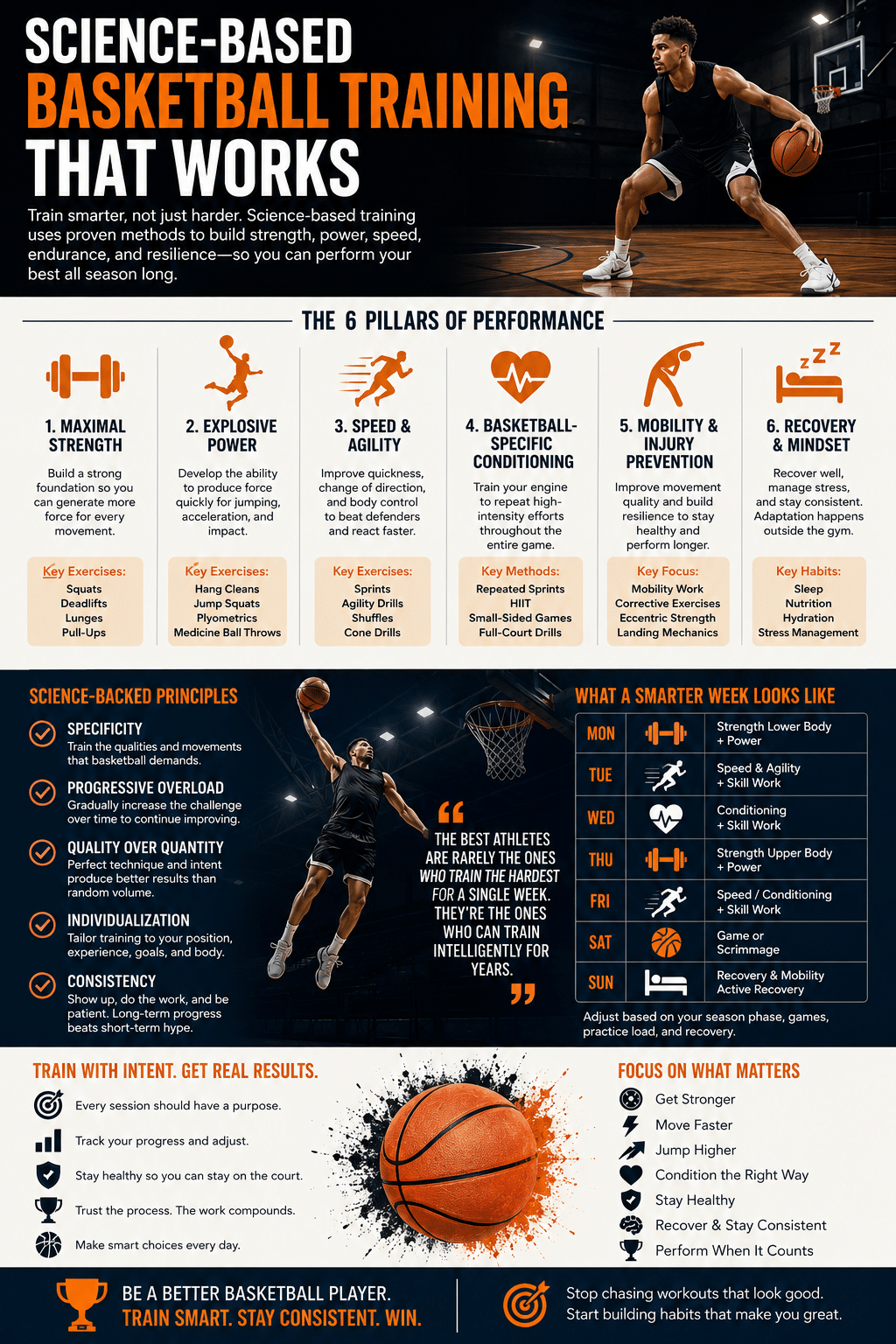
Not every part of basketball training deserves equal attention at every stage of development.
A younger or less experienced player generally needs broad skill development, fundamental strength, coordination, and exposure to different movement patterns.
An advanced athlete may need more targeted work based on position, playing style, testing data, injury history, and competitive schedule.
The following hierarchy provides a useful starting point:
- Basketball skills and decision-making
- General movement competency
- Foundational strength
- Speed and power
- Basketball-specific conditioning
- Individualized mobility and durability work
- Recovery, nutrition, and load management
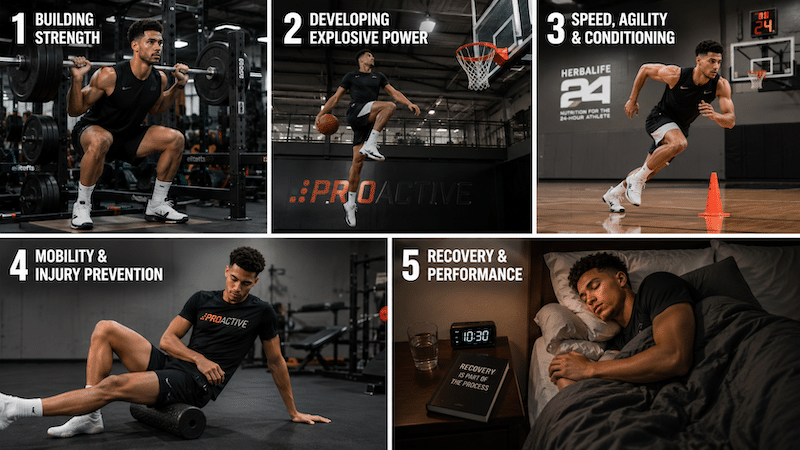
The order does not mean conditioning or recovery are unimportant; it means that advanced methods cannot compensate for weak fundamentals.
Why Basketball Skill Training Must Remain the Priority
Physical preparation can expand what you are capable of doing, but it cannot replace basketball skill.
A stronger and faster athlete still needs to shoot, pass, dribble, finish, defend, rebound, communicate, and make good decisions.
Skill training should therefore occupy a significant portion of a basketball player’s overall development.
The most productive skill work has a clear objective.
Instead of taking hundreds of unfocused shots, organize sessions around specific situations such as footwork into a shot, finishing from a particular angle, reading a ball screen, or maintaining technique under controlled fatigue.
Begin with lower-variability repetitions when learning or refining a movement.
Once the technique becomes more stable, add defenders, time pressure, decision-making, contact, and game-like constraints.
This progression connects technical improvement with the perception and decision-making demands of competition.
Important: A move you can perform alone does not automatically become a move you can recognize and execute against a defender.
Train Skills While Fresh and Under Fatigue
Most skill development should occur while you are fresh enough to maintain precision.
However, some practice should deliberately expose skills to realistic fatigue.
Basketball games require you to shoot, pass, defend, and make decisions after repeated sprints and physical contact.
The key is controlling the amount of fatigue.
If every repetition becomes technically poor, the session is no longer preparing you to perform well when tired; it is repeatedly practicing mistakes.
Strength Training Is the Physical Foundation
Strength influences nearly every physical component of basketball.
It helps you produce force into the floor, maintain position, absorb contact, control landings, decelerate, and tolerate the repeated demands of a long season. It also creates the foundation from which speed and power can develop.
Research supports using structured physical training to improve basketball-related fitness and performance rather than relying exclusively on court work (Cao et al., 2024).
Many players remain concerned that lifting weights will make them slow or excessively bulky. In practice, poorly designed training can create unnecessary fatigue, but intelligently programmed strength work usually makes players more physically capable.
The objective is not to train like a competitive bodybuilder or powerlifter. It is to build enough usable strength to improve basketball performance.
Best Strength Exercises for Basketball Players

There is no single mandatory exercise, but an effective program usually contains the following patterns:
- Squat
- Hinge
- Split stance or lunge
- Step-up
- Upper-body push
- Upper-body pull
- Carry
- Anti-extension and anti-rotation core work
- Calf and ankle strengthening
- Hamstring and adductor strengthening
Squats, trap-bar deadlifts, Romanian deadlifts, split squats, lunges, hip thrusts, presses, rows, pull-ups, and loaded carries can all be productive when they match the athlete’s experience and anatomy.
Step-ups are especially useful because they develop unilateral leg strength in a relatively simple movement.
They can also be adjusted easily by changing the box height, load, tempo, or range of motion.
My guide to the best exercises for basketball players explains which movements have been most valuable throughout my professional career.
How Heavy Should Basketball Players Lift?
Basketball players can benefit from both heavier and moderate-load strength training.
Heavier training develops maximal force, while moderate loads allow athletes to accumulate useful volume with less joint and neurological stress. The right balance depends on the training phase, exercise, experience level, and proximity to games.
You do not need to test maximum lifts frequently. Most basketball players are better served by building strength through high-quality repetitions while leaving a small amount of capacity in reserve.
Strength Training Advice for Basketball Players From My Experience
Strength training has made nearly every part of basketball easier for me.
As I became stronger, I could finish through contact, defend physical players, hold rebounding position, and tolerate the demands of the season more effectively.
That strength is valuable because it supports basketball performance rather than becoming an isolated goal.
Power Training Turns Strength Into Athletic Performance
Strength describes how much force you can produce.
Power reflects how quickly you can express that force.
Basketball rewards rapid force production because the most important movements happen quickly.
Jumping for a rebound, accelerating into open space, contesting a shot, or changing direction does not give you several seconds to develop force.
Power training can include:
- Plyometric jumps
- Loaded jumps
- Medicine-ball throws
- Olympic-lift variations
- Short sprints
- Bounds and hops
- Explosive push-ups
- Ballistic resistance exercises
Research indicates that resistance and plyometric training can improve jumping performance in basketball players, and that combined approaches may be particularly useful when programmed appropriately (Luo et al., 2025).
Benefits of Olympic-Lift Variations
Olympic-lift variations can help athletes develop rapid triple extension through the ankles, knees, and hips.
I have used hang cleans throughout my career because they combine total-body coordination with explosive force production.
However, they require sufficient coaching and technical competency.
Basketball players do not need to perform Olympic lifts if the technical demands outweigh the benefit, but especially if you have the chance to work with a personal trainer or sports performance coach, learning the Olypic lifts can produce significant benefits for you as an athlets.
Loaded jumps, trap-bar jumps, kettlebell swings, and medicine-ball throws can provide simpler power-training alternatives.
Train Power Before Fatigue
Explosive exercises should generally be performed early in a workout when you are physically and mentally fresh.
Once jump height, speed, landing quality, or coordination decreases noticeably, the session is creating more fatigue than useful power output.
Power training depends on quality rather than exhaustion.
I suggest you use relatively low repetitions and sufficient rest between sets.
Every repetition should look intentional and athletic.
Plyometric Training for Basketball
Plyometric exercises help develop the stretch-shortening cycle, which allows muscles and tendons to absorb and release energy rapidly.
This ability contributes to jumping, sprinting, changing direction, and reacting quickly after landing.
Research has found that plyometric training can improve jumping, sprinting, change-of-direction performance, and balance in basketball players (Ramirez-Campillo et al., 2020).
Useful plyometric categories include:
- Pogo hops
- Countermovement jumps
- Broad jumps
- Bounds
- Lateral jumps
- Depth landings
- Drop jumps
- Repeated jumps
- Single-leg jumps
- Approach jumps
A complete program should not include all of these at once; select exercises based on the quality you need to improve.
Landing and Braking Come Before Advanced Jumping
Players often focus entirely on jumping higher while overlooking their ability to land and stop safely.
Deceleration training teaches you to absorb force, control your center of mass, and maintain useful joint positions.
These qualities matter during defensive closeouts, drives, transition play, and nearly every contested landing.
Before adding high volumes of depth jumps or repeated maximal jumps, develop control through snap-downs, low-level landing drills, controlled lateral bounds, and gradual deceleration progressions.
Account for Total Jump Volume
Basketball players already jump frequently during skills sessions, practices, and games.
Additional plyometrics should be counted as part of your total workload rather than treated as harmless preparation.
More jumping is not automatically better, especially during a crowded competitive schedule.
Use lower plyometric volumes during the season and prioritize exercises that address a specific need.
A few excellent jumps are more valuable than a long circuit of progressively slower repetitions.
How to Increase Your Vertical Jump
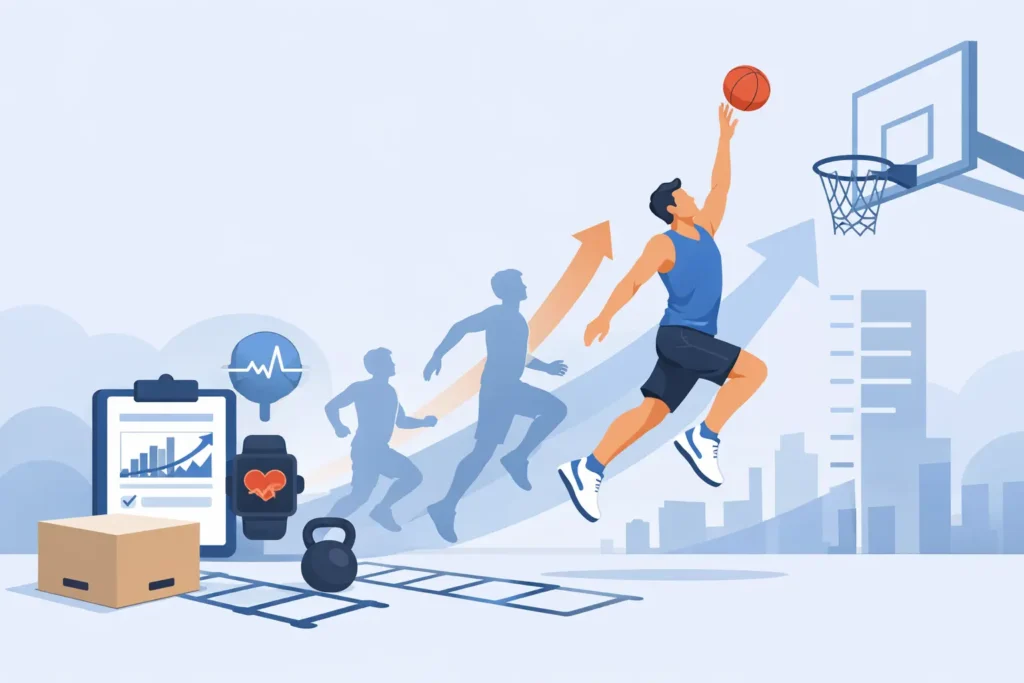
Improving your vertical jump requires more than repeatedly attempting to jump as high as possible.
Your results depend on strength relative to body weight, rate of force development, coordination, tendon qualities, mobility, jumping technique, and the ability to tolerate consistent training.
My complete guide on how to increase your vertical jump explains how strength training, plyometrics, loaded jumps, body composition, and recovery fit together.
A productive vertical-jump program usually combines:
- Foundational lower-body strength
- Maximal or near-maximal jumps
- Low-level reactive plyometrics
- Loaded power exercises
- Sprinting
- Landing practice
- Adequate recovery
Avoid changing your program every week.
Vertical-jump development requires enough consistency for your body to adapt and enough measurement to determine whether the training is working.
Speed and Acceleration Training
Basketball speed is primarily expressed through short accelerations rather than maximum-velocity sprinting over long distances.
Players frequently sprint between approximately 5 and 20 meters before stopping, changing direction, or transitioning into another movement.
This makes acceleration mechanics and horizontal force production especially important.
Effective speed training can include:
- Wall acceleration drills
- Falling starts
- Two-point and three-point starts
- Resisted sprints
- Hill sprints
- Short unresisted sprints
- Lateral-to-linear transitions
- Crossover-step accelerations
- Closeout-to-sprint combinations
My sprint workouts guide provides additional methods for improving acceleration, speed, and conditioning.
Speed Training Requires Full Recovery
Speed work should not feel like traditional conditioning.
If each sprint becomes substantially slower, you are no longer training maximal speed.
You are training the ability to sprint while fatigued.
Both qualities matter, but they should not be confused.
Use longer rest periods when developing speed and shorter recovery periods when targeting repeated-sprint conditioning.
Agility, Change of Direction, and Deceleration
Change-of-direction training and agility are related but different.
Change of direction involves a planned movement, such as running through a predetermined cone drill.
Agility requires reacting to an opponent, ball, visual cue, or changing environment.
Planned drills are useful for teaching:
- Foot placement
- Body position
- Braking angles
- Crossover steps
- Lateral pushes
- Reacceleration mechanics
Reactive drills are necessary for transferring those physical qualities into basketball.
A player can become excellent at memorized cone patterns without becoming better at staying in front of an opponent.
Once movement technique is established, include partner drills, small-sided games, mirror drills, and decision-based exercises.
Train Deceleration Deliberately
Acceleration gets more attention, but basketball players must decelerate before most changes of direction.
Poor braking ability can waste time, reduce defensive control, and increase stress on the knees and ankles.
Eccentric strength, single-leg control, trunk positioning, and progressive stopping drills all contribute to better deceleration.
Lateral bounds, drop lunges, snap-downs, controlled closeouts, and short sprint-to-stop drills can help athletes learn to accept force without losing position.
Basketball-Specific Conditioning
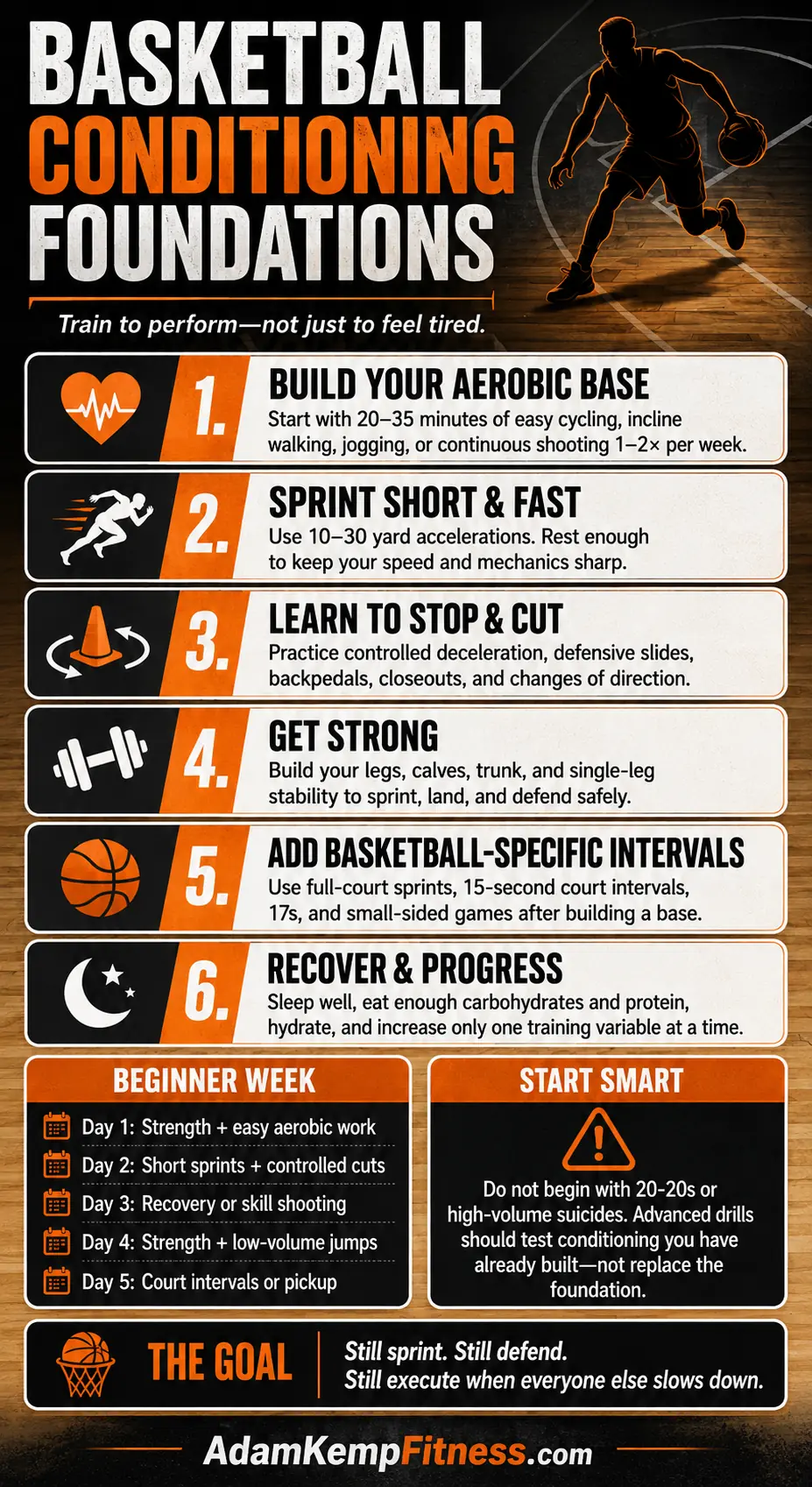
Basketball conditioning should prepare you to repeat explosive efforts while recovering during brief periods of lower-intensity movement.
Because basketball is intermittent rather than continuous, players must be prepared to repeatedly transition between sprinting, shuffling, jumping, jogging, walking, and stopping.
High-intensity interval training and repeated-sprint methods can improve several basketball-relevant fitness qualities when used appropriately (Cao et al., 2025).
Useful conditioning methods include:
- Repeated short sprints
- Tempo runs
- Shuttle runs
- Full-court transition drills
- Small-sided games
- EMOM sprint sessions
- Bike or rowing intervals
- Court circuits with controlled work-to-rest ratios
Does Long-Distance Running Help Basketball Players?
Steady aerobic training can improve general fitness and support recovery between high-intensity efforts.
However, long-distance running should not dominate a basketball player’s conditioning plan because it does not reproduce the sport’s movement patterns, force demands, or repeated accelerations and decelerations.
Low-impact aerobic work on a bike, elliptical, rowing machine, or in a pool can build aerobic capacity while reducing additional pounding.
This can be especially useful during rehabilitation, high-volume training periods, or active recovery days.
The problem is not aerobic training itself.
The problem is using so much slow, repetitive conditioning that it reduces the quality of strength, power, speed, or basketball work.
Mobility and Movement Quality
Basketball demands usable motion through the ankles, hips, thoracic spine, and shoulders.
Mobility should not be viewed as a contest to become as flexible as possible. The goal is to access and control the ranges of motion needed for basketball.
My guide to movement quality explains how mobility, stability, coordination, and strength work together.
Common areas to address include:
- Ankle dorsiflexion
- Hip rotation
- Hip extension
- Adductor mobility
- Thoracic rotation
- Shoulder movement
- Foot and ankle control
- Landing positions
Mobility work should be individualized.
Stretching an area that already has sufficient range of motion will not necessarily improve performance, especially when the actual limitation is strength or motor control.
Build Strength Through Your Available Range
Mobility improvements become more useful when you develop strength and control in the new range.
Slow eccentrics, pauses, isometrics, loaded mobility exercises, and controlled full-range strength movements can help turn temporary flexibility into movement you can use on the court.
Basketball Injury-Reduction Training
No training program can prevent every injury.
Basketball includes contact, unpredictable landings, collisions, fatigue, and rapid changes of direction.
However, effective basketball training can improve your capacity to tolerate these demands.
A well-rounded durability program should consider:
- Progressive strength training
- Landing mechanics
- Deceleration ability
- Calf and soleus strength
- Hamstring strength
- Adductor strength
- Single-leg control
- Appropriate jump and sprint progressions
- Workload management
- Recovery between demanding sessions
Exercise-based injury-prevention programs can reduce and prevent sports injuries, with strength training demonstrating particularly meaningful protective effects in systematic research (Lauersen et al., 2014).
Do not use “prehab” exercises as an excuse to avoid meaningful strength development.
Small band exercises can be useful, but they should complement, not replace, progressively loaded movements.
Recovery Is Part of Basketball Training
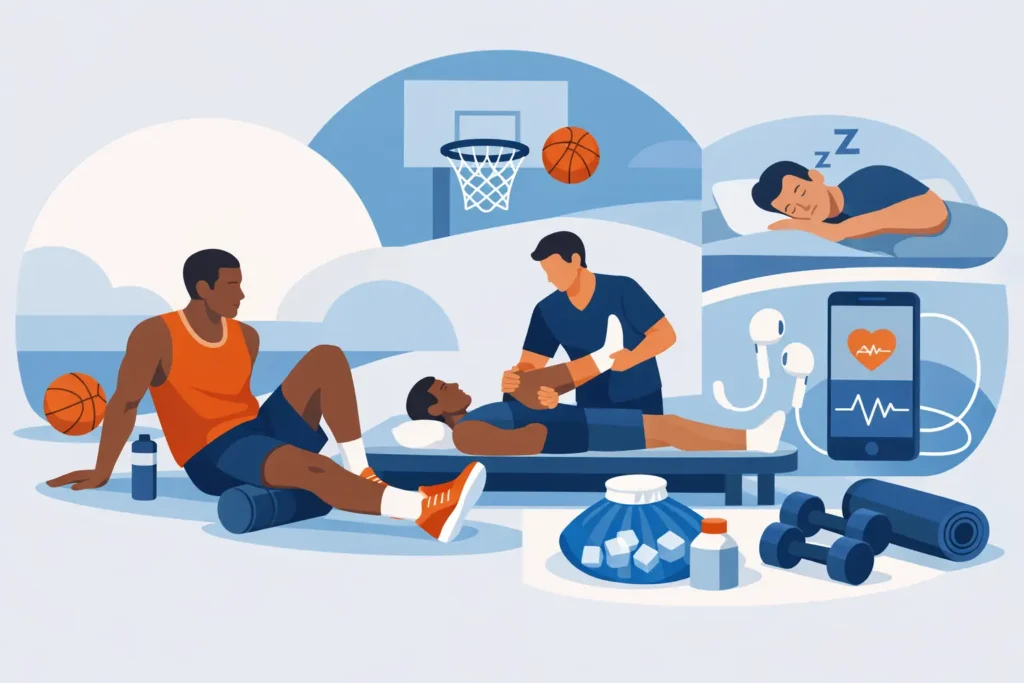
You do not adapt during the hardest moment of a workout.
Adaptation occurs afterward when the body has sufficient time and resources to respond.
A complete basketball recovery routine should account for sleep, nutrition, hydration, psychological stress, travel, soreness, injury history, and the amount of training you completed.
Recovery needs are individual and change throughout the season.
The same player may tolerate four demanding training sessions during the offseason but struggle with two additional workouts during a week containing three games.
The balance between training stress and recovery is essential for maintaining performance and avoiding prolonged maladaptation (Kellmann et al., 2018).
Muscle Recovery Tools
Massage guns, foam rollers, compression boots, and other devices may reduce stiffness or improve perceived recovery, but they cannot replace rest and appropriate programming.
My guide to the best muscle recovery tools explains which products I have found useful throughout my professional career.
Use recovery technology to make a good plan more comfortable.
Do not use it to repeatedly suppress warning signs while continuing to overload an injured area.
Basketball Nutrition and Hydration
Training creates the stimulus for adaptation, but nutrition supplies the energy and raw materials needed to support it.
Basketball players need sufficient total energy, carbohydrates, protein, dietary fat, fluids, electrolytes, vitamins, and minerals.
The exact amounts depend on body size, training volume, environment, schedule, and goals.
My sports nutrition basics guide explains how to build a performance-focused diet without making nutrition unnecessarily complicated.
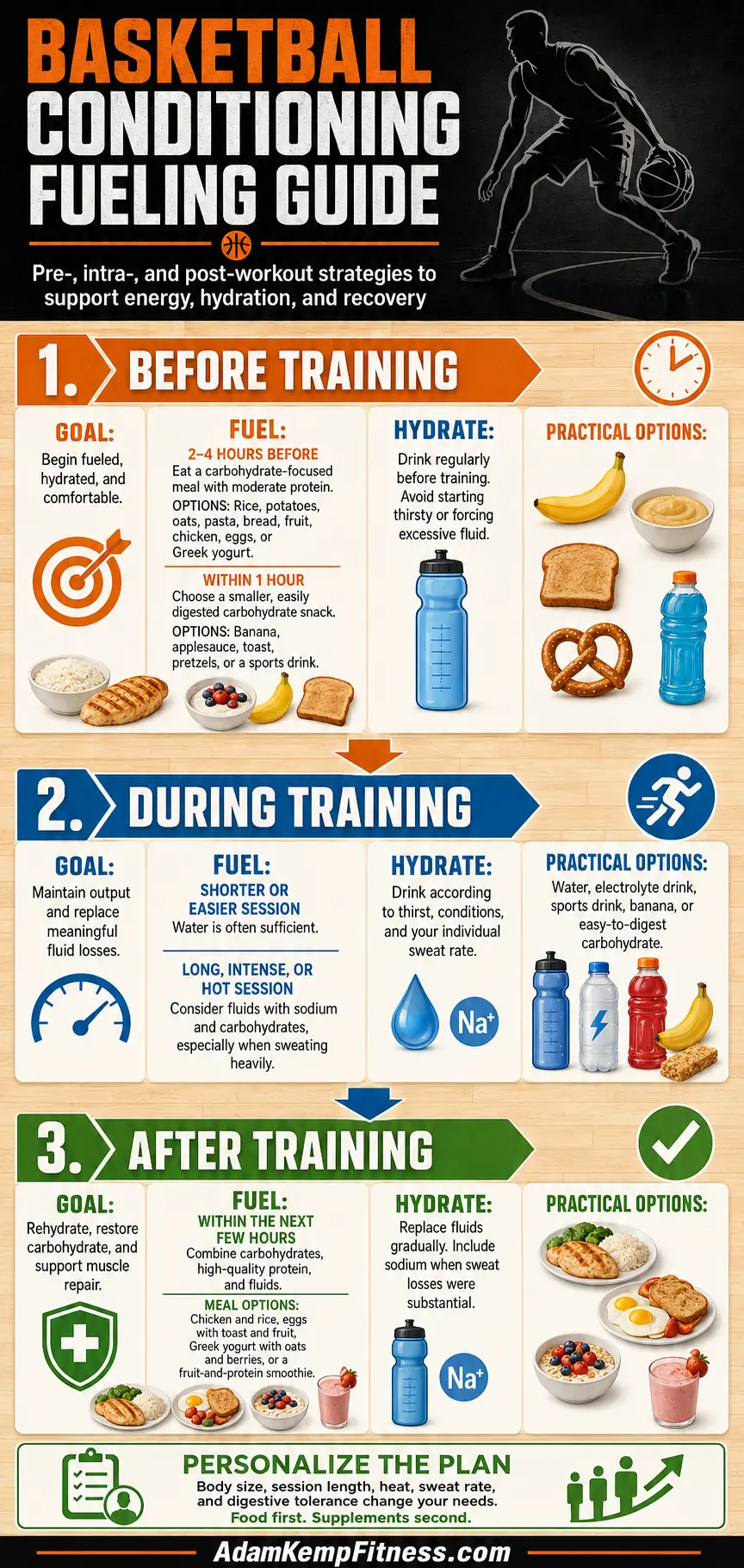
Carbohydrates Support High-Intensity Basketball
Carbohydrates are particularly important during demanding practices, games, tournaments, and multiple-session days.
Low carbohydrate availability can make it harder to sustain repeated high-intensity efforts and technical quality.
Increase carbohydrate intake around your most demanding basketball sessions rather than treating every day exactly the same.
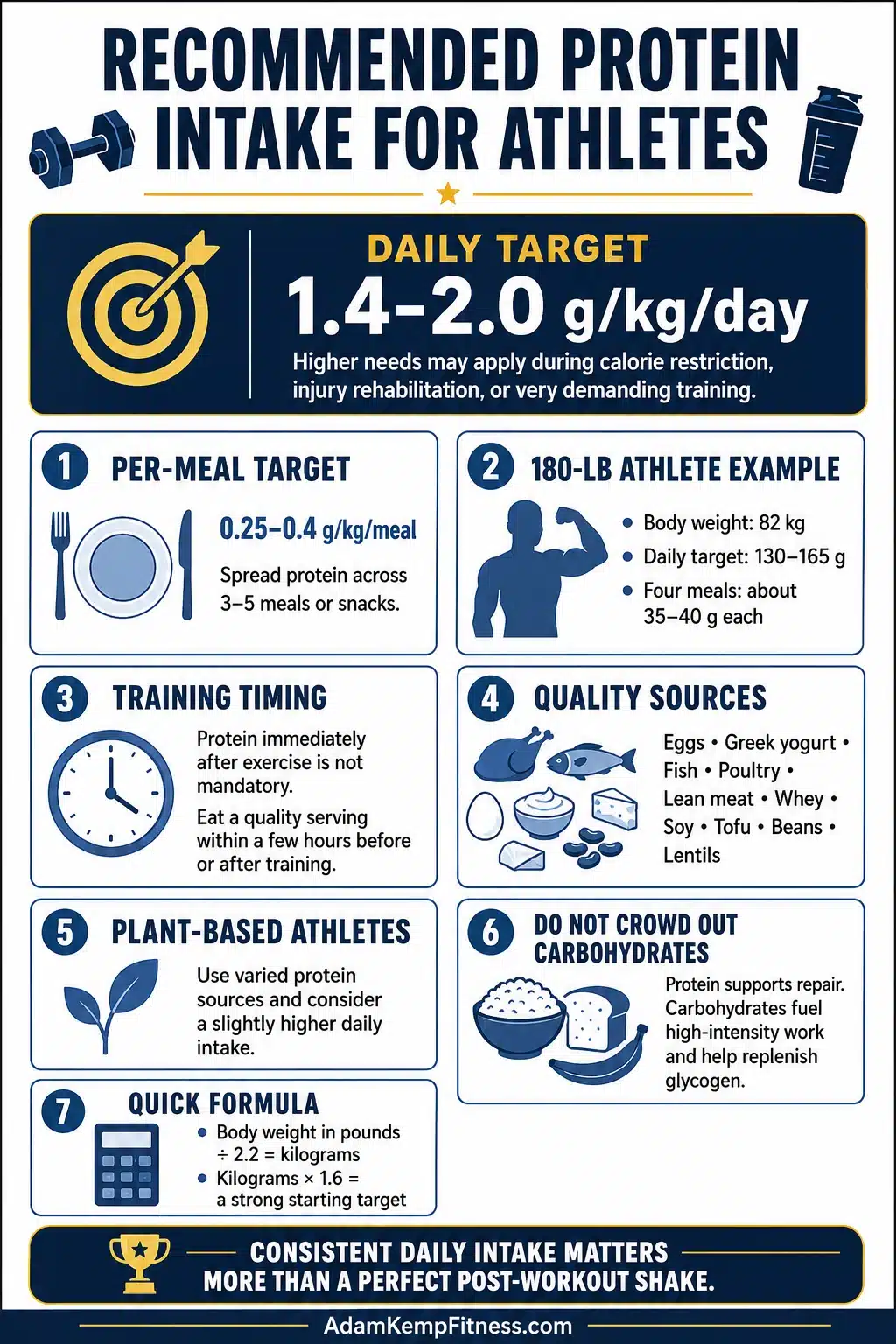
Protein Supports Adaptation
Protein supports muscle repair, remodeling, and adaptation.
Distribute quality protein sources across meals rather than relying entirely on one large serving after training.
Protein supplements can provide convenience, but whole foods should remain the foundation whenever practical.
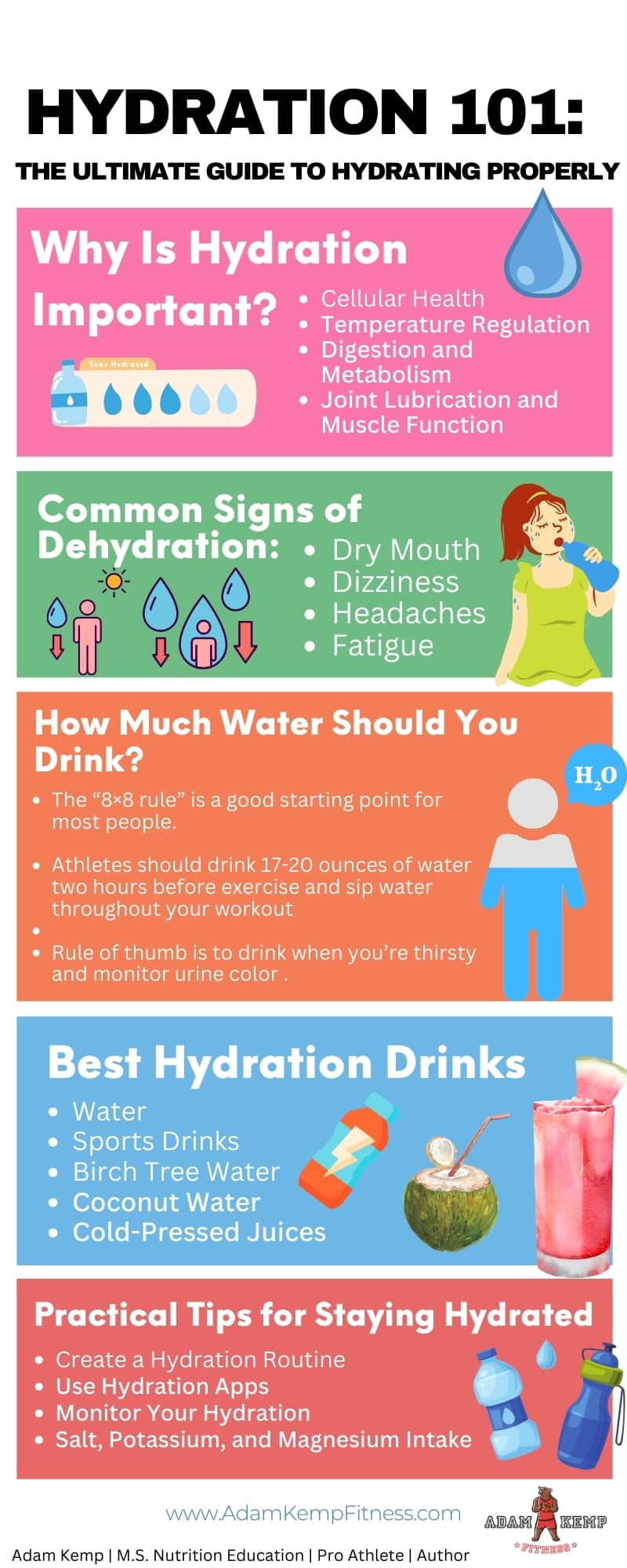
Hydration Affects Performance
Even modest fluid losses can make demanding exercise feel harder.
Begin training hydrated and replace the fluid and sodium lost through sweat.
My hydration guide explains how athletes can build a practical hydration plan instead of relying on thirst alone.
How to Structure Basketball Training Throughout the Year
The same basketball training program should not be used year-round.
Training priorities must shift as your competitive calendar, practice volume, game schedule, and recovery capacity change.
Offseason
The offseason provides the best opportunity to create meaningful physical adaptations.
Primary goals may include:
- Building strength
- Adding or reducing body mass
- Improving jump performance
- Developing speed
- Correcting movement limitations
- Expanding individual skills
- Rehabilitating injuries
- Building conditioning gradually
This is generally when athletes can tolerate the highest strength-training volume because games are not competing for recovery resources.
Preseason
Preseason connects offseason development with the demands of competition.
Strength work normally continues, but court intensity, repeated-sprint conditioning, team practices, and basketball-specific movement become more prominent.
Training should become more specific without abandoning the physical qualities developed during the offseason.
In Season
The in-season goal is usually to maintain important qualities while staying healthy and prepared for games.
Strength and power work should continue, but total training volume often needs to decrease.
Short, high-quality sessions can preserve strength and explosiveness without producing unnecessary soreness.
A week with one game requires a different plan than a week with three games and significant travel.
Postseason Transition
After the season, take enough time to recover physically and mentally.
That does not necessarily require complete inactivity.
Light movement, recreational exercise, rehabilitation, and low-pressure training can help you transition before beginning another structured offseason.
Sample Offseason Basketball Training Week
This example illustrates how different qualities can fit together. It is not an individualized program.
| Day | Primary focus |
|---|---|
| Monday | Acceleration, lower-body strength and basketball skills |
| Tuesday | Upper-body strength, mobility and shooting |
| Wednesday | Basketball conditioning or small-sided games |
| Thursday | Plyometrics, total-body power and basketball skills |
| Friday | Lower-body strength, change of direction and shooting |
| Saturday | Competitive basketball, optional aerobic work or individual skills |
| Sunday | Rest or light active recovery |
Skill work can be performed more frequently than shown, but its volume and intensity should account for the rest of the week.
Sample In-Season Basketball Training Week
An in-season schedule must be built around practices and games.
| Day | Primary focus |
|---|---|
| Monday | Team practice and short strength session |
| Tuesday | Team practice and individual skills |
| Wednesday | Game |
| Thursday | Recovery and mobility |
| Friday | Team practice and short power session |
| Saturday | Game |
| Sunday | Rest or light recovery |
This example would need to change if travel, playing time, practice intensity, or injury status changed.
How to Measure Basketball Training Progress
A workout should not be considered effective simply because it felt difficult.
Use performance markers that connect to your goals:
- Vertical-jump height
- Standing broad jump
- Short sprint time
- Change-of-direction time
- Strength on key exercises
- Repeated-sprint performance
- Shooting percentage
- Shooting accuracy under controlled fatigue
- Playing availability
- Session rating of perceived exertion
- Sleep, soreness, and readiness
- Practice and game film
Not every variable needs to improve simultaneously.
During some phases, maintaining strength while improving conditioning is a successful outcome.
Test often enough to identify trends but not so frequently that testing replaces training.
Many athletes benefit from formal physical testing every four to eight weeks during the offseason.
Common Basketball Training Mistakes
Chasing Fatigue
Sweat, soreness, and exhaustion show that a workout was demanding. They do not prove that it was productive.
Judge training by adaptation over time.
Doing Too Many Random Drills
Constantly changing exercises makes it difficult to develop proficiency or measure improvement.
Keep important movements in your program long enough to progress them.
Treating Every Workout Like Conditioning
Strength, speed, power, and skill require different levels of fatigue and rest.
If every session becomes an exhausting circuit, the quality of your most important work will decline.
Ignoring Deceleration and Landing
Jumping and sprinting are only half of the equation.
Basketball players must also stop, land, and redirect force efficiently.
Copying Professional Players
A professional athlete’s workout reflects years of preparation, individual needs, and a specific place in the season.
Copying the visible workout without understanding its context can produce poor results.
Training Through Persistent Pain
Temporary muscular fatigue is different from recurring joint pain, instability, swelling, or declining function.
Seek an appropriate medical or rehabilitation assessment rather than using recovery tools to hide worsening symptoms.
Failing to Adjust During the Season
Training volume that works in June may create excessive fatigue during a demanding week in January.
Keep important qualities in the program, but adjust volume according to practices, games, travel, and readiness.
Frequently Asked Questions About Basketball Training
Final Thoughts: How to Actually Get Better at Basketball
Basketball training works when every part of the program supports a clear adaptation.
Build skills through purposeful repetition and decision-making.
Build strength so you can produce and absorb force, then use sprinting, plyometrics, and power training to express it quickly.
Condition yourself for the repeated high-intensity demands of basketball rather than chasing fatigue for its own sake.
Train mobility, deceleration, and landing control so that your physical abilities remain available throughout practices, games, and long seasons.
Most importantly, give the process enough time to work.
The players who make lasting progress are not always the ones who complete the most dramatic workouts.
They are the ones who train with purpose, measure improvement, manage fatigue, and consistently perform high-quality work for years.
If your goal is to become a professional athlete, physical ability is only one piece of the process.
Your habits, resilience, decision-making, relationships, opportunities, and ability to remain healthy matter as well.
For more basketball workouts, exercise demonstrations, and lessons from my professional career, subscribe to Adam Kemp Fitness on YouTube.
Explore More Basketball Training Articles
Use the resources below to explore basketball strength, conditioning, recovery, mobility, nutrition, and athletic development in greater detail.
This website does not provide medical advice. This website site does contain affiliate links, and purchases may earn a commission.
Read my Medical Disclaimer, Review Disclaimer, and Publishing Policies for more details. Use of this site indicates acceptance of these terms.
Check Out Some of My YouTube Videos Below, and Please Follow on YouTube for More Educational Health and Fitness Content!
![Subscribe to @AdamKempFitness for more training, general health, recovery, and nutrition tips from a professional basketball player with a master’s degree in Nutrition Education! 🏀💪
Seated Max Vertical Jumps From a Box are one way I train explosive takeoff power with maximum intent on every rep.
Starting seated, with a pause and minimal rocking or dipping, reduces the contribution of a quick countermovement and emphasizes producing force from a relatively static position (National Strength and Conditioning Association [NSCA], 2020).
For athletes, the training goal is explosive lower-body force production and coordinated extension through the hips, knees, and ankles. I use this variation to practice driving hard into the floor and accelerating my body upward.
My preferred setup: 3 sets of 3 reps or 4 sets of 2 reps, supersetted with a strength or power exercise.
I keep the reps low, reset between jumps, and take longer rest periods so I’m ready to attack every takeoff. Even when pairing exercises, I give myself enough recovery to keep the jumps sharp.
Every rep has one goal: jump as high as possible. I focus on an explosive takeoff, a controlled landing, and consistent quality throughout the session.
Save this for your next power workout! 🚀
Reference: NSCA. (2020). Stretch-shortening cycle.
#VerticalJump #JumpTraining #ExplosivePower #AthleticPerformance #BasketballTraining](https://www.adamkempfitness.com/wp-content/plugins/feeds-for-youtube/img/placeholder.png)