Incline Walking: Benefits, Muscles Worked, Calories Burned & More!
 Reading Time: 13 minutes
 Incline walking is one of the simplest ways to make walking considerably more challenging without transitioning into running.
By increasing the treadmill grade or walking uphill outdoors, you force your body to perform more work against gravity, which can increase cardiovascular demand, energy expenditure, and lower-body muscle recruitment compared with walking on level ground (Franz & Karm, 2012; Silder et al., 2012).
This combination makes incline walking useful for people trying to improve cardiovascular fitness, burn more calories, support weight loss, or add relatively low-impact conditioning alongside strength training.
I also like incline walking for athletes because it can provide meaningful general conditioning without requiring another session of high-speed running, jumping, or other mechanically demanding exercise.
The right speed and incline depend on your fitness level, training goals, body size, and what else you are doing throughout the week, but there is no need to make every session brutally difficult.
Used intelligently, incline walking can be one of the most versatile forms of cardio you can add to a fitness program.
What Is Incline Walking?
Incline walking simply means walking uphill rather than across a flat surface.
Outdoors, that could involve hiking or walking up a hill.
On a treadmill, incline is generally expressed as a percentage grade, such as 5%, 10%, or 15%.
However, a 10% incline does not mean the treadmill is tilted 10 degrees.
Instead, a 10% grade means the surface rises approximately 10 units vertically for every 100 units traveled horizontally.
The important part from a training perspective is that increasing the incline substantially changes the physical demands of walking.
Your body must repeatedly move its mass upward against gravity, requiring more work from the lower-body muscles and cardiovascular system.
What Are the Benefits of Incline Walking?
Incline walking occupies an interesting middle ground between ordinary walking and more intense cardiovascular exercise.
It can dramatically increase the difficulty of a walk while still allowing you to maintain a walking gait.
The primary benefits of incline walking include:
- Increased cardiovascular demand
- Greater calorie expenditure than level walking at the same speed
- Increased glute, hamstring, quadriceps, and calf involvement
- Improved lower-body muscular endurance
- Effective aerobic conditioning
- Less impact than many forms of running
- Adjustable intensity for different fitness levels
- Useful conditioning for athletes
- Convenient indoor training
- Potential support for weight loss and body composition goals
One reason I particularly like incline walking is how easily you can manipulate the difficulty.
Instead of constantly walking faster, you can increase the incline while maintaining a comfortable walking speed.
That creates an enormous range of possible workloads.
What Muscles Does Incline Walking Work?
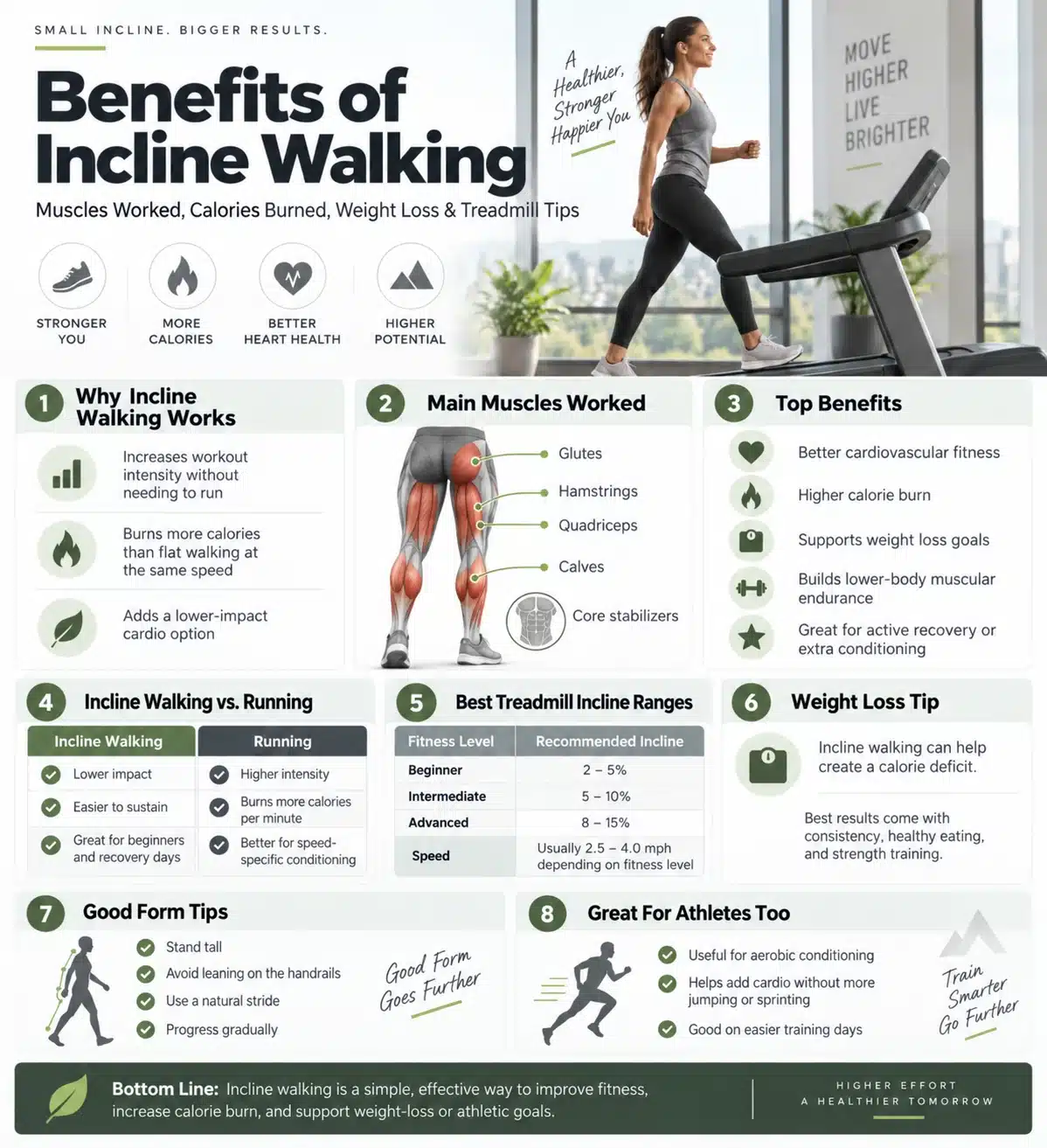
Incline walking primarily trains the muscles responsible for extending the hips, knees, and ankles.
These include the:
- Gluteus maximus
- Hamstrings
- Quadriceps
- Gastrocnemius
- Soleus
- Other stabilizing muscles around the hips, ankles, and trunk
Research comparing level and uphill walking demonstrates progressively greater activation of several hip, knee, and ankle extensor muscles as incline increases (Franz et al., 2012).
For example, Franz & Kram (2012) found substantially greater activation of the gluteus maximus, hamstrings, quadriceps, gastrocnemius, and soleus during steep uphill walking compared with level walking.
Does Incline Walking Build Glutes?
Incline walking can increase glute involvement compared with walking on flat ground, particularly as the incline becomes steeper.
However, increased muscle activation does not automatically mean incline walking is an optimal muscle-building exercise.
If your primary goal is building larger or stronger glutes, progressive resistance exercises such as squats, Romanian deadlifts, hip thrusts, lunges, and step-ups should remain the foundation of your program.
Think of incline walking as additional muscular work rather than a replacement for strength training.
Does Incline Walking Burn More Calories?
At the same walking speed, increasing the incline generally increases energy expenditure because your body must perform additional work against gravity.
The Compendium of Physical Activities, for example, assigns approximately 5.3 METs to moderate-to-brisk hill walking at a 1% to 5% grade and approximately 7 METs at a 6% to 10% grade, although actual energy expenditure varies substantially between individuals (Herrmann et al., 2024).
Laboratory research also demonstrates that metabolic cost increases as treadmill incline increases (Silder et al., 2012).
That does not mean everyone should immediately set the treadmill to its maximum incline.
A moderate incline you can maintain consistently often provides a better workout than an extremely steep incline that makes you hold onto the treadmill, shorten the workout dramatically, or lose good walking mechanics.
How Many Calories Does Incline Walking Burn?
There is no single number because calorie expenditure depends on several factors, including:
- Body weight
- Walking speed
- Incline percentage
- Workout duration
- Fitness level
- Individual movement efficiency
The American College of Sports Medicine walking equation estimates oxygen consumption during steady-state treadmill walking using both speed and grade:
VO₂ = (0.1 × speed) + (1.8 × speed × grade) + 3.5
Speed is expressed in meters per minute, and treadmill grade is expressed as a decimal, meaning a 10% incline is entered as 0.10 (Moore et al., 2021).
This illustrates why incline has such a strong effect.
Even when walking speed remains unchanged, increasing the grade increases the estimated oxygen requirement and therefore the energetic demand.
Treadmill calorie counters should still be treated as estimates rather than exact measurements.
Their calculations may not accurately account for individual physiology, body composition, movement efficiency, or whether someone is holding onto the treadmill.
Is Incline Walking Good for Weight Loss?
Incline walking is one of the best exercises for weight loss because it offers a sustainable way to increase weekly energy expenditure.
However, incline walking does not independently cause fat loss.
Weight loss ultimately requires energy expenditure to exceed energy intake over time.
Physical activity can contribute to this calorie deficit while providing health and fitness benefits beyond changes on the scale (Centers for Disease Control and Prevention [CDC], 2026).
Nutrition typically plays the larger role in creating the calorie deficit needed for substantial weight loss, while regular exercise can increase energy expenditure, preserve physical capacity, and support long-term weight management.
For many people, incline walking works particularly well because it can be performed frequently without creating the same fatigue as repeated high-intensity workouts.
That matters.
The workout you can perform consistently for months is generally more useful for weight management than a workout that burns enormous numbers of calories but leaves you exhausted after a week.
Is Incline Walking Better Than Running for Weight Loss?
Neither incline walking nor running automatically produces greater weight loss.
Running generally burns more calories per minute when performed at substantially higher intensities, while incline walking may be easier to perform frequently or for longer durations.
The better option depends on the entire training program.
Someone who can comfortably incline walk for 40 minutes four times per week may accumulate more useful weekly cardiovascular work than someone who runs intensely once and is too sore to train effectively afterward.
Incline Walking vs. Regular Walking
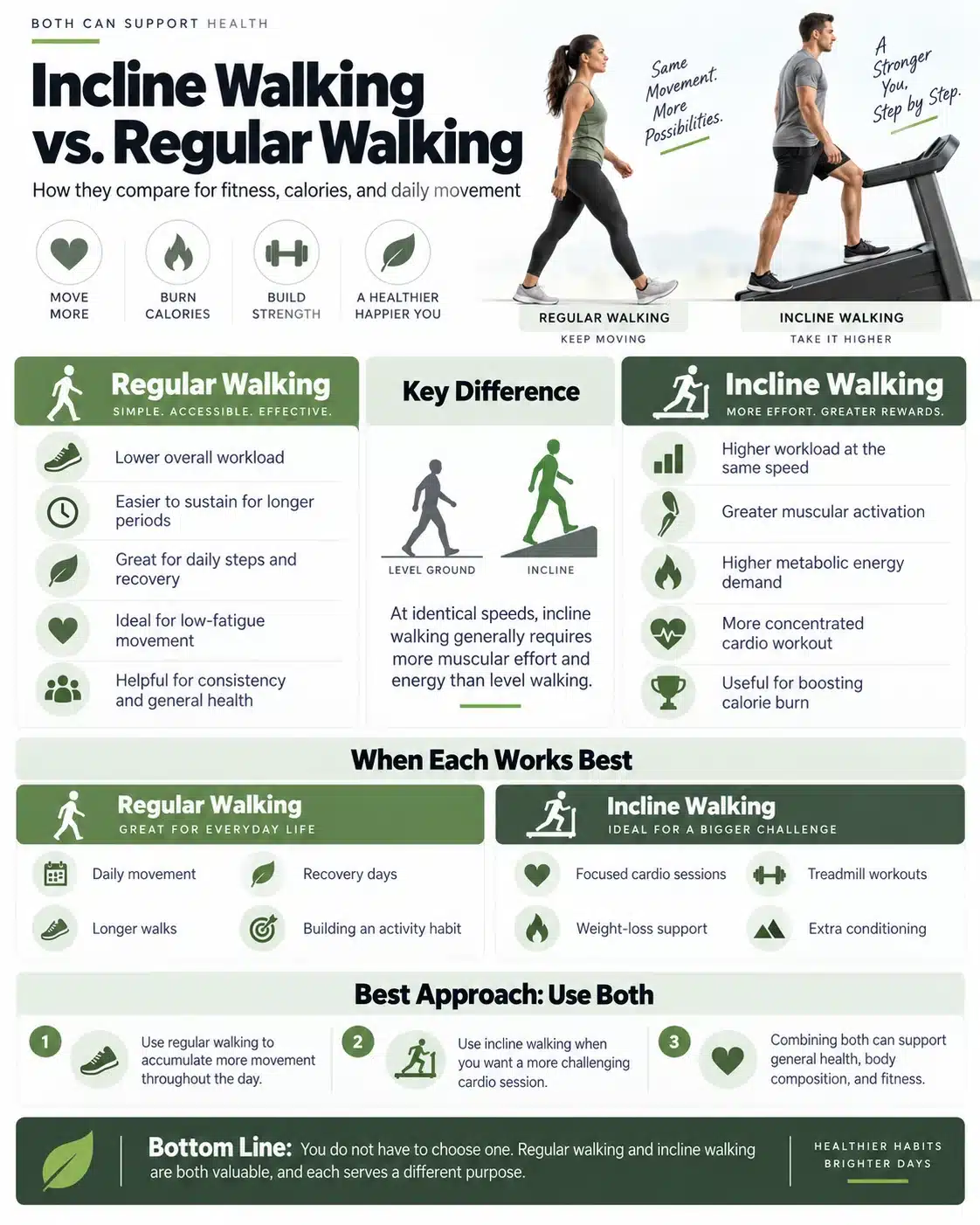
Regular walking and incline walking are both valuable.
Incline walking simply increases the workload.
At identical speeds, walking uphill generally requires greater muscular activation and metabolic energy than walking on level ground (Franz et al., 2012; Silder et al., 2012).
However, regular walking has an advantage when your goal is accumulating large amounts of low-fatigue movement.
You do not have to choose one.
For general health and body composition, I prefer combining them.
Use ordinary walking to accumulate daily movement and incline walking when you want a more concentrated cardiovascular workout.
Incline Walking vs. Running
Running generally allows you to reach higher speeds and cardiovascular intensities, making it extremely valuable for aerobic fitness and athletic conditioning.
Incline walking offers a different advantage, and I believe it is one of the best cardio alternatives to running.
You can significantly increase cardiovascular demand while maintaining a walking gait.
One 2024 treadmill study comparing high-incline walking with low-incline jogging observed lower foot and sacral impact acceleration during high-incline walking while still producing substantial heart-rate and muscular demands (Kundu et al., 2024).
That does not mean incline walking is inherently “better for your joints” or safer for every person.
Very steep inclines can still place substantial demands on the calves, Achilles tendon, feet, knees, and hips.
However, incline walking can be an attractive conditioning option when you want to increase cardiovascular stress without continually accumulating the impact and speed associated with running.
What Is the Best Incline for Walking?
There is no universal best treadmill incline.
A useful starting framework is:
| Fitness Level | Incline | Speed | Duration |
|---|---|---|---|
| Beginner | 2-5% | 2.5-3.2 mph | 15-30 min |
| Intermediate | 5-10% | 2.5-3.5 mph | 20-40 min |
| Advanced | 8-15% | 2.5-4.0 mph | 20-45 min |
| Recovery/Easy Cardio | 2-6% | Comfortable | 20-45+ min |
These are starting ranges rather than rigid prescriptions.
A larger athlete may find 3 mph at 10% extremely demanding, while a smaller endurance-trained person may consider it moderate.
Heart rate, breathing, perceived exertion, and walking mechanics are more useful than chasing one specific incline number.
A Few of the Best Incline Walking Workouts
Incline walking workouts can be adjusted for different goals, whether you want an easier recovery session, a steady cardiovascular workout, or a more demanding calorie-burning challenge.
The best approach is to match the incline, speed, and duration to your current fitness level and the purpose of the session rather than chasing the steepest possible treadmill setting.
The workouts below offer practical ways to use incline walking for general fitness, weight loss, endurance, and athletic conditioning.
A Simple Incline Walking Workout for Beginners
If you are new to incline walking, start conservatively.
Try:
5 minutes: 0-2% incline
10 minutes: 3-5% incline
5 minutes: 5-7% incline
5 minutes: 1-2% cool-down
Choose a speed where you can maintain a natural stride without holding onto the treadmill.
Over time, increase either duration, speed, or incline.
You usually do not need to increase all three simultaneously.
Incline Walking Workout for Weight Loss
For weight management, I generally prefer moderate workouts you can repeat consistently.
Try:
Warm-up: 5 minutes at 1-3%
Main workout: 25-40 minutes at 5-10%
Cool-down: 5 minutes at 0-2%
Keep the intensity challenging enough that your breathing increases but sustainable enough that you can finish without feeling destroyed.
Remember that the workout is only one piece of weight management.
Healthy eating patterns, sleep, stress management, resistance training, and overall daily movement all influence long-term results (CDC, 2025).
Incline Walking Workout for Athletes
Athletes can use incline walking as low-intensity conditioning after strength training or on easier training days.
One option is:
5 minutes: Easy warm-up
20-30 minutes: 5-10% incline at a controlled pace
5 minutes: Easy cool-down
Keep the session aerobic rather than turning it into a competition.
If your legs are already heavily fatigued from practices, games, plyometrics, or lower-body strength training, lower the incline.
Recovery sessions should contribute to recovery, not quietly become another maximum-effort workout.
How Often Should You Do Incline Walking?
Two to five incline walking sessions per week can work well for many people.
The right frequency depends on the intensity of the sessions and the rest of your training.
Someone whose primary exercise is walking may tolerate incline walking most days.
An athlete already completing several practices, strength workouts, and games may only need one or two dedicated incline sessions.
Also remember that incline walking increases work for the calves, hamstrings, quadriceps, and glutes.
Treat it as training rather than assuming it creates zero fatigue simply because you are walking.
Common Incline Walking Mistakes
Frequently Asked Questions About Incline Walking
Final Thoughts: Is Incline Walking Worth Doing?
Incline walking is one of the easiest ways to make ordinary walking substantially more demanding without immediately moving into running.
Increasing treadmill grade can increase cardiovascular workload, calorie expenditure, and activation of the glutes, hamstrings, quadriceps, and calves while allowing you to control speed and overall training stress.
For weight loss, its biggest advantage may be sustainability.
For athletes, its biggest advantage may be the ability to accumulate useful conditioning without turning every cardio workout into another session of sprinting, jumping, or hard running.
And for general fitness, it provides an incredibly simple method of progression: walk the same speed and gradually make the hill steeper.
Start with a manageable incline, maintain good walking mechanics, and progress according to what your body can recover from.
Done consistently, incline walking can be a highly effective addition to a cardiovascular, weight-loss, or athletic-performance program.
This website does not provide medical advice. This website site does contain affiliate links, and purchases may earn a commission.
Read my Medical Disclaimer, Review Disclaimer, and Publishing Policies for more details. Use of this site indicates acceptance of these terms.
Check Out Some of My YouTube Videos Below, and Please Follow on YouTube for More Educational Health and Fitness Content!
![Subscribe to @AdamKempFitness for more training, general health, recovery, and nutrition tips from a professional basketball player with a master’s degree in Nutrition Education! 🏀💪
Seated Max Vertical Jumps From a Box are one way I train explosive takeoff power with maximum intent on every rep.
Starting seated, with a pause and minimal rocking or dipping, reduces the contribution of a quick countermovement and emphasizes producing force from a relatively static position (National Strength and Conditioning Association [NSCA], 2020).
For athletes, the training goal is explosive lower-body force production and coordinated extension through the hips, knees, and ankles. I use this variation to practice driving hard into the floor and accelerating my body upward.
My preferred setup: 3 sets of 3 reps or 4 sets of 2 reps, supersetted with a strength or power exercise.
I keep the reps low, reset between jumps, and take longer rest periods so I’m ready to attack every takeoff. Even when pairing exercises, I give myself enough recovery to keep the jumps sharp.
Every rep has one goal: jump as high as possible. I focus on an explosive takeoff, a controlled landing, and consistent quality throughout the session.
Save this for your next power workout! 🚀
Reference: NSCA. (2020). Stretch-shortening cycle.
#VerticalJump #JumpTraining #ExplosivePower #AthleticPerformance #BasketballTraining](https://www.adamkempfitness.com/wp-content/plugins/feeds-for-youtube/img/placeholder.png)