What to Do When Chronic Pain Becomes Too Much
 Reading Time: 14 minutes
 When chronic pain becomes too much to manage with rest, ice, or over-the-counter remedies, deeper intervention may be needed.
Unlike temporary soreness, chronic pain can gradually affect nearly every aspect of life, from mobility and sleep to mental health and daily responsibilities.
Persistent pain can make it harder to exercise, concentrate, work, care for family members, and participate in activities that once felt routine.
Over time, these limitations may contribute to frustration, isolation, fear of movement, and a reduced sense of independence.
For these reasons, recognizing the difference between an acute injury and a chronic pain condition is essential for effective chronic pain management and improving your quality of life.
Pain is not solely a measure of tissue damage.
It is a personal sensory and emotional experience influenced by biological, psychological, and social factors, which helps explain why two people with similar injuries can experience pain very differently (Raja et al., 2020).
Additionally, knowing when to seek professional help, exploring available treatment options, and advocating for your needs are critical steps toward regaining control.
Realizing what to do when chronic pain becomes too much can make the difference between an ongoing struggle and timely, meaningful relief.
What is Chronic Pain?
Chronic pain is generally defined as pain that persists or recurs for more than three months.
This definition is more precise than assuming that pain must continue for exactly 12 weeks or remain present after an injury has completely healed.
Chronic pain may continue after an identifiable injury, occur alongside a long-term health condition, or develop without a clearly detectable source.
The International Classification of Diseases distinguishes between chronic primary pain, in which pain becomes a health condition in its own right, and chronic secondary pain associated with another underlying disease or injury (Treede et al., 2019).
It can range from mild and intermittent to severe and continuous.
However, pain intensity alone does not reveal how severely the condition affects someone’s life.
A person with moderately intense pain may experience major disruptions to sleep, work, exercise, or parenting, while someone reporting a higher pain score may retain more daily function.
For this reason, healthcare professionals should assess physical function, emotional health, sleep, medication use, and quality of life in addition to pain intensity.
Chronic pain can also change how the nervous system processes sensory information.
In some conditions, pain pathways may become more sensitive, making normally painful input feel more intense or turning ordinarily nonpainful sensations into uncomfortable ones.
This does not mean the pain is imaginary or “all in someone’s head.”
It means pain comes from a complex protective system involving the body, spinal cord, brain, emotions, environment, and past experiences.
What Causes Chronic Pain?
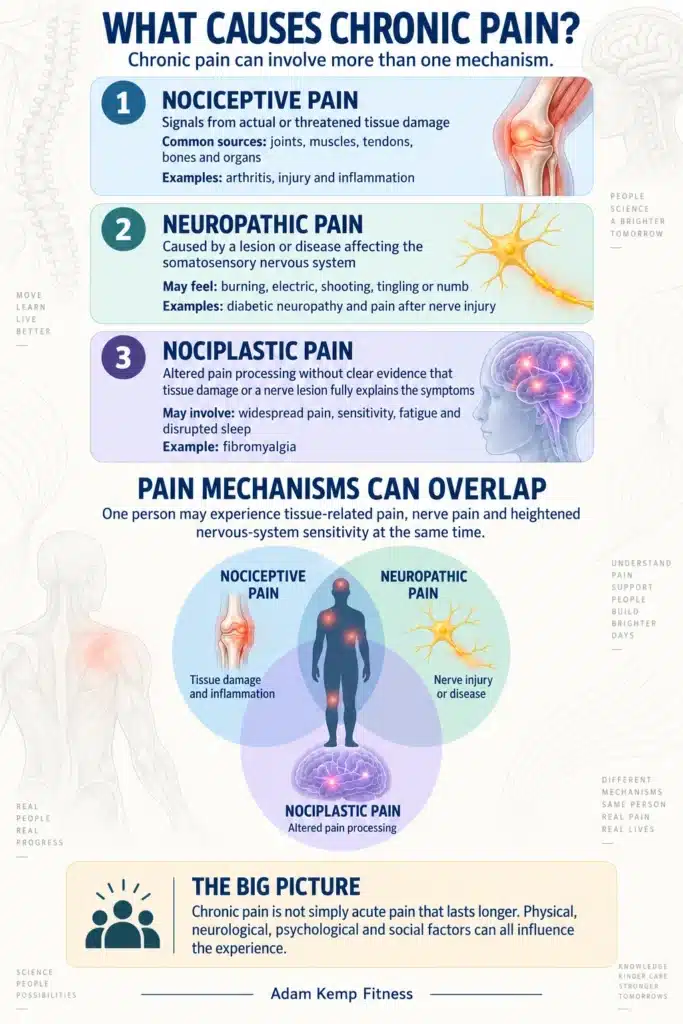
Chronic pain can be caused by a wide range of factors, including past injuries, ongoing inflammation, nerve damage, autoimmune disorders, repetitive physical stress, or underlying conditions such as arthritis, fibromyalgia, migraines, endometriosis, or persistent back pain.
Musculoskeletal pain may originate in joints, muscles, tendons, bones, or surrounding connective tissues.
Neuropathic pain develops when a disease or injury affects the somatosensory nervous system and may feel burning, electric, shooting, tingling, or numb.
Some people experience nociplastic pain, a term used when altered pain processing appears to contribute to symptoms even though there is no clear evidence that ongoing tissue damage or a nerve lesion fully explains the pain.
Fibromyalgia is one condition commonly associated with this type of pain processing.
Multiple mechanisms can exist at the same time.
For example, someone with arthritis may experience joint pain, heightened nervous system sensitivity, disrupted sleep, muscle weakness, and anxiety about movement, with each factor shaping the overall experience.
In some cases, the original injury has healed, but the nervous system continues to produce an amplified protective response. In other cases, an active disease process or unresolved mechanical problem continues to generate pain signals.
This complexity is why chronic pain should not automatically be treated as a longer version of an acute injury.
Repeatedly resting, icing, or masking symptoms may not address the physical, neurological, psychological, or social factors maintaining the problem.
Can You Manage Chronic Pain on Your Own?
It is possible to manage chronic pain on your own in certain situations, mostly depending on the root cause of the issue and the necessary treatment options.
To manage chronic pain on your own, focus on consistent lifestyle strategies that support physical function, recovery, and nervous-system regulation:
- Exercise gently and regularly, using activities such as walking, swimming, cycling, mobility exercises, or resistance-band work to maintain strength and function. Begin below your current tolerance, progress gradually, and ask a physical therapist or qualified healthcare professional for guidance if movement substantially increases your symptoms.
- Prioritize sleep by maintaining a regular sleep and wake schedule, limiting late-night stimulation, and creating a comfortable sleeping environment. Pain can interfere with sleep, while inadequate sleep may increase pain sensitivity, creating a cycle that deserves attention from both directions.
- Use relaxation techniques such as slow breathing, progressive muscle relaxation, mindfulness meditation, or calming sensory activities. These practices may reduce stress-related muscle tension and emotional distress, although they should complement appropriate medical care rather than replace it.
- Adopt a balanced, nutrient-dense diet built around vegetables, fruits, legumes, whole grains, lean proteins, nuts, seeds, and sources of unsaturated fat. An overall healthy dietary pattern may support cardiovascular and metabolic health, but no single “anti-inflammatory” food has been proven to eliminate chronic pain.
- Track pain patterns using a journal or app to identify possible triggers and measure which strategies bring relief. Record function, activity, sleep, mood, medication use, and recovery, not only a daily pain score, because progress may appear first as better movement or greater participation in daily life.
- Limit alcohol and avoid smoking, because both may interfere with sleep, recovery, medication safety, and overall health. Smoking is also associated with several persistent pain conditions, although the relationship can involve multiple behavioral and biological factors.
These approaches support physical and emotional well-being and are foundational to chronic pain self-management.
But remember, self-management does not mean handling everything alone.
Self-management simply means actively participating in your care and working with healthcare professionals to make informed, sustainable decisions.
It is also important to avoid the “boom-and-bust” cycle.
Doing too much on a relatively good day can provoke a flare that leads to several days of inactivity, whereas pacing distributes activity more evenly and may help rebuild tolerance over time.
What Should You Do When Chronic Pain Becomes Too Much?

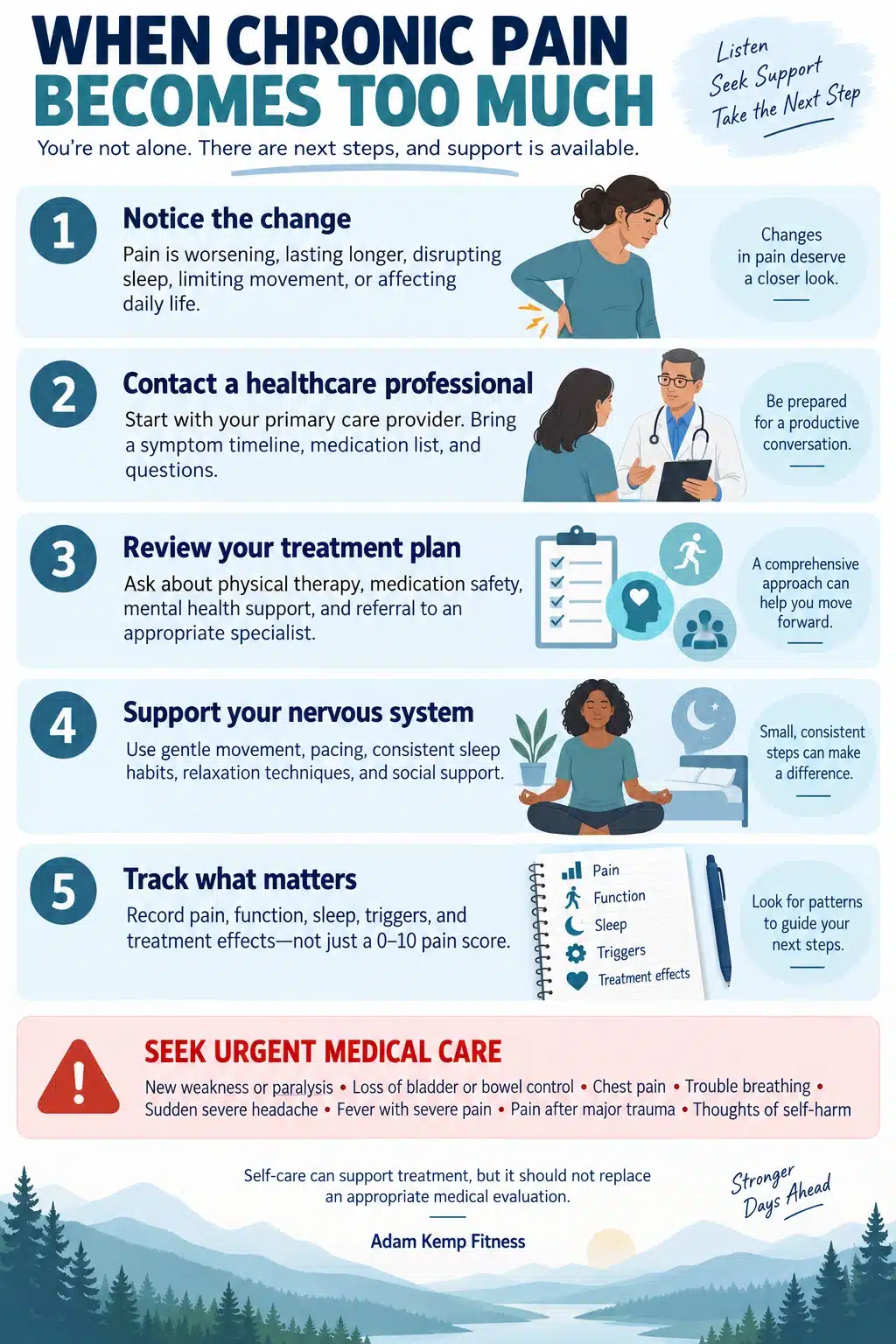
When chronic pain becomes too much to bear, it may indicate that your current coping strategies, treatment plan, or level of support are no longer sufficient.
“Too much” does not have to mean reaching the highest number on a pain scale.
Pain deserves reassessment when it prevents you from sleeping, working, moving safely, caring for yourself, maintaining relationships, or enjoying meaningful activities.
At this stage, repeatedly pushing through symptoms or waiting indefinitely for improvement can contribute to physical deconditioning and emotional exhaustion.
Seeking medical guidance, reviewing treatment options, and building a dependable support system are practical steps to restore function and improve quality of life.
Certain symptoms require more urgent attention.
Seek emergency medical care for pain accompanied by chest pressure, difficulty breathing, sudden weakness or paralysis, loss of bladder or bowel control, a sudden severe headache, confusion, fever with severe pain, major trauma, or thoughts of self-harm.
Pay Attention to How Long the Pain Lasts
Pain that develops a few days after an unfamiliar or demanding workout, known as delayed-onset muscle soreness (DOMS), is common.
DOMS generally begins after exercise, becomes most noticeable within approximately one to three days, and then gradually improves (Cheung et al., 2003).
Pain that persists for weeks or months, repeatedly returns, or follows a worsening pattern is different.
That kind of discomfort deserves more than stretching, icing, or hoping it will eventually disappear.
Duration matters, but it is not the only factor.
A new pain that is severe, rapidly worsening, or accompanied by neurological or systemic symptoms may require evaluation well before three months have passed.
The key is noticing changes in both symptoms and function.
Pain that begins to limit walking, exercise, sleep, concentration, work, or basic self-care may be clinically important even if its intensity has not increased dramatically.
Numbness, tingling, progressive weakness, unexplained weight loss, swelling, fever, night sweats, or pain that consistently wakes you may provide additional information that a clinician needs to know.
These signs do not automatically indicate a dangerous condition, but they should not be ignored.
The earlier someone communicates meaningful changes, the sooner a healthcare professional can investigate possible causes and determine whether imaging, laboratory testing, rehabilitation, medication changes, or specialist care are appropriate.
Don’t Over-Rely on OTC Pain Medications
Over-the-counter medications such as ibuprofen, naproxen, and acetaminophen can provide useful short-term relief for certain conditions.
However, being available without a prescription does not make these medications risk-free.
Ibuprofen and naproxen are nonsteroidal anti-inflammatory drugs, or NSAIDs.
Excessive or prolonged use can increase the risk of stomach ulcers, gastrointestinal bleeding, kidney problems, elevated blood pressure, heart attack, and stroke, particularly among people with specific medical conditions or those taking interacting medications (U.S. Food and Drug Administration [FDA], 2015).
Tylenol contains acetaminophen, which is not an NSAID and carries a different risk profile.
Taking more than the recommended amount, or unintentionally combining several cold, flu, sleep, and pain products containing acetaminophen, can cause serious liver damage (FDA, 2017).
OTC medication can also reduce symptoms without addressing why the pain is occurring.
Relief may be valuable, but repeatedly using medication to remain active through a worsening injury or unexplained pain can delay an appropriate evaluation.
Some people explore alternatives such as CBD for pain relief.
Although preliminary research has generated interest, evidence remains insufficient to consider nonprescription CBD a reliably effective treatment for most chronic pain conditions, and products may vary in dose, purity, labeling accuracy, and drug-interaction risk (National Center for Complementary and Integrative Health [NCCIH], 2025).
Important: Always follow medical advice and use pain medications as directed within a broader, doctor-approved chronic pain management plan. Ask a physician or pharmacist to review everything you take, including prescriptions, OTC products, supplements, CBD, and cannabis-based products.
Start With Your Primary Care Provider
Before moving directly into specialist care, many people begin by visiting their primary care provider to discuss what they are experiencing.
A primary care clinician can review the pain history, perform a physical examination, evaluate medications, and identify medical conditions that may require testing or immediate treatment.
This appointment can also help determine whether the symptoms are primarily musculoskeletal, neurological, inflammatory, visceral, or potentially related to another health problem.
Preparing for the visit can make the conversation more productive.
Bring a timeline of when the pain began, what makes it better or worse, previous injuries, treatments attempted, medication doses, sleep changes, and specific activities you can no longer perform comfortably.
Instead of saying only that your pain is an eight out of ten, explain what the pain prevents you from doing. Information such as “I can only stand for 10 minutes,” “I wake up four times each night,” or “I stopped climbing stairs” gives the clinician a clearer picture of its functional impact.
Your provider may recommend conservative treatment, order laboratory tests or imaging when clinically indicated, or refer you to physical therapy, neurology, rheumatology, orthopedics, psychology, or pain medicine.
Not every case requires imaging, and an abnormality on an MRI or X-ray does not always explain the severity of someone’s symptoms.
Imaging findings should be interpreted alongside the examination, medical history, and pattern of functional limitations.
Don’t Ignore Signs of Chronic Pain
Some types of pain fluctuate, while others remain present in a way that gradually changes how a person moves, sleeps, thinks, and participates in daily life.
Chronic back pain, for instance, can affect sleep, focus, confidence in movement, physical activity, and mood.
What begins as a physical symptom can therefore become a broader obstacle to health and independence.
People often adapt by avoiding stairs, skipping exercise, changing how they walk, or quietly withdrawing from social activities.
These adaptations may feel protective in the short term, but prolonged inactivity can contribute to weakness, stiffness, reduced cardiovascular fitness, and greater fear of movement.
Conversely, ignoring pain and forcing the body through every activity is not always productive.
A healthier goal is to distinguish between tolerable discomfort from safe rehabilitation and warning signs that suggest an activity or treatment plan needs to be modified.
Chronic pain is also associated with higher rates of anxiety, depression, and sleep disturbance.
These consequences do not invalidate the physical experience; they demonstrate how closely pain, mood, behavior, and recovery interact.
If chronic pain is accompanied by hopelessness or thoughts of self-harm, seek immediate crisis or emergency support.
Emotional distress is a legitimate component of pain care and should be addressed with the same seriousness as physical limitations.
Explore Your Options with Specialists
When basic treatment does not provide sufficient improvement, it may be time to consult professionals who evaluate and treat particular pain conditions.
Depending on the symptoms, this could involve a physical therapist, physiatrist, neurologist, rheumatologist, orthopedic specialist, psychologist, occupational therapist, or pain management professional.
Each discipline examines a different part of the problem, which is one reason coordinated care can be valuable.
Physical therapy may focus on graded movement, strength, mobility, balance, and confidence in using the affected area.
Psychological treatments such as cognitive behavioral therapy do not suggest that pain is imaginary; instead, they provide practical strategies for coping with distress, improving activity patterns, and reducing pain-related fear (National Institute of Neurological Disorders and Stroke [NINDS], 2026).
Pain-management physicians may consider medication adjustments, targeted injections, nerve blocks, or other procedures when appropriate.
However, no procedure should be viewed as automatically necessary simply because pain has lasted a long time.
Some of the top orthopedic surgeons have experience treating complex structural problems that have not responded adequately to rest, physical therapy, or medication.
Surgery may be reasonable when a clearly identified structural problem matches the symptoms and evidence suggests an operation is likely to improve function.
It is not always the answer, so patients should ask about expected benefits, risks, alternatives, recovery time, and what may happen without surgery.
The strongest plan is often multidisciplinary rather than dependent on one treatment. Exercise, rehabilitation, medication, psychological support, occupational adjustments, sleep care, and medical procedures may each address a different contributor to the pain experience.
Maintain Consistent Communication With Your Healthcare Providers
Once treatment begins, stay in contact with your healthcare team and explain what is helping, what is not changing, and what may be causing side effects.
Pain relief is not always immediate or linear.
A treatment may improve walking tolerance or sleep before it noticeably changes pain intensity, while another may reduce pain but cause side effects that make it unsuitable for long-term use.
Also try to track measurable outcomes such as how far you can walk, how long you can work, how often pain interrupts your sleep, and whether you can participate in important activities.
These functional markers make it easier to decide whether a treatment is producing meaningful benefits.
Be honest about medication use, CBD or cannabis products, supplements, fear of movement, depression, and difficulties following the plan.
Clinicians need accurate information to identify interactions, adjust recommendations, and distinguish treatment failure from addressable barriers.
It is also reasonable to ask questions when you do not understand the diagnosis or treatment rationale.
Useful questions include what the clinician believes is causing the pain, what evidence supports the proposed treatment, what improvement should look like, and how long the plan should be tried before reassessment.
Chronic pain recovery is rarely a straight line, but consistent communication between doctor and patient helps keep treatment responsive to changing needs.
Use Mindfulness-Based Pain Relief Techniques Consistently
Mindfulness is more than a general stress-management tool, but it should not be presented as a guaranteed way to eliminate pain.
Practices such as mindful breathing, body scans, prayer, and meditation train people to observe sensations, thoughts, and emotions without immediately reacting.

This may help reduce pain-related distress, catastrophizing, and the emotional amplification that can make symptoms more difficult to tolerate.
Experimental research indicates that mindfulness meditation can influence pain processing through mechanisms that are not identical to placebo-based pain relief (Zeidan et al., 2015).
However, the size of the benefit varies, and mindfulness is generally more realistic as one part of a broader treatment plan.
These techniques do not require someone to pretend that pain is harmless or pleasant.
The objective is to create a small gap between the sensation and the automatic fear, tension, or avoidance response that may follow.
Consistency matters more than forcing a long session.
Starting with 5 to 10 minutes of slow breathing, guided meditation, or a prayer session may be more manageable than expecting 20 minutes of perfect concentration every day.
Some people benefit from a structured mindfulness-based stress reduction program, while others prefer short guided practices or simple check-ins during normal activities. If focusing inward intensifies anxiety, trauma symptoms, or distress, a mental health professional can help identify a more appropriate strategy.
When practiced realistically and consistently, mindfulness may change how a person responds to discomfort and help preserve participation in meaningful activities, even when chronic pain becomes too much.
Final Thoughts: Can You Live Pain-Free After Dealing with Chronic Pain?
When chronic pain becomes too much, it is natural to wonder whether living completely pain-free is still possible.
Some people recover fully when the underlying cause heals or responds to treatment.
For others, especially those with complex or long-standing conditions, complete pain elimination may not be a realistic or immediately achievable goal.
That does not mean treatment has failed or that improvement is impossible.
Evidence-based care may reduce pain, improve sleep, rebuild physical capacity, restore independence, and make symptoms less dominant in everyday life.
Approaches such as physical therapy, appropriately selected medication, cognitive behavioral therapy, mindfulness, sleep treatment, and lifestyle adjustments can address different contributors to chronic pain.
The most appropriate combination depends on the diagnosis, personal goals, medical history, and response to previous treatments.
Neuroplasticity, which is the nervous system’s ability to change in response to experience, helps explain both how pain can become persistent and how pain processing may change through rehabilitation and learning.
However, neuroplasticity should not be interpreted as proof that every chronic pain condition can be “rewired” away through positive thinking or meditation alone.
Success is better measured by more than the absence of pain.
Sleeping longer, walking farther, returning to work, exercising safely, reducing medication-related side effects, and reconnecting with family or hobbies can all be meaningful parts of recovery.
With appropriate evaluation, coordinated care, and patient-centered goals, many people can achieve substantial and lasting improvements even after chronic pain becomes too much to handle alone.
This website does not provide medical advice. This website site does contain affiliate links, and purchases may earn a commission.
Read my Medical Disclaimer, Review Disclaimer, and Publishing Policies for more details. Use of this site indicates acceptance of these terms.