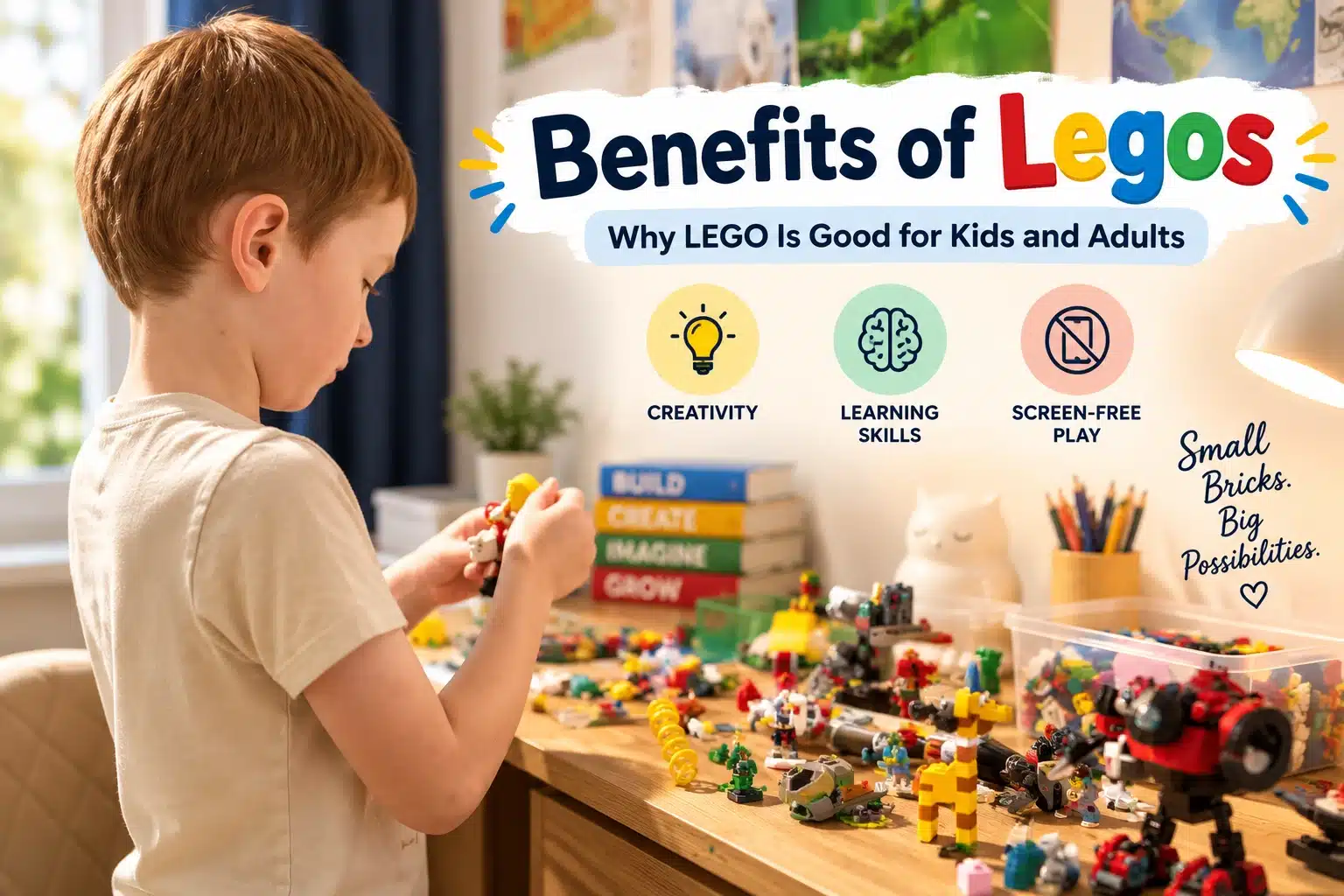
Benefits of LEGOs: Why Are LEGOs Good for Kids and Adults?
 Reading Time: 17 minutes
 There’s no doubt about it: the benefits of LEGOs go far beyond simply giving kids and adults something fun to build.
Some of my favorite childhood memories involve sitting on the floor with LEGO bricks, taking sets apart, rebuilding them, and turning the same collection of pieces into something completely different the next day.
Now, one of the things I enjoy most is getting to share that same experience with my wife and son.
Our LEGO collection has grown quite a bit over the years, and we have especially enjoyed Harry Potter, Sonic, NINJAGO, the newer Pokémon SMART Play sets, and plenty of other LEGO sets that have slowly taken over different parts of our home.
For us, though, LEGO is much more than another toy to collect.
Building together gives us uninterrupted family time, gets our phones out of our hands, challenges our brains in different ways, and gives my son something entertaining that also requires patience, coordination, creativity, and problem-solving.
Also, because we homeschool our son, LEGO has become a core part of our STEM learning and one of the hands-on tools we use to reinforce the broader benefits of homeschooling.
We also try to pair activities like LEGO with the other health and fitness tips for children we follow at home, so mental development, movement, sleep, nutrition, and screen habits all support each other rather than being treated separately.
Research on LEGO construction and block play suggests that these activities can engage spatial reasoning, visuospatial working memory, mathematical thinking, executive function, fine motor control, creativity, and social development, particularly when children are actively building rather than simply following instructions passively (McDougal et al., 2023; McDougal et al., 2024; Yogman et al., 2018).
Adults may benefit too, since building LEGO sets can provide a focused, screen-free activity that encourages creativity and sustained attention while creating an opportunity to relax, connect with other people, and become absorbed in something enjoyable.
That combination of cognitive stimulation, hands-on learning, creativity, family connection, and screen-free fun helps explain the wide-ranging benefits of Legos.
Are LEGOs Good for Kids?
Yes, LEGO bricks are an excellent toy for children because building combines physical manipulation, imagination, planning, spatial reasoning, trial and error, and problem-solving in the same activity.
The American Academy of Pediatrics emphasizes that developmentally appropriate play helps children develop cognitive, language, social-emotional, self-regulation, and executive-function skills (Yogman et al., 2018).
Construction toys are particularly interesting because children are not simply looking at something.
They have to manipulate pieces, determine how objects relate to one another, remember what they are trying to build, correct mistakes, and continuously adjust their plans.
That combination makes LEGO play what I would consider active entertainment.
Instead of a toy doing most of the work for the child, the child has to provide much of the thinking.
Are Legos Good for Your Brain?
One of the most common questions parents ask is, are Legos good for your brain?
Strong evidence shows that LEGO construction engages several cognitive abilities, though it would be an exaggeration to claim that simply playing with LEGO makes someone smarter.
Researchers have found relationships between LEGO construction ability, spatial skills, visuospatial memory, mental rotation, and mathematics performance in children (McDougal et al., 2023).
A 2024 controlled study took the research a step further by having 7- to 9-year-old children complete six weeks of physical LEGO training, digital LEGO training, or craft activities.
The children who trained with LEGO clearly improved their LEGO construction ability, and researchers found some evidence of transfer to arithmetic, although improvements across broader spatial and mathematical abilities were limited (McDougal et al., 2024).
That distinction matters.
LEGO should not be marketed as a shortcut to intelligence, but building does require the brain to repeatedly practice useful cognitive processes.
When you look at a partially completed model and determine where a particular piece belongs, for example, you may be using visual perception, working memory, spatial orientation, attention, and problem-solving simultaneously.
That is one reason LEGO can feel mentally engaging even when you are having fun.
What are the Benefits of LEGOs for Kids?
The benefits of LEGOs come from the way building combines thinking, movement, creativity, and play into one hands-on activity.
For kids, LEGO play can support spatial reasoning, fine motor skills, problem-solving, attention, creativity, and social development, while adults may benefit from the focus, relaxation, and screen-free mental engagement that come with building.
What makes LEGO especially valuable is that it can challenge the brain without feeling like structured work.
Whether someone is following detailed instructions, creating something from scratch, or building together as a family, the process encourages active participation rather than passive entertainment.
The specific benefits can differ between children and adults, but many of the same underlying skills, including concentration, planning, coordination, and creative thinking, can be developed and enjoyed at any age.
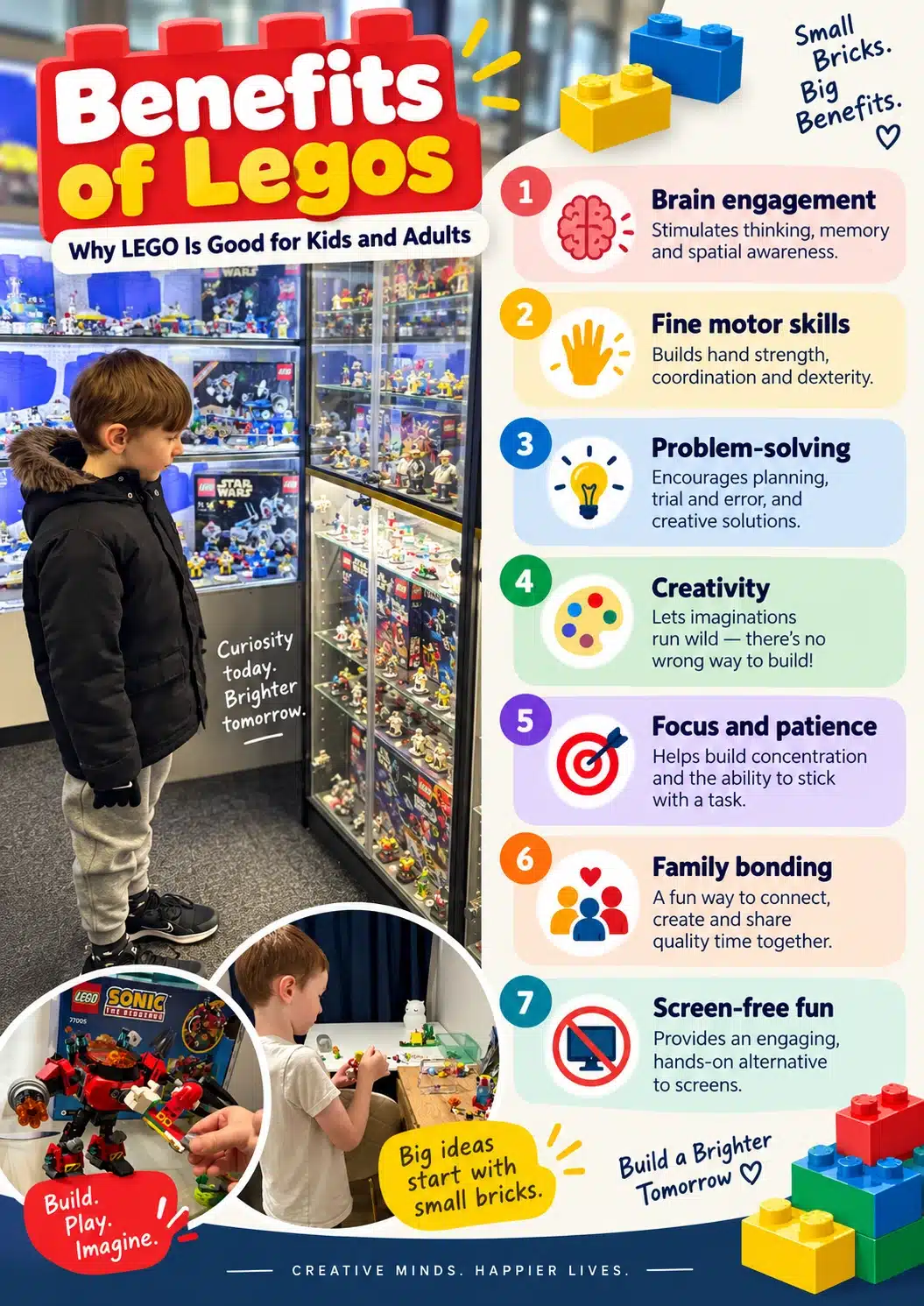
1.) LEGO Building Develops Spatial Reasoning
Spatial reasoning is probably one of the strongest arguments for the educational benefit of Legos.
Spatial reasoning involves understanding the position, shape, orientation, size, and movement of objects in space.
Imagine looking at an instruction booklet showing a LEGO brick from one angle and then needing to identify the correct piece and position it accurately on a three-dimensional structure.
Your brain has to translate visual information into physical action.
Research involving children has consistently connected LEGO construction ability with spatial abilities, including mental rotation and visuospatial processing (Brosnan, 1998; McDougal et al., 2023).
These spatial thinking skills are involved in mathematics, geometry, engineering, navigation, sports, architecture, science, and countless everyday activities.
2.) Playing With Legos Challenges Visuospatial Working Memory
Working memory allows us to temporarily hold and manipulate information while completing a task.
LEGO building frequently requires visuospatial working memory because you need to remember what a structure should look like while determining where individual pieces belong.
One study involving 7-year-old children found that LEGO construction ability was related to mathematics performance and visuospatial memory, with visuospatial memory helping explain the relationship between construction ability and mathematics (Richardson et al., 2014).
That does not prove that building LEGO sets automatically improves math grades.
However, it shows that construction play draws on cognitive systems that are also important for academic learning.
3.) LEGO Play Encourages Problem-Solving
Every LEGO builder eventually encounters the same situation.
Something does not fit.
Maybe you missed a piece five steps earlier, used the wrong brick, built something backward, or created your own structure that cannot support its weight.
You have to figure out what happened and find a solution.
For children, these small problems create repeated opportunities to practice analyzing a situation, changing strategies, and trying again.
The American Academy of Pediatrics identifies play as an important way for children to develop planning, problem-solving, attention, and executive-function skills (Yogman et al., 2018).
Sometimes the greatest LEGO benefits might come from the builds that do not work perfectly the first time.
4.) LEGO Can Support Executive Function
Executive function refers to a collection of mental skills that help us plan, maintain attention, remember instructions, regulate behavior, and complete goals.
Building a LEGO set naturally incorporates many of these processes.
A child has to organize pieces, follow a sequence, ignore distractions, keep track of progress, recognize errors, and continue working until the project is finished.
A randomized controlled trial examining semi-structured block play found improvements in early mathematics and executive-function outcomes among preschool children, suggesting construction play may be a useful way to support school-readiness skills (Schmitt et al., 2018).
LEGO is only one type of block play, but the underlying processes are similar.
5.) LEGO Builds Fine Motor Skills
Parents searching for the benefits of Legos for kids should not overlook what is happening with their children’s hands.
Picking up tiny pieces, rotating them, aligning studs, separating bricks, attaching accessories, and manipulating small LEGO figures require precise finger and hand movements.
These abilities fall under fine motor skills, sometimes casually called small motor skills.
Research examining block and LEGO play has reported improvements in fine motor development among preschool children, although some studies in this area are relatively small and should be interpreted cautiously (Fauziah & Puspitasari, 2024).
The mechanism itself also makes practical sense.
LEGO play requires repeated pinching, gripping, positioning, pushing, pulling, and bilateral hand coordination.
For young children, these movements provide repeated opportunities to practice hand-eye coordination and controlled finger movements.
6.) LEGO Encourages Hand-Eye Coordination and Visual-Motor Integration
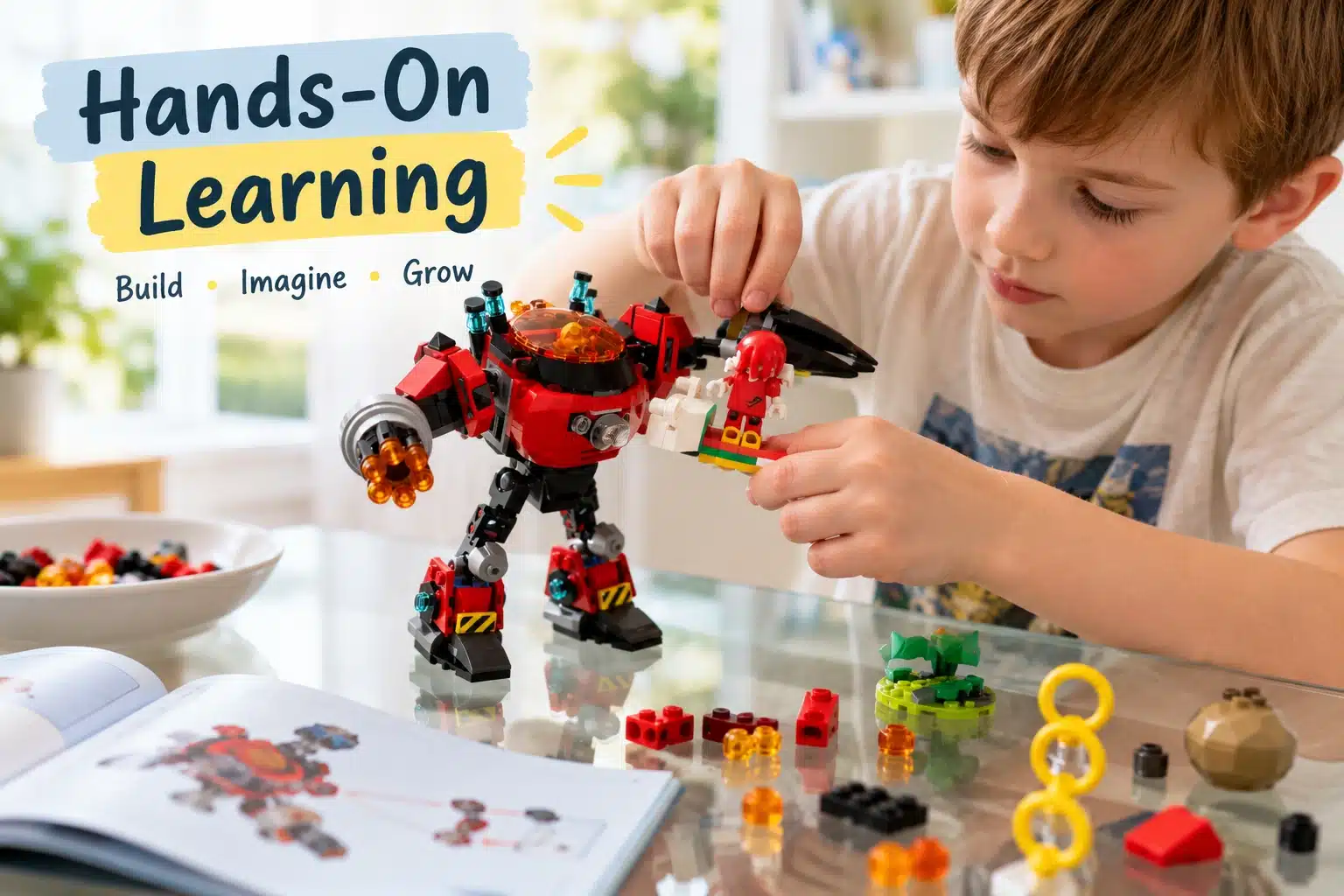
LEGO construction requires the eyes and hands to constantly communicate.
You see where a piece should go, determine its orientation, move your hand toward the structure, and make increasingly small adjustments until it fits.
This is a form of visual-motor integration.
Research on children’s block play has found relationships between construction activities, spatial visualization, and visual-motor coordination (Caldera et al., 1999).
Those skills are also used in drawing, writing, sports, crafts, using utensils, tying shoes, and many other daily activities.
7.) LEGO Can Encourage Mathematical Thinking
LEGO probably should not replace math homework, but building naturally exposes children to mathematical concepts.
Children count studs, compare lengths, identify symmetry, recognize patterns, estimate size, divide structures into sections, and learn how different dimensions relate to each other.
Research has repeatedly identified associations between LEGO construction ability and mathematics performance (McDougal et al., 2023; Richardson et al., 2014).
The 2024 LEGO training study also found some evidence of improvement in arithmetic following LEGO training, although broad transfer across mathematics and spatial skills was limited (McDougal et al., 2024).
That is a useful way to interpret the research: LEGO creates opportunities to practice mathematical and spatial thinking, but it should complement education rather than replace it.
8.) LEGO Supports Creativity and Imagination
There are really two different ways to play with LEGO.
You can follow instructions and construct exactly what the designers intended, or you can dump thousands of bricks onto the floor and create something that has never existed before.
Both have value.
Instruction-based building emphasizes attention, sequencing, spatial reasoning, and precision, while free building places greater demands on imagination, experimentation, and creative problem-solving.
One of the things I loved most about LEGO as a child was that finishing the official build did not mean the toy was finished.
You could take everything apart and create something entirely different.
That open-ended quality is difficult to reproduce with many modern toys.
9.) LEGO Teaches Patience and Persistence
Large LEGO sets can take hours, days, or sometimes much longer to complete.
Children quickly learn that the finished product does not appear immediately.
They have to work through hundreds of small steps before seeing the final result.
Along the way, pieces disappear under furniture, sections break, instructions get misread, and sometimes several steps need to be reversed.
Working through those frustrations can create natural opportunities to practice persistence.
Parents can make this even more valuable by resisting the temptation to immediately fix every mistake.
Sometimes giving a child enough time to identify and solve the problem independently is more useful than completing the build faster.
10.) LEGO Can Help Children Practice Focus and Attention
Building LEGO can require surprisingly long periods of concentration.
A complicated set may require a child to repeatedly search for specific pieces, interpret visual instructions, remember where they are in the sequence, and carefully complete each step.
Unlike rapidly changing digital entertainment, physical construction generally moves at the builder’s pace.
That does not mean LEGO should be promoted as a treatment for attention disorders, but it can provide an environment where sustained, goal-directed attention is naturally rewarded.
The reward is simple.
Pay attention long enough, and something begins to appear in your hands.
11.) LEGO Provides Valuable Screen-Free Play
One of my favorite benefits of LEGOs has almost nothing to do with the bricks themselves.
When my wife, son, and I are sitting together building something, our phones usually disappear.
That alone has become valuable.
The American Academy of Pediatrics continues to emphasize the developmental importance of real-world, screen-free play and meaningful interaction between children and caregivers (American Academy of Pediatrics, n.d.; Yogman et al., 2018).
LEGO gives families something to do together, rather than simply telling everyone to stop looking at screens.
I think that distinction matters.
Removing a phone creates an empty space, while building something together fills that space with conversation, attention, creativity, and a shared goal.
12.) LEGO Can Strengthen Parent-Child Bonding
Some of the biggest LEGO benefits have nothing to do with academic development.
Building together gives parents and children a shared project where conversation can happen naturally.
The American Academy of Pediatrics notes that play creates opportunities for parents to fully engage with their children, understand their perspective, communicate, and strengthen their relationship (Yogman et al., 2018).
I have experienced that personally with my son.
Sometimes we are working carefully through a set together, while other times he has a completely different idea for what something should become.
Both situations create opportunities for me to learn how he thinks rather than simply instructing him.
Our Pokémon, Harry Potter, and NINJAGO sets are fun to collect, but the memories I made while building them are far more valuable to me than the sets themselves.
13.) LEGO Can Develop Communication and Social Skills
LEGO becomes a social exercise when multiple people build together.
Someone searches for pieces, someone reads instructions, someone assembles a section, and eventually everyone has to coordinate what they are doing.
Children can practice asking questions, sharing materials, explaining ideas, negotiating disagreements, and cooperating toward a common goal.
Play more broadly is recognized as an important environment for developing communication, cooperation, emotional regulation, and social skills (Yogman et al., 2018).
Free building can be particularly interesting because children may have to explain ideas that exist only in their imagination.
Turning that internal idea into something another person can understand is a valuable communication challenge.
14.) LEGO Can Encourage Independent Play
Children do not always need adults organizing every minute of their entertainment.
One of the benefits of LEGO is that it can work equally well as a family activity or independent play.
Give a child a collection of bricks and no instructions, and suddenly they are responsible for deciding what happens next.
They choose what to build, determine which pieces they need, solve the problems they create, and decide when the project is finished.
That sense of ownership can be incredibly valuable.
The American Academy of Pediatrics has long emphasized that unstructured play gives children opportunities to practice creativity, problem-solving, decision-making, and independent exploration (Yogman et al., 2018).
What are the Benefits of LEGOs for Adults?
The benefits of LEGOs for adults are different from many of the developmental benefits that make LEGO valuable for children, as adults are generally not building LEGO sets to learn how to manipulate small objects or develop basic spatial concepts.
Instead, LEGO can provide focused leisure, creativity, relaxation, social connection, and an enjoyable way to temporarily disconnect from work and digital distractions.
There is less direct research on casual adult LEGO building than there is on child development, so some claims should remain modest.
However, research involving LEGO SERIOUS PLAY workshops has found that adults experienced higher components of flow and happiness compared with traditional meeting formats, along with greater creative output (Zenk et al., 2022).
That doesn’t mean every LEGO session brings psychological benefits, but it does something many adult builders intuitively understand: becoming deeply absorbed in a hands-on creative task can feel mentally different from scrolling on a phone.
LEGO Can Be a Form of Active Mental Recovery for Adults
When I say LEGO helps my brain rest, I do not mean my brain completely shuts off.
It is almost the opposite.
Building gives my attention one relatively simple, enjoyable place to go.
Instead of bouncing between notifications, emails, social media, work, news, and everything else competing for attention, I can concentrate on finding the next piece.
That kind of focused leisure can feel restorative even though the brain remains engaged.
Research in other creative activities provides some indirect support for this idea.
For example, one small study found that 45 minutes of art making reduced average salivary cortisol among healthy adults, although responses varied considerably between individuals and the research did not involve LEGO specifically (Kaimal et al., 2016).
I would therefore describe LEGO as a potentially relaxing hobby rather than a stress treatment.
For me, the benefit is straightforward.
It gives my mind somewhere enjoyable to be.
LEGO May Encourage Flow
You may have experienced an hour of LEGO building that somehow felt like 15 minutes.
Psychologists often describe this type of deep absorption as flow, a state where attention becomes strongly focused on an activity and awareness of time can change.
Research using LEGO SERIOUS PLAY found higher measures of certain flow components and happiness compared with conventional meetings (Zenk et al., 2022).
Again, structured LEGO SERIOUS PLAY is different from building a Harry Potter castle at home.
Still, the underlying experience of becoming completely absorbed in a challenging but manageable hands-on activity helps explain why so many adults find LEGO relaxing.
LEGO Gives Adults a Reason to Put Their Phones Down
This might be one of LEGO’s most underrated modern benefits.
Most adults already spend an enormous portion of their day interacting with screens.
- Work happens on screens.
- Entertainment happens on screens.
- Communication happens on screens.
- Even relaxation often means moving from a computer to a television and then to a phone.
LEGO offers something increasingly rare: tactile entertainment.
You are touching, sorting, examining, building, and creating something physical in front of you.
For my family, that makes LEGO time a natural opportunity to put our phones somewhere else and be present.
LEGO Can Be a Lifelong Family Hobby
One reason LEGO has remained part of my life is that it grows with you.
As a child, I loved building because it was fun.
As an adult, I still enjoy the building itself, but now I also appreciate the concentration, creativity, nostalgia, and family connection that come with it.
Then my son gave the hobby another dimension.
Seeing him become excited about a Pokémon or Sonic set reminds me of the excitement I felt opening LEGO sets when I was young.
My wife builds with us as well, which has turned something I originally loved as an individual hobby into one of the activities we share as a family.
That may be my favorite LEGO benefit of all.
Good toys entertain a child for a while.
Great toys can become part of a family’s story.
Following Instructions vs. Free-Building With LEGO
Parents sometimes wonder whether children get more educational value from following LEGO instructions or creating their own designs.
I think children should do both.
Following instructions develops sequencing, attention to detail, visual-spatial interpretation, persistence, and the ability to work toward a predefined goal.
Free building shifts the challenge toward creativity, planning, experimentation, storytelling, and open-ended problem-solving.
A simple strategy is to build the official model first and then eventually give your child permission to destroy it.
That might sound painful after spending hours constructing it, but taking sets apart and combining pieces creates an entirely new learning environment.
The instructions disappear.
Now the child has to become the designer.
How New LEGO Sets Keep Kids Interested
Another advantage of LEGO is that children can connect construction play with subjects they already love.
That has definitely happened with my son.
Pokémon, Sonic, Harry Potter, and NINJAGO give him recognizable characters and worlds, while the LEGO format turns those interests into something he can physically build and manipulate.
The newer LEGO Pokémon SMART Play sets are particularly interesting because LEGO designed them to add interactive responses while maintaining screen-free physical play.
According to the LEGO Group, the Pokémon SMART Play lineup, introduced in 2026, uses SMART Bricks, figures, and tags to create interactive play experiences that include training, nurturing, exploring, and battling Pokémon (The LEGO Group, 2026).
Technology does not automatically make a toy educational.
However, I like the idea of using technology to make physical play more interactive rather than requiring children to stare at another screen.
Frequently Asked Questions About LEGO Benefits
Final Thoughts: What Are the Biggest Benefits of Legos?
After playing with LEGO throughout my childhood and now building sets with my wife and son, I think the biggest mistake is viewing LEGO as either purely educational or purely entertainment.
It can easily be both.
The research suggests meaningful connections between construction play and spatial reasoning, visuospatial memory, mathematics, executive function, fine motor development, creativity, and other skills involved in healthy childhood development.
At the same time, some of the strongest claims surrounding LEGO and brain development go beyond what current research can prove, and parents do not need to justify every toy through an academic outcome.
Sometimes play should simply be play.
For my family, LEGO gives us a reason to sit together, put our phones down, work toward something, talk, laugh, solve little problems, and create something we are excited to see when it is finished.
I loved LEGO when I was a kid.
Now I get to watch my son love it too, while my wife and I get just as invested in finding the missing piece or finishing the next section.
Considering how many forms of entertainment demand very little from us other than staring at a screen, I appreciate having something in our house that asks us to use our hands, attention, imagination, and brains.
That combination is probably the simplest explanation for why Legos are good for kids and adults.
This website does not provide medical advice. This website site does contain affiliate links, and purchases may earn a commission.
Read my Medical Disclaimer, Review Disclaimer, and Publishing Policies for more details. Use of this site indicates acceptance of these terms.
Check Out Some of My YouTube Videos Below, and Please Follow on YouTube for More Educational Health and Fitness Content!
![Subscribe to @AdamKempFitness for more training, general health, recovery, and nutrition tips from a professional basketball player with a master’s degree in Nutrition Education! 🏀💪
Seated Max Vertical Jumps From a Box are one way I train explosive takeoff power with maximum intent on every rep.
Starting seated, with a pause and minimal rocking or dipping, reduces the contribution of a quick countermovement and emphasizes producing force from a relatively static position (National Strength and Conditioning Association [NSCA], 2020).
For athletes, the training goal is explosive lower-body force production and coordinated extension through the hips, knees, and ankles. I use this variation to practice driving hard into the floor and accelerating my body upward.
My preferred setup: 3 sets of 3 reps or 4 sets of 2 reps, supersetted with a strength or power exercise.
I keep the reps low, reset between jumps, and take longer rest periods so I’m ready to attack every takeoff. Even when pairing exercises, I give myself enough recovery to keep the jumps sharp.
Every rep has one goal: jump as high as possible. I focus on an explosive takeoff, a controlled landing, and consistent quality throughout the session.
Save this for your next power workout! 🚀
Reference: NSCA. (2020). Stretch-shortening cycle.
#VerticalJump #JumpTraining #ExplosivePower #AthleticPerformance #BasketballTraining](https://www.adamkempfitness.com/wp-content/plugins/feeds-for-youtube/img/placeholder.png)