How to Get More Vitamins and Minerals in Your Diet
 Reading Time: 16 minutes
 Learning how to get more vitamins and minerals in your diet doesn’t require chasing a perfect grocery trip or buying a cabinet full of supplements.
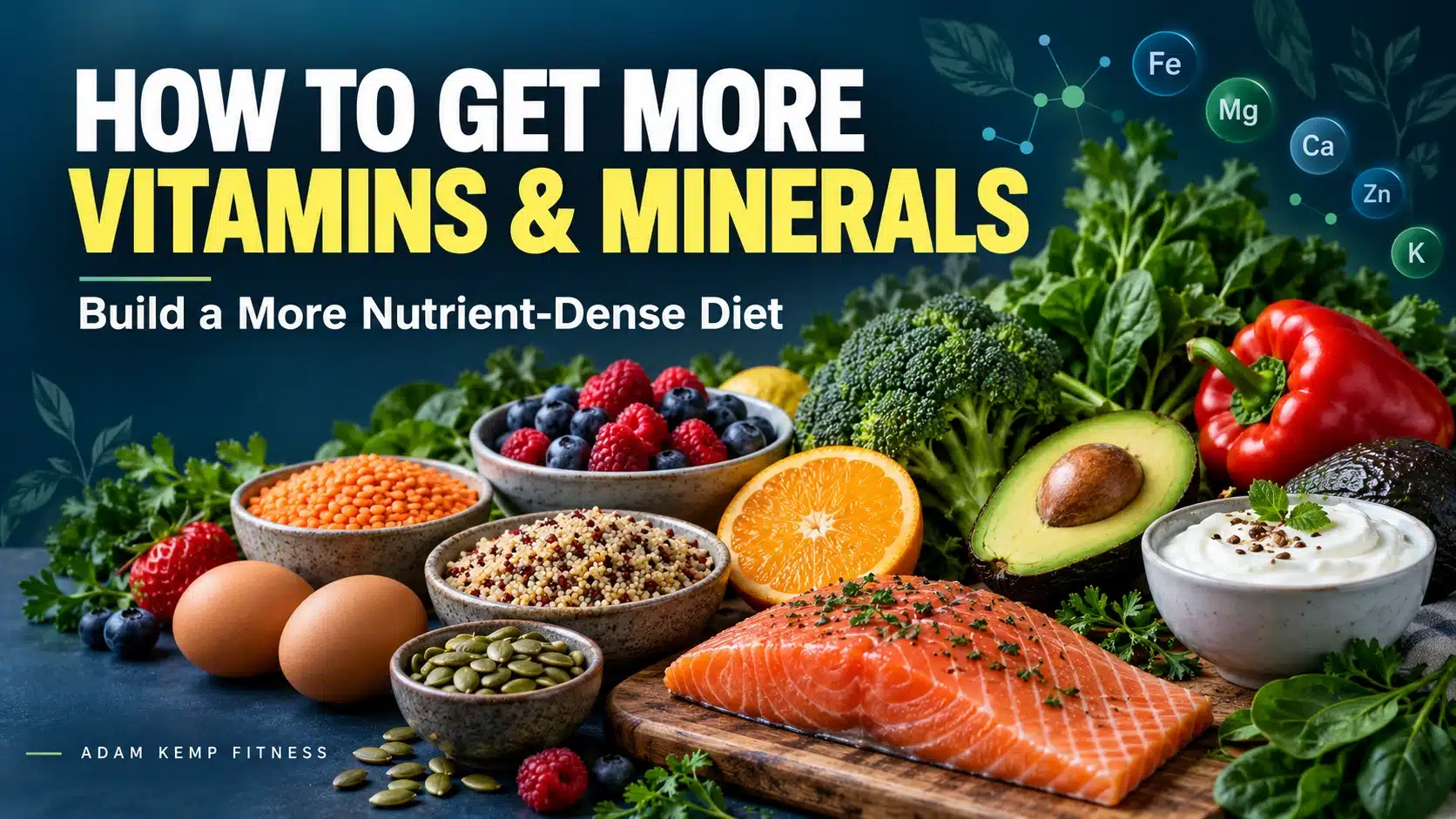
The most reliable strategy is to make nutrient-dense foods the foundation of your meals, use fortified foods strategically, and supplement only where food, lifestyle, or a medical condition leaves a meaningful gap.
Calories matter because they provide energy, and protein, carbohydrates, and dietary fats matter because the body needs them in relatively large amounts.
However, meeting calorie and macronutrient targets does not guarantee that you are getting enough iron, calcium, zinc, magnesium, iodine, potassium, or vitamins A, B12, C, D, E, and K.
That distinction explains why someone can consume plenty of calories, or have a larger body, and still have one or more nutrient deficiencies.
Malnutrition includes deficiencies, excesses, and imbalances in nutrient intake, so a person can have both undernutrition and overweight (World Health Organization [WHO], 2024).
What Is a Nutrient-Dense Diet?
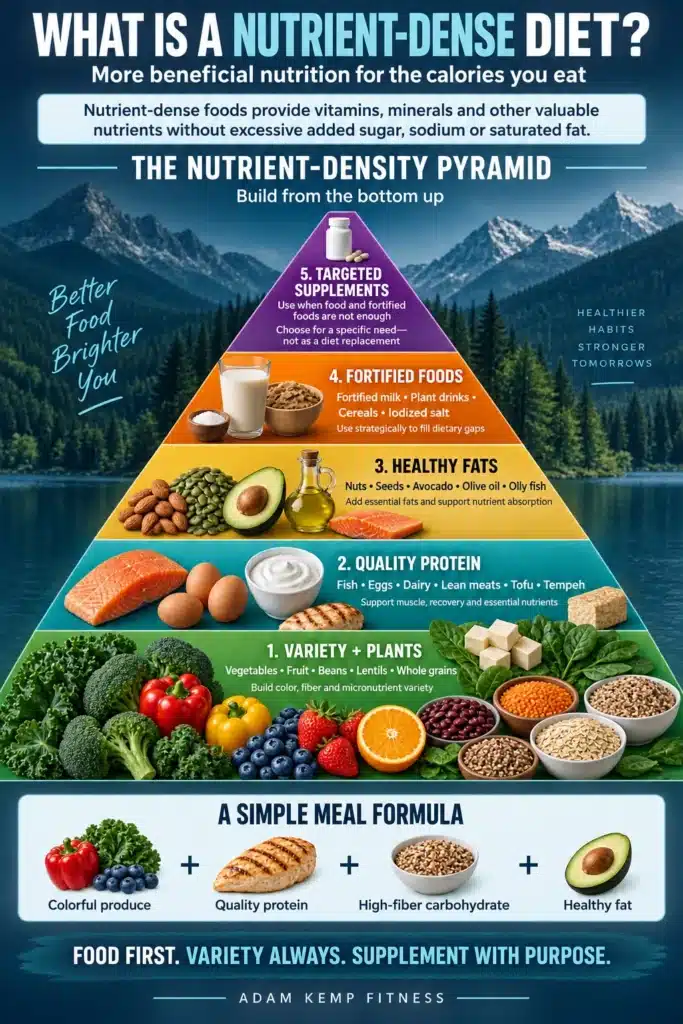
Nutrient density describes how much beneficial nutrition a food provides relative to its calories.
Nutrient-dense foods tend to provide several vitamins, minerals, protein, fiber, essential fatty acids, or other useful compounds without excessive added sugar, sodium, or saturated fat.
Vegetables, fruits, beans, lentils, nuts, seeds, whole grains, eggs, dairy products, fish, seafood, and lean meats can all contribute to a nutrient-dense diet.
No single food supplies everything, which is why variety across food groups is more valuable than depending on one fashionable “superfood.”
Vitamins and Minerals vs. Calories and Macronutrients
Carbohydrates and fat provide most of the energy measured in calories, while protein supplies amino acids needed for tissue maintenance and many other functions.
Vitamins and minerals do not provide calories, but they help regulate energy metabolism, oxygen transport, bone health, nerve function, immunity, fluid balance, and countless chemical reactions.
This creates two separate questions:
- Are you eating enough, or too much, total energy and the appropriate balance of protein, carbohydrates, and fats?
- Does that food provide the range of micronutrients your body needs?
A diet can answer the first question well and the second poorly.
For example, a person could reach 2,500 calories and a high protein target through refined snack foods, sugary drinks, and a limited selection of protein products while consistently missing fiber, potassium, magnesium, vitamin C, folate, or other micronutrients.
The Role of Foods and Drinks
Food should carry most of the nutritional workload because meals can provide micronutrients alongside protein, fiber, healthy fats, and a complex food matrix. Drinks can either support that foundation or quietly displace it.
Water remains the default hydration choice, but milk, fortified soy milk, kefir, and some fortified plant drinks can contribute protein, calcium, vitamin D, vitamin B12, iodine, or potassium.
Smoothies can also be nutrient-dense when made with whole fruit or vegetables, a protein source, and nuts or seeds, though they are easier to consume quickly than solid meals.
Coffee and tea contain bioactive compounds but should not be treated as multivitamins.
When iron status is a concern, avoid routinely drinking tea or coffee with iron-rich meals because their polyphenols can reduce nonheme iron absorption.
Sugar-sweetened drinks and many alcoholic beverages supply calories with little micronutrient value.
Juice can provide vitamins, but whole fruit is usually more filling and preserves more fiber, so juice is best viewed as an optional contributor rather than a replacement for fruit and water.
Cold-pressed juice is an exception as it usually preserves some fiber as well, and a more substantial amount of vitamins and minerals.
For these reasons, juicing once a day at home is a relatively simple way to get more vitamins and minerals in your diet.
When Fortified Foods Are Helpful
Fortification adds nutrients that were not naturally present in meaningful amounts, while enrichment restores certain nutrients lost during processing.
Both approaches can improve population nutrition and help individuals meet specific needs.
Useful examples include:
- Iodized salt for iodine
- Milk or plant-based drinks fortified with vitamin D
- Plant-based drinks and cereals fortified with vitamin B12
- Calcium-fortified plant drinks or orange juice
- Enriched grain products containing iron and folic acid
- Fortified breakfast cereals providing iron, B vitamins, or vitamin D
Fortified foods are especially valuable when dietary restrictions remove a major natural source.
Vegans, for example, need a reliable source of vitamin B12 from fortified foods or supplements because unfortified plant foods are not dependable sources (NIH ODS, 2025b).
Fortification does not automatically make a product healthy.
Compare labels because two plant milks or breakfast cereals can look similar while containing very different amounts of protein, calcium, vitamin D, vitamin B12, added sugar, and sodium.
The Role of Multivitamin Supplements
A multivitamin can provide nutritional insurance in some situations, but it cannot turn a low-quality diet into a nutrient-dense one.
Supplements generally do not provide the protein, fiber, essential fats, potassium, and a wide range of food components found in balanced meals.
The limitation is not simply that all multivitamins have “bad absorption.”
Absorption varies by nutrient form, dose, timing, health status, and interactions; some supplemental nutrients are absorbed well, while others compete with one another or are poorly matched to an individual’s needs.
Foods also provide nutrients in combinations that can matter.
Fat helps with fat-soluble vitamins, vitamin C supports nonheme iron absorption, and fermented dairy can deliver protein, calcium, and other nutrients together; this broader food matrix is one reason pills should normally supplement rather than replace a strong diet.
Multivitamins also create two practical problems: their broad formulas may provide too little of the nutrient you truly need and unnecessary amounts of nutrients you already get.
High doses can cause harm or interact with medicines, so more is not automatically better (National Center for Complementary and Integrative Health [NCCIH], 2024).
When Targeted Supplements Are Appropriate
A specific supplement may be appropriate when there is a known dietary gap, increased requirement, a laboratory-confirmed deficiency, an absorption problem, or a life-stage recommendation.
Common examples include vitamin B12 for vegans, folic acid around conception, vitamin D supplements when intake and sun exposure are inadequate, or iron under medical supervision after deficiency is identified.
Choose the smallest effective intervention: improve food intake where practical, add a fortified food when it reliably solves the problem, or use a targeted supplement when food is insufficient.
Athletes should also select third-party-tested supplements to reduce the risk of contamination with undeclared substances.
Can You Be Overweight and Malnourished?
Yes. Body weight reflects energy balance over time, but it doesn’t show whether a person meets every vitamin and mineral requirement.
The coexistence of excess body weight and micronutrient inadequacy is part of what public-health researchers call the double burden of malnutrition.
A calorie-rich but monotonous diet can promote weight gain while providing too little of particular nutrients, especially when nutrient-poor foods repeatedly displace vegetables, fruit, legumes, whole grains, seafood, dairy, or other nutrient-rich choices (WHO, 2024).
This does not mean that everyone with overweight is deficient or that everyone at a lower weight is well nourished.
Nutrient status depends on food choices, absorption, health conditions, medications, life stage, sun exposure, and other factors that cannot be determined from appearance alone.
What Are Empty Calories?
“Empty calories” is an informal term for foods and drinks that supply substantial energy but relatively little protein, fiber, vitamins, or minerals.
They are not always literally empty, since many still contain small amounts of nutrients, but they use part of your calorie budget without doing much to meet broader nutritional needs.
Common examples include sugar-sweetened drinks, candy, many desserts, and some highly refined snack foods.
Frequent intake of added sugars can make it harder to meet nutrient needs while remaining within an appropriate calorie range (U.S. Food and Drug Administration [FDA], 2024).
An occasional dessert does not cause malnutrition, and a nutrient-dense diet does not require absolute restriction.
The larger concern is displacement: when low-nutrient foods and drinks become so frequent that there is no longer enough room, appetite, or calorie allowance for foods that provide what the body needs.
How to Get More Vitamins and Minerals from Food
If you want to get more vitamins and minerals in your diet, the most important change isn’t adding a supplement; it is improving the nutritional value of the meals you already eat.
These steps create the foundation for getting more vitamins and minerals in your diet:
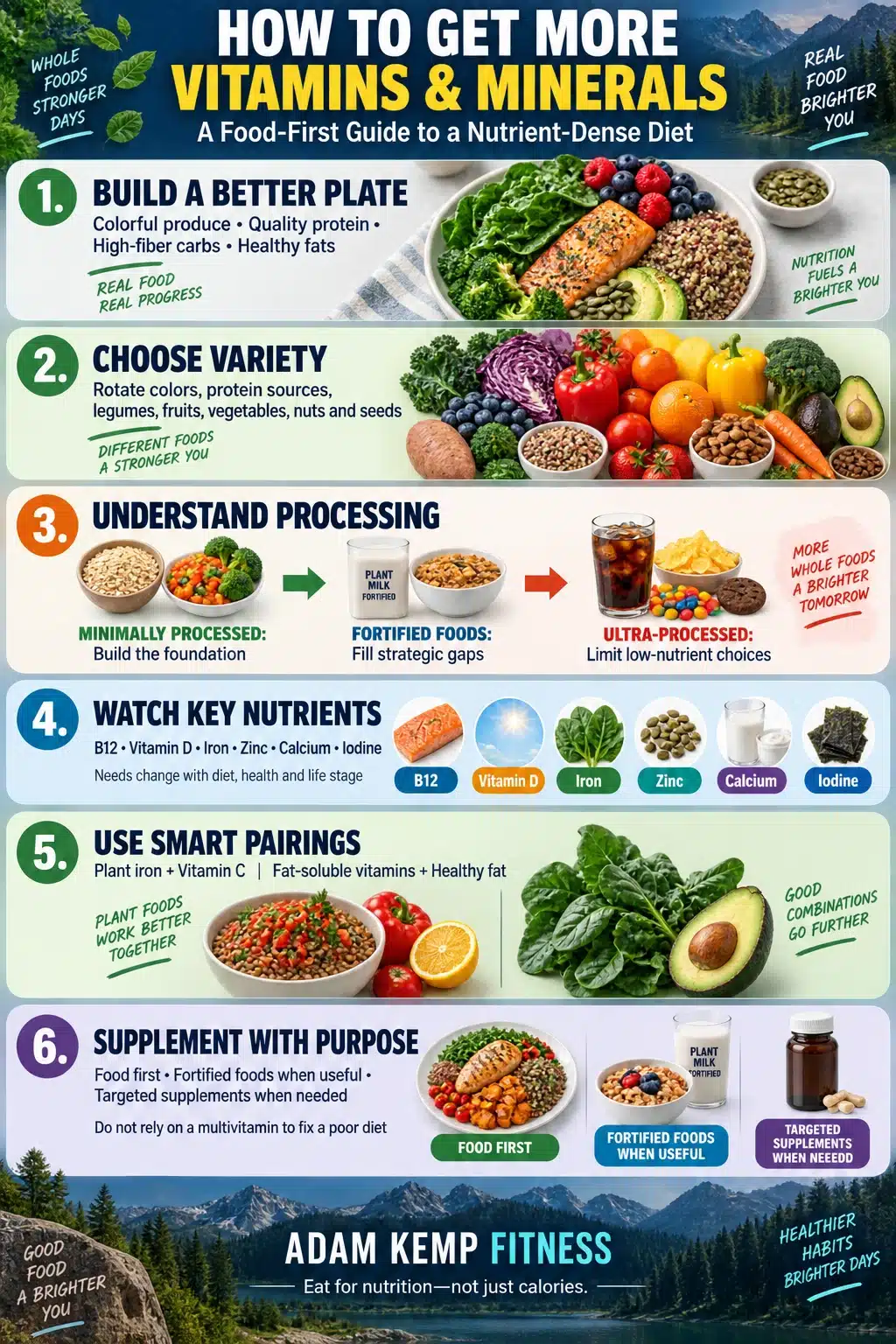
1.) Build Most Meals Around Four Nutritional Roles
Aim to include:
- A colorful fruit or vegetable: leafy greens, berries, peppers, tomatoes, carrots, broccoli, citrus fruit, squash, or another seasonal option
- A quality protein source: fish, eggs, poultry, lean meat, Greek yogurt, cottage cheese, tofu, tempeh, beans, or lentils
- A high-fiber carbohydrate: potatoes, oats, quinoa, brown rice, whole-grain bread, beans, fruit, or another minimally processed starch
- A source of healthy fat: nuts, seeds, avocado, olives, olive oil, or oily fish
This is not a rigid formula, but it makes dietary gaps less likely.
A lentil bowl with vegetables, brown rice, pumpkin seeds, and a yogurt-based sauce, for example, covers more nutritional ground than a meal built around one isolated macronutrient.
2.) Eat a Wider Variety of Foods Across the Week
Variety matters because different foods specialize in different nutrients.
Citrus fruit and peppers are rich in vitamin C; dairy and calcium-set tofu provide calcium; beans provide folate, iron, magnesium, and potassium; seafood provides iodine, selenium, vitamin B12, and omega-3 fats.
Instead of trying to eat every nutrient every day, rotate food families across the week.
Use different-colored vegetables, alternate beans and lentils, vary protein sources, and switch between several fruits, whole grains, nuts, and seeds.
3.) Upgrade Foods You Already Eat
Small substitutions are often easier to sustain than rebuilding your entire diet.
Choose whole-grain bread instead of refined bread, add berries and seeds to oatmeal, add vegetables to eggs or pasta, replace some of the meat in chili with beans, or choose fortified milk or a plant drink instead of a beverage with little nutritional value.
These upgrades can increase fiber and micronutrient intake without requiring complicated recipes.
They also preserve familiar meals, which makes consistency more realistic.
4.) Pair Foods to Improve Absorption
The amount listed on a food label isn’t always what your body absorbs.
Nutrient form, the rest of your meal, digestive health, and your current nutrient status all affect bioavailability.
Pair plant sources of iron, such as lentils, beans, tofu, or fortified grains, with vitamin C-rich foods such as peppers, citrus fruit, kiwi, strawberries, or broccoli.
Vitamin C improves nonheme iron absorption, while plant compounds such as phytate can reduce it (National Institutes of Health Office of Dietary Supplements [NIH ODS], 2025a).
Fat-soluble vitamins A, D, E, and K are generally better supported by meals that contain some dietary fat.
Meanwhile, soaking, sprouting, fermenting, and cooking certain legumes and grains may reduce some antinutritional compounds, although a varied diet usually matters more than micromanaging every preparation method.
5.) Preserve Nutrition Without Fearing Convenience
“Convenient” and “unhealthy” are not synonyms.
Frozen vegetables and fruit, canned beans, canned fish, plain yogurt, prewashed greens, nut butter, and microwaveable whole grains can make a nutritious diet easier.
Frozen produce can be especially helpful because it is harvested, preserved, and ready when needed, which reduces spoilage and removes a common barrier to eating more plants.
Choose products based on their overall nutritional profile rather than assuming fresh always means better.
Understanding Minimally Processed, Processed, and Ultra-Processed Foods
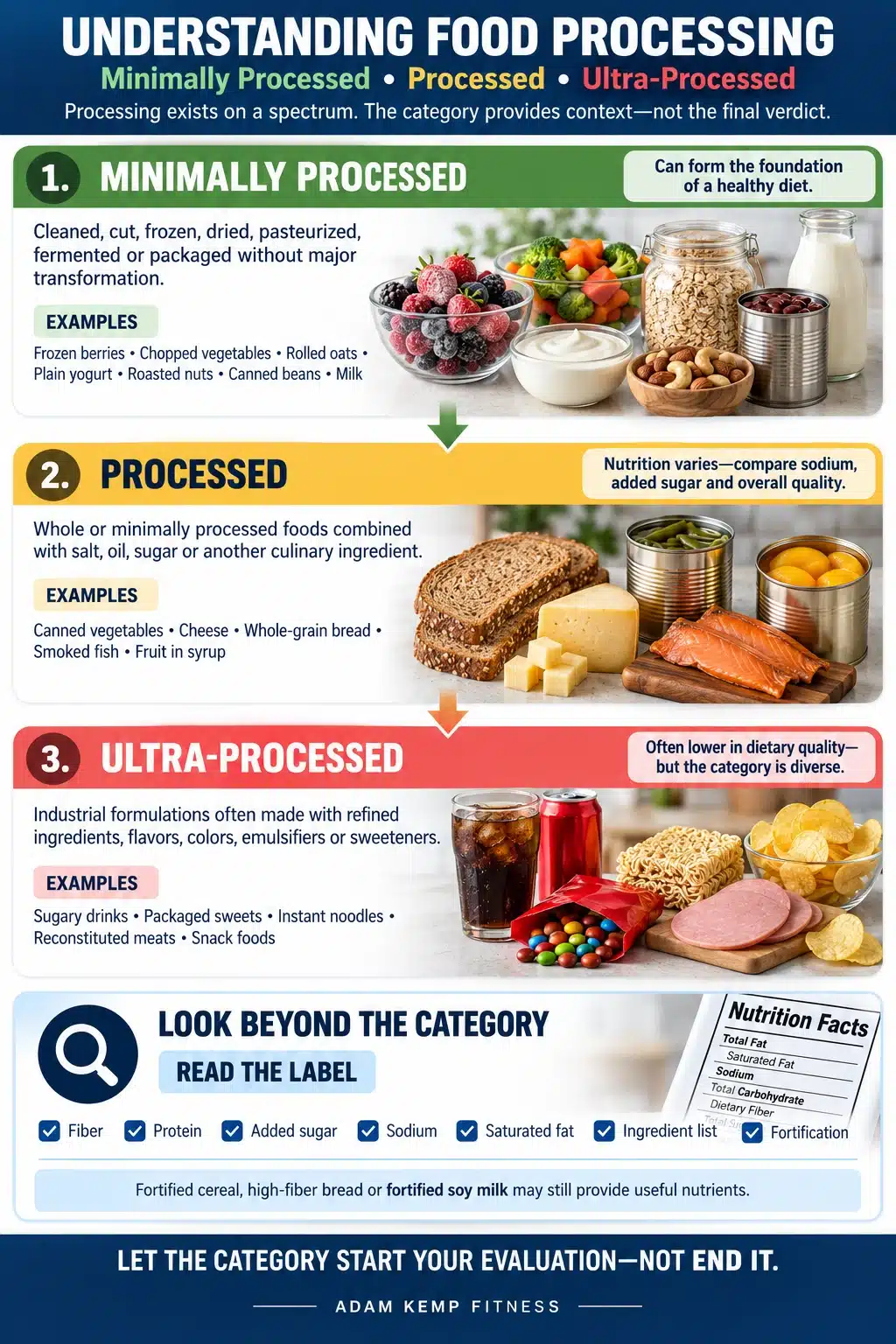
Food processing exists on a spectrum.
The degree of processing can be useful context, but it should not replace reading the ingredient list and Nutrition Facts label.
Minimally Processed Foods
Minimally processed foods have been cleaned, cut, frozen, dried, pasteurized, fermented, or packaged without fundamental transformation.
Examples include frozen berries, chopped vegetables, rolled oats, plain yogurt, roasted nuts, canned beans, and pasteurized milk.
These foods often retain much of their original nutritional value and can form the majority of a healthy diet.
Processing that improves safety, storage, accessibility, or convenience is not inherently harmful.
Processed Foods
Processed foods generally combine a whole or minimally processed food with salt, oil, sugar, or another culinary ingredient.
Examples can include canned vegetables with salt, cheese, whole-grain bread, smoked fish, or fruit canned in syrup.
Their nutritional value varies widely.
A processed whole-grain bread or canned bean may support a nutrient-dense diet, while a product with excessive sodium or added sugar may be better used less often.
Ultra-Processed Foods
Ultra-processed foods are industrial formulations that often contain refined ingredients, flavors, colors, emulsifiers, sweeteners, or other additives and may bear little resemblance to the foods from which their ingredients originated.
Many packaged sweets, sugary drinks, instant noodles, reconstituted meat products, and snack foods fit this category.
Higher ultra-processed food intake is often linked to poorer overall dietary quality, and U.S. data show these products contribute a disproportionate share of added sugar intake (Martínez Steele et al., 2016).
However, the category is diverse, so the label “ultra-processed” should begin a nutritional evaluation rather than end it.
A fortified whole-grain cereal, high-fiber bread, or fortified soy milk may be substantially processed while still providing nutrients that are difficult for some people to get.
Judge these foods by their fiber, protein, added sugar, sodium, saturated fat, ingredient list, fortification, and role in your overall diet.
Nutrients That Deserve Special Attention
The nutrients most likely to need attention depend on what you eat, your age, sex, health, medications, location, and life stage.
The table below is a screening guide, not a diagnosis or a reason to supplement blindly.
| Nutrient | Who may need closer attention? | Useful food sources and strategies |
|---|---|---|
| Vitamin B12 | Vegans; some vegetarians; older adults; people using certain acid-reducing drugs or metformin; people with absorption disorders | Fish, meat, eggs, dairy, fortified cereals, fortified nutritional yeast, fortified plant drinks, or a reliable supplement |
| Vitamin D | People with limited sun exposure, darker skin, malabsorption, or diets low in fortified foods and oily fish | Salmon, trout, egg yolks, fortified dairy or plant drinks, UV-exposed mushrooms, and supplements when indicated |
| Iron | People with heavy menstrual bleeding, pregnant people, frequent blood donors, endurance athletes, and vegetarians or vegans | Meat and shellfish; or beans, lentils, tofu, seeds, and fortified grains paired with vitamin C |
| Zinc | Vegans and vegetarians, especially with high-phytate diets; people with certain digestive disorders | Oysters, meat, dairy, beans, nuts, seeds, fortified cereal; use soaking, sprouting, or fermentation when practical |
| Calcium | People who avoid dairy without replacing it; postmenopausal adults; people with low food intake | Dairy, calcium-set tofu, canned sardines or salmon with bones, kale, bok choy, and fortified plant drinks |
| Iodine | Vegans, people who avoid seafood and dairy, pregnant people, and people who use only non-iodized specialty salts | Iodized salt, seafood, dairy, eggs, or clinician-guided supplementation; seaweed content is highly variable |
| Folate | People who rarely eat legumes or leafy greens; anyone who may become pregnant | Lentils, beans, asparagus, leafy greens, avocado, citrus, and enriched grains; folic acid is recommended around conception |
| Omega-3 fats | People who do not eat fish or seafood | Salmon, sardines, trout, walnuts, chia, flax, hemp, and algae-derived EPA/DHA when appropriate |
Vitamin B12 for Vegan and Vegetarian Diets
Vitamin B12 deserves the clearest warning because deficiency can cause megaloblastic anemia and neurological changes, and symptoms may take years to become obvious.
Vegans should not rely on spirulina, fermented foods, or unfortified nutritional yeast as dependable sources (NIH ODS, 2025b).
Vegetarians who eat eggs and dairy may obtain some B12, but adequacy depends on the quantities consumed.
Check labels on fortified products and discuss an appropriate supplement with a qualified healthcare professional if intake is inconsistent.
Zinc and Iron on Plant-Based Diets
Plant foods can provide substantial zinc and iron, but absorption can be lower because phytate binds these minerals.
NIH guidance notes that vegetarians have higher iron requirements because nonheme iron is less bioavailable, while beans, lentils, tofu, nuts, seeds, and fortified grains remain useful sources (NIH ODS, 2025a).
Regularly eating legumes, tofu or tempeh, nuts, seeds, and whole grains, and pairing plant iron with vitamin C, matters more than occasionally eating one “high-iron” vegetable.
Anyone with fatigue, weakness, shortness of breath, reduced exercise tolerance, or heavy menstrual bleeding should seek appropriate testing rather than self-prescribing high-dose iron.
Vitamin D Is Not Only a Vegan Issue
Vitamin D is naturally present in relatively few foods, so omnivores can also fall short.
Oily fish and fortified milk help, while fortified plant drinks and supplements can be especially important for people avoiding animal products.
Sun exposure contributes to vitamin D status, but season, latitude, skin pigmentation, clothing, sunscreen use, age, and time outdoors change how much is produced.
A blood test and professional guidance are more informative than guessing based on diet alone (NIH ODS, 2024a).
Other Dietary Patterns Create Different Gaps
A dairy-free diet requires deliberate replacement of calcium, vitamin D, iodine, and sometimes protein.
A gluten-free diet can be low in iron, folate, and fiber when you replace enriched wheat products mainly with refined rice- or starch-based alternatives.
Very low-carbohydrate diets may restrict fruit, legumes, whole grains, and some vegetables, potentially reducing fiber, potassium, magnesium, folate, and vitamin C.
Restrictive weight-loss and very low-calorie diets make adequacy harder because fewer calories leave less room to obtain all essential nutrients.
Can MyFitnessPal or Other Nutrition Trackers Help?
MyFitnessPal, Cronometer, MacroFactor, and similar apps can help identify repeated patterns.
A seven-day log may reveal that you rarely consume calcium-rich foods, that vegetables disappear on busy days, or that the same limited menu leaves several micronutrients consistently low.
However, the output is only an estimate.
User-created database entries can be inaccurate, serving sizes may be wrong, cooking changes nutrient content, and many product entries include calories and macronutrients but omit micronutrient data.
Use a tracker as an audit, not a diagnosis:
- Record seven reasonably typical days, including at least one weekend day.
- Weigh or measure unfamiliar portions, but do not let precision become obsessive.
- Choose verified or database-quality food entries whenever possible.
- Look at weekly averages rather than panicking over one low day.
- Investigate nutrients that remain low, then confirm whether entries contain complete data.
- Correct the pattern with food or fortified foods before assuming you need several supplements.
- Use medical history, symptoms, and laboratory testing when deficiency is plausible.
The Recommended Dietary Allowance is a planning target, not proof that every day below 100% causes a deficiency.
Similarly, reaching 100% in an app does not prove that a nutrient was absorbed or that blood levels are adequate.
A Simple Plan to Get More Vitamins and Minerals
If your diet currently feels inconsistent, start with these priorities in order:
- Replace one daily low-nutrient food or drink. Swap soda for water, fruit, milk, or a fortified alternative; replace candy with fruit and nuts; or exchange refined snacks for yogurt and berries.
- Add produce to two meals each day. Begin with options you will reliably eat, including frozen and canned choices.
- Include legumes several times per week. Beans, peas, and lentils provide a useful combination of fiber, protein, folate, iron, magnesium, and potassium.
- Rotate protein sources. Use a mix of fish, eggs, dairy, lean meats, tofu, tempeh, beans, or lentils according to your dietary preferences.
- Choose one dependable calcium source each day. Dairy, calcium-set tofu, bone-in canned fish, or a fortified plant drink are practical options.
- Identify your dietary-pattern risks. Vegans need reliable B12; dairy-free eaters need a calcium plan; people who avoid seafood and iodized salt should assess iodine.
- Audit one normal week. Use a tracker to find patterns, then focus on the two or three most consistent gaps.
- Test when appropriate. Persistent fatigue, neurological symptoms, unusual weakness, restrictive eating, heavy menstrual bleeding, digestive disease, or other risk factors deserve professional evaluation.
Do not try to correct every number overnight.
A few repeatable changes, such as vegetables at lunch and dinner, fruit and nuts for snacks, legumes several times per week, varied protein, and one intentional fortified food, can dramatically improve the nutrient density of an otherwise ordinary diet.
Frequently Asked Questions About Getting More Vitamins and Minerals in Your Diet
Final Thoughts: Improve the Diet Before Chasing Supplements
The best way to get more vitamins and minerals is to build a varied, nutrient-dense eating pattern that you can repeat. Whole and minimally processed foods should do most of the work, while carefully chosen fortified foods can solve practical gaps without undermining diet quality.
Supplements have a legitimate role, especially for vitamin B12 in vegan diets, diagnosed deficiencies, restricted diets, pregnancy, absorption problems, or limited vitamin D exposure.
They work best as targeted tools, not substitutes for the foods and drinks that shape your overall nutrition.
This website does not provide medical advice. This website site does contain affiliate links, and purchases may earn a commission.
Read my Medical Disclaimer, Review Disclaimer, and Publishing Policies for more details. Use of this site indicates acceptance of these terms.