
Healthy Sleep Habits for Wellness, Performance and More!
 Reading Time: 13 minutes
 Healthy sleep habits are the repeatable daily behaviors that give your body enough time, timing, and opportunity to sleep well.
They influence recovery, athletic performance, appetite, concentration, mood, immune function, and how consistently you can follow the rest of your health plan.
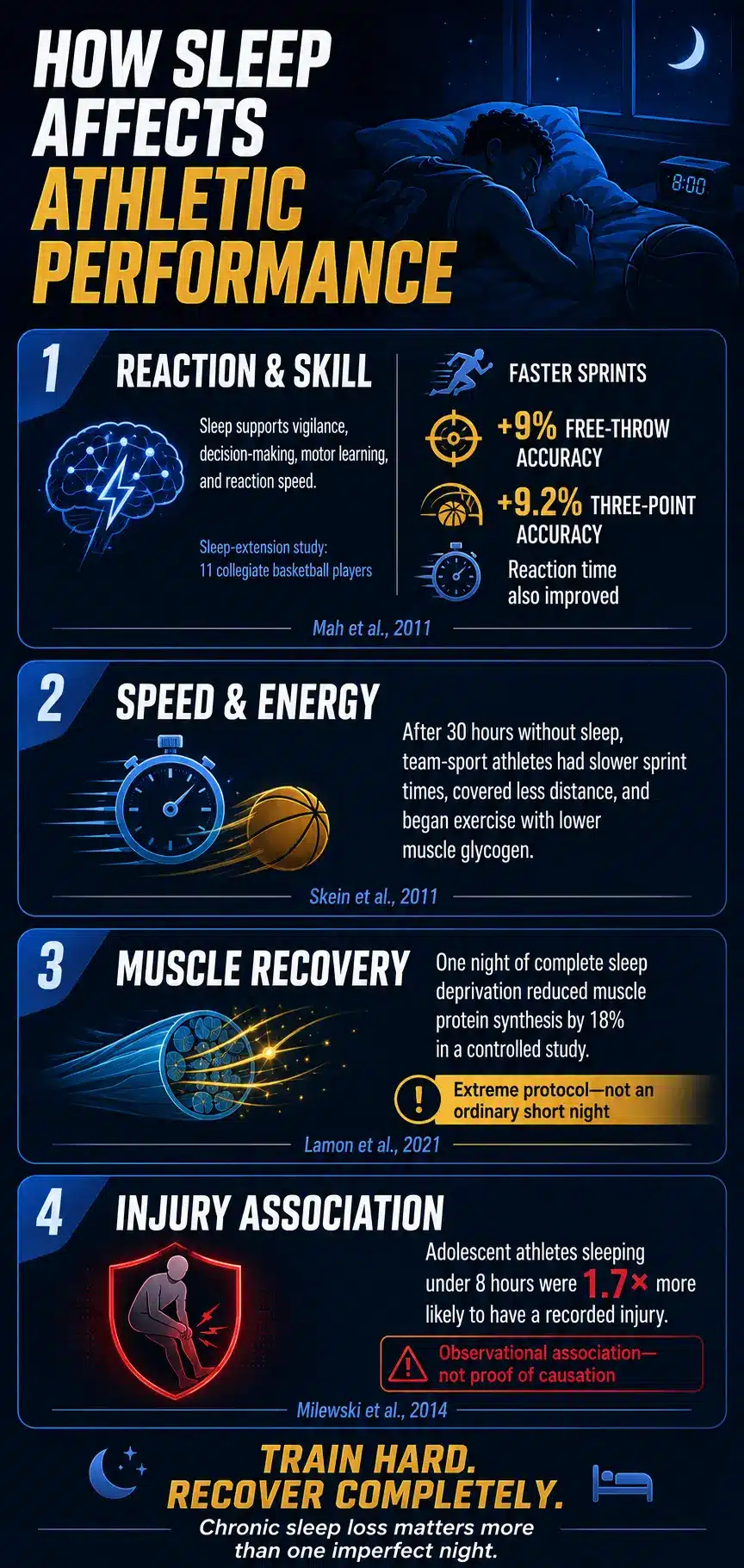
As a professional basketball player, sleep is not a passive luxury reserved for days off.
It is a performance behavior that is critical to my livelihood.
You can follow a smart training program and eat a high-quality diet, but poor sleep can make both less effective.
However, the goal is not a perfect nighttime routine or a collection of expensive sleep products; it is a practical system that works in everyday life and stays useful when training, travel, work, or family responsibilities disrupt your schedule.

Optimize Your Sleep.
Improve Your Performance.
Learn the exact sleep strategies I use as a professional athlete to improve recovery, boost energy, and perform at a higher level every day.
What Are Healthy Sleep Habits?
Healthy sleep habits are sometimes called sleep hygiene, but the term includes more than keeping your bedroom dark or avoiding your phone at night.
The most effective habits support the three main conditions your body needs for reliable sleep:
- Enough sleep opportunity: You allow adequate time in bed instead of trying to function on chronic sleep restriction.
- Stable circadian timing: Your wake time, light exposure, meals, and activity provide consistent signals to your internal body clock.
- Sufficient sleep pressure: You stay active during the day and avoid behaviors, such as long late-afternoon naps, that make it harder to feel sleepy at night.
Most adults should get at least seven hours of sleep regularly, although individual needs vary and many people function best with seven to nine hours (Watson et al., 2015).
Athletes and highly active adults may need more sleep during demanding training, competition, injury recovery, or travel.
But, sleep duration is only one part of healthy sleep.
Timing, regularity, continuity, and daytime functioning also matter, so spending eight hours in bed doesn’t necessarily mean you got eight hours of restorative sleep.
Why Healthy Sleep Habits Matter
Sleep supports attention, memory, emotional regulation, metabolic health, immune activity, motor learning, and physical recovery.
Repeated sleep restriction can also impair judgment while making people progressively less aware of how impaired they have become (Van Dongen et al., 2003).
For someone trying to lose fat, build muscle, improve athletic performance, or simply have more productive days, sleep can affect the behaviors that produce those outcomes.
Several poor nights can create a cycle where you rely on more caffeine, experience stronger food cravings, train with less focus, and stay up too late again.
A poor night doesn’t erase your progress, and worrying too much about sleep can make the next night harder.
The larger concern is the repeated pattern, not an occasional disruption.
For a closer look at these physical effects, read my guide to how sleep affects fitness and your body.
Athletes can also use my more specific guide to sleep optimization for athletic performance.
10 Healthy Sleep Habits That Actually Work
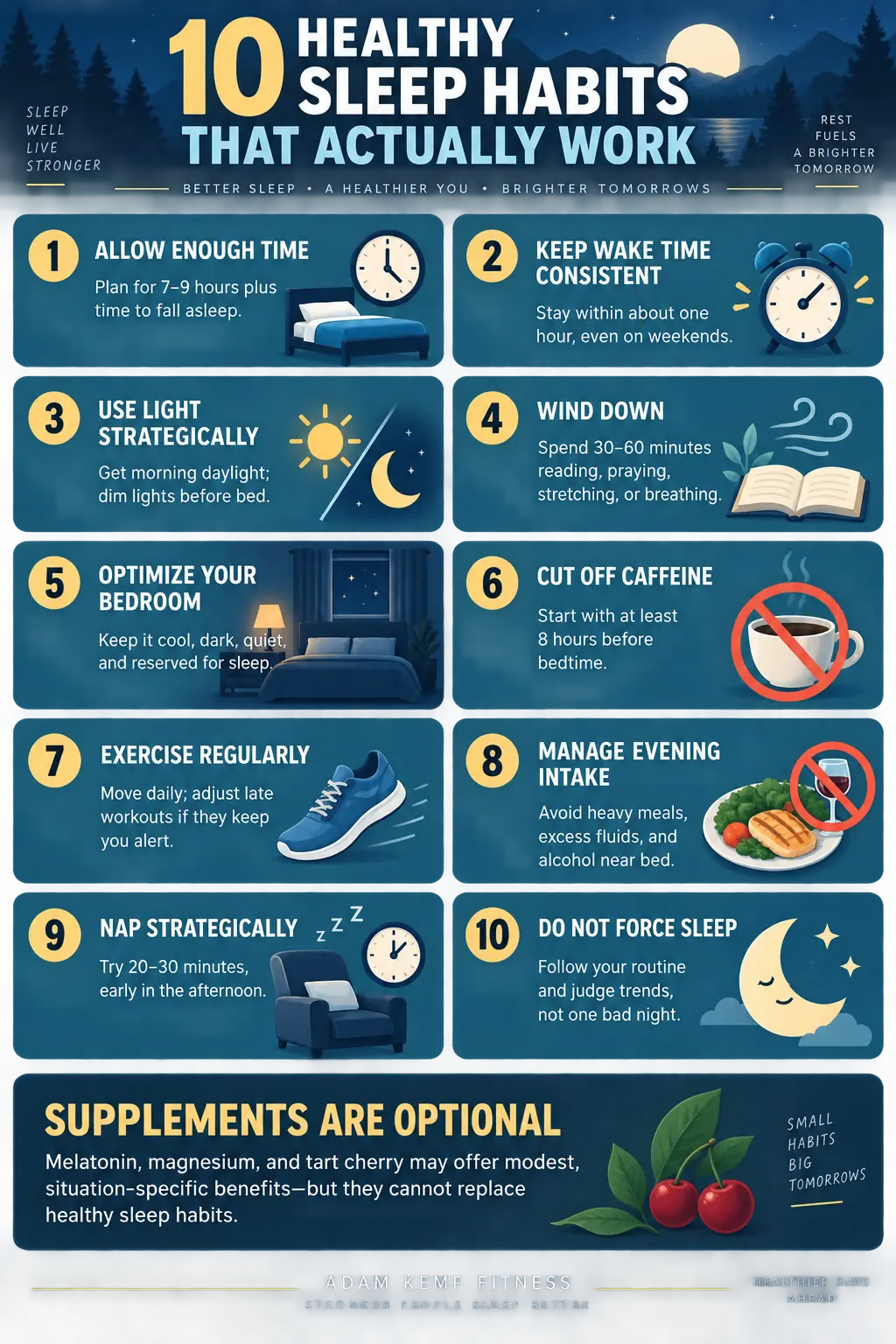
1.) Give Yourself Enough Time to Sleep
No bedtime routine can compensate for an inadequate sleep opportunity.
If you need eight hours of actual sleep, allowing exactly eight hours between going to bed and waking up probably isn’t enough, because you also need time to fall asleep and may briefly wake during the night.
Work backward from your required wake time and build in a realistic buffer.
If you must wake at 6:30 a.m., getting into bed around 10:00 p.m. may be more practical than expecting to fall asleep instantly at 10:30 p.m.
Do not judge your needs from one night.
Track your daytime energy, mood, concentration, training quality, and dependence on alarms or caffeine across several weeks.
2.) Keep Your Wake Time Consistent
A regular wake time is one of the most useful healthy sleep habits because it anchors your circadian rhythm.
This internal timing system helps coordinate sleepiness, alertness, body temperature, appetite, and hormone release.
Try to keep your wake time within approximately one hour on most days, including weekends.
You don’t need a rigid schedule, but shifting from a 6:30 a.m. weekday wake time to 10:30 a.m. every weekend can create social jet lag and make Sunday-night sleep harder.
If you need additional recovery, an earlier bedtime or a planned nap is often less disruptive than completely reversing your schedule.
3.) Get Bright Light Early and Dim Light at Night
Light is the strongest environmental signal for circadian timing.
Bright light after waking reinforces daytime alertness and can support earlier sleepiness that evening, while substantial late-night light exposure can shift sleep timing later (Blume et al., 2019).
Get outdoors after waking when possible.
A short walk, time on a balcony, or breakfast in natural light can help; outdoor light is generally much brighter than indoor lighting, even on a cloudy day.
In the final hour before bed, lower overhead lighting and screen brightness.
The goal is not to fear every source of blue light; it is to reduce both bright light and mentally stimulating content when you want your brain to transition toward sleep.
4.) Create a Short, Repeatable Wind-Down Routine
A good routine should reduce arousal rather than become another complicated task.
For the final 30 to 60 minutes before bed, finish demanding work and choose a few quiet activities you can repeat consistently.
Reading, prayer, a warm shower, light stretching, calm music, slow breathing, or writing down tomorrow’s priorities can all work.
The exact activity matters less than the predictable transition from an active day to a quieter night.
If stress is the main barrier, my guides to progressive muscle relaxation and healthy ways to unwind after a long day offer more targeted strategies.
5.) Make Your Bedroom Cool, Dark, Quiet, and Boring
Your bedroom should remove barriers to sleep.
Keep it comfortably cool, dark, and quiet, and set the temperature to your preference rather than treating one number as universally ideal.
Blackout curtains, an eye mask, earplugs, a fan, or steady background noise can help when you can’t control your environment.
A supportive mattress and pillow matter if discomfort repeatedly wakes you, but you don’t need expensive sleep technology.
Reserve your bed primarily for sleep and intimacy when practical.
Working, eating, gaming, and scrolling in bed can strengthen the association between the bed and wakefulness.
If you cannot fall asleep and are becoming frustrated, get out of bed and do something calm in dim light until sleepiness returns.
This principle is part of stimulus control, a core component of cognitive behavioral therapy for insomnia.
6.) Stop Using Caffeine Early Enough
Caffeine can improve alertness and exercise performance, but it can also reduce sleep duration or quality, even if you can still fall asleep.
In a controlled trial, 400 milligrams of caffeine taken six hours before bed reduced total sleep time by more than one hour (Drake et al., 2013).
A practical starting point is to stop caffeine at least eight hours before bedtime, then adjust for your dose and sensitivity.
Someone who metabolizes caffeine slowly or consumes a large pre-workout may need an earlier cutoff.
Remember that coffee is not the only source.
Energy drinks, pre-workout supplements, tea, chocolate, and some medications can contribute to your daily total; my guide to caffeine benefits, dosages, and side effects explains these tradeoffs in more detail.
7.) Exercise Regularly, but Adjust the Timing When Necessary
Regular exercise generally improves sleep quality and may reduce insomnia symptoms, though effects vary by exercise type, timing, fitness level, and individual (Kredlow et al., 2015).
Walking, resistance training, aerobic exercise, and sport can all contribute.
Evening exercise is not automatically harmful.
However, a hard late workout may delay sleep for people who remain physically hot, mentally stimulated, or reliant on pre-workout caffeine afterward.
If evening training consistently leaves you wired, move intense sessions earlier when possible.
When that isn’t realistic, extend your cooldown, reduce post-workout stimulation, avoid late stimulants, and ease into bed more calmly.
8.) Manage Evening Food, Fluids, and Alcohol
Going to bed very hungry can make it difficult to settle down, particularly after hard training.
A balanced dinner or a small pre-sleep snack with protein and carbohydrates may help when it fits your energy needs.
At the same time, large or high-fat meals immediately before lying down can worsen discomfort or acid reflux in susceptible people.
Excessive fluid close to bedtime can also increase nighttime bathroom trips.
Alcohol may make you feel sleepy, but sedation is not the same as healthy sleep.
Alcohol can fragment sleep later in the night and alter sleep architecture, especially at higher doses; read my full guide to alcohol and sleep for a deeper explanation (Ebrahim et al., 2013).
9.) Use Naps Strategically
Naps can improve alertness after travel, an early practice, a short night, or a demanding training block.
They are most useful when planned, not taken automatically whenever you feel tired.
For a quick reset, try approximately 20 to 30 minutes earlier in the afternoon.
Longer naps may help you recover after substantial sleep loss, but they are also more likely to cause sleep inertia or make it harder to fall asleep that night.
If you already struggle with insomnia, keep naps short, early, or temporarily remove them while rebuilding nighttime sleep pressure.
My article on the benefits and limitations of naps covers when longer naps may be appropriate.
10.) Protect Sleep Without Trying to Control It
Healthy sleep habits create favorable conditions, but sleep itself cannot be forced.
Constantly checking the clock, chasing a perfect wearable score, or panicking after a poor night can increase arousal and make sleep harder.
Use wearable data to observe long-term patterns rather than treating every sleep-stage estimate as a medical measurement.
Your daytime alertness, mood, training performance, and ability to function safely are often more meaningful than a single score.
After a poor night, return to your normal wake time, get morning light, use caffeine thoughtfully, and avoid dramatically changing the entire day.
Consistency usually helps more than an emotional attempt to “make up” every lost minute.
Can Sleep Supplements Improve a Healthy Sleep Routine?

Sleep aid supplements may provide a modest extra benefit in the right situation, but they are not substitutes for adequate sleep opportunity, consistent timing, or treatment of a sleep disorder.
The evidence also differs substantially by ingredient, dose, population, and outcome measured.
Introduce only one product at a time so you can evaluate benefits, side effects, and next-day alertness.
Check with a healthcare professional or pharmacist if you use prescription medication, are pregnant, have a medical condition, or plan to combine products.
Melatonin

Melatonin is a hormone involved in circadian timing, not simply a strong sedative.
Supplemental melatonin is most useful when the problem involves timing, such as jet lag, shift work, or a delayed sleep schedule; its average benefits for ordinary insomnia are usually modest (Ferracioli-Oda et al., 2013).
More is not necessarily better.
A low dose may be enough, and timing can matter as much as the dose, so taking a large amount at bedtime may cause next-day grogginess without addressing the underlying problem.
Read my complete melatonin guide before deciding whether it fits your routine.

Last update on 2026-09-17 / This article includes affiliate links/Images via Amazon Product Advertising API. I may earn commissions on purchases made through these links.
Magnesium
Magnesium plays a role in nervous-system function, but claims that it reliably acts as a sleep medication are stronger than the evidence.
Research is mixed, with possible benefits more likely in people who have low magnesium intake or existing sleep difficulties (Arab et al., 2023).
Magnesium glycinate is commonly chosen because it is generally well tolerated, while magnesium citrate is more likely to have a laxative effect.
Supplemental magnesium can interact with certain medications, and people with impaired kidney function should obtain medical guidance.
My guides to magnesium for sleep and the best magnesium sources and supplements for sleep explain the evidence and different forms in greater depth.
Two magnesium supplements I personally use for sleep are Qunol Magnesium Glycinate and Life Extension Magnesium L-Threonate.

Last update on 2026-09-17 / This article includes affiliate links/Images via Amazon Product Advertising API. I may earn commissions on purchases made through these links.

Last update on 2026-09-17 / This article includes affiliate links/Images via Amazon Product Advertising API. I may earn commissions on purchases made through these links.
Tart Cherry
Tart cherries contain polyphenols and small amounts of naturally occurring melatonin.
Small studies have reported improvements in certain sleep measures, but the evidence is limited, and tart cherry should not be treated as a proven insomnia therapy (Howatson et al., 2012).
Tart cherry juice or concentrate also contributes carbohydrates and calories, which may matter depending on your diet.
Athletes may find it more appealing when they want a product that could complement both sleep and exercise recovery, but expectations should remain realistic.

Last update on 2026-09-17 / This article includes affiliate links/Images via Amazon Product Advertising API. I may earn commissions on purchases made through these links.
Glycine
Small human studies suggest that approximately 3 grams of glycine before bed may improve subjective sleep quality or next-day fatigue in some people, but the evidence base is much smaller than the marketing often implies (Bannai & Kawai, 2012).
Consider it an optional experiment, not a foundational sleep habit.
Herbal Sleep Aids and Adaptogens
Valerian, chamomile, ashwagandha, lavender, and other herbal products are frequently marketed for sleep.
Some may help specific people relax, but study quality, product composition, and results are inconsistent.
Herbal does not automatically mean risk-free.
These products can cause sedation, interact with medications, or vary in potency; my guide to adaptogens for sleep can help you compare them more carefully.

A Note for Competitive Athletes
Competitive athletes should choose supplements tested by a reputable third-party program, such as NSF Certified for Sport or Informed Sport.
A label alone cannot guarantee that a product is free from undeclared or prohibited substances.
Supplements should support a strong system, not become the system.
If you need several products every night just to sleep, investigate the schedule, stressors, medication, pain, breathing issues, or sleep disorders that may be driving the problem.
When Healthy Sleep Habits Are Not Enough
Persistent sleep difficulty is not always a discipline problem.
Chronic pain, anxiety, depression, medication effects, sleep apnea, restless legs syndrome, hormonal changes, and circadian-rhythm disorders can all interfere with sleep.
Speak with a qualified healthcare professional if you regularly snore loudly, wake gasping or choking, experience severe daytime sleepiness, fall asleep while driving, or have sleep problems that persist for months.
Sleep apnea can occur in people of many body types and fitness levels.
For chronic insomnia, cognitive behavioral therapy for insomnia (CBT-I) is recommended as the first-line treatment for most adults rather than relying solely on sleep-hygiene advice or supplements (Qaseem et al., 2016).
My guide to dealing with insomnia explains when professional assessment becomes important.
A Simple Healthy Sleep Habits Checklist
If your sleep feels inconsistent, begin with this short checklist:
- Allow at least seven to nine hours for sleep based on your individual needs.
- Keep your wake time reasonably consistent throughout the week.
- Get outdoor light and some movement early in the day.
- Stop caffeine early enough that it is not affecting bedtime.
- Exercise regularly, adjusting late training if it keeps you alert.
- Keep the bedroom cool, dark, quiet, and primarily associated with sleep.
- Use a simple 30- to 60-minute wind-down routine.
- Avoid using alcohol as a sleep aid.
- Keep naps short and early if nighttime sleep is difficult.
- Add supplements only after the fundamentals are stable.
Choose one or two healthy habits that address your biggest barriers and practice them for at least two weeks.
Changing everything at once makes it difficult to identify what actually helps.
Frequently Asked Questions About Healthy Habits for Sleep
Final Thoughts: How to Build Healthy Sleep Habits That Survive Real Life
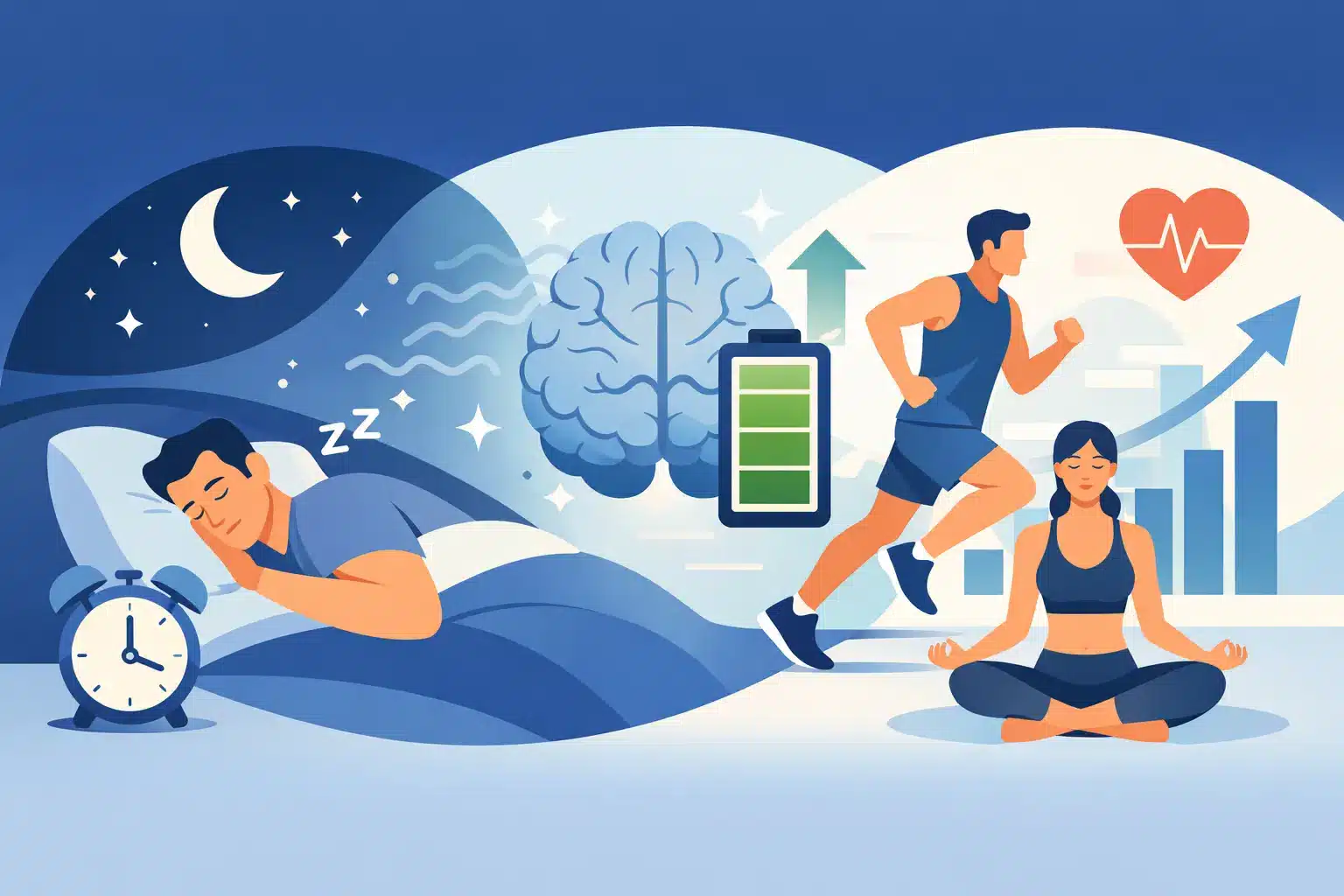
The best healthy sleep habits aren’t the ones that look perfect online; they are the time-tested ones that survive travel, family obligations, late practices, demanding workweeks, and the occasional poor night.
Start with adequate sleep opportunity, a consistent wake time, morning light, an appropriate caffeine cutoff, and a short wind-down period.
Once those fundamentals are solid, improve your environment or try one targeted supplement if there is a clear reason.
Treat sleep like training: build a sound plan, follow it consistently, and adjust it using honest feedback rather than searching for a shortcut.
You will not sleep perfectly every night, but a durable routine can improve the quality of many nights over time.
This website does not provide medical advice. This website site does contain affiliate links, and purchases may earn a commission.
Read my Medical Disclaimer, Review Disclaimer, and Publishing Policies for more details. Use of this site indicates acceptance of these terms.


