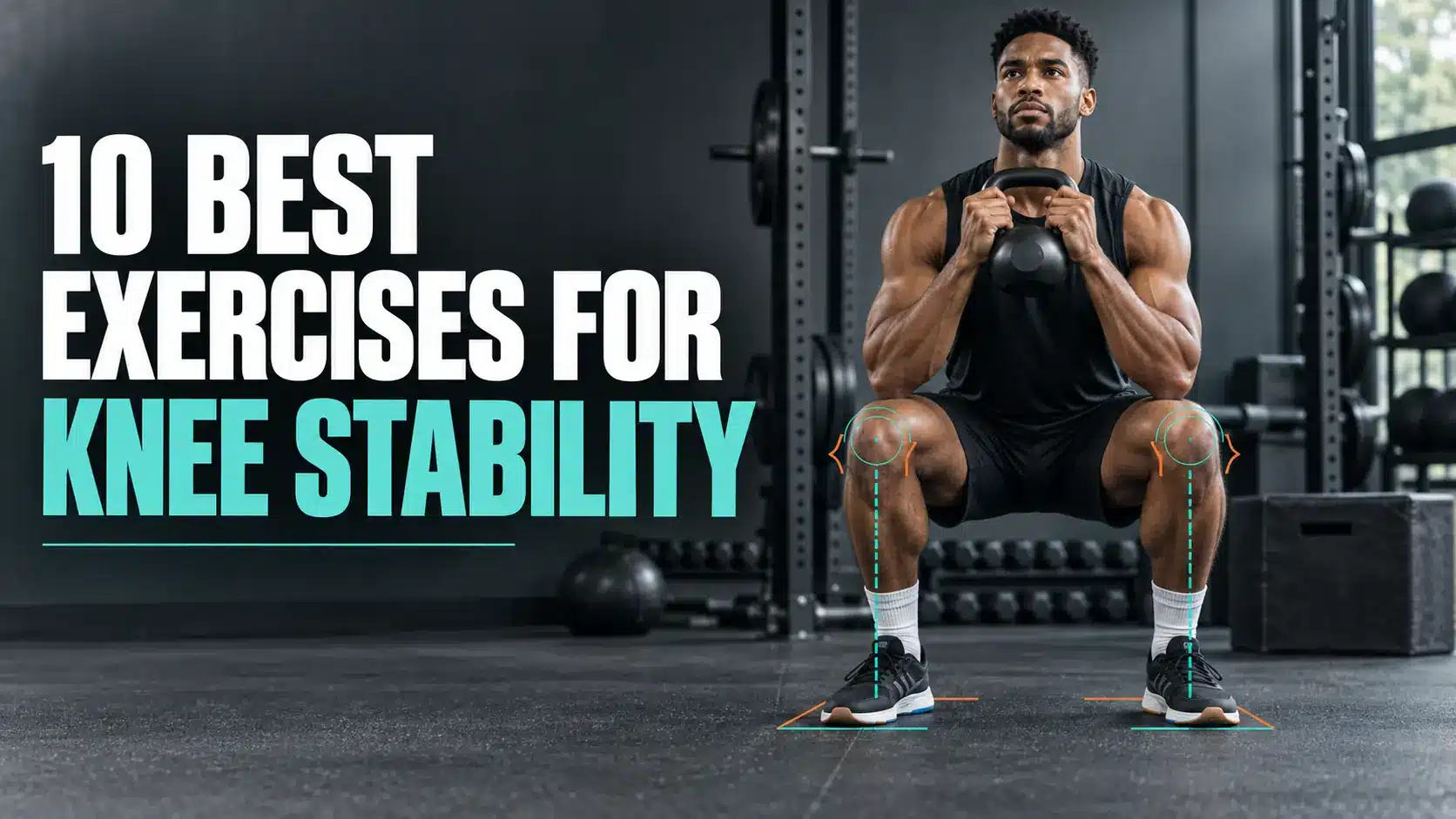
10 Best Exercises for Knee Stability and Control
 Reading Time: 13 minutes
 The best exercises for knee stability strengthen the muscles surrounding your knees while teaching your entire lower body to control force.
They should improve coordination between your hips, quadriceps, hamstrings, calves, ankles, and feet rather than attempting to keep your knees rigid.
There are dozens of effective knee-stability exercises, and no single list is ideal for every person.
However, these are my 10 personal choices for the best exercises for knee stability because they collectively build strength, balance, alignment, deceleration, and control across several movement patterns.
As a professional basketball player who has spent their professional career working to improve their joints, especially their knees, I have learned that knee stability is rarely just a knee issue.
My favorite exercises for knee stability address the joint directly while also developing the hip, ankle, and foot function needed to control the knee during squatting, running, landing, and changing direction.
These knee exercises can help you build stronger, more confident movement, but they cannot diagnose or resolve every source of knee pain.
Lastly, your exercise selection should reflect your symptoms, physical capabilities, injury history, and current training level.
Read below to learn more about knee health, along with the best exercies for knee stability (in my opinion)!
Why is Knee Stability Important
Knee stability is the ability to keep the knee appropriately aligned and controlled while your body moves under load, and it does not mean preventing all movement or forcing the joint to remain perfectly still.
During a squat, lunge, landing, or step-down, the knee should move smoothly through a tolerable range while remaining coordinated with the hip, ankle, and foot.
Some movement is natural, but uncontrolled collapse, shifting, or buckling may indicate you need more strength, coordination, or a medical evaluation.
The quadriceps control knee flexion and extension, while the hamstrings help stabilize the joint and control the shinbone.
The glutes influence the position of the thigh, and the calves, ankles, and feet help absorb and redirect forces before they reach the knee.
This is why an effective knee-stability program should include more than isolated knee exercises.
Clinical guidelines for patellofemoral pain support combining hip- and knee-targeted exercises rather than strengthening only one region (Willy et al., 2019).
What Causes Knee Pain and Instability?
Knee pain can arise from many different structures and circumstances, including sudden injuries, repetitive stress, rapid increases in training volume, muscle weakness, poor load tolerance, osteoarthritis, patellofemoral pain, tendon irritation, or meniscus and ligament injuries.
However, pain doesn’t always mean the knee is physically unstable.
A knee may feel unreliable because pain limits muscle output, swelling alters joint awareness, or the surrounding muscles cannot tolerate the demands placed on them.
Common factors that may contribute to knee pain or poor control include:
- Weakness or reduced endurance in the quadriceps
- Poor hip strength or coordination
- Limited ankle mobility
- Insufficient calf and foot strength
- Rapid increases in running, jumping, or lifting volume
- Poor control during single-leg movements
- Inadequate recovery between demanding sessions
- Previous ligament, meniscus, tendon, or cartilage injuries
- Osteoarthritis or other joint conditions
Strengthening can help with several knee conditions, but the right program depends on the cause.
Exercise is strongly recommended for knee osteoarthritis, while combined hip- and knee-targeted exercise is recommended for patellofemoral pain (Kolasinski et al., 2020; Willy et al., 2019).
If you have sharp pain, major swelling, locking, true buckling, an inability to bear weight, or symptoms following a traumatic injury, seek an evaluation from a qualified medical professional.
These 10 knee stability exercises are training options, not a substitute for an individual diagnosis or rehabilitation plan.
How Do Knee-Stability Exercises Help?
Knee-stability exercises progressively expose the joint and its surrounding muscles to forces they must manage in daily life and sports.
Over time, this practice can improve strength, balance, joint awareness, and confidence during loaded movement.
Different exercises address different pieces of the stability puzzle, including:
- Squats and terminal knee extensions strengthen the quadriceps.
- Split squats and step-downs improve single-leg control.
- Romanian deadlifts strengthen the hamstrings and glutes.
- Lateral band walks target hip control.
- Calf raises improve ankle strength and force absorption.
- Balance reaches develop coordination across the entire leg.
No exercise can guarantee freedom from pain or injury.
However, stronger quadriceps and hamstrings can improve the knee’s ability to absorb and control force, while progressive exercise can increase the activity that the joint and surrounding tissues can tolerate (American Academy of Orthopedic Surgeons, n.d.).
10 Best Exercises for Knee Stability
These are not the only effective exercises for knee stability; however, they are my 10 personal favorites because each one fills a specific role, and together they create a balanced approach to strength, stability, and movement control.
The right starting point depends on your current strength, symptoms, mobility, and training history.
Begin with a manageable range of motion and resistance, then gradually progress the load, repetitions, range, or complexity with each of the best exercises for knee stability!
1.) Spanish Squats
Spanish squats are one of my favorite exercises for strengthening the quadriceps while keeping the torso upright and making knee tracking easy to monitor.
They can also be useful when conventional squatting is uncomfortable, although individual responses vary.
Secure a thick resistance band behind both knees and attach it to a stable anchor.
Lean backward into the band, sit down into a squat, and keep your feet flat as your knees travel forward in line with your toes.
Perform two to four sets of 8–15 controlled repetitions. Alternatively, begin with 20- to 45-second isometric holds at a comfortable depth.
Why I chose it: Spanish squats directly challenge the quadriceps without requiring a barbell or complex setup. They are easy to scale and can help rebuild confidence in knee-dominant positions.
2.) Step-Downs
Step-downs reveal whether you can control your knee and pelvis while lowering your body on one leg. T
his movement is directly relevant to descending stairs, decelerating, landing, and many athletic actions.
Stand on a low step and shift your weight onto one foot.
Slowly lower the opposite heel toward the floor, lightly touch down, and return to standing using the working leg.
Keep the pelvis relatively level, maintain pressure through the entire foot, and prevent the working knee from collapsing inward.
Complete two to three sets of 6–10 repetitions per side.
Why I chose it: Step-downs build eccentric quadriceps strength and single-leg control while making movement compensations easy to identify.
3.) Split Squats
The split squat builds unilateral leg strength without the balance and momentum required for a walking or forward lunge.
It also lets you train the hip, knee, and ankle together through a controlled range of motion.
Take a staggered stance and lower your body mostly straight down.
Keep pressure through the front foot, and let the front knee move forward over the toes when it feels comfortable and stays controlled.
Use a three-second lowering phase to improve positional awareness.
Start with bodyweight, then gradually add dumbbells once you can complete every repetition without losing balance or alignment.
Why I chose it: Split squats build usable single-leg strength while remaining more stable and adjustable than many dynamic lunge variations.
4.) Single-Leg Deadlifts
Single-leg deadlifts strengthen the hamstrings and glutes while challenging balance, foot control, and hip stability.
These qualities help control thigh and knee position during single-leg movement.
Stand on one leg with the knee slightly bent.
Hinge at the hips and extend the opposite leg behind you while your torso moves forward, then squeeze the glutes to return to standing.
Do not focus on reaching the floor.
Keep your hips as square as possible and use a wall or rack for light support if balance prevents you from loading the target muscles.
Complete two to three sets of 6–10 repetitions per leg.
Why I chose it: This exercise develops posterior-chain strength and rotational control without placing the knee through a large range of flexion.
5.) Lateral Band Walks
The gluteal muscles help control the position of the thigh during running, landing, squatting, and changing direction.
Lateral band walks, also known as lateral monster walks, provide a simple way to train the outer hips before more demanding lower-body exercises.
Place a resistance band above the knees or around the ankles.
Assume a shallow athletic stance, take controlled sideways steps, keep your feet relatively straight, and maintain tension on the band.
Complete two to three rounds of 8–15 steps in each direction. Avoid rocking your torso or allowing the trailing leg to snap inward.
Why I chose it: Lateral band walks are accessible, require minimal equipment, and prepare the hips to help control unwanted inward movement of the knee.
6.) Terminal Knee Extensions
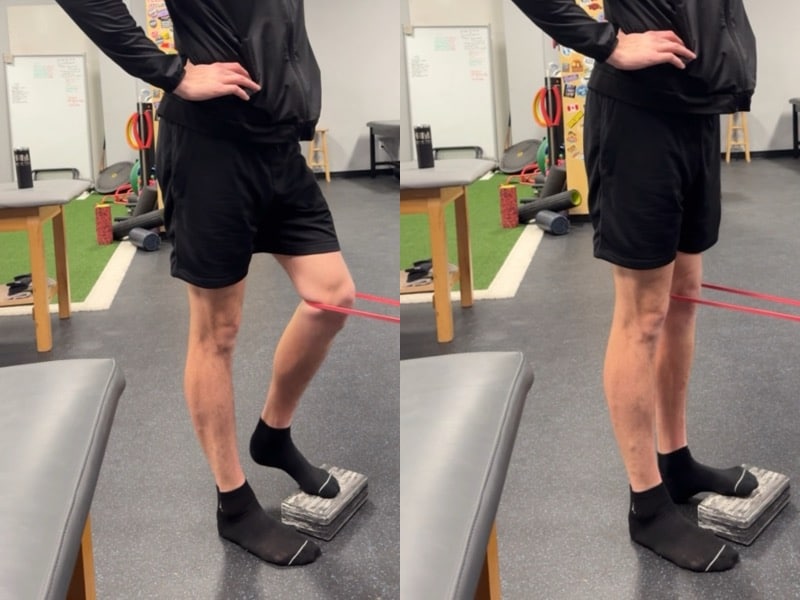
Terminal knee extensions train quadriceps activation near the end of knee extension.
Loop a resistance band behind one knee and anchor it behind you.
Begin with the knee slightly bent, then straighten it by contracting the quadriceps and pressing the back of the knee into the band.
Pause for one or two seconds before returning under control. Perform two to three sets of 12–20 repetitions.
Why I chose it: Terminal knee extensions are low-impact, easy to control, and useful for practicing deliberate quadriceps contraction. They don’t replace loaded squats, split squats, or step-downs. Instead, they complement larger exercises that strengthen the leg through a greater range of motion.
7.) Calf Raises
The calf and ankle complex absorbs force during walking, running, jumping, and deceleration.
A weak or poorly controlled ankle can influence how forces move upward toward the knee.
Stand tall, rise onto the balls of your feet, pause at the top, and lower slowly. Avoid rolling toward the outer edges of your feet.
Progress from bilateral to single-leg calf raises. Include both straight-knee and slightly bent-knee variations, as they emphasize different parts of the calf muscles.
Build toward two to four sets of 10–20 repetitions.
Why I chose it: Knee programs often overlook the lower leg, even though the calves and ankles help manage force during nearly every weight-bearing activity.
8.) Controlled Reverse Lunges
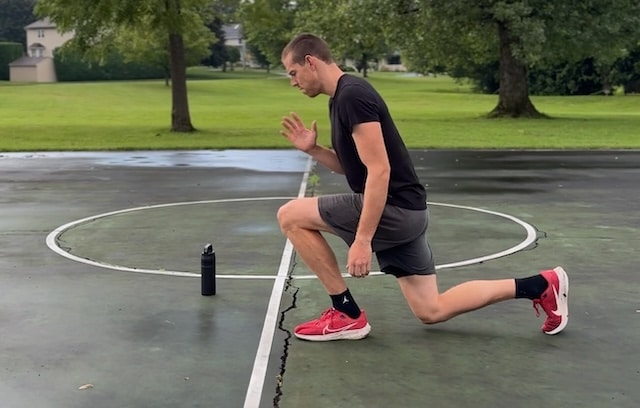
Reverse lunges build single-leg strength while letting you control depth and stride length.
Some people also find them more comfortable than forward lunges because stepping backward reduces the lead leg’s abrupt braking demand.
Step one foot backward and lower smoothly while keeping the front foot planted.
Drive through the front leg to return to the starting position without aggressively pushing off the back foot.
Hold a wall or squat rack if balance limits the quality of your repetitions.
Perform two to three sets of 6–12 repetitions per side.
Why I chose it: Reverse lunges bridge the gap between stationary strength exercises and more dynamic athletic movements.
The reverse slide lunge is a sibling of the traditional reverse lunge, and it likewise promotes knee stability in a unique way.
9.) Single-Leg Balance With Reach
Static balance has value, but balance becomes more transferable when the rest of your body moves around the supporting leg.
Reaching in multiple directions requires the foot, ankle, knee, and hip to make continuous adjustments.
Stand on one foot with the knee slightly bent.
Reach the opposite foot forward, diagonally, and sideways, lightly tapping the floor in each direction.
Maintain your foot tripod by keeping pressure beneath the heel, the base of the big toe, and the base of the little toe. Complete two to three rounds of four to six reaches in each direction.
Why I chose it: Balance reaches combine proprioception, foot control, hip stability, and single-leg knee control in one scalable movement.
10.) Goblet Squats
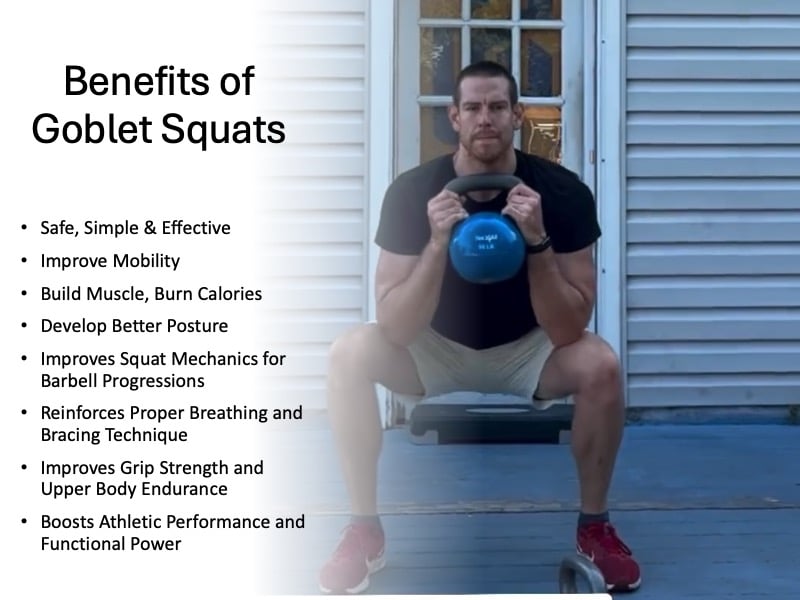
Goblet squats strengthen the quadriceps, glutes, hamstrings, and trunk while letting you practice coordinated movement in both knees.
Holding the weight in front of your body can also make it easier to keep your torso upright and sit between your hips.
Hold a dumbbell or kettlebell close to your chest.
Brace your trunk, keep your feet planted, and lower as far as you can while maintaining control and a comfortable range of motion.
Allow your knees to travel forward and track in the general direction of your toes.
Drive the floor away to return to standing without allowing the knees to collapse inward.
Begin with two to four sets of 6–12 repetitions. Increase the range of motion or resistance only after you can maintain consistent foot pressure and knee control.
Why I chose it: Goblet squats provide a simple bilateral strength exercise that is easier to learn and self-correct than many barbell squat variations.
How to Build a Knee-Stability Workout
You do not need to perform all 10 knee-stability exercises in one session. For most recreational athletes and lifters, choosing four or five complementary movements two or three times per week is a more practical approach.
A balanced beginner workout could include:
- Lateral band walks: 2 sets of 10 steps per direction
- Goblet squats: 3 sets of 8–12 repetitions
- Step-downs: 3 sets of 6–8 repetitions per leg
- Single-leg Romanian deadlifts: 3 sets of 8 repetitions per leg
- Calf raises: 3 sets of 12–20 repetitions
Another session could replace goblet squats with Spanish squats, step-downs with reverse lunges, and Romanian deadlifts with balance reaches.
If you already strength train, add two or three of these movements around your main lower-body exercises instead of adding unnecessary training volume.
How to Progress Knee-Stability Exercises
The way you are doing the best exercises for knee stability must eventually become more challenging if you want them to continue producing adaptations.
However, you do not need to progress every variable simultaneously.
You can progress an exercise by:
- Adding one or two repetitions
- Increasing resistance slightly
- Expanding the range of motion
- Slowing the lowering phase
- Adding a brief pause
- Using less external balance support
- Moving from bilateral to unilateral variations
- Increasing movement speed after mastering control
I always recommend that you progress one variable at a time.
A heavier exercise is not automatically more effective if the additional load causes you to lose the control you are trying to develop.
Mild muscular fatigue is expected, but increasing joint pain is not the goal.
If symptoms become progressively worse during the workout or remain noticeably elevated the following day, reduce the load, volume, or range and reassess the exercise.
Form Cues for Stronger, More Stable Knees
Begin by creating a stable tripod foot, with pressure under your heel, the base of your big toe, and the base of your little toe.
From this foundation, allow your knee to move naturally in the same general direction as your toes.
Forward knee travel is normal during squatting, lunging, running, and climbing stairs.
You do not need to keep your shins vertical unless a temporary modification has been recommended because of pain or injury.
Watch for repeated inward collapse of the knee, loss of the foot arch, a substantial hip drop, or a painful catch at a specific point in the movement.
Recording your exercise from the front and side can reveal compensations that are difficult to feel in real time.
Perfectly symmetrical movement is not required, and a small amount of natural variation is normal.
The goal is to develop repeatable control through a range your body currently tolerates.
Can These Exercises Help Knee Pain?
These knee stability exercises are certainly some of the best exercises for knee pain as well, and they may help when knee discomfort is influenced by weakness, poor coordination, limited training tolerance, or insufficient control.
Exercise programs involving knee and hip strengthening are particularly well supported for patellofemoral pain, while strengthening, aerobic exercise, and neuromuscular training are among the recommended options for knee osteoarthritis (Kolasinski et al., 2020; Willy et al., 2019).
However, “knee pain” is a symptom, not a specific diagnosis.
An exercise that helps one condition may irritate another, and an otherwise good exercise can become inappropriate when its load, depth, or volume exceeds your current capacity.
Use these movements to build capacity, not to push through unexplained pain.
Persistent pain, swelling, locking, traumatic injury, or true episodes of giving way warrant an individualized medical assessment.
Final Thoughts: Choosing the Best Exercises for Knee Stability
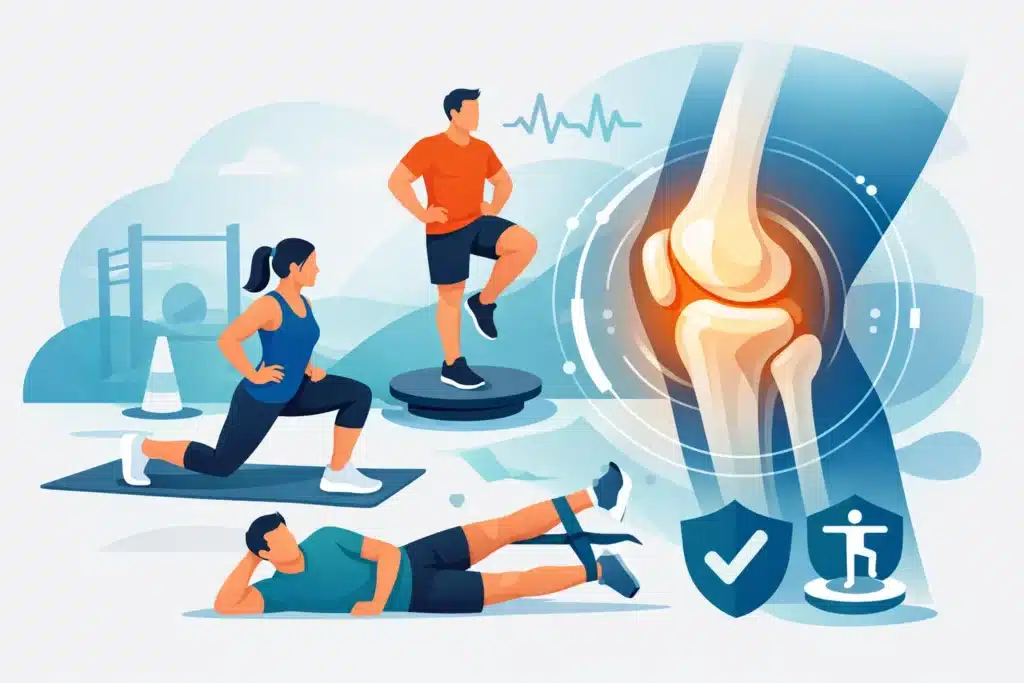
No definitive list of the 10 best exercises for knee stability exists because people have different weaknesses, injury histories, goals, and movement demands.
For example, step-ups, Bulgarian split squats, and Cossack squats also come to mind as excellent exercises for knee stability.
The exercises in this article are my personal favorites because they strengthen the knees while also targeting the hips, hamstrings, calves, ankles, feet, and balance systems that influence knee control.
You do not need complicated equipment or unstable surfaces to build stable knees.
Strong knees are not knees that never move.
They are knees supported by a lower body that can absorb force, control motion, and respond confidently to the demands of everyday life and athletic performance.
This website does not provide medical advice. This website site does contain affiliate links, and purchases may earn a commission.
Read my Medical Disclaimer, Review Disclaimer, and Publishing Policies for more details. Use of this site indicates acceptance of these terms.