The Role of Amino Acids for Muscle Growth
 Reading Time: 7 minutes
 Understanding the role of amino acids for muscle growth can help you make smarter nutrition decisions before and after resistance training.
Amino acids are the building blocks your body uses to synthesize muscle proteins, repair trained tissue, and support the adaptations that gradually produce greater muscle size and strength.
Research shows that consuming essential amino acids after resistance exercise can improve net muscle protein balance, shifting the body toward a more anabolic state (Børsheim et al., 2002).
Leucine is particularly important because it activates the molecular signaling involved in muscle protein synthesis, although it works best when the other essential amino acids are also available (Dreyer et al., 2008).
However, amino acids cannot compensate for inconsistent training or inadequate overall nutrition.
Whether they come from protein-rich foods, protein powder, or a targeted supplement, consuming enough complete protein throughout the day remains the most practical foundation for getting sufficient amino acids for muscle growth.
What Happens to Your Muscles After a Workout?
Resistance training places mechanical tension on your muscles and temporarily increases both muscle protein synthesis and muscle protein breakdown.
Although challenging workouts can cause microscopic muscle damage, these “micro-tears” are not the primary cause of muscle growth, and excessive damage may interfere with training quality.
Muscle growth occurs when resistance training and adequate nutrition produce a positive net protein balance repeatedly over time.
In simple terms, your body must build more muscle protein than it breaks down.
Muscle protein synthesis is the process your body uses to create new muscle proteins.
Resistance training stimulates this process, while dietary protein supplies the amino acids needed to complete it.
Think of resistance training as the signal that tells your body to renovate a building.
Amino acids provide the construction materials, but the renovation still requires an appropriate training stimulus, sufficient energy, quality sleep, and time to recover.
What Are Amino Acids?
Amino acids are organic compounds that combine to form proteins.
When you consume protein-rich foods, your digestive system breaks those proteins into amino acids and small peptides that can be absorbed and used throughout the body.
These compounds support far more than muscle growth.
Amino acids also contribute to the production of enzymes, hormones, neurotransmitters, immune proteins, and other molecules required for normal health.
For athletes and active adults, their best-known role is supporting the repair, remodeling, and growth of skeletal muscle.
Resistance exercise makes muscle tissue more responsive to protein, while amino-acid availability allows muscle protein synthesis to proceed.
However, more is not always better. Once you consume enough high-quality protein to meet your needs, adding large amounts of isolated amino acids is unlikely to produce proportionally greater muscle growth.
Essential vs. Non-Essential Amino Acids
The amino acids used to build proteins are commonly divided into essential and non-essential categories:
- Essential amino acids (EAAs): Nine amino acids that the body cannot produce in sufficient quantities and must obtain through food or supplements.
- Non-essential amino acids: Amino acids the body can generally synthesize on its own.
- Conditionally essential amino acids: Amino acids that the body normally produces but may need in greater amounts during illness, injury, or other forms of physiological stress.
All amino acids have important biological roles, but the nine essential amino acids are particularly important for muscle protein synthesis.
If one essential amino acid is unavailable, it can limit your body’s ability to assemble new muscle proteins.
Complete protein sources provide all nine EAAs in sufficient proportions.
Examples include eggs, dairy products, meat, fish, poultry, soy, and carefully formulated protein powders.
Many plant foods also contribute meaningfully to daily protein intake, even if an individual food contains relatively less of one or more EAAs.
Eating a varied diet that includes legumes, soy foods, whole grains, nuts, and seeds can provide an effective amino acid profile throughout the day.
Which Amino Acids Are Best for Muscle Growth?
Leucine, isoleucine, and valine are the three branched-chain amino acids, commonly known as BCAAs.
Leucine receives the most attention because it partly signals and activates molecular pathways involved in muscle protein synthesis.
However, leucine cannot build muscle by itself.
It may help turn on the construction process, but all nine EAAs must be available to provide the materials needed to produce complete muscle proteins.
Research indicates that BCAAs alone can increase muscle protein synthesis after resistance exercise, but the response is smaller than the response generally produced by a complete protein containing all essential amino acids (Jackman et al., 2017).
Therefore, whey protein, another complete protein, or a balanced EAA supplement is usually a stronger choice than a BCAA-only product.
BCAA supplements may be useful in limited circumstances, but they are often unnecessary for people already consuming enough high-quality protein.
When comparing supplements, consider the full nutritional context rather than assuming that a higher leucine or BCAA dose automatically leads to more muscle growth.
How Much Protein Do You Need for Muscle Growth?
Your total daily protein intake matters more than any single amino-acid dose or perfectly timed post-workout shake.
A large meta-analysis found that protein supplementation modestly improved gains in muscle size and strength during resistance training, with average benefits leveling off at about 1.6 grams of protein per kilogram of body weight per day (Morton et al., 2018).
That figure is a useful target, not a rigid limit. Individual requirements can vary with body size, age, training volume, protein quality, total calorie intake, and whether you are maintaining, gaining, or losing weight.
A practical range for many resistance-trained adults is approximately 1.4–2.0 grams of protein per kilogram per day.
People dieting aggressively, completing high training volumes, or relying heavily on lower-quality protein sources may benefit from aiming toward the upper end of that range (Jäger et al., 2017).
Distributing protein across three to five meals is generally more practical than consuming most of it at dinner.
For many adults, roughly 20–40 grams of high-quality protein per meal provides an effective dose, although larger athletes may need more.
Related Reading: How Much Protein Do You Need to Gain Muscle?
Does Protein Timing Matter for Muscle Growth?
The traditional “anabolic window” suggested that athletes had only about 30 minutes after training to consume protein.
Current evidence supports a much wider and more flexible opportunity.
Muscle remains responsive to protein for many hours after resistance exercise.
The urgency of a post-workout meal also depends on when and what you ate before training; if you consumed a protein-rich meal within a few hours of your workout, you probably don’t need to rush to a shake immediately afterward (Aragon & Schoenfeld, 2013).
As a practical guideline, consume a high-quality protein source within approximately two hours after training when convenient.
If you exercised fasted or haven’t eaten protein for several hours, eating sooner is more useful.
Carbohydrates can also support recovery by replenishing muscle glycogen, particularly when training sessions are long, intense, or performed multiple times per day.
However, carbohydrates do not replace the EAAs required for muscle protein synthesis.
Whole Foods vs. Amino Acid Supplements
Whole foods should provide most of your daily protein because they deliver amino acids alongside vitamins, minerals, fats, carbohydrates, and other beneficial nutrients.
Eggs, Greek yogurt, cottage cheese, poultry, lean meat, fish, tofu, tempeh, beans, and lentils can all contribute to a muscle-building diet.
Protein powders and amino acid supplements are tools for convenience, not requirements for growth.
They can be helpful when you cannot tolerate a full meal, train early in the morning, have limited access to food, or need an easy way to reach your daily protein target.
Whey protein is rapidly digested and contains all nine EAAs, including a substantial amount of leucine.
Casein, soy, pea blends, and other complete or complementary protein products can also be effective depending on your dietary preferences and digestive tolerance.
An EAA supplement offers a concentrated source of essential amino acids with relatively little volume.
This may be useful around training for athletes who have a low appetite, but it generally offers less nutritional value and satiety than a balanced meal.
BCAA-only supplements are less comprehensive because they provide only three of the nine EAAs.
If your diet already contains sufficient complete protein, purchasing additional BCAAs is unlikely to be the most effective use of your supplement budget.
How to Use Amino Acids for Muscle Growth
You do not need a complicated supplement schedule to benefit from amino acids.
Focus on the habits that consistently provide your muscles with both a growth stimulus and the nutrients required to adapt:
- Perform progressive resistance training consistently.
- Consume enough total calories to support your goal.
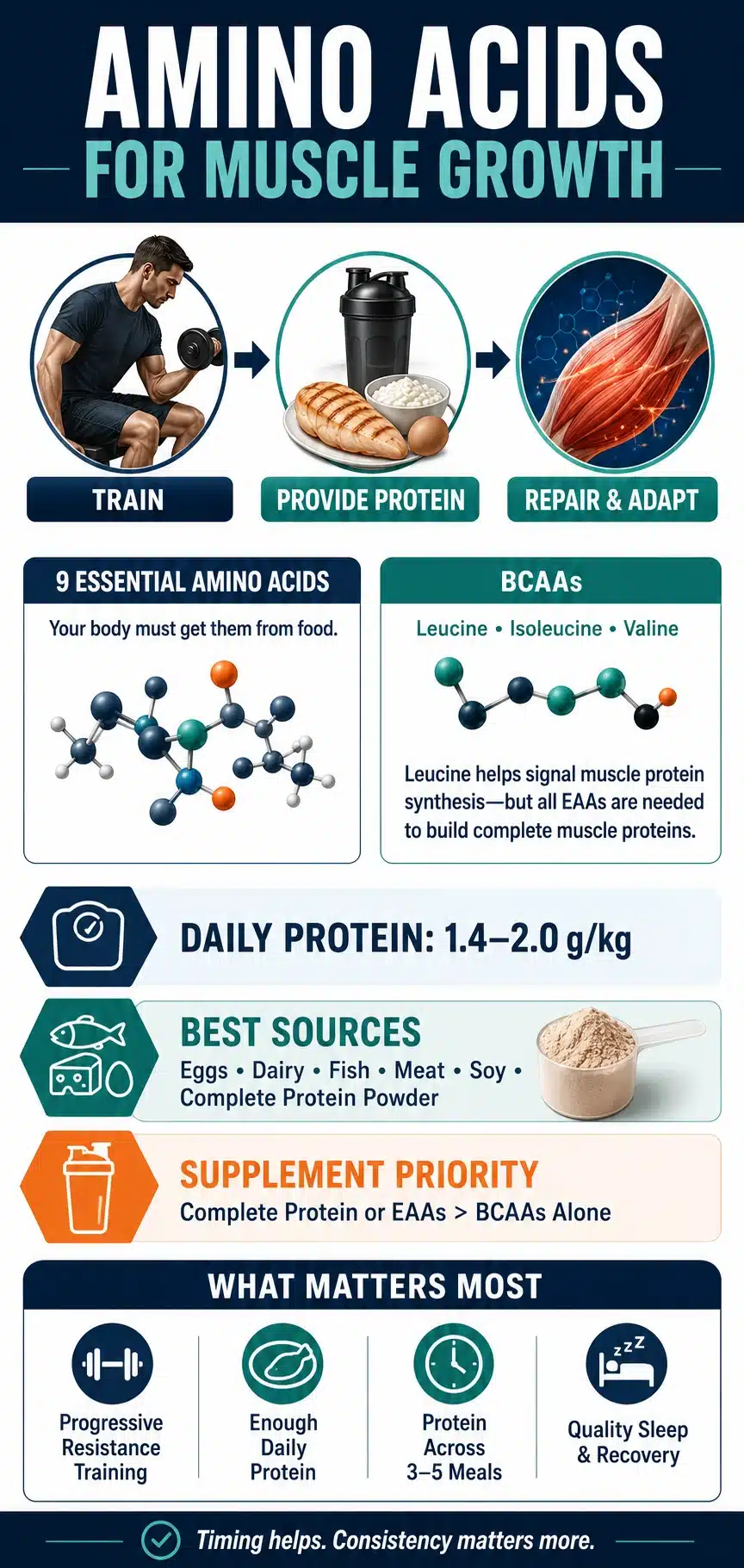
- Aim for approximately 1.4–2.0 grams of protein per kilogram of body weight per day.
- Spread protein across several meals rather than relying on one large serving.
- Include a high-quality protein source before or after training.
- Prioritize complete proteins or balanced EAA formulas over BCAA-only products.
- Use supplements when they improve convenience, digestion, or consistency.
- Protect sleep and recovery so your body can adapt to training.
These fundamentals have a much greater influence on long-term results than chasing a precise supplement dose or a narrow post-workout feeding window.
Final Thoughts on Amino Acids for Muscle Growth
Amino acids are essential for repairing and building muscle, but they cannot create muscle growth without progressive resistance training and adequate overall nutrition.
The most important priorities are consuming enough total protein, obtaining all nine EAAs, distributing protein reasonably throughout the day, and training consistently.
Whole foods and complete protein sources will meet these needs for most people. EAA supplements can offer convenience in specific situations, while BCAA-only products are usually less valuable when your diet already provides sufficient protein.
The best strategy for using amino acids for muscle growth is not to search for a shortcut.
Build a reliable nutrition plan that supports your training day after day, and let those repeated habits produce measurable progress over time.
Read Next: BCAAs vs EAAs
This website does not provide medical advice. This website site does contain affiliate links, and purchases may earn a commission.
Read my Medical Disclaimer, Review Disclaimer, and Publishing Policies for more details. Use of this site indicates acceptance of these terms.