

Is Creatine Safe to Take Daily? What the Evidence Says
 Reading Time: 8 minutes
 Creatine is one of the few sports supplements I have consistently trusted throughout my professional basketball career, but is creatine safe to take daily for months or even years?
For healthy adults using an appropriate dose, research strongly supports daily creatine monohydrate as a safe and effective way to improve strength, power, muscle growth, and repeated high-intensity performance (Kreider et al., 2017).
Still, the answer to is creatine safe to take daily depends on your health, dosage, and the quality of the supplement you choose.
Creatine should complement consistent training, nutritious food, hydration, and sleep, and anyone with kidney disease, reduced kidney function, or medications that affect the kidneys should consult a qualified healthcare professional before using it.
What is Creatine?
Creatine is a naturally occurring compound made from the amino acids arginine, glycine, and methionine.
Your body produces it primarily in the liver and kidneys, while smaller amounts also come from foods such as red meat and fish.
Approximately 95% of the body’s creatine is stored in skeletal muscle, mostly as phosphocreatine.
During intense exercise, phosphocreatine helps rapidly regenerate adenosine triphosphate (ATP), the primary energy source for muscle contraction (Kreider et al., 2017).
Because natural creatine stores are limited, supplementation can increase the amount available within your muscles.
This may help you produce more force, complete additional high-quality repetitions, and recover more effectively between repeated bursts of intense activity.
Creatine is not a steroid, stimulant, or artificial shortcut to muscle growth.
It supports the energy system behind explosive movements, but its long-term benefits still depend on progressive training, sufficient nutrition, and consistent recovery.
Although several forms are sold, creatine monohydrate remains the most thoroughly researched.
It has consistently demonstrated strong effectiveness, safety, stability, and value compared with more expensive alternatives (Kreider et al., 2017).

Why Should You Always Choose Creatine Monohydrate?

Creatine monohydrate should be the default choice because it is the most thoroughly researched form of creatine.
Its ability to increase muscle creatine stores, improve high-intensity exercise performance, and support gains in strength and lean mass has been demonstrated across decades of research (Kreider et al., 2017).
Alternative forms such as creatine hydrochloride, buffered creatine, creatine nitrate, and creatine ethyl ester are often marketed as more absorbable or less likely to cause water retention.
However, current evidence has not shown these products to produce consistently better results than creatine monohydrate (Antonio et al., 2021).
Creatine monohydrate is also generally less expensive and widely available without unnecessary ingredients.
A plain, unflavored powder makes it easy to control your daily dose while avoiding the stimulants, sweeteners, and proprietary blends sometimes included in pre-workout products.
For additional quality assurance, choose a product tested by an independent certification program such as NSF Certified for Sport, Informed Sport, or USP.
Third-party testing is especially valuable for competitive athletes because it helps reduce, but cannot completely eliminate, the risk of contamination or inaccurate labeling.
Micronized creatine monohydrate is a useful option if regular powder doesn’t dissolve well for you.
“Micronized” simply means the particles are smaller, so it may mix more easily, but it is still the same evidence-supported form of creatine.
Is Creatine Safe to Take Daily for Healthy Adults?
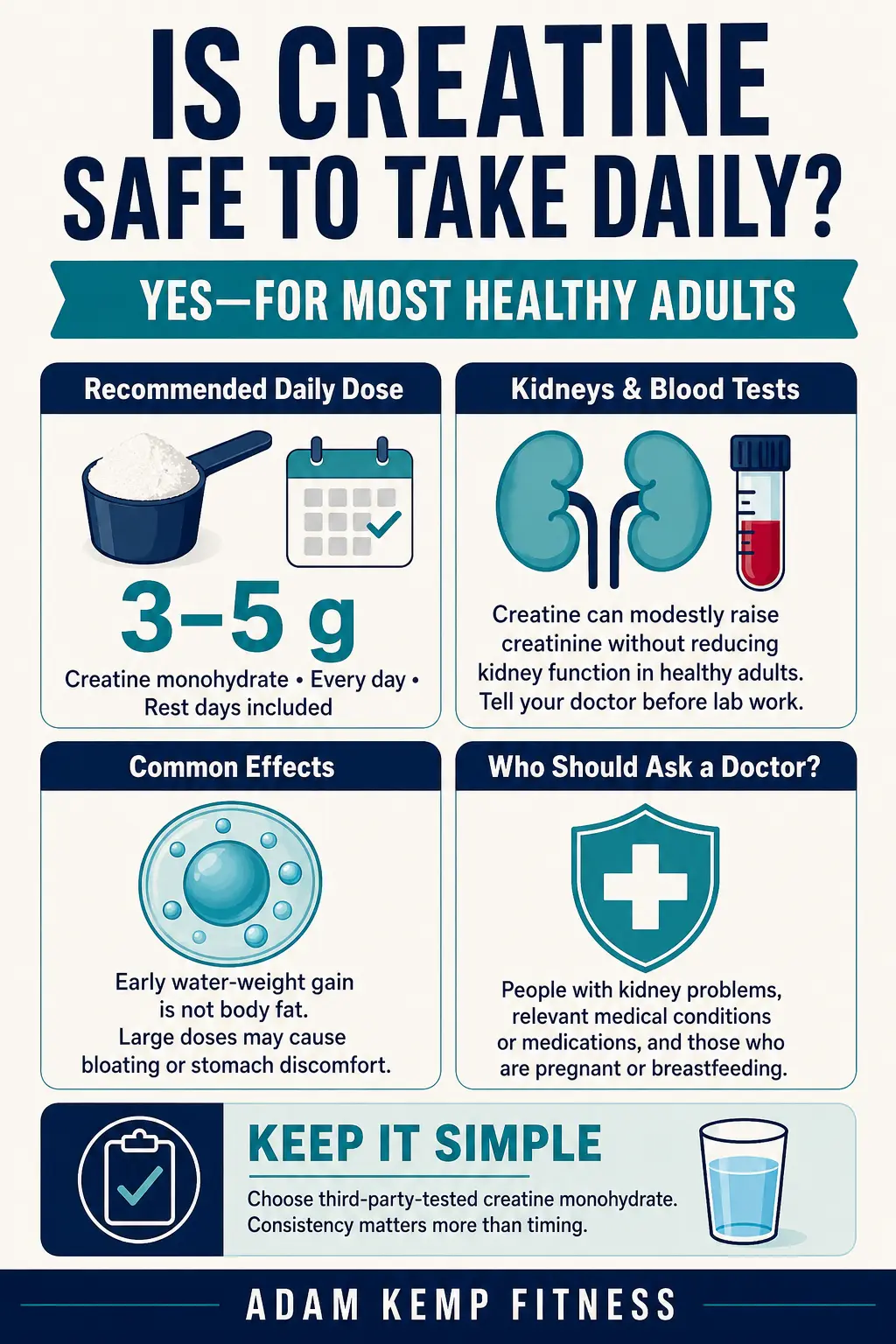
For most healthy adults, creatine is considered safe to take every day at recommended doses.
Decades of research have found no consistent evidence that short- or long-term creatine monohydrate supplementation damages the kidneys, liver, or cardiovascular system in otherwise healthy people (Kreider et al., 2017).
A recent systematic review and meta-analysis found that creatine may cause a small increase in serum creatinine but does not significantly reduce glomerular filtration rate, a more direct measure of kidney function.
This distinction matters because creatinine can rise as creatine is metabolized without indicating actual kidney damage (Naeini et al., 2025).
Daily use is also how creatine provides its greatest benefit.
Consistently taking approximately 3–5 grams per day helps maintain elevated muscle creatine stores, supporting repeated high-intensity efforts such as lifting, sprinting, and jumping.
I have used creatine throughout my professional basketball career because its value is practical rather than dramatic.
It does not replace disciplined training, nutrition, hydration, or sleep, but it supports the repeated explosive efforts and demanding strength work required over a long season.
However, research involving healthy adults should not be automatically applied to everyone.
People with kidney disease, impaired kidney function, or medical conditions and medications that affect kidney health should speak with a physician before taking creatine regularly.
What is the Best Daily Dose for Creatine?
For most healthy adults, the best daily dose is 3–5 grams of creatine monohydrate.
Smaller individuals may maintain elevated muscle creatine stores with 3 grams per day, while larger athletes and people carrying more muscle may prefer 5 grams (Kreider et al., 2017).
Another option is to base the maintenance dose on body weight at approximately 0.03 grams per kilogram per day.
However, precisely calculating your dose is usually unnecessary because 3–5 grams works well for most people.
A loading phase can saturate your muscles faster, but it is optional.
The standard protocol uses approximately 20 grams per day, divided into four 5-gram servings, for five to seven days, followed by a maintenance dose of 3–5 grams daily.
Without loading, taking 3–5 grams per day will typically produce similar muscle saturation within approximately three to four weeks.
This slower approach may be more convenient and less likely to cause temporary bloating, loose stools, or stomach discomfort.
Take creatine every day, including rest days, because its benefits depend on maintaining muscle saturation rather than producing an immediate pre-workout effect.
Timing matters far less than consistency, so mix it with water, add it to a shake, or take it with whichever meal makes the habit easiest to maintain.
More is not necessarily better once your muscles are saturated.
Unless a healthcare professional recommends otherwise, exceeding the standard maintenance dose is unlikely to deliver additional performance benefits and may increase the likelihood of digestive discomfort.
Does Creatine Affect Your Kidneys or Blood Test Results?
Kidney health is one of the most common concerns about daily creatine use, but studies have not shown that recommended doses damage kidney function in healthy adults.
Creatine naturally converts into creatinine, so supplementation may modestly increase the creatinine measured during a routine blood test without indicating kidney injury.
A 2025 meta-analysis found that creatine supplementation can slightly increase serum creatinine without significantly reducing glomerular filtration rate, a more meaningful measure of kidney function (Naeini et al., 2025).
Because muscle mass, recent exercise, hydration status, and creatine use can all influence creatinine, the result should be interpreted within a broader clinical context.
Tell your physician that you use creatine before undergoing laboratory testing, particularly if you are muscular or train intensely, so they can determine whether markers such as cystatin C, urine albumin, or another assessment would provide useful context.
Who Should Consult a Doctor Before Taking Creatine?
People with chronic kidney disease, reduced kidney function, a history of kidney problems, or another condition affecting fluid balance should consult a healthcare professional before taking creatine.
The same precaution applies to anyone using medications that may affect kidney function, as the decision should consider the medication, dosage, health history, and laboratory results.
Pregnant or breastfeeding individuals should also seek medical guidance because long-term safety data in these populations remain limited.
Creatine has been studied in adolescents, but available safety research is less extensive than in adults, so parental involvement and supervision by a qualified healthcare professional are appropriate (Jagim & Kerksick, 2021).
These precautions do not prove that creatine is inherently dangerous for these groups; they reflect the need for more individualized risk assessment.
Common Creatine Side Effects and Misconceptions
The most common noticeable effect of creatine is an initial increase in body weight caused primarily by greater water retention within muscle cells, not an increase in body fat.
Some users also experience bloating, loose stools, or stomach discomfort, particularly when taking large single doses or completing an aggressive loading phase.
Dividing a loading dose, or skipping loading and taking 3–5 grams daily, usually makes creatine easier to tolerate.
Research also does not support the common claim that properly dosed creatine causes dehydration or muscle cramps in healthy users (Antonio et al., 2021).
Concerns about hair loss originated largely from one small study that measured an increase in dihydrotestosterone rather than hair loss, while a 2025 randomized trial found no significant differences in DHT or hair-growth measurements between creatine and placebo groups (Lak et al., 2025).
How to Take Creatine Every Day
For most healthy adults, the simplest approach is to take 3–5 grams of creatine monohydrate every day, including rest days.
Add it to water, a protein shake, or a meal, and connect it to an existing habit because consistency matters more than precise timing.
Continue training progressively and eating enough protein and total calories to support your goal, since creatine enhances a productive routine rather than compensating for a poor one.
If your weight rises during the first few weeks, evaluate your strength, performance, waist measurement, and body composition rather than assuming the change reflects body fat.
Whether your goal is building muscle, improving explosive performance, or preserving lean mass while aging, creatine works best as a modest advantage accumulated through months of consistent training.
Best Creatine Supplement
In my opinion, Optimum Nutrition Micronized Creatine Monohydrate is the best creatine supplement because it provides 5 grams of pure creatine monohydrate per serving without an unnecessarily complicated formula.
Its micronized texture also mixes easily into water or a protein shake, which makes consistent daily use more convenient.
As a professional athlete, I also value that the product is Informed-Choice certified and regularly tested for substances banned in sports.
It combines the most thoroughly researched form of creatine with straightforward dosing, dependable quality control, and a reasonable price, everything I want from a daily creatine supplement.


Last update on 2026-08-20 / This article includes affiliate links/Images via Amazon Product Advertising API. I may earn commissions on purchases made through these links.
This website does not provide medical advice. This website site does contain affiliate links, and purchases may earn a commission.
Read my Medical Disclaimer, Review Disclaimer, and Publishing Policies for more details. Use of this site indicates acceptance of these terms.


