Cold Plunge vs Sauna for Better Recovery
 Reading Time: 8 minutes
 Whether you are a professional athlete like me or simply someone who wants to feel better after daily or weekly workouts, the cold plunge vs sauna debate matters because each method affects soreness, readiness, and long-term training adaptations differently.
However, the cold plunge vs sauna decision should not be based on which method feels tougher or looks more impressive.
Instead, it should depend on your training goal, competition schedule, and how your body responds.
After more than a decade of professional basketball, I use both methods, but rarely for the same reason or at the same point in my week.
Over the years, my approach to choosing between sauna vs cold plunge recovery has become more strategic as I have learned how differently heat and cold can affect how my body feels and performs.
Earlier in the week, when I have at least two days before a game, I generally prefer a traditional dry Finnish sauna after training.
Sauna bathing helps me relax and feels restorative, while repeated post-exercise heat exposure may also support heat acclimation, blood-volume adaptations, and certain measures of endurance performance (Kirby et al., 2021; Scoon et al., 2007).
I avoid long sauna sessions too close to competition because they can leave me feeling temporarily lethargic, especially after a demanding practice or if I do not replace enough fluid and electrolytes.
That is my personal response rather than a universal rule, but it shows why recovery methods must be placed intelligently within a training schedule.
The day before a game, I am more likely to choose a cold plunge or ice bath because it often gives my legs a noticeable sense of freshness without adding much physical demand.
On the other hand, cold-water immersion can reduce perceived soreness and support short-term recovery, which can be useful when performance readiness matters more than maximizing the adaptations from that day’s training (Petersen & Fyfe, 2021).
I used to take ice baths much more frequently, including after strength workouts, but my approach changed as the evidence developed.
Regular cold-water immersion immediately after resistance training may modestly reduce muscle hypertrophy and interfere with some strength- and power-related adaptations, so I no longer treat cold exposure as an automatic post-workout habit (Piñero et al., 2024).
Sauna use does not appear to carry the same concern and may complement cardiovascular and heat adaptations when used appropriately.
Heat exposure has also been investigated for its effects on heat-shock proteins, muscle signaling, and brain-derived neurotrophic factor (BDNF), although direct human evidence linking ordinary sauna use to meaningful increases in BDNF or muscle development remains preliminary.
After games, the equation changes because immediate recovery becomes the priority.
When both are available, I may use a sauna and cold plunge directly after the game, focusing less on protecting a single training adaptation and more on relaxing, reducing soreness, and beginning the recovery process before the next practice or competition.
Both methods can be valuable, and both can be misused.
The real question is not simply whether a cold plunge or sauna is “better,” but which type of stress helps your body recover from the work you just completed while preparing for what comes next.
Cold Plunge vs Sauna: The Main Differences
Cold plunging and sauna bathing stress the body in opposite directions.
A cold plunge rapidly cools the skin and causes blood vessels near the surface to constrict.
The immediate result is a sharp nervous-system response, followed by a period when many people feel alert, calm, and less sore.
A sauna raises skin and core temperature, increases circulation to the skin, and creates a controlled heat stress.
It often promotes relaxation, loosens stiff muscles, and can make it easier to fall asleep when used at the right time.
Neither method replaces the fundamentals: enough calories, protein, fluids, sleep, smart programming, and low-intensity movement.
Think of them as recovery tools with specific jobs, not shortcuts around the basics.
When Cold Plunging Makes Sense
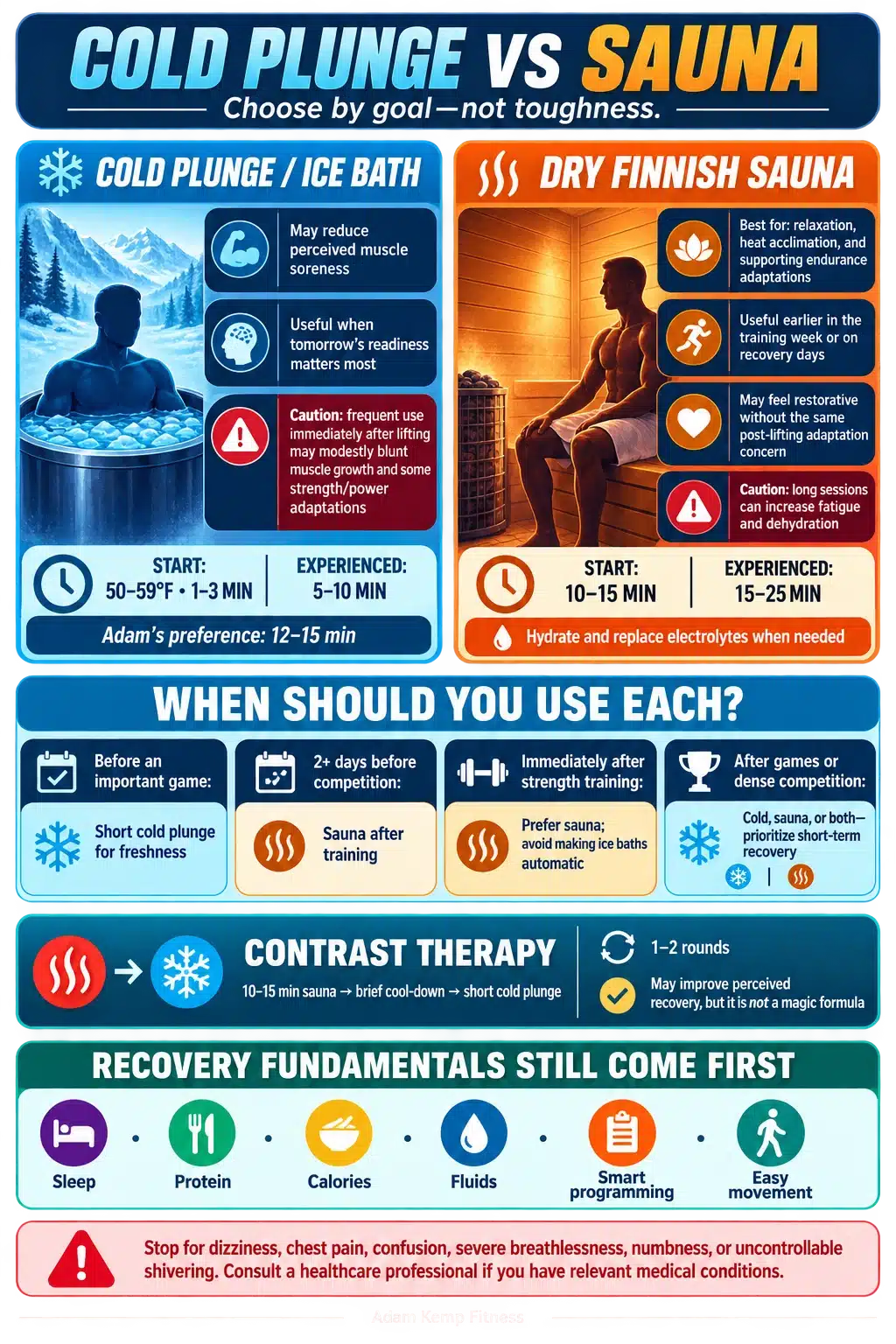
Cold-water immersion can be valuable when the priority is short-term symptom relief or getting ready to perform again soon.
Research consistently suggests it can reduce perceived muscle soreness after demanding exercise, especially during periods with multiple games, practices, or intense training sessions close together (Moore et al., 2023).
That matters for athletes in tournament settings, endurance events, and busy professionals who need to feel functional after an unusually hard workout.
A cold plunge may also provide a mental reset.
The initial discomfort requires controlled breathing, and the feeling afterward can be energizing.
The trade-off is important: regular cold-water immersion immediately after resistance training may blunt some of the muscle-building and strength-related adaptations you want from lifting.
The exact effect depends on the temperature, duration, training status, and how often you use it, but the practical message is clear.
If hypertrophy or strength is your top goal, do not make an ice bath your automatic post-lift ritual.
Instead, save cold exposure for a different time of day, or use it strategically after competition, high-volume conditioning, or sessions where feeling fresh tomorrow matters more than maximizing today’s adaptation.
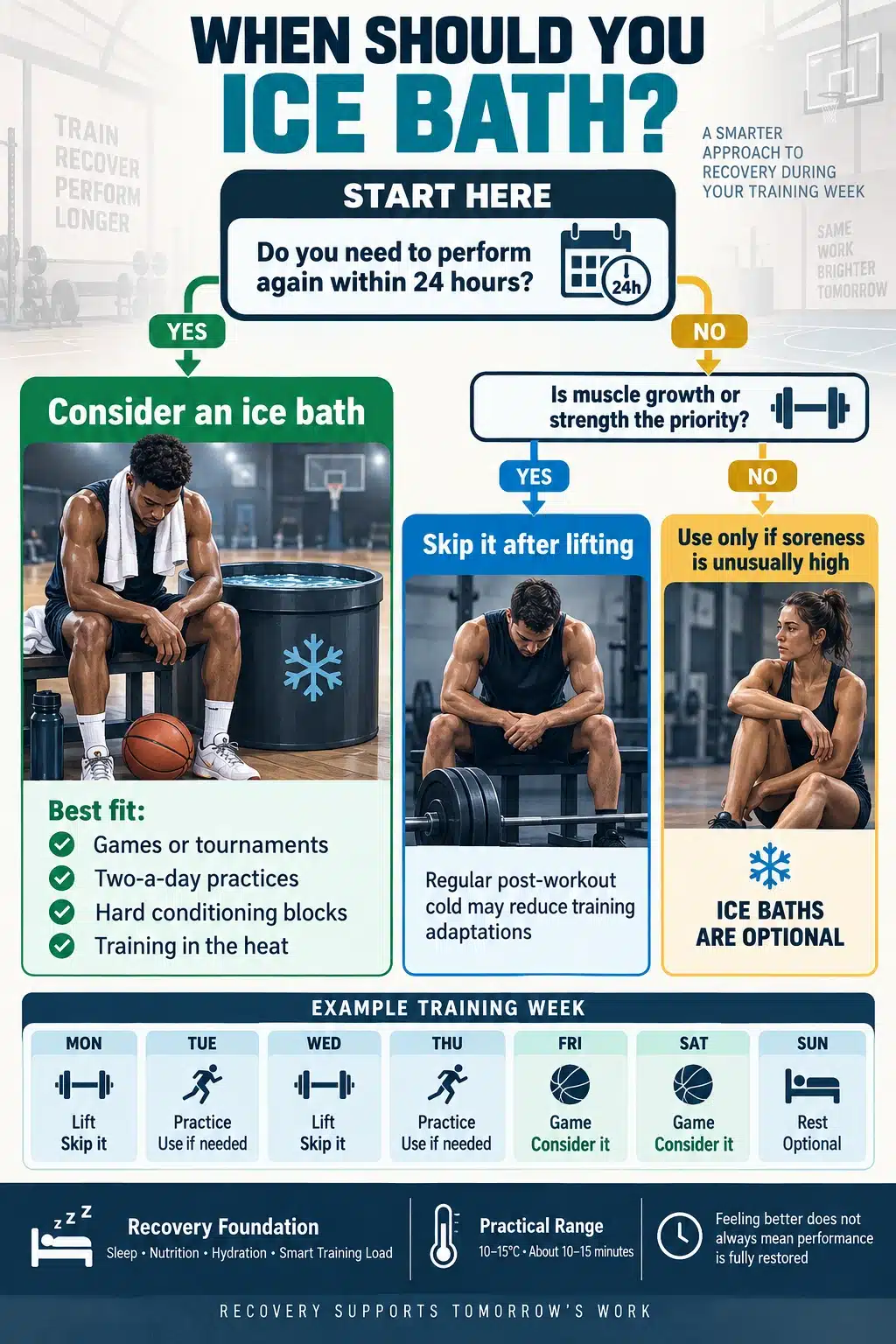
You can read my guide on when you should take an ice bath to learn more information on this topic.
A Practical Ice Bath Protocol for Recovery
For most healthy adults, water around 50 to 59 degrees Fahrenheit for 5 to 10 minutes is enough to create a meaningful stimulus.
Colder is not automatically better.
Starting with 1 to 3 minutes in moderately cold water is plenty if you are new to the practice, but I prefer 12-15-minute sessions.
You do not need to force your entire body underwater, and you should keep your face out of the water.
Focus on steady nasal breathing or slow controlled breaths rather than trying to prove your toughness.
If you are shivering uncontrollably, numb, dizzy, or unable to regulate your breathing, get out.
When Saunas Makes Sense
Sauna use is often the more versatile choice for general wellness, relaxation, and long-term habit building.
It can help you unwind after work, reduce muscle stiffness, and create a clear transition from a stressful day into an evening recovery routine.
Frequent sauna bathing is also associated in observational research with favorable cardiovascular outcomes.
That does not mean sauna sessions are a substitute for aerobic exercise, nutrition, or medical care.
It does mean heat exposure can be a valuable addition to an already healthy lifestyle, especially if you enjoy it enough to use it consistently.
For active people, sauna sessions may be especially useful after easy cardio, mobility work, or on rest days.
Heat can feel restorative without creating the same concern about reducing post-lifting muscle adaptation.
It can also support heat acclimation for athletes preparing to train or compete in hot conditions, although that is a more specific performance strategy and should be built gradually.
Timing matters for sleep.
Many people sleep better after a sauna in the evening because their bodies cool down afterward, supporting the natural temperature shift that precedes sleep.
Finish your session early enough to rehydrate, cool down, and feel settled before bed. If a late sauna leaves you overstimulated or thirsty all night, move it earlier.
A Practical Sauna Protocol for Recovery
A useful starting point is 10 to 15 minutes in a traditional sauna, followed by a cool-down period and hydration.
Experienced users may tolerate 15 to 25 minutes, but most people don’t need longer sessions.
Infrared saunas generally operate at a lower air temperature, so sessions are often longer, but the right duration is still the one you can tolerate comfortably without pushing into dehydration or dizziness.
Drink water before and after your session, particularly if you trained that day.
If you sweat heavily, replenishing electrolytes can be helpful as well.
Avoid alcohol before or during sauna use, and do not treat a big sweat as evidence that you are detoxing your body.
Your liver and kidneys handle that work.
Sweat loss is primarily fluid loss, which needs to be replaced.
Are Ice Baths or Saunas Better for Muscle Growth, Fat Loss, and Performance?
For muscle growth, sauna use is generally the simpler choice around resistance training.
You can use it after lifting if you stay hydrated and do not turn the session into an exhausting endurance event.
Cold plunging is better reserved for occasions when soreness management or next-day performance takes priority over gaining every possible adaptation from a workout.
For fat loss, neither tool is a major driver.
Sauna use can produce an immediate drop on the scale through sweat loss, but that is water weight, not body-fat loss.
Cold exposure may slightly increase energy expenditure as the body works to maintain temperature, but it is not a meaningful replacement for a calorie deficit, consistent strength training, daily movement, and adequate protein.
Performance depends on the sport and calendar.
Cold water can be useful during dense competition schedules.
Sauna use may help support heat tolerance and relaxation.
If you train recreationally three or four days per week and want to feel better overall, choose the modality you enjoy and can use without compromising sleep, hydration, or training quality.
Should You Combine Cold Plunges and Sauna Sessions?
Contrast therapy, which involves alternating between heat and cold, is popular because many people find it invigorating.
It may reduce perceived soreness and improve how recovered you feel, but the evidence does not show it is superior for repairing exercise-induced muscle damage or improving every aspect of physical recovery (Bieuzen et al., 2013).
If you enjoy it, keep the process simple.
- Spend 10 to 15 minutes in the sauna, cool down for a few minutes, then use a short cold plunge.
- One or two rounds are enough.
- Avoid making the contrast extreme, especially when you are new to either practice.
The best time for contrast therapy is usually after a game, hard conditioning day, or during a recovery-focused period.
It is less ideal immediately after a lifting session designed to build muscle.
The goal is to use exercise recovery methods intentionally rather than stacking stressors just because they are popular.
Safety Comes Before Discipline
Cold and heat exposure are not appropriate for everyone.
Speak with a qualified healthcare professional before using a cold plunge or sauna if you have cardiovascular disease, uncontrolled high blood pressure, a history of fainting, circulation problems, kidney disease, are pregnant, or take medications that affect blood pressure, hydration, or temperature regulation.
Never use either method alone if you are inexperienced or have a health concern.
Avoid them when you are sick, severely dehydrated, hungover, or exhausted from a long day in the heat.
Get out immediately if you experience chest pain, severe shortness of breath, confusion, or lightheadedness.
Real discipline is not staying in longer than your body can safely handle.
True discipline is building a recovery routine that lets you train well again tomorrow.
Start with the option that fits your goal this week, pay attention to sleep and performance, and let consistency do more for you than intensity ever will.
Read Next: Steam Room vs Sauna: Which is Better for Your Health
This website does not provide medical advice. This website site does contain affiliate links, and purchases may earn a commission.
Read my Medical Disclaimer, Review Disclaimer, and Publishing Policies for more details. Use of this site indicates acceptance of these terms.
Check Out Some of My YouTube Videos Below, and Please Follow on YouTube for More Educational Health and Fitness Content!
![Subscribe to @AdamKempFitness for more training, general health, recovery, and nutrition tips from a professional basketball player with a master’s degree in Nutrition Education! 🏀💪
Seated Max Vertical Jumps From a Box are one way I train explosive takeoff power with maximum intent on every rep.
Starting seated, with a pause and minimal rocking or dipping, reduces the contribution of a quick countermovement and emphasizes producing force from a relatively static position (National Strength and Conditioning Association [NSCA], 2020).
For athletes, the training goal is explosive lower-body force production and coordinated extension through the hips, knees, and ankles. I use this variation to practice driving hard into the floor and accelerating my body upward.
My preferred setup: 3 sets of 3 reps or 4 sets of 2 reps, supersetted with a strength or power exercise.
I keep the reps low, reset between jumps, and take longer rest periods so I’m ready to attack every takeoff. Even when pairing exercises, I give myself enough recovery to keep the jumps sharp.
Every rep has one goal: jump as high as possible. I focus on an explosive takeoff, a controlled landing, and consistent quality throughout the session.
Save this for your next power workout! 🚀
Reference: NSCA. (2020). Stretch-shortening cycle.
#VerticalJump #JumpTraining #ExplosivePower #AthleticPerformance #BasketballTraining](https://www.adamkempfitness.com/wp-content/plugins/feeds-for-youtube/img/placeholder.png)