Muscle Building for Beginners: Simple Tips That Actually Work
 Reading Time: 18 minutes
 Muscle building for beginners works best when you learn how to move correctly, train the major muscle groups consistently, and give your body enough food and sleep to adapt.
Your first several months of resistance training can produce noticeable changes, but trying to progress faster than your technique and recovery allow is one of the easiest ways to develop pain, lose motivation, or stop training altogether.
You do not need a complicated workout split, advanced exercises, or a cabinet full of supplements.
A successful approach to muscle building for beginners starts with mastering bodyweight exercises, developing a repeatable mobility routine, and gradually progressing to compound exercises that can become more challenging over time.
As a professional basketball player, I have learned that the most effective training plans are rarely the most exciting, but they are the ones you can execute with focus, recover from consistently, and improve progressively without getting hurt repeatedly.
This guide to muscle building for beginners explains how to build a foundation through better movement, smart exercise selection, progressive overload, enough calories, adequate protein, and consistent sleep.
As you will learn, muscle building for beginners becomes much simpler once you put these priorities in the right order.
How Muscle Building Works
Muscle building occurs as resistance training creates mechanical tension in your muscles, signaling them to adapt to the demands placed on them.
Food supplies the energy and amino acids needed to support that adaptation, while sleep and rest provide time for repair and growth.
Nearly every reasonable resistance-training structure can increase strength and muscle compared with performing no resistance training.
Different combinations of weight, repetitions, sets, and training frequency can work, although multiple-set programs generally produce better muscle-building results than consistently performing only one set (Currier et al., 2023).
Beginners are especially responsive because resistance training is a new stimulus.
However, the speed at which your muscles become stronger can temporarily exceed the speed at which your technique, tendons, joints, and exercise judgment develop.
That is why your first goal should not be lifting as much weight as possible.
Your first goal should be to build a body prepared to train consistently.
Best Muscle Building Tips for Beginners
Learn Good Movement Form Before Adding Heavy Weight
Good form is not about making every repetition look identical for every person.
Body proportions, mobility, injury history, and exercise selection can all affect what an effective movement looks like.
However, beginners should be able to control the weight, maintain a stable position, use a comfortable range of motion, and feel the intended muscles working.
If the load forces you to rush, bounce, twist, shorten the movement excessively, or rely on momentum, it is probably too heavy for your current ability.
Learning good form has several immediate benefits:
- It helps distribute stress through the muscles and joints as intended.
- It makes it easier to identify which exercises fit your body.
- It creates a consistent technique that can be progressively overloaded.
- It helps you recognize the difference between muscular effort and potentially harmful pain.
- It builds the coordination needed for more advanced exercises.
Resistance training is not inherently dangerous, but technique errors, poor load management, fatigue, and attempting weights beyond your ability can increase injury risk.
If possible, have a qualified coach evaluate your movement patterns when you begin training.
You can also record a few working sets from the side and front.
Video cannot diagnose every technical problem, but it can reveal changes in range of motion, balance, bar path, or body position that are difficult to notice while lifting.
Start With Bodyweight Movement Patterns
Before worrying about barbell numbers, learn how to control your body.
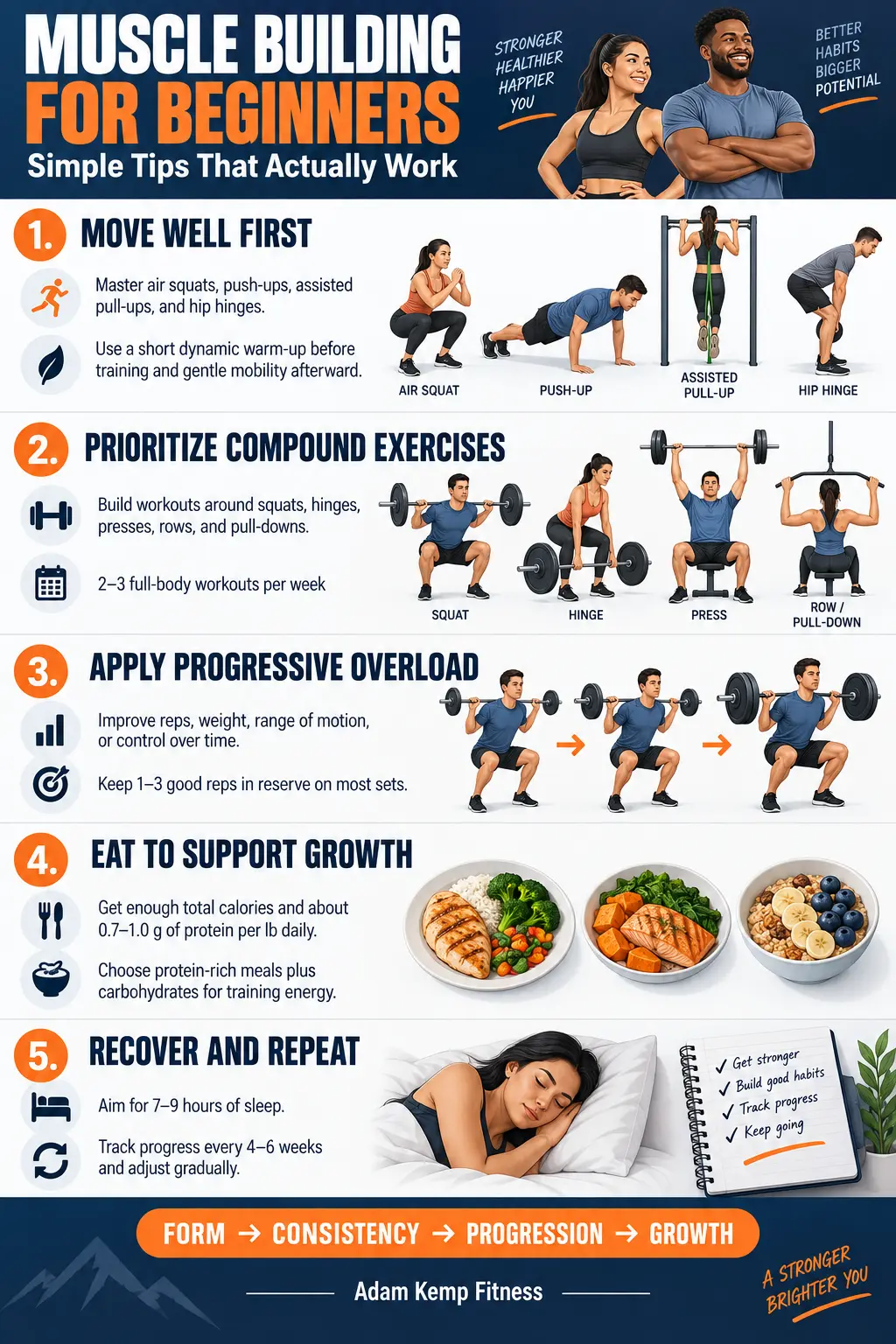
Air squats, push-ups, assisted pull-ups, rows, hip hinges, lunges, planks, and carries are great bodyweight exercises for beginners that teach fundamental movement patterns that show up throughout more advanced strength training.
A bodyweight exercise does not need to be easy to be appropriate for a beginner.
The exercise should be adjusted to your current strength and mobility.
For example, you can perform push-ups against a wall, countertop, bench, or Smith machine bar before progressing to the floor.
You can use an assisted pull-up machine or a resistance band to build the strength needed for unassisted pull-ups.
Air squats can teach you to coordinate the hips, knees, ankles, and torso before adding external resistance. If maintaining balance is difficult, practice squatting to a bench or holding a stable support.
The goal is not to remain with bodyweight training forever.
These exercises establish movement competency that makes future progression safer and more productive.
Bodyweight Movements Worth Mastering
Try to develop control over these basic patterns:
| Movement pattern | Beginner exercise | Possible progression |
|---|---|---|
| Squat | Supported air squat or box squat | Goblet squat, front squat, or leg press |
| Horizontal push | Incline push-up | Floor push-up or dumbbell bench press |
| Vertical pull | Band pulldown or assisted pull-up | Lat pulldown or pull-up |
| Horizontal pull | Bodyweight row or band row | Cable row or dumbbell row |
| Hip hinge | Bodyweight hip hinge | Kettlebell deadlift or Romanian deadlift |
| Single-leg movement | Supported split squat | Reverse lunge or Bulgarian split squat |
| Trunk stability | Dead bug or elevated plank | Full plank, Pallof press, or loaded carry |
You do not need to master the hardest version before using external weight. You simply need enough control to understand the movement and perform its next progression safely.
Develop a Pre-Workout Mobility Routine
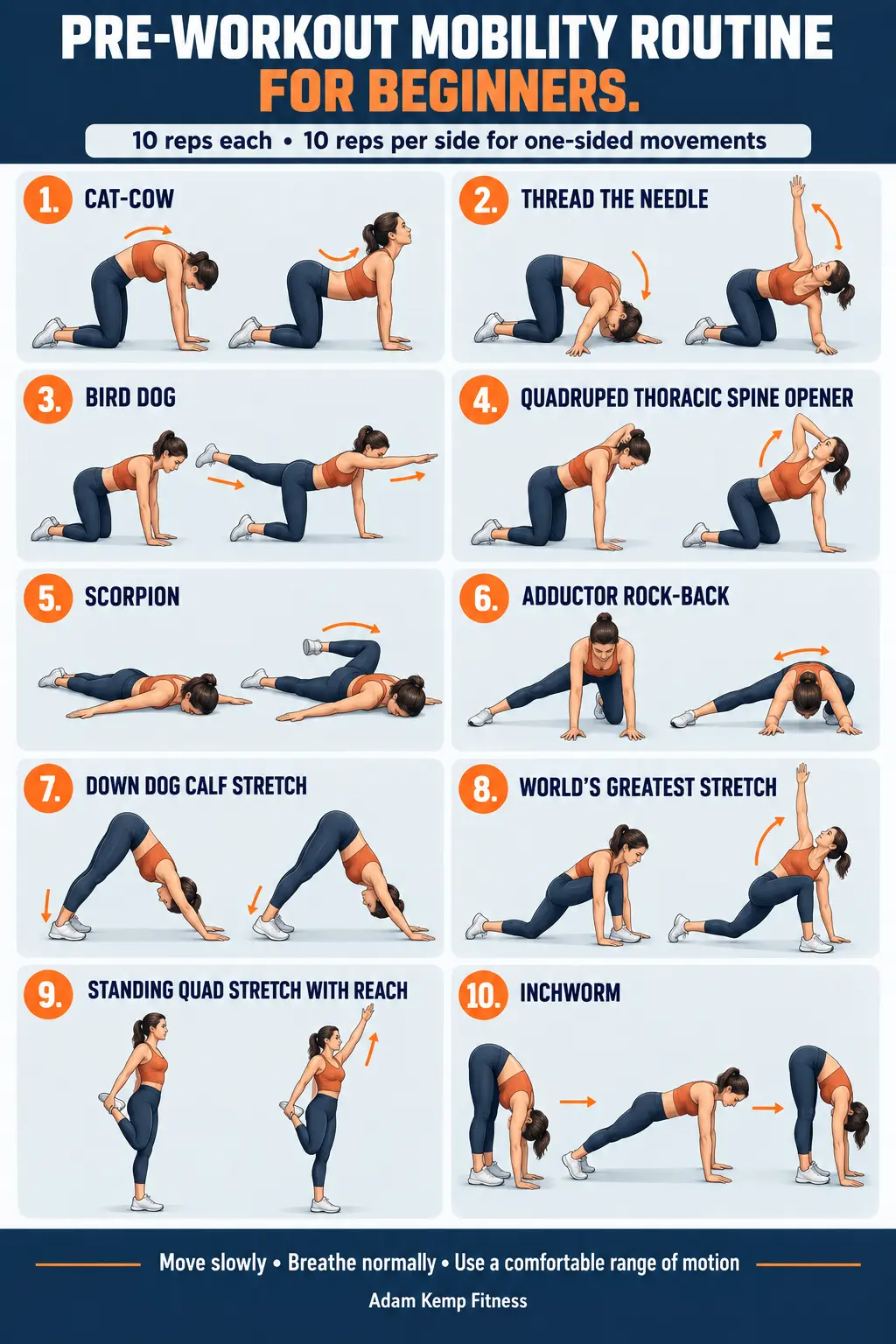
A short pre-workout warm-up routine should prepare you for the movements you are about to perform.
It should raise body temperature, explore the range of motion required during the session, and help you identify stiffness or discomfort before handling challenging loads.
Begin with three to five minutes of easy walking, cycling, rowing, or another activity that gradually raises your heart rate.
Follow it with dynamic movements for the joints and muscles you will train.
Before a lower-body workout, your routine might include:
- Ankle rocks
- Hip rotations
- Adductor rock-backs
- Bodyweight squats
- Glute bridges
- Reverse lunges
Before an upper-body workout, it might include:
- Arm circles
- Wall slides
- Band pull-aparts
- Scapular push-ups
- Light cable or band rows
- Controlled push-ups

Dynamic warm-ups can improve readiness without requiring a long, exhausting routine. In contrast, prolonged static stretching immediately before strength or power exercise may temporarily reduce performance, particularly when individual stretches are held for 60 seconds or longer (Behm et al., 2016).
Static stretching isn’t inherently harmful, and brief stretching can help when a specific restriction prevents you from getting into a comfortable exercise position, but follow it with active movement and progressively heavier warm-up sets.
Use Exercise-Specific Warm-Up Sets
Mobility drills cannot completely prepare you for an exercise that you have not practiced.
Before your working sets, perform lighter versions of the movement you plan to train.
For example, before goblet squats, do a set of controlled air squats, then one or two progressively heavier goblet-squat sets.
Before bench pressing, start with push-ups or an empty bar, then gradually add weight.
Warm-up sets should improve your readiness, not fatigue you.
Keep the repetitions controlled and reduce the number of repetitions as the weight approaches your working load.
Build a Short Post-Workout Mobility Routine
Post-workout mobility does not need to be another workout.
Five to ten minutes is enough for most beginners.
Use this time to slow your breathing and gently work on areas that commonly become restricted.
You might perform calf stretches after lower-body training or chest and lat stretches after an upper-body session.
Stretching is not a guarantee against soreness or injury, but it can help you maintain or improve flexibility when performed consistently.
Think of post-workout mobility as long-term movement maintenance rather than an immediate recovery cure.
A useful routine may include two to four stretches held for approximately 20–45 seconds each.
The sensation should be mild to moderate tension rather than sharp pain, numbness, or joint pressure.
Make Compound Exercises the Foundation of Your Workouts
Compound exercises train several joints and muscle groups simultaneously.
Squats, deadlift variations, presses, rows, pull-ups, pulldowns, lunges, and loaded carries let you train a lot of muscle without filling your program with dozens of exercises.
These movements should form the bulk of most beginner workouts because they develop strength, coordination, and muscle efficiently.
Isolation exercises can then provide additional work for specific areas such as the biceps, triceps, shoulders, calves, or hamstrings.
A productive workout might contain three or four compound movements followed by one to three isolation or core exercises.
More exercises aren’t automatically better, especially if the extra work reduces your effort, technique, or recovery.
Free Weights vs. Machines for Beginners
Debating free weights vs. machines for muscle building for beginners is less important than learning how both can help you with overall muscle development and a healthy physique.
Contrary to some beliefs, exercise machines are not an inferior form of training.
They can help beginners train a muscle hard without needing as much balance, stabilization, or technical skill.
Free weights can develop coordination and allow more freedom to adjust your movement path. However, that freedom also requires greater control.
A combination often works best.
You might use goblet squats, dumbbell presses, and Romanian deadlifts as your primary free-weight exercises, then add leg curls, cable rows, lat pulldowns, and machine presses to build additional training volume.
Choose exercises that feel stable, allow a comfortable range of motion, and can be progressed gradually.
If a movement consistently causes joint pain despite reasonable adjustments, replace it rather than trying to force your body to tolerate it.
Follow a Simple Full-Body Beginner Program for Muscle Building
Two or three full-body workouts per week are enough for most beginners.
This schedule provides frequent practice with important movements while leaving recovery days between sessions.
Training each major muscle group at least twice per week can be an efficient structure, but your weekly training volume matters more than following one perfect frequency.
Here is a simple three-day structure:
Day 1
| Exercise | Sets | Repetitions |
|---|---|---|
| Goblet squat or leg press | 2–3 | 8–12 |
| Dumbbell bench press or push-up | 2–3 | 8–12 |
| Seated cable row | 2–3 | 8–12 |
| Romanian deadlift | 2 | 8–10 |
| Plank | 2 | 20–40 seconds |
Day 2
| Exercise | Sets | Repetitions |
|---|---|---|
| Supported split squat | 2–3 | 8–10 per leg |
| Dumbbell overhead press | 2–3 | 8–12 |
| Lat pulldown or assisted pull-up | 2–3 | 8–12 |
| Hip thrust or glute bridge | 2–3 | 10–15 |
| Farmer’s carry | 2–3 | 20–40 meters |
Day 3
| Exercise | Sets | Repetitions |
|---|---|---|
| Leg press or goblet squat | 2–3 | 10–12 |
| Incline dumbbell press | 2–3 | 8–12 |
| Chest-supported row | 2–3 | 8–12 |
| Leg curl or light deadlift variation | 2–3 | 10–15 |
| Lateral raise and biceps curl | 2 | 10–15 each |
The exercises are examples, not mandatory selections.
Your equipment, mobility, medical history, and individual goals should determine the exact variations you use.
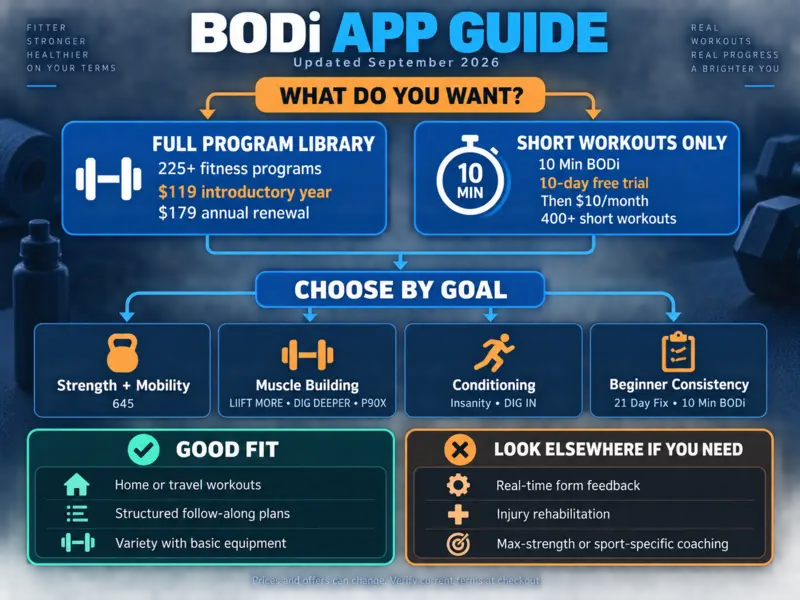
If you would like to watch and follow along with a muscle-building program on your phone, I highly recommend the BODi App by Team BeachBody.
I use their programs as well, and they offer tons of workouts and workout pgroams which you can use to help build muscle and stick with a plan.
Begin With a Manageable Training Volume
Start with approximately two working sets per exercise, particularly during your first two to four weeks.
Add a third set only when you are recovering well and maintaining good form.
Although higher weekly training volumes can support greater hypertrophy, beginners do not need to start with the highest volume they may eventually tolerate.
The updated American College of Sports Medicine position statement found that resistance training improves muscle size across many program designs, while higher volumes can provide additional hypertrophy benefits once a person is prepared for them (Currier et al., 2026).
Beginning with fewer productive sets gives you room to progress.
Starting with excessive volume often produces unnecessary soreness and makes it difficult to determine how much training you actually need.
Train Hard Without Taking Every Set to Failure
A set must be challenging enough to stimulate adaptation, but you do not need to reach absolute muscular failure every time.
For most compound exercises, finish the set when you believe you could complete another one to three technically sound repetitions.
These remaining repetitions are often called “reps in reserve.”
Stopping with one to three reps in reserve allows you to train with meaningful effort while reducing the technique breakdown and fatigue that often occur at failure.
Training to failure can be used occasionally, particularly on stable isolation exercises or machines.
However, current evidence does not indicate that reaching momentary failure on every set is necessary for muscle growth (Grgic et al., 2022).
Beginners also have limited experience estimating how close they are to failure.
Your accuracy will improve as you record workouts and learn how different levels of effort feel.
Use Progressive Overload Without Rushing
Progressive overload means gradually increasing the training demand as your body adapts.
It can involve adding repetitions, weight, sets, range of motion, or control.
Adding weight is only one form of progress.
Performing the same weight with a smoother technique, deeper range of motion, or less unnecessary momentum can be equally valuable.
A simple double-progression system works well:
- Choose a repetition range, such as 8–12 repetitions.
- Select a weight you can perform for at least eight controlled repetitions.
- Keep the same weight until you reach 12 repetitions on every working set.
- Increase the weight by the smallest practical amount.
- Return to the lower end of the range and repeat the process.
For example, you might progress from three sets of 8, 8, and 8 repetitions to 10, 9, and 8, and eventually to 12, 12, and 12.
At that point, increase the weight slightly instead of making a large jump.
Keep a workout log with the exercise, weight, repetitions, sets, and any useful notes about form or discomfort. Without a record, progressive overload becomes guesswork.
Progress Exercises in Stages
Exercise progression should reflect your control, not your impatience.
A more advanced exercise is only useful if it allows you to train the intended muscles effectively.
A logical lower-body progression might look like:
- Supported air squat
- Bodyweight box squat
- Unassisted air squat
- Goblet squat
- Double-dumbbell squat
- Front squat or back squat
A pushing progression could move from wall push-ups to incline push-ups, to floor push-ups, to dumbbell bench presses, and eventually to heavier barbell or dumbbell pressing.
Pulling progressions may begin with band rows and pulldowns before moving to cable rows, assisted pull-ups, and unassisted pull-ups.
There is no deadline for reaching the final variation.
Progress when you can perform the current exercise through a comfortable range of motion with consistent technique and without pain.
You can also remain with a simpler exercise and continue adding repetitions or resistance if it works well for your body.
Eat Enough Calories to Build Muscle
Muscle growth is energetically expensive.
Although beginners can sometimes build muscle at maintenance calories or even during a modest calorie deficit, gaining muscle generally becomes easier when sufficient energy is available.
If you are naturally lean, consistently training, and not gaining weight or strength, begin with a modest calorie surplus rather than an extreme bulk.
Adding approximately 200–300 calories per day is a reasonable initial experiment, but your actual needs should be adjusted according to changes in performance, body weight, appetite, and body composition.
A practical goal is slow weight gain rather than rapid scale movement.
Aggressive surpluses do not force your body to build muscle at an unlimited rate and are more likely to produce unnecessary body-fat gain.
Monitor your average morning body weight across the week rather than reacting to a single measurement.
Sodium, carbohydrate intake, hydration, digestion, and stress can all cause short-term fluctuations.
If your weekly average does not change for two or three weeks, slightly increase your food intake.
If your weight is rising rapidly and your waist measurement is increasing disproportionately, reduce the surplus.
For more realistic expectations, read my guide to realistic muscle-gain results.

Consume Enough Protein
Protein supplies the amino acids needed to repair and build muscle tissue.
A practical target for most people performing resistance training is approximately 0.7–1.0 grams of protein per pound of body weight per day, or about 1.6–2.2 grams per kilogram.
A large meta-analysis found that protein supplementation enhanced resistance-training gains in muscle size and strength, with average benefits leveling off around 1.6 grams per kilogram per day, although some individuals may benefit from higher amounts (Morton et al., 2018).
You do not need to reach the highest end of the range immediately.
Begin by including a meaningful protein source in three or four meals each day.
Useful options include:
- Eggs
- Greek yogurt or cottage cheese
- Chicken or turkey
- Lean beef
- Fish and seafood
- Milk or fortified soy milk
- Tofu or tempeh
- Beans and lentils
- Whey, casein, soy, or plant-based protein powder
Protein powder is a convenient food product, but it is not a requirement.
Use it when it helps you meet your target more easily, but do not assume a shake is automatically better than a balanced meal.
Spreading protein across three to five meals can make your daily target more manageable.
Aiming for approximately 25–40 grams per meal is a practical starting point for many adults, although larger people may need more.
Do Not Neglect Carbohydrates and Dietary Fat
Protein gets the most attention in muscle-building discussions, but carbohydrates support training performance and help replenish muscle glycogen.
Better training sessions can improve your ability to accumulate productive work over time.
Fruit, oats, rice, potatoes, beans, whole-grain bread, and other minimally processed carbohydrate sources can form the foundation of your intake.
Foods that are easier to digest may be preferable immediately before training.
Dietary fat supports general health and helps make meals satisfying.
Include healthy sources of dietary fat such as olive oil, nuts, seeds, avocado, eggs, fatty fish, and dairy products according to your preferences and calorie needs.

Beginners frequently focus so heavily on protein that they under-eat total calories.
If your meals are consistently too small, reaching a high protein target will not fully compensate for inadequate energy intake.
Sleep Is One of Your Most Important Muscle-Building Tools
Sleep supports physical recovery, cognitive function, exercise performance, and the hormonal environment involved in adaptation.
Most adults should aim for at least seven hours, while many perform better with about seven to nine hours.
Even short periods of severe sleep restriction can negatively affect muscle protein synthesis and recovery-related physiology (Saner et al., 2020).
Poor sleep can also make workouts feel harder, reduce movement quality, and increase dependence on caffeine.
A productive sleep routine can include:
- Maintaining a consistent bedtime and wake time
- Keeping the bedroom cool, dark, and quiet
- Reducing bright light and stimulating content before bed
- Avoiding large amounts of caffeine late in the day
- Finishing difficult workouts several hours before bedtime when possible
- Creating a short routine that signals the end of the day
You cannot always control the length or quality of every night’s sleep.
However, consistently sacrificing sleep to add more workouts is usually a poor trade for a beginner trying to build muscle.
When sleep is temporarily limited, reduce training volume or intensity instead of forcing your normal workload.
Maintaining a smaller dose of quality training is often better than accumulating several poor sessions.
Treat Rest Days as Part of Your Program
Your muscles don’t grow if you keep them constantly tired. They grow when training and recovery occur in a productive cycle.
Rest days can include walking, light cycling, easy mobility work, or normal daily activity.
You don’t need to stay completely inactive, but the activity should leave you feeling better rather than adding significant fatigue.
Stress outside the gym also affects your recovery capacity.
Work demands, family responsibilities, travel, illness, and inadequate food intake can all reduce how much training you can productively tolerate.
During stressful periods, reduce the number of sets while preserving the main movement patterns.
This approach helps maintain your routine without turning each workout into another recovery problem.
Understand Soreness and Pain
Delayed-onset muscle soreness is common when you begin training, change exercises, or perform more volume than usual.
However, soreness is not proof that a workout stimulated more growth.
A productive workout should be judged by technique, effort, and long-term progression.
Chasing soreness often encourages unnecessary volume and frequent exercise changes.
Mild muscular soreness that improves as you move is generally different from sharp pain, worsening joint pain, numbness, instability, or pain that changes your movement pattern.
Stop or modify the exercise if you experience these warning signs.
Persistent pain should be evaluated by an appropriately qualified healthcare professional.
No general training plan can account for every previous injury or medical condition.
Supplements Are Optional
Supplements can support a good program, but beginners should establish consistent training, nutrition, and sleep before worrying about minor performance gains.
As I mentioned before, protein powder can help you meet your daily protein target. It is especially useful when you have limited time, a low appetite, or difficulty obtaining enough protein from meals.
Creatine monohydrate is one of the most thoroughly researched sports supplements, and a daily dose of three to five grams can support improvements in strength, high-intensity exercise performance, and lean mass when combined with resistance training (Kreider et al., 2017).
A loading phase is optional, and expensive specialty forms have not consistently demonstrated advantages over standard creatine monohydrate.
People with kidney disease or other relevant medical concerns should speak with a healthcare professional before using it.
Caffeine may improve exercise performance, but it can also interfere with sleep or increase anxiety.
If you need large amounts of caffeine to complete normal workouts, you may need to address your sleep, nutrition, or training volume.
Be skeptical of products promising rapid muscle growth, “testosterone optimization,” or dramatic transformations.
No legal supplement can replace progressive resistance training, adequate calories, sufficient protein, and sleep.
Common Beginner Muscle-Building Mistakes
Changing Exercises Too Often
Repeating exercises gives you the opportunity to improve your technique and measure progress.
Keep your main movements consistent for at least several weeks unless an exercise causes pain or clearly does not fit your body.
Starting With Too Much Training Volume
More work creates more fatigue, but it does not always create more muscle. Begin with a manageable dose and add sets only when your performance and recovery show that you are ready.
Adding Weight Before Earning It
A heavier repetition is not progress if your range of motion and control deteriorate. Build repetitions within a target range before increasing the load.
Ignoring Mobility Limitations
You do not need exceptional flexibility to build muscle, but you need enough usable mobility to enter your training positions comfortably. Consistent pre- and post-workout mobility is more useful than waiting for pain or stiffness to become severe.
Eating “Clean” but Not Eating Enough
Nutrient-dense foods support health, but very filling meals can make it difficult for naturally lean beginners to consume enough calories. Add calorie-dense foods such as olive oil, nuts, rice, oats, dried fruit, dairy products, or smoothies when necessary.
Sacrificing Sleep for More Workouts
An extra workout does not automatically improve your results. When it reduces sleep or prevents recovery, it may make the rest of your training less productive.
Judging Progress Too Quickly
Strength can improve rapidly as you develop coordination, while visible muscle growth requires more time.
Assess your program across months, not individual workouts.
Developing sustainable fitness habits will produce more progress than repeatedly starting aggressive programs you cannot maintain.
How to Track Muscle-Building Progress
Use several measurements because no single method tells the entire story.
Scale weight can change because of muscle, body fat, glycogen, hydration, food intake, and digestion.
Track:
- Weekly average body weight
- Exercises, sets, repetitions, and loads
- Waist, arm, thigh, and chest measurements
- Progress photos under similar conditions
- Exercise technique
- Energy, sleep, soreness, and joint comfort
- How your clothes fit
Review these trends every four to six weeks.
If your technique, repetitions, or loads are improving while your body weight changes slowly, your program may be working even before dramatic visual changes appear.
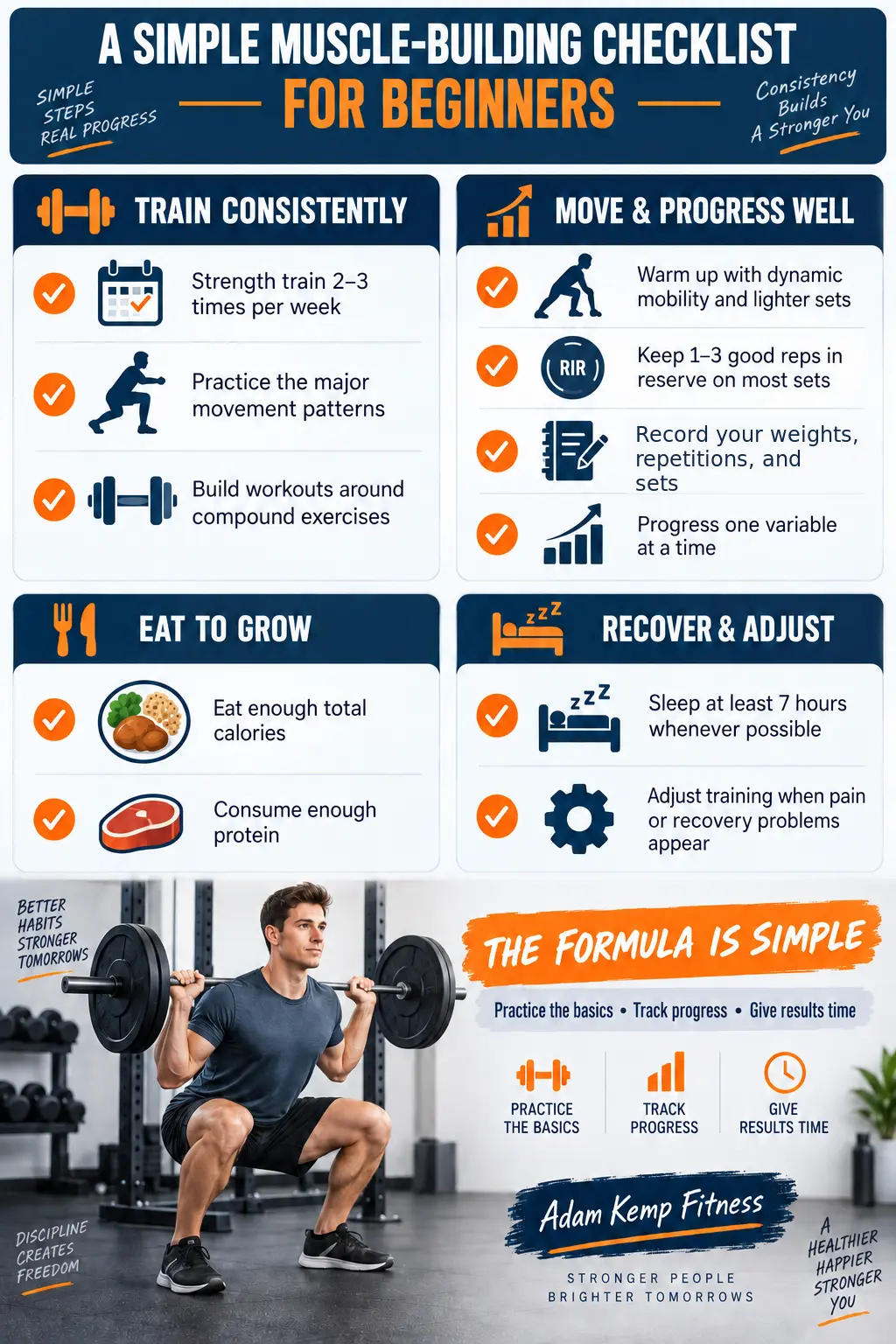
A Simple Muscle-Building Checklist for Beginners
Before searching for a more advanced program, make sure you are consistently doing the following:
- Strength training two or three times per week
- Practicing the major movement patterns
- Warming up with dynamic mobility and lighter exercise-specific sets
- Building workouts around compound exercises
- Completing most sets with one to three good repetitions in reserve
- Recording weights, repetitions, and sets
- Progressing one variable at a time
- Eating enough total calories
- Consuming enough protein
- Sleeping at least seven hours whenever possible
- Adjusting training when pain or recovery problems appear
If these habits are in place, you do not need to keep searching for a secret muscle-building method.
You need to continue executing the plan and allow enough time for the results to accumulate.
Final Thoughts: Muscle Building for Beginners
The best beginner muscle-building program will you how to squat, hinge, push, pull, brace, and control resistance in ways that can be developed for years.
Begin with bodyweight exercises and accessible variations, then progress toward more challenging compound movements as your control improves.
Use a short mobility routine before and after training, record your workouts, and gradually increase the demand.
Support that training with sufficient calories, protein-rich meals, consistent sleep, and realistic expectations.
Muscle building for beginners is ultimately a process of mastering simple actions and repeating them long enough for small improvements to become visible strength and muscle.
This website does not provide medical advice. This website site does contain affiliate links, and purchases may earn a commission.
Read my Medical Disclaimer, Review Disclaimer, and Publishing Policies for more details. Use of this site indicates acceptance of these terms.