Recommended Protein Intake for Athletes for Optimal Results
 Reading Time: 9 minutes
 The recommended protein intake for athletes is higher than the minimum amount needed to prevent deficiency because intense training increases the body’s demand for muscle repair, remodeling, and adaptation.
Although training provides the stimulus for improvement, protein supplies the essential amino acids needed to rebuild stressed tissues.
Most athletes should consume approximately 1.4–2.0 grams of protein per kilogram of body weight per day, with needs influenced by training volume, sport type, energy intake, body composition, and performance goals (Jäger et al., 2017).
Athletes restricting calories or attempting to preserve lean mass during fat loss may benefit from the upper end of this range, or potentially more in specific circumstances.
Daily protein intake is the foundation, but protein quality, meal distribution, and timing also influence how effectively the body uses it.
Understanding these variables makes it easier to set a realistic recommended protein intake for athletes that supports recovery and performance without unnecessarily crowding out carbohydrates, healthy fats, and other essential nutrients.
Most athletes benefit from approximately 0.25 to 0.4 grams of protein per kilogram of body weight per meal.
Why Optimal Protein Intake Matters for Athletes
Optimal protein intake provides athletes with the amino acids needed to repair damaged tissue, remodel muscle, and adapt to repeated training stress.
Exercise provides the stimulus for improvement, but sufficient protein helps the body translate that stimulus into stronger and more resilient tissue.
Protein also supports the maintenance or development of lean muscle mass, which can contribute to strength, power, joint stability, and overall physical capacity.
Consuming enough protein becomes especially important during demanding training periods, injury rehabilitation, or calorie restriction, when muscle breakdown may increase and recovery resources are limited (Jäger et al., 2017).
However, protein does not directly replace the energy used during intense exercise.
Carbohydrates remain particularly important for supporting repeated sprints, heavy lifting, practice, and competition, while dietary fats support hormone production, cellular health, and energy availability.
The goal is therefore not to consume as much protein as possible.
It is to consume enough to support adaptation and recovery without displacing the carbohydrates, fats, vitamins, minerals, and total calories required for athletic performance.
For most athletes, achieving an appropriate daily total and distributing it across several meals is more useful than relying on one oversized serving or an immediate post-workout shake.
This consistent approach keeps essential amino acids available at multiple points throughout the day, creating repeated opportunities to stimulate muscle protein synthesis (Thomas et al., 2016).
When protein intake matches the athlete’s body size, workload, goals, and energy intake, the body is better equipped to preserve muscle, recover between sessions, and adapt productively over time.
How Much Protein Should Athletes Eat?
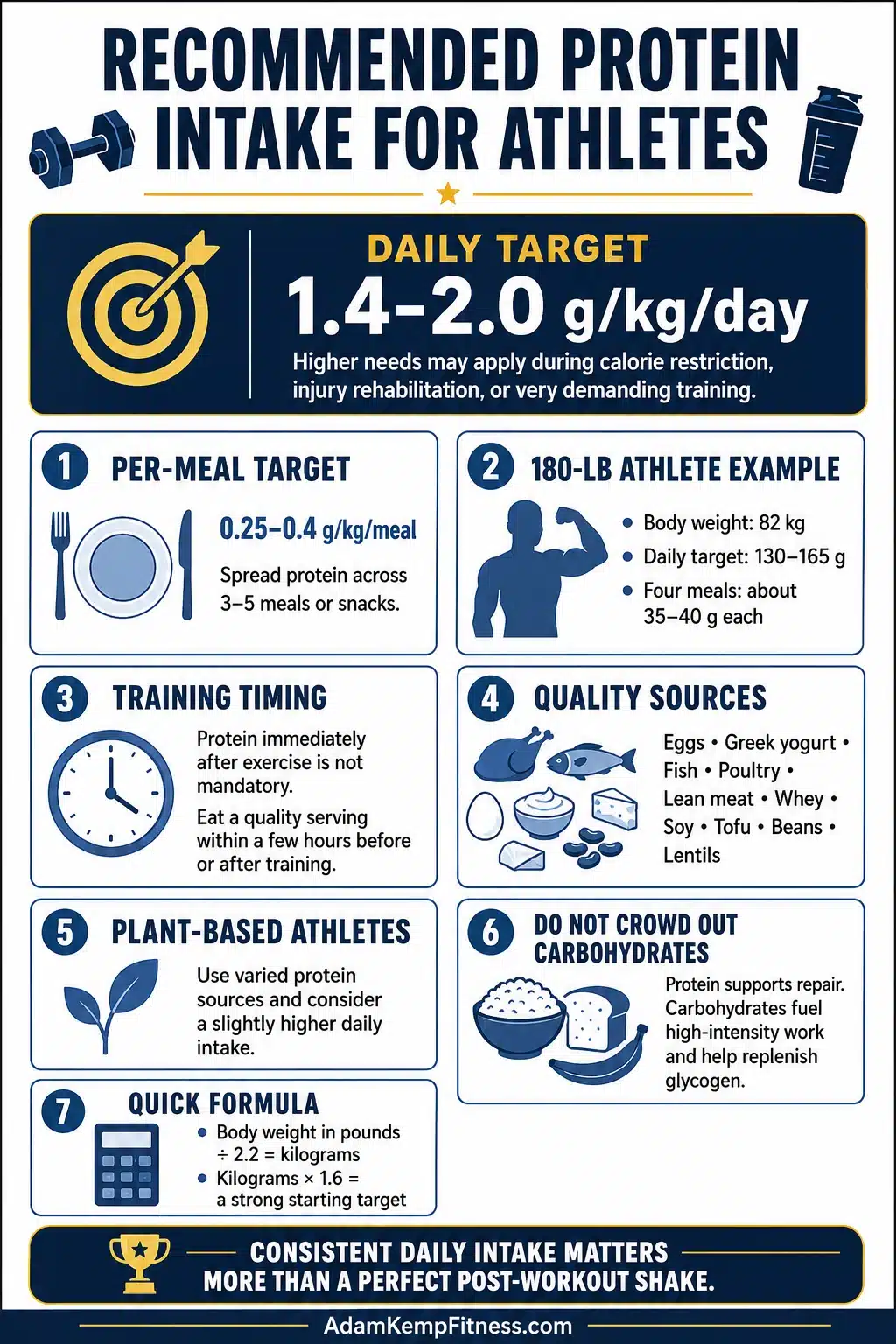
For most active adults and athletes, a practical evidence-based range is 1.4 to 2.0 grams of protein per kilogram of body weight per day.
Athletes who train hard, lift weights, play high-volume sports, or try to lose body fat while maintaining muscle often do well toward the upper end of that range.
If you weigh 180 pounds, you weigh about 82 kilograms.
A daily target of 1.6 to 2.0 grams per kilogram would equal roughly 130 to 165 grams of protein per day.
That range is high enough to support most strength, muscle-building, and recovery goals without turning every meal into a chore.
Your needs may be higher when calories are low.
During a fat-loss phase, the body has less energy available for recovery, and adequate protein becomes even more valuable for preserving lean mass.
Lean athletes in a substantial calorie deficit may benefit from roughly 1.8 to 2.4 grams per kilogram daily, especially when training volume remains high.
On the other hand, someone doing moderate exercise a few times per week does not necessarily need bodybuilder-level protein intake.
Consistency matters more than chasing an extreme number. Set a realistic target, hit it most days, and adjust based on hunger, body composition, training quality, and recovery.
Optimal Daily Protein Distrubtion for Athletes
Your total daily intake is the foundation, but distribution matters too.
Muscle protein synthesis rises after you eat a quality protein-containing meal, then returns toward baseline.
Eating nearly all of your protein at dinner may still help you reach your daily total, but it is not the best approach for maximizing repeated recovery opportunities throughout the day.
A useful target is to eat protein across three to five meals or snacks.
Most athletes benefit from approximately 0.25 to 0.4 grams of protein per kilogram of body weight per meal.
For many people, that works out to about 25 to 40 grams at a time.
A 180-pound athlete, for example, might divide 150 grams of protein into four meals of roughly 35 to 40 grams each.
That could mean eggs and Greek yogurt for breakfast, chicken and rice for lunch, a protein shake after training, and salmon or lean beef for dinner.
Do You Need Protein Immediately After Training?
The so-called anabolic window is wider than most supplement marketing suggests.
You do not need to panic if you cannot drink a shake the second your workout ends.
However, eating protein within a few hours before or after training is still a smart habit, especially if you trained fasted or have another session later that day.
Post-workout nutrition is most useful when it fits into a larger exercise recovery plan.
A meal containing protein and carbohydrates after intense training can support muscle repair and replenish glycogen.
This matters even more for basketball players, runners, field-sport athletes, and anyone completing multiple practices or workouts in a day.
During my professional basketball career, recovery nutrition was never about finding one perfect shake or supplement.
It was about avoiding long stretches without food, consistently getting enough protein, and eating enough carbohydrates to meet the demands of practices, lifting, travel, and games.
Impact of Protein Quality on Daily Protein Intake Needs for Athletes
Protein quality refers to the amino acid profile and how well a source supports muscle protein synthesis.
Animal proteins such as eggs, dairy, fish, poultry, lean meat, and whey are complete proteins, meaning they provide all essential amino acids in meaningful amounts.
Plant proteins can absolutely support athletic performance too, but they often require more planning.
Soy foods, pea protein blends, beans, lentils, tofu, tempeh, quinoa, and seitan can all contribute.
Athletes eating mostly plant-based diets may benefit from slightly higher total protein intake and a wider variety of sources across the day.
Leucine is one essential amino acid that plays a major role in signaling muscle protein synthesis.
Whey protein, dairy, meat, and soy are especially effective options.
You don’t need to count leucine in every meal, but this is one reason a serving of Greek yogurt, a whey shake, chicken breast, or tofu is often more effective for recovery than a low-protein snack.
Whole foods should make up most of your intake because they also provide vitamins, minerals, healthy fats, and carbohydrates.
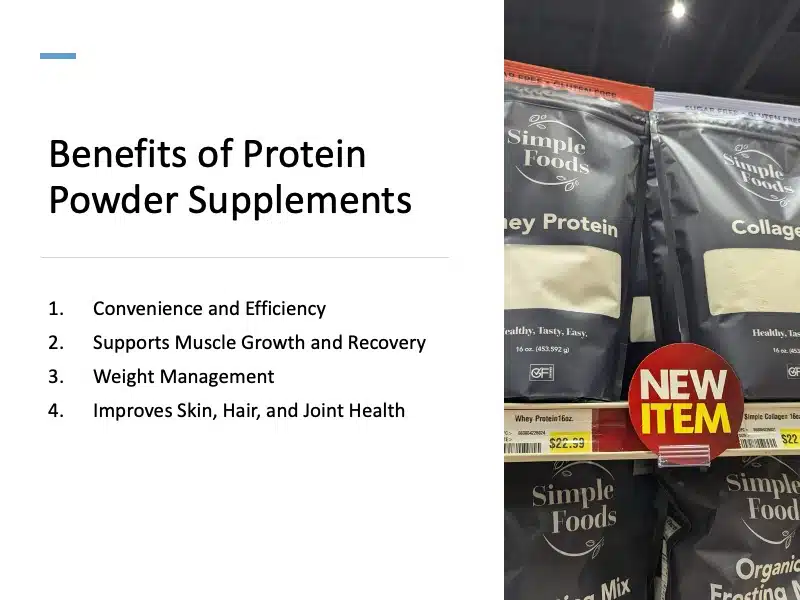
Protein powder supplements are useful when convenience is the issue, not because they are inherently superior to food.
A high-protein shake can be a practical option after practice, while traveling, or when your schedule makes a full meal difficult.
Plant vs. Animal Protein Sources for Athletes
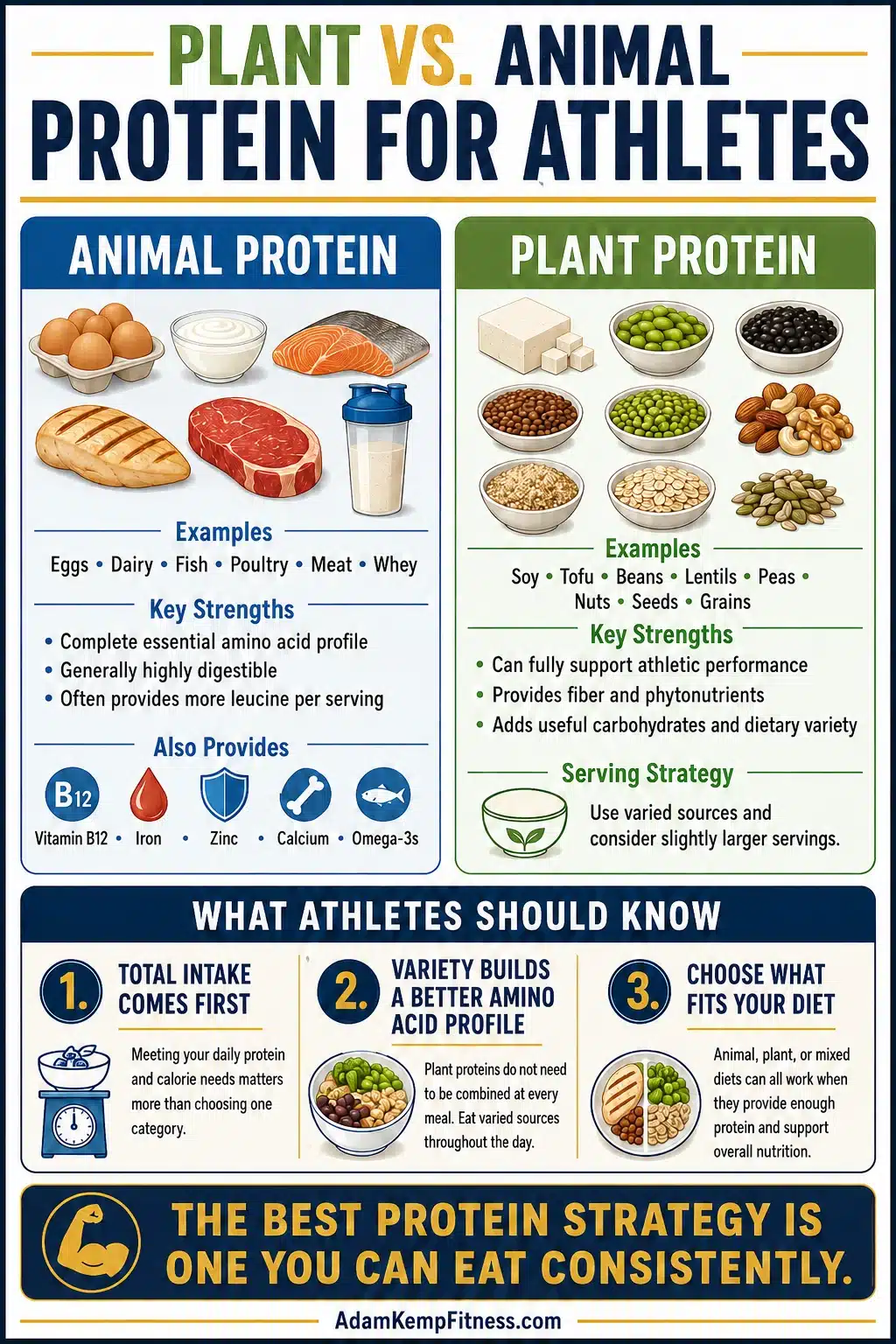
Animal proteins such as eggs, dairy, fish, poultry, meat, and whey generally contain all nine essential amino acids in favorable proportions and are highly digestible.
They also tend to provide more leucine per serving, making it easier to stimulate muscle protein synthesis with a moderate portion.
Plant proteins can still fully support muscle growth, recovery, and athletic performance when total protein and calorie intake are adequate.
However, some plant sources contain lower amounts of one or more essential amino acids or are less digestible, so plant-based athletes may benefit from eating slightly larger portions and combining varied sources such as soy, tofu, beans, lentils, peas, grains, nuts, and seeds (Jäger et al., 2017).
Athletes do not need to combine complementary plant proteins at every meal.
Consuming a varied diet throughout the day generally provides an adequate amino acid profile, while soy protein and well-formulated plant-protein blends can offer quality comparable to many animal-based options.
Neither category is automatically healthier in every context.
Animal foods provide vitamin B12, iron, zinc, calcium, and omega-3 fatty acids, while plant foods provide fiber, phytonutrients, and a wider range of carbohydrates; for most athletes, the best approach meets protein needs while supporting overall dietary quality and personal preferences.
Important: Do Not Let Protein Consumption Crowd Out Carbohydrates
Athletes sometimes overcorrect after learning about protein.
They start eating large amounts of meat, shakes, and protein bars while unintentionally cutting carbohydrate intake too low.
This can hurt performance.
Protein supports repair and adaptation.
But carbohydrates provide a major fuel source for high-intensity work.
If you lift hard, sprint, play basketball, run intervals, or train for a sport with repeated bursts of effort, insufficient carbohydrate intake can leave you flat, slow recovery, and make training feel harder than it should.
The goal is not a high-protein diet at the expense of everything else.
Build meals around a protein anchor, then add carbohydrates appropriate for your training demands along with fruits, vegetables, and healthy fats.
On heavier training days, your carbohydrate needs generally rise. On rest days, you may need fewer carbs, but protein should remain relatively consistent.
Common Protein Intake Mistakes That Limit Results
The most common mistake is estimating intake without ever checking it.
Many people believe they eat “a lot of protein,” yet their breakfast contains 10 grams, lunch contains 20 grams, and dinner is their only substantial protein meal.
Tracking for even a few days can reveal whether your current habits match your goal.
Another mistake is relying on protein bars and processed snacks as the foundation of the diet.
These products can be convenient, but they are often expensive and less filling than a real meal.
Use them strategically, not as a replacement for quality food.
Finally, do not assume a higher protein intake can compensate for poor training, inadequate sleep, low calorie intake, or inconsistent hydration.
Nutrition works best when it supports disciplined training and recovery habits. It cannot rescue a program that lacks those basics.
A Simple Way to Set Daily Protein Intake Goals for Athletes
Start by multiplying your body weight in kilograms by 1.6.
This is a strong middle-ground target for most athletes and recreational lifters.
If you are in a calorie deficit, train frequently, or struggle to maintain muscle, move toward 1.8 to 2.0 grams per kilogram.
Then divide that number among the meals you already eat.
Do not redesign your entire life overnight. If breakfast is currently low in protein, add eggs, cottage cheese, Greek yogurt, or a shake.
If lunch is inconsistent, prepare a dependable protein source in advance.
Small, repeatable changes are usually more effective than complicated meal plans that disappear after one busy week.
People with kidney disease or other medical conditions should discuss major dietary changes with a qualified healthcare professional.
For healthy individuals who train regularly, a protein intake within typical sports nutrition ranges is generally a practical, well-supported strategy.
Your protein target should make your training life easier, not more stressful.
Build a routine you can repeat through busy workweeks, travel, hard practices, and weekends.
When your meals consistently support what you do in the gym or on the field, better recovery stops being something you hope for and becomes part of your preparation.
This website does not provide medical advice. This website site does contain affiliate links, and purchases may earn a commission.
Read my Medical Disclaimer, Review Disclaimer, and Publishing Policies for more details. Use of this site indicates acceptance of these terms.