CBD for Tourette Syndrome: Does CBD Help Suppress Tics?
 Reading Time: 18 minutes
 Using CBD for Tourette syndrome may help some people manage motor tics, anxiety, sleep problems, and premonitory urges, but the scientific evidence requires an important clarification: the strongest results involve cannabis-based medicines containing both cannabidiol (CBD) and tetrahydrocannabinol (THC), not CBD alone.
As someone who has lived with Tourette syndrome since childhood and played professional basketball for more than a decade, I have personally found full-spectrum CBD to be one of, if not the most effective, remedies to suppress my motor tics and help me live a “normal” life.
Along with decades of lived experience, I hold a Master’s Degree in Nutrition Education and use that background to critically examine how diet, supplements, lifestyle habits, and therapeutic options may help me manage my tics.
The preliminary cannabinoid research, combined with the substantial relief I personally experience and the ability to integrate full-spectrum CBD with other supportive approaches, has led me to view it as one of the most promising tools in my Tourette syndrome management plan.
However, my experience is not proof that the same approach will work for everyone, and the inclusion of small amounts of THC in full-spectrum CBD products creates legitimate concerns involving side effects, legality, and drug testing.
For me, responsible full-spectrum CBD use is not about escaping reality or chasing intoxication; it is about quieting the involuntary movements that disrupt my body so I can function, compete, and live more comfortably on my own terms.
What Is Tourette Syndrome?
Tourette syndrome is a neurodevelopmental condition characterized by multiple motor tics and at least one vocal tic persisting for more than one year.
Tics are involuntary or semi-voluntary movements and sounds that commonly fluctuate with stress, excitement, fatigue, illness, and changes in routine.
Many people with Tourette syndrome experience a premonitory urge, such as a building physical or sensory tension that occurs before a tic and temporarily improves after completing it.
Tourette syndrome can also coexist with attention-deficit/hyperactivity disorder, obsessive-compulsive symptoms, anxiety, depression, sleep difficulties, and problems regulating emotions.
I have also been diagnosed with ADHD, and combining a very low dose of methylphenidate with full-spectrum CBD and the other strategies I use to manage my tics has provided even greater benefits for my concentration and overall symptom control.
I did not try methylphenidate until after the car accident my wife and I experienced in December 2024, which dramatically worsened my tics and made them far more difficult to manage
Important: CBD and methylphenidate can affect people differently, and this combination should be used only with appropriate medical supervision.
These associated conditions sometimes cause more impairment than the tics themselves.
Therefore, an effective Tourette syndrome treatment may improve quality of life even when it does not eliminate every motor or vocal tic.
Does CBD Help Tourette Syndrome?
CBD may help certain symptoms associated with Tourette syndrome, but there is currently insufficient evidence to conclude that CBD by itself reliably suppresses tics.
Most favorable clinical evidence involves THC alone or formulations combining THC and CBD.
The Tourette Association of America has noted that published research does not yet demonstrate that purified CBD or high-CBD, very-low-THC cannabis consistently treats Tourette syndrome, although CBD may influence the therapeutic and adverse effects of THC-containing formulations (Tourette Association of America, n.d.).
This distinction is important because “CBD,” “full-spectrum CBD,” and “medical cannabis” are frequently treated as interchangeable terms online.
They are chemically and clinically different products that can produce different benefits, side effects, and drug-testing outcomes.
A more accurate conclusion is that the endocannabinoid system appears to be a promising therapeutic target for Tourette syndrome, while the specific contribution of CBD remains uncertain.
CBD may be helpful as one part of a balanced cannabinoid formulation, but current evidence does not establish it as a proven “stand-alone” tic suppressant.
However, the absence of conclusive evidence is not the same as evidence that full-spectrum CBD provides no benefit, particularly given how much remains unknown about the underlying neurobiology of Tourette syndrome and how differently individuals respond to treatment.
Personal experience should not replace controlled research, but it remains clinically meaningful in a condition requiring individualized symptom management, and I personally experience significant relief from my motor tics when using full-spectrum CBD.
My Experience Using Full-Spectrum CBD for Tourette Syndrome
I was diagnosed with Tourette syndrome when I was approximately 8 years old, and involuntary motor tics have remained part of my daily life throughout my professional basketball career.
Tourette syndrome is often reduced to stereotypes about uncontrollable swearing, but my experience primarily involves sudden movements, premonitory urges, internal tension, and periods when it feels as though my body is repeatedly misfiring.
In a profile about my life and basketball career, the largest sports magazine in Poland, Fakt, described how I developed motor tics as a child and continued experiencing them while playing professionally.
When people ask how I can compete with Tourette syndrome, I do not have a dramatic explanation: the tics are simply part of me, and I have spent most of my life learning how to perform with them rather than waiting for them to disappear.
My symptoms can become less noticeable when I am fully engaged in a game because my attention is occupied by the immediate demands of competition.
As I explained to Przegląd Sportowy, however, the movements may return while I am sitting on the bench or standing quietly at the free-throw line.
That difference illustrates something important about Tourette syndrome: a person who appears comfortable or symptom-free for a few minutes may still be using considerable physical and mental effort to manage their tics.
The condition fluctuates, and what others see does not always reflect what is happening internally.
My tics generally intensify when I am injured, underslept, physically overworked, emotionally strained, or uncertain about something important in my life.
In an interview with Authority Magazine, I explained that pressure and stress can make my motor tics feel almost uncontrollable, which is why mental preparation and predictable routines have always been essential to my performance.
I have also learned that managing Tourette syndrome requires much more than taking one supplement or medication.
I told Thrive Global that self-care is a way of life for me because everyday choices involving stress, caffeine, food, sleep, training, and recovery can determine whether my tics remain manageable or substantially interfere with my quality of life.
At that time, yoga and meditation were important parts of my routine, and I genuinely believed they were helping me. I no longer personally believe in or practice yoga and meditation because my Christian faith has led me toward prayer as the foundation of my spiritual and mental life.
Prayer gives me a sense of peace, perspective, and stability that I previously sought through those practices.
I often combine prayer with slow, controlled breathing exercises, which help me reduce physical tension without separating that calming process from my faith.
Diet is another major part of how I manage Tourette syndrome because my nervous system does not respond equally well to every food, stimulant, or eating pattern.
I pay close attention to caffeine, hydration, blood-sugar fluctuations, meal quality, digestive health, and foods that seem to increase inflammation or leave me feeling physically overstimulated.
These habits do not cure Tourette syndrome, but they can influence the conditions under which my tics become better or worse.
Prayer, breathing exercises, nutrition, sleep, exercise, recovery, and careful stimulant use create the foundation that allows any additional remedy, including CBD, to work more effectively.
Physical trauma has made that relationship even more obvious to me.
In an interview with PolskiKosz about recovering from a serious car accident and returning to professional basketball, I discussed the sudden, involuntary motor tics caused by my form of Tourette syndrome while explaining the difficult work required to regain my health.
Injuries do not affect only the damaged muscle, joint, or bone; they can disrupt sleep, increase anxiety, change movement patterns, and place the entire nervous system under additional strain.
Some of my most difficult periods with tics have occurred when my body was simultaneously trying to manage pain, rehabilitation, uncertainty, and the pressure to return to basketball.
That connection between physical stress and neurological symptoms was one of the primary reasons I became interested in CBD.
I was not looking to become intoxicated or escape from reality; I wanted something that could support recovery, reduce internal tension, and help quiet the involuntary movements that made it harder to feel comfortable in my own body.
One of the first times I discussed my experience publicly was in a 2018 CelebStoner feature about CBD, chronic pain, and Tourette syndrome.
At the time, I explained that full-spectrum CBD products had improved my overall quality of life and made my motor tics substantially easier to manage.
Through personal experimentation, I found full-spectrum CBD more effective for my tics than CBD treated as an isolated compound.
That does not prove that everyone with Tourette syndrome needs THC, but my experience is consistent with an important feature of the emerging research: the most encouraging results generally involve cannabis-based medicines containing both CBD and THC rather than purified CBD alone.
The effect is not that I suddenly forget I have Tourette syndrome.
Instead, the internal pressure often feels quieter, the urge to complete certain movements becomes less demanding, and my body feels less trapped in a cycle of tension, tic, temporary relief, and renewed tension.
That relief can affect far more than the visible frequency of my tics.
When my body is calmer, it may be easier to rest, concentrate, communicate, recover from training, spend relaxed time with my family, and complete ordinary tasks without constantly fighting involuntary movements.
However, I want to describe these benefits responsibly rather than present my experience as universal proof.
Tourette syndrome varies substantially between people, and a product that helps one person may be ineffective or may increase anxiety, sedation, cognitive difficulty, or other symptoms in someone else.
My perspective on cannabis has also become more cautious and precise over time.
I still believe adults with Tourette syndrome should have responsible access to cannabis-based medicines, especially when conventional options have been ineffective or poorly tolerated, but advocacy must include honest discussion of the risks.
Full-spectrum CBD contains THC, even when the quantity is small, and the product is legally classified as hemp.
That THC may contribute to the therapeutic effect, but it can also interact with medications, violate employment policies, and produce a positive drug test.
For me, full-spectrum CBD is neither a miracle cure nor an excuse to ignore the fundamentals of health.
It is one component of a larger strategy built around Christian prayer, controlled breathing, intentional nutrition, quality sleep, responsible training, recovery, and awareness of the situations that worsen my tics.
Most importantly, I do not use CBD because I am ashamed of having Tourette syndrome or believe every tic must be hidden. I use it because reducing the physical burden of my tics helps me function more comfortably, remain present with the people I love, and live more freely on my own terms.
Why Full-Spectrum CBD May Work Differently Than CBD Isolate
CBD isolate contains cannabidiol without the other naturally occurring cannabinoids found in the cannabis plant.
Broad-spectrum CBD contains multiple cannabis compounds but is generally processed to remove THC, while full-spectrum CBD retains CBD, minor cannabinoids, terpenes, and a legally limited or medically prescribed quantity of THC.
The idea that these compounds may work more effectively together is commonly called the “entourage effect.”
This remains a plausible but incompletely proven explanation, and it should not be presented as settled science.
For Tourette syndrome specifically, the clinical evidence suggests that THC may be more directly involved in tic reduction than CBD.
CBD may still contribute by influencing anxiety, sleep, tolerability, cannabinoid signaling, or the subjective intensity of premonitory urges, but researchers have not clearly separated these effects.
Therefore, someone who reports success with “full-spectrum CBD” may actually be responding to the interaction between CBD and a small amount of THC.
That does not invalidate the benefit, but it changes how the result should be described and introduces additional safety considerations.
How Cannabinoids Could Affect Tics
The endocannabinoid system helps regulate neurotransmitter activity throughout the brain.
Cannabinoid receptors are present in brain areas involved in movement, reward, emotional regulation, and habit formation, including the basal ganglia, which are highly relevant to Tourette syndrome.
Cannabinoids can influence dopamine, gamma-aminobutyric acid, glutamate, acetylcholine, and other signaling systems associated with motor control.
This provides a biologically plausible explanation for why cannabis-based medicines might affect tics, premonitory urges, anxiety, and obsessive-compulsive symptoms (Tourette Association of America, n.d.).
THC primarily activates cannabinoid CB1 receptors and produces the intoxicating effects associated with cannabis.
CBD does not produce the same “high” and has a more indirect, complex pharmacological profile involving numerous receptors, enzymes, and signaling pathways.
It is still unclear whether cannabinoid treatments reduce tics directly or make tics easier to manage by reducing stress, anxiety, poor sleep, or the discomfort of premonitory urges.
Both outcomes can matter to patients, but they are not scientifically identical.
What Does the Research Say About Cannabis and Tourette Syndrome?
Early controlled trials primarily investigated THC.
A small crossover trial involving 12 adults and a six-week trial involving 24 adults reported improvements in some measures of tic severity, but the studies were too small to support broad conclusions (Tourette Association of America, n.d.).
More recent research has investigated standardized combinations of THC and CBD. In a randomized, double-blind crossover trial involving adults with severe Tourette syndrome, an oral formulation containing THC and CBD reduced tics and appeared to improve tic-related impairment, anxiety, and obsessive-compulsive symptoms, although cognitive side effects were also observed (Mosley et al., 2023).
Another randomized controlled investigation of cannabis-based medicine found promising improvements in tic severity and quality of life, with stronger responses among some participants at higher cannabinoid doses.
However, the overall evidence remains limited by small sample sizes, short treatment periods, variable formulations, and individual differences in response (Serag et al., 2024).
Observational studies generally produce encouraging but less reliable findings.
In one study of adults receiving medical cannabis, many participants reported meaningful improvements in tic severity and associated symptoms, but adverse effects such as dry mouth, fatigue, dizziness, and cognitive changes were also common (Anis et al., 2022).
These findings support further research and carefully supervised access for appropriate adults.
They do not establish cannabis as a universal first-line treatment or prove that over-the-counter CBD oil will reproduce the effects of standardized THC–CBD medicines used in clinical trials.
Is Full-Spectrum CBD the Best CBD for Tourette Syndrome?
Full-spectrum CBD is scientifically more relevant to the existing Tourette research than CBD isolate because it contains at least some THC.
However, “more relevant” does not automatically mean safer or better for every person.
People who are extremely sensitive to THC, have previously experienced panic or paranoia from cannabis, take interacting medications, or have a personal or family history of psychosis may need to avoid THC-containing products.
The potential benefit must also be weighed differently for children, adolescents, pregnant individuals, drivers, employees in safety-sensitive jobs, and drug-tested athletes.
Full-spectrum CBD may be worth discussing with a knowledgeable physician when an adult has functionally impairing tics that have not responded adequately to behavioral therapy or conventional medication.
It should be considered a personalized medical decision, not a general wellness recommendation.
CBD, THC, and Drug Testing
One of the greatest misconceptions about CBD is that any product sold as hemp-derived or federally compliant is incapable of causing a positive drug test.
Standard drug tests generally target THC metabolites rather than CBD, but full-spectrum CBD intentionally contains some THC, and repeated use can allow those metabolites to accumulate.
Even broad-spectrum and CBD-isolate products may present a risk if they are contaminated, mislabeled, or manufactured without adequate quality control.
Federal drug-testing experts have specifically warned that CBD oils and other cannabis-derived products can produce positive urine results for THC metabolites (Substance Abuse and Mental Health Services Administration [SAMHSA], 2019).
The rules are somewhat different for athletes governed by the World Anti-Doping Agency.
CBD itself is not prohibited, while THC and other natural or synthetic cannabinoids are prohibited in competition, not at all times throughout the year (World Anti-Doping Agency [WADA], 2026).
Unless a sport has received approval for a different definition, WADA’s in-competition period generally begins at 11:59 p.m. on the day before competition and continues through the competition and sample-collection process.
Therefore, THC use occurring out of competition is not automatically an anti-doping violation, although residual metabolites can still create a problem if they remain above the applicable threshold when an in-competition sample is collected.
WADA applies a urinary threshold of 150 nanograms per milliliter for the THC metabolite 11-nor-9-carboxy-THC.
This relatively high threshold was designed to reduce the likelihood that remote or incidental exposure would produce an adverse analytical finding (WADA, 2022).
For that reason, modest use of a properly manufactured, legally compliant, low-THC full-spectrum CBD product is generally less likely to cause a failed WADA test than using THC-dominant cannabis close to competition.
WADA-tested athletes may therefore have less reason for concern than workers subject to strict zero-tolerance testing, particularly when CBD is used out of competition and the product’s THC content has been independently verified.
However, “less likely” does not mean impossible.
THC clearance varies according to the product, dose, frequency of use, body composition, metabolism, and time between the final dose and sample collection, while inaccurate labels or batch contamination can substantially increase exposure.
Athletes should also understand that a certificate of analysis cannot guarantee compliance, and WADA places ultimate responsibility for prohibited substances found in a sample on the athlete.
Anyone using full-spectrum CBD should choose a batch-tested product designed for drug-tested athletes, carefully review its cannabinoid profile, and leave a conservative interval before competition rather than treating the 150-ng/mL threshold as a guaranteed safety margin.
The risk may be manageable under WADA rules, but it is different for employment, military, probation, legal, or clinical testing programs, which may apply lower thresholds or different policies.
Anyone governed by those systems should assume that full-spectrum CBD could cause a positive THC result even when the product is legal and does not produce noticeable intoxication.
Why Drug-Testing Policies Need More Nuance
Responsible cannabis advocacy does not require pretending THC has no risks.
It requires distinguishing medical use from impairment and recognizing that the presence of a cannabinoid does not always answer the most important questions.
A person using a low-THC product to manage a neurological condition may still violate a zero-tolerance policy even when the product does not make them feel intoxicated.
Conversely, holding a medical authorization does not automatically mean someone is safe to drive, practice, compete, or operate equipment after using THC.
Better policies should evaluate the purpose of testing, the biological specimen used, validated concentration thresholds, the likelihood of recent impairment, and whether the individual had a legitimate medical explanation.
Patients also deserve transparent written rules before their health decisions become employment or eligibility disputes.
Potential Benefits of CBD for Tourette Syndrome Beyond Reduced Tic Frequency
Tourette syndrome is not experienced as a simple tic count.
A treatment can be valuable if it reduces the intensity of premonitory urges, helps a person sleep, decreases anxiety, or makes a tic less painful and disruptive.
Clinical research has reported potential improvements in obsessive-compulsive symptoms, anxiety, sleep, and overall impairment alongside changes in tic severity (Mosley et al., 2023).
These secondary effects may partially explain why some patients describe cannabis-based medicine as life-changing even when observers still notice tics.
This also helps explain why treatment outcomes should include more than the number of movements or vocalizations recorded during a brief clinical visit.
Pain, exhaustion, concentration, social participation, sleep, confidence, and the effort required to suppress tics are all meaningful parts of the condition.
Risks and Side Effects of CBD and THC
CBD is non-intoxicating, but it is not biologically inactive or risk-free.
It can cause sleepiness, gastrointestinal symptoms, appetite changes, liver enzyme elevations, and clinically relevant interactions with medications metabolized via certain liver pathways (U.S. Food and Drug Administration [FDA], 2020).
THC can cause dizziness, sedation, slowed reaction time, impaired short-term memory, anxiety, paranoia, and changes in perception.
Risks generally increase with higher doses, frequent use, younger age, and vulnerability to psychotic or substance-use disorders.
Cannabis may also interact with medications used for Tourette syndrome, ADHD, anxiety, depression, epilepsy, sleep, and other conditions.
Anyone combining cannabinoid products with prescription medicine should review the combination with a physician or pharmacist.
The FDA advises against CBD and THC use during pregnancy and breastfeeding. Evidence in children with Tourette syndrome remains especially limited, and concern about neurodevelopment means pediatric use should never be treated as an extension of adult self-experimentation (FDA, 2019; Woerner et al., 2025).
How to Approach CBD Use for Tourette Syndrome Responsibly
The safest approach begins with a clinician who understands tic disorders and cannabinoid medicine.
The discussion should include the severity of the tics, coexisting conditions, current medications, previous reactions to cannabis, mental-health history, legal status, and occupational or athletic testing requirements.
When a supervised trial is appropriate, a patient should use a standardized product with independent laboratory testing for CBD, THC, pesticides, residual solvents, microbes, and heavy metals.
The certificate of analysis should correspond to the product’s actual batch, not serve as a generic marketing document.
Starting with a low dose and increasing gradually can reduce the risk of avoidable side effects.
Patients should track the exact CBD and THC quantities, tic frequency, tic intensity, premonitory urges, sleep, anxiety, concentration, and adverse reactions instead of relying only on a general impression.
Oral oils and capsules have a slower onset and longer duration than inhaled cannabis, which can make the effects easier to monitor but also easier to accidentally redose before the first dose has fully taken effect.
Smoking introduces respiratory exposure and is not a neutral delivery method, particularly for athletes or people with asthma.
No one should drive, practice, compete, or perform safety-sensitive work while impaired.
Responsible use also means storing every cannabis product securely away from children and never assuming that a familiar plant-based product is harmless.
CBD Should Not Replace Established Tourette Treatments Automatically
Comprehensive Behavioral Intervention for Tics, commonly called CBIT, remains one of the best-supported non-drug treatments for Tourette syndrome.
It teaches awareness of tic urges, competing responses, and strategies for identifying environmental factors that intensify symptoms.
Medications such as alpha-2 adrenergic agonists, dopamine-modulating medicines, and other neurologic or psychiatric treatments may also be appropriate depending on tic severity and coexisting conditions.
Cannabis-based medicine should normally be considered within a broader treatment plan rather than as a replacement for every established option.
My own management strategy has never depended on one product.
Sleep, stress management, breathing exercises, prayer, training-load management, emotional support, and accepting rather than feeling ashamed of Tourette syndrome have all influenced how well I function.
Advocacy Means Supporting Choice and Accuracy
People with Tourette syndrome deserve more than two unhelpful extremes: exaggerated promises that cannabis cures tics or blanket stigma suggesting that any patient who uses cannabis is irresponsible.
Clearly, the evidence supports a more respectful position.
Some adults experience meaningful relief from THC-containing or THC–CBD cannabis-based medicines, particularly when standard treatments have been inadequate.
Others experience little benefit or side effects that make treatment unsuitable.
Patients should have access to qualified medical supervision, accurately labeled products, fair drug-testing policies, and research that measures outcomes important to the Tourette community.
They should also receive honest information about uncertainty, intoxication, medication interactions, cognitive effects, and the additional risks faced by younger patients.
Final Verdict: Can CBD Suppress Tourette Tics?
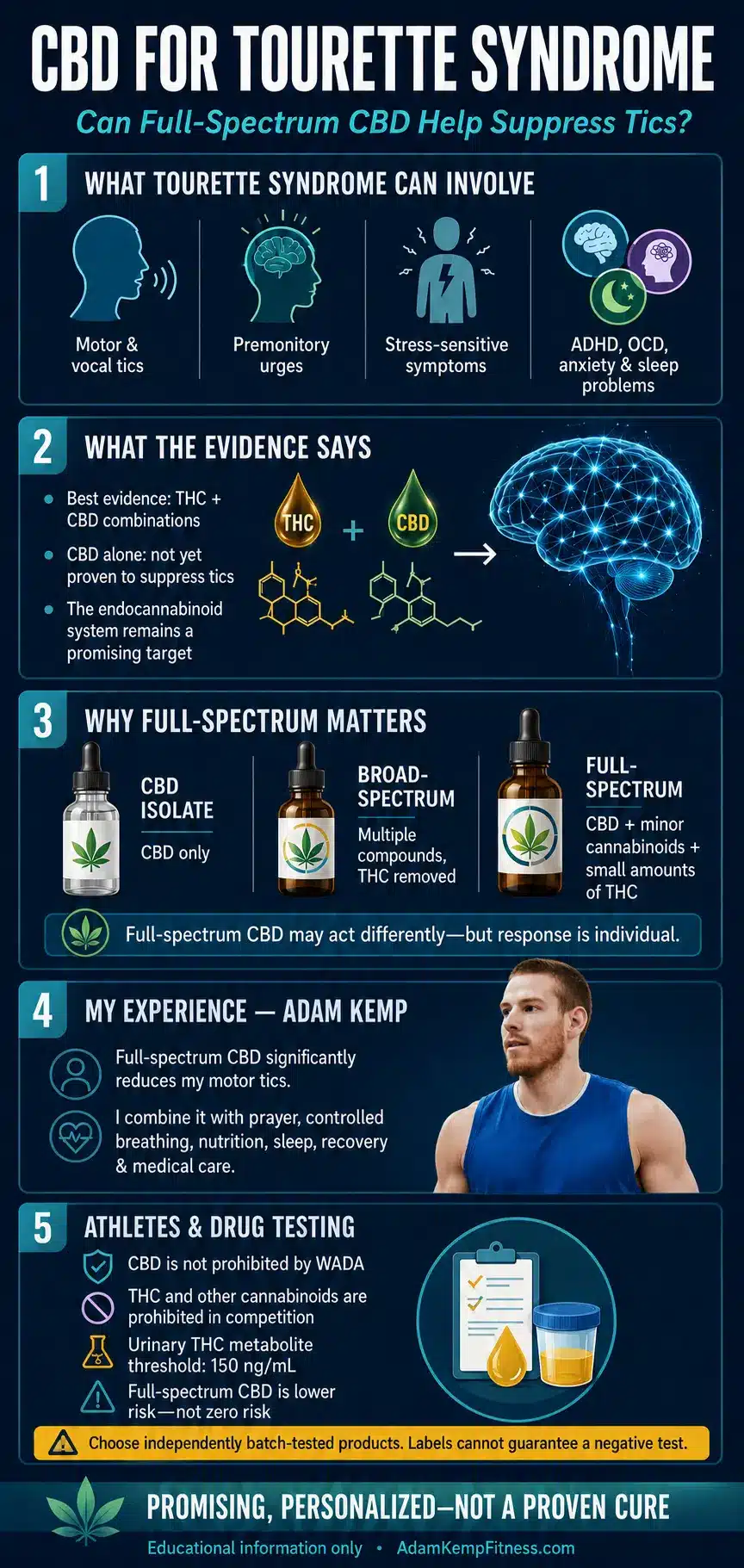
CBD alone has not been proven to consistently suppress tics in people with Tourette syndrome, but the more persuasive evidence supports carefully dosed cannabis-based medicines containing THC, often in combination with CBD, for selected adults with persistent and functionally impairing symptoms.
Based on my experience, full-spectrum CBD can feel substantially different from CBD isolate and may help make motor tics, physical tension, and stress easier to manage.
Nevertheless, the same THC content that may contribute to its effectiveness can also create side effects, legal complications, and positive drug tests.
Full-spectrum CBD should therefore be viewed as a potentially useful but imperfectly studied option, not a cure and not a risk-free supplement.
Responsible cannabis advocacy means defending patients’ right to explore promising treatments while being equally committed to accurate labeling, medical oversight, realistic expectations, and informed consent.
Frequently Asked Questions About CBD and Tourette Syndrome
This website does not provide medical advice. This website site does contain affiliate links, and purchases may earn a commission.
Read my Medical Disclaimer, Review Disclaimer, and Publishing Policies for more details. Use of this site indicates acceptance of these terms.