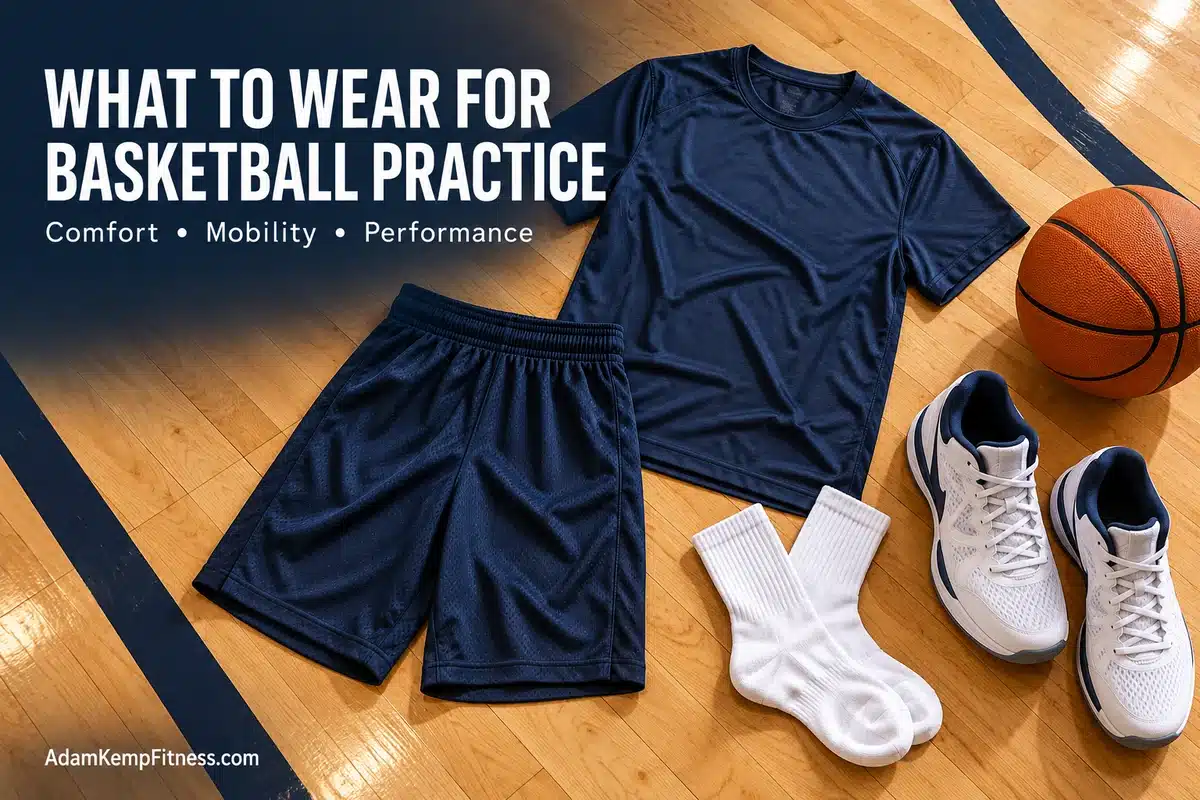
What to Wear for Basketball Practice: A Guide to Comfort and Performance
 Reading Time: 6 minutes
 Determining what to wear for basketball practice isn’t a fashion question (although sports and fashion are often intertwined.
Instead, it is a question of choosing comfortable clothes and well-fitting shoes so you can focus on shooting, cutting, and defending without constantly adjusting your gear.
Every basketball coach seems to have some version of the same line: “If you’re thinking about your shirt, you’re not thinking about the game.”
Sounds obvious until you actually watch a player spend half a drill tugging a shirt that keeps riding up every time they raise their arms for a shot.
Basketball practices run long: two to three hours of running, jumping, cutting, stopping short, and repeating it all.
Clothes that fight a player the whole time become just another distraction, pulling focus away from the drill or competition in front of them.
However, none of this needs to get complicated.
As a professional basketball player with over 25 years of experience in the basketball world, in this article, I’ll discuss what actually matters when picking out what to wear for basketball practice, from shirts and shorts to shoes, socks, and team uniforms, so players can focus on the game instead of their clothes.
Most Important Clothes for Basketball Practice You Need to Carefully Choose
When choosing what to wear for basketball practice, do a quick movement check: can you shoot, squat, and shuffle without anything pulling, slipping, or rubbing?
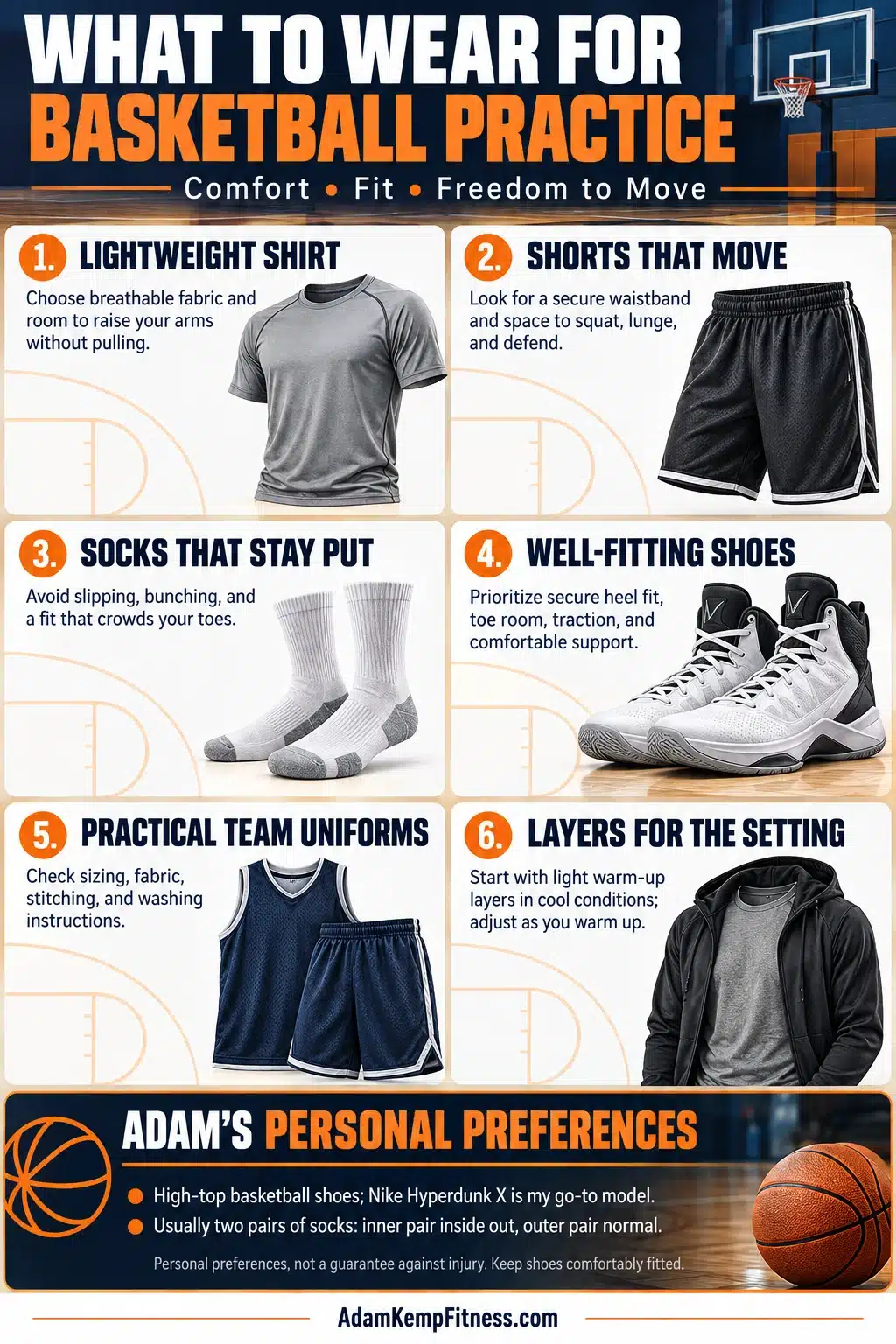
Here’s what I look for when choosing shirts, shorts, socks, shoes, and team uniforms based on my experience playing professional basketball.
The Shirt Matters More Than You’d Think
You might not think your shirt’s material matters in your basketball training session, but believe me, its material and fit can make a huge difference!
A shirt that’s too tight across the shoulders shows up the second someone raises their arms for a shot.
Too baggy, and it flaps around during a fast break, which is its own kind of annoying.
Lightweight material wins here almost every time.
A thick cotton tee turns into a wet, heavy mess by the second half of practice, and nobody wants that clinging to them mid-drill.
“Cotton is king” sounds convincing until you remember Seinfeld’s “The Chaperone,” in which George Costanza’s switch to cotton Yankees uniforms leaves players struggling to move after the uniforms shrink.
Your basketball practice shirt probably won’t create a sitcom disaster, but the episode makes a useful point: choose something that feels comfortable when you actually play, not just when you try it on.
A breathable fabric handles sweat much better once things pick up.
The shirt’s “fit” is the real deciding factor, though.
Somewhere between “restrictive” and “flapping in the wind” is where you want to land, and honestly it’s easier to feel than to describe.
Try it on, raise your arms like you’re shooting, see if it pulls.
Shorts Need Room to Actually Move

Nobody stands still in basketball.
Sprint, stop, pivot, sprint again, sideways shuffle, repeat for two hours straight.
Shorts that bind at the hip or pull when you lunge are going to get noticed fast, and not in a good way.
A decent waistband matters too, more than people think about upfront.
There’s nothing worse than stopping a drill to yank your shorts back into place.
Coaches notice that. So do teammates.
If your kid practices three or four times a week, more than one pair of shorts just makes sense.
Saves you from doing laundry every single night and gives them something clean without a scramble.
Socks: For Grip and Cushion
Socks that stay put matter more than people give them credit for.
A sock sliding down or bunching inside your basketball shoe can quickly become a distraction during practice.
I almost always wear two pairs of socks, except when I wear NBA socks or the special basketball socks I received during training camp with EA7 Armani Milano.
My personal trick is to turn the inner pair inside out and wear the outer pair normally over it.
For me, this setup provides extra cushioning and helps reduce slipping, rubbing, blisters, and calluses.
Just make sure both pairs fit comfortably inside your shoes without crowding your toes or making the fit too tight.
Basketball Shoes
Basketball shoes are one of the most important parts of what to wear for basketball practice.
Fit, traction, cushioning, and how securely the shoe holds your foot deserve more attention than its color or the player promoting it.
I have worn high-top basketball shoes throughout my career, and I have stuck with the Nike Hyperdunk X as my go-to model.
I prefer the feel of high-tops around my ankles, but that doesn’t mean every player needs the same shoe.
Look for a secure heel, enough room for your toes, and a comfortable fit through the midfoot without squeezing or numbness.
Try shoes on with your basketball socks, and watch for slipping, rubbing, or pressure points rather than assuming discomfort will disappear once you break them in.
Support matters, but a higher collar does not guarantee protection against ankle sprains.
Although I personally do not feel more comfortable in low-top basketball shoes and believe they are better for reducing ankle sprains, a randomized study of 622 basketball players found no significant difference in ankle sprains between the high-top and low-top shoe groups, so shoe height alone should not determine your choice (Barrett et al., 1993).
The goal is a basketball shoe that feels stable and comfortable during cuts, stops, and landings.
Properly fitting athletic shoes can also help you avoid the rubbing and pressure that contribute to blisters and calluses, keeping minor irritations from becoming distractions during practice.
Team Uniforms
A team uniform gives players a coordinated look, but comfort, fit, and freedom of movement should guide the choice.
Players should be able to shoot, sprint, and defend without constantly adjusting their jerseys or shorts.
For teams wanting that coordinated look but want to make sure their players are comfortable to perform, girls basketball uniforms from a trusted store like All Sports Uniforms get the job done well.
Before ordering, check the sizing information, fabric details, and care instructions rather than choosing solely by appearance.
Prioritize lightweight, breathable material that feels comfortable throughout practice.
Have players test the fit by raising their arms, squatting, and moving into a defensive stance to check for pulling, bunching, or restriction.
Durability matters, too, especially when uniforms need washing several times a week.
Look for secure stitching, a dependable waistband, and straightforward washing instructions to help keep the outfit ready for regular use.
The most expensive uniform isn’t automatically the best choice, so choose one that fits your team’s budget and lets players focus on the drill, not their clothes.
Remember: Weather and Location Change Things
Not every practice happens in the same setting.
A packed indoor gym can get uncomfortably warm fast, or an outdoor practice on a cold evening is a completely different situation.
- Warm gym, warm session: shirt and shorts, done.
- Cold outdoor practice: start in a warm-up jacket or track pants, shed a layer once you’re actually moving and warmed up.
Just make sure extra layers don’t turn into extra restrictions.
A jacket that’s too bulky defeats the purpose the moment it slows someone down during a drill.
Final Thoughts: How to Choose What to Wear to a Basketball Practice
Final Thoughts: How to Choose What to Wear for Basketball Practice
Choosing what to wear for basketball practice starts with a simple checklist: a lightweight shirt, shorts that allow unrestricted movement, socks that stay in place, and basketball shoes that fit securely and comfortably. Build your outfit around those essentials before worrying about colors, brands, or matching uniforms.
Throughout my basketball career, I’ve developed personal preferences, including high-top shoes and my two-sock setup. Your ideal combination may look different, so pay attention to how your gear feels when you shoot, cut, and defend.
For younger players, ask specific questions: Do your shoes rub? Does your waistband stay up, and can you raise your arms without your shirt pulling?
The best practice gear earns its place through fit, comfort, and durability.
Choose clothing that holds up to regular use and lets you focus on your game during practice instead of adjusting your outfit.
This website does not provide medical advice. This website site does contain affiliate links, and purchases may earn a commission.
Read my Medical Disclaimer, Review Disclaimer, and Publishing Policies for more details. Use of this site indicates acceptance of these terms.
Check Out Some of My YouTube Videos Below, and Please Follow on YouTube for More Educational Health and Fitness Content!
![Subscribe to @AdamKempFitness for more training, general health, recovery, and nutrition tips from a professional basketball player with a master’s degree in Nutrition Education! 🏀💪
Seated Max Vertical Jumps From a Box are one way I train explosive takeoff power with maximum intent on every rep.
Starting seated, with a pause and minimal rocking or dipping, reduces the contribution of a quick countermovement and emphasizes producing force from a relatively static position (National Strength and Conditioning Association [NSCA], 2020).
For athletes, the training goal is explosive lower-body force production and coordinated extension through the hips, knees, and ankles. I use this variation to practice driving hard into the floor and accelerating my body upward.
My preferred setup: 3 sets of 3 reps or 4 sets of 2 reps, supersetted with a strength or power exercise.
I keep the reps low, reset between jumps, and take longer rest periods so I’m ready to attack every takeoff. Even when pairing exercises, I give myself enough recovery to keep the jumps sharp.
Every rep has one goal: jump as high as possible. I focus on an explosive takeoff, a controlled landing, and consistent quality throughout the session.
Save this for your next power workout! 🚀
Reference: NSCA. (2020). Stretch-shortening cycle.
#VerticalJump #JumpTraining #ExplosivePower #AthleticPerformance #BasketballTraining](https://www.adamkempfitness.com/wp-content/plugins/feeds-for-youtube/img/placeholder.png)