
Is Pokemon Go Good for Exercise? Benefits & Walking Tips
 Reading Time: 13 minutes
 Yes, Pokémon GO can be good for exercise because it encourages you to walk more consistently.
Research supports its potential to increase daily movement, although benefits vary by player and may diminish when the initial excitement fades (Howe et al., 2016; Koh et al., 2026).
Pokémon GO also encourages non-exercise activity thermogenesis (NEAT), the energy you expend through everyday movement outside structured workouts, by giving you a fun reason to take extra steps while casually exploring your neighborhood (Levine, 2002).
When I first played and wrote about Pokémon GO in July 2016, I loved the idea that catching Pokémon could give people another reason to get outside and walk.

My wife and I have regularly, off and on, played the same Pokemon Go account since 2016 (although she did start her own account eventually), and now our 6 year old son plays with us as well!
Pokemon Go appeals to me because it’s a fantastic way for us to connect as a family and offers more excuses for outdoor walks, which always offer more than just a chance to add steps.
As a professional basketball player with a master’s degree in nutrition education, I strongly value activities that make healthy habits easier to maintain for my own health and for others.
The potential benefits of Pokemon Go also extend beyond exercise, as an outdoor walk can combine movement, daylight, nature, and opportunities to connect with others.
Keep reading below to learn more about the answer to the question “Is Pokemon Go Good for Exercise?”
About This Guidance: I’m Adam Kemp, a professional basketball player with a master’s degree in nutrition education. This article provides general education, not individualized medical advice; adapt activity to your abilities and seek qualified guidance when a health condition or injury affects exercise.
What Is Pokémon GO?
Pokémon GO is a free-to-play smartphone game that connects catching virtual Pokémon with exploring real-world locations.
It uses your phone’s location to place you on an interactive map, where you can discover Pokémon, visit PokéStops, and participate in activities at locations called Gyms.
The game also includes optional augmented reality features, which make Pokémon appear within your surroundings through your phone’s camera.
Players can collect Pokémon, hatch Eggs through walking, trade with others, and take part in battles.
For exercise, its appeal is straightforward: Pokémon GO gives walking a purpose beyond simply getting from one place to another.
Exploring a park or taking an extra neighborhood loop becomes part of the adventure, making everyday movement feel more like play.
Why Do People Think Pokémon GO Is Good for Exercise?
People think Pokémon GO is good for exercise because it makes walking part of an enjoyable game.
Searching for Pokémon, visiting PokéStops, and walking to hatch Eggs give players reasons to explore their surroundings and take steps they might otherwise skip.
The appeal of using Pokemon Go as exercise is especially understandable for people who find traditional workouts intimidating or ordinary walks uninteresting.
Pokémon GO adds goals, rewards, and a sense of adventure, while social features can turn a walk into an activity shared with friends.
There is also research behind this reputation: one study estimated that players added approximately 955 daily steps during their first week after installing the game, though the increase faded in the following weeks (Howe et al., 2016).
Casual walking during gameplay can also contribute to non-exercise activity thermogenesis (NEAT), the energy used for everyday movement outside structured exercise (Levine, 2002).
From my perspective, the strongest argument for Pokémon GO is that it can make it easier to move more each day.
Its exercise value depends on how much you actually walk and whether you maintain that habit.
Does Pokémon GO Count as Exercise?
Walking while playing Pokémon GO counts as physical activity, and a planned walk can serve as exercise.
However, whether it provides a meaningful aerobic workout depends on your pace and effort, rather than how many Pokémon you catch.
The CDC recommends at least 150 minutes of moderate-intensity aerobic activity or 75 minutes of vigorous activity weekly, plus muscle-strengthening activity on at least two days (Centers for Disease Control and Prevention [CDC], 2023).
Brisk walking can contribute to that aerobic target. A useful guide is the talk test: at moderate intensity, you can generally talk but cannot comfortably sing (CDC, n.d.).
| How You Play | What It Means for Exercise |
|---|---|
| Sit while catching Pokémon or managing your collection | Gameplay adds little walking |
| Walk slowly with frequent stops | Adds movement, but may remain light activity |
| Walk briskly between safe stopping points | Can contribute moderate-intensity aerobic minutes |
| Combine walking with separate strength workouts | Addresses more of the components recommended for adult fitness |
A 45-minute outing is not automatically 45 minutes of moderate exercise if much of it involves standing still. Track actual walking time and effort alongside your total steps.
What Does Research Say About Pokémon GO and Physical Activity?
The evidence is encouraging, but it does not show that downloading the game reliably produces lasting fitness improvements.
Early Research Found a Short-Term Increase in Steps
A 2016 study of 1,182 U.S. adults ages 18–35 estimated that installing Pokémon GO was associated with 955 additional daily steps during the first week. The increase gradually declined, and by the sixth week the researchers no longer observed a significant effect (Howe et al., 2016).
This was an observational study, not a randomized trial, and it measured steps rather than changes in cardiovascular fitness or body fat. Its practical lesson is that starting a walking habit and maintaining one are different challenges.
Newer Research Shows Benefits and Limitations
A 2026 scoping review covering 186 sources found evidence of increased walking and outdoor activity, along with associations with social connection and well-being. However, activity gains were often temporary, and long-term effects remained uncertain (Koh et al., 2026).
My interpretation is that Pokémon GO works best as a reason to begin moving, supported by a routine that survives changes in your enthusiasm for the game.
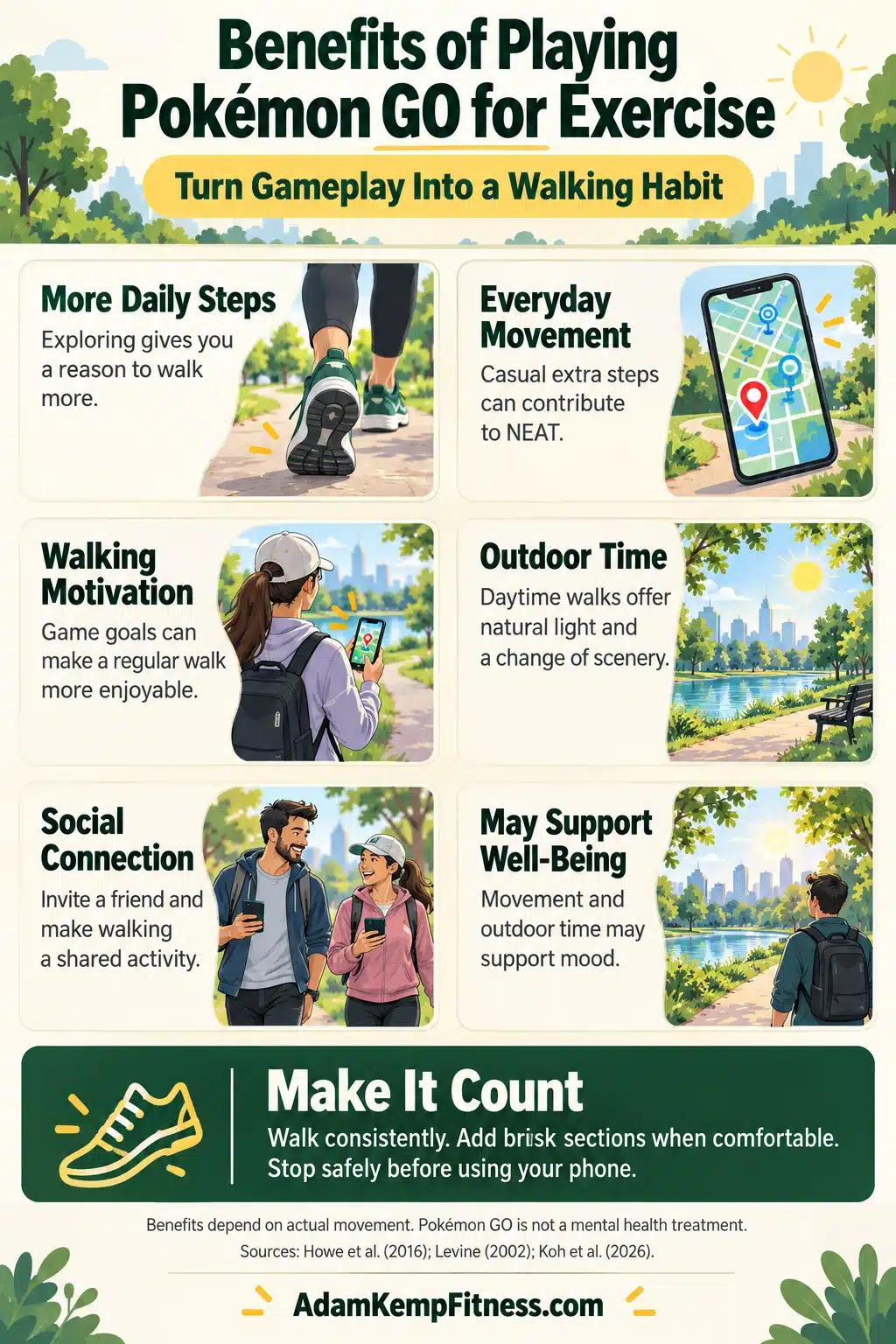
Benefits of Playing Pokémon GO for Exercise
Pokémon GO gives walking an extra sense of purpose, turning a familiar neighborhood route into an opportunity to explore, collect, and connect with others.
The gameplay of Pokémon Go itself also acts as a fitness reward, as you are “rewarded” for walking more by finding new Pokémon, and research has linked playing with increased daily steps, although maintaining those gains requires consistency (Howe et al., 2016).
For me, its biggest appeal is making an active choice feel enjoyable.
Here are the main benefits of Pokémon GO that support a healthier, more active lifestyle.
It Gives Walking a Purpose
For someone who finds walking without a destination uninteresting, searching for Pokémon provides an immediate reason to leave home.
Nostalgia, exploration, and game rewards are among the motivations identified in Pokémon GO research (Koh et al., 2026).
My suggestion is to give each outing a walking goal before choosing a gaming goal.
“Walk my neighborhood loop” is a more dependable activity plan than “keep playing until something exciting appears.”
It Can Help You Build a More Active Routine
You do not have to reach 10,000 steps before your walking becomes worthwhile.
A meta-analysis of 15 international cohorts found that higher daily step counts were associated with lower mortality risk, with benefits appearing below that familiar threshold (Paluch et al., 2022).
Use your current activity level as a starting point.
If you normally walk very little, a manageable additional outing is a more useful first goal than immediately trying to match someone else’s daily total.
Pokemon Go can help many people become more active by giving them something else to chase (Pokemon) instead of a specific workout goal.
It Can Make Walking More Social
Pokémon GO research has linked participation to greater social connection and lower loneliness among some players (Koh et al., 2026).
For practical use, consider arranging a regular walk with a friend or family member.
It Offers an Enjoyable Way to Practice Consistency
My favorite use for Pokémon GO is as an invitation to repeat an ordinary walk.
Instead of judging each outing by calories or distance, first ask whether it helped you follow through.
If the game makes a short walk more appealing, let that be enough initially.
You can add time or purposeful brisk sections once the routine feels comfortable.
Encourages More Time Outdoors
Pokémon GO gives you a reason to step outside, explore your neighborhood, and add a walk to your day.
For people who spend most of their time indoors, it can make an outdoor break more appealing.
Creates Opportunities for Daylight Exposure
A daytime Pokémon GO walk provides exposure to natural light, an important signal for the body’s circadian rhythms.
These rhythms help regulate sleep and the timing of melatonin production (National Institute of General Medical Sciences [NIGMS], n.d.).
Sunlight’s UVB rays also allow your skin to produce vitamin D, which supports bone health and normal muscle and immune function.
However, production varies with season, skin pigmentation, clothing, and other factors, so outdoor walks do not guarantee adequate levels (National Institutes of Health, Office of Dietary Supplements [NIH ODS], n.d.).
Enjoy your walks with appropriate sun protection, and meet vitamin D needs through food and supplementation when appropriate (American Academy of Dermatology, n.d.).
Encourages Exploration of Natural Spaces
Playing in parks or along greenways can combine walking with time in nature.
Research has linked spending at least 120 minutes weekly in natural environments to better self-reported health and well-being (White et al., 2019).
May Support Mental Health
Pokémon GO may support mental well-being by making walking, outdoor time, and social connection more enjoyable.
Research on players has reported associations with positive mood and reduced distress (Koh et al., 2026).
Broader research supports the role of exercise for mental health, as it has shown that walking or jogging can reduce depressive symptoms, although confidence in the findings was limited (Noetel et al., 2024).
Daytime walks also provide natural light exposure, which is relevant to the sleep and mood changes associated with seasonal affective disorder (National Institute of Mental Health, n.d.).
Low vitamin D levels have also been associated with depression, but that does not mean more sunlight or vitamin D supplements will resolve symptoms (NIH Office of Dietary Supplements, n.d.).
For practical use, invite a friend or family member on a manageable walk and leave room for conversation and enjoying your surroundings.
Treat the game as an enjoyable addition to your routine, alongside appropriate care for persistent mental health symptoms.
How Many Calories Do You Burn Playing Pokémon GO?
There is no single calorie-burn value for Pokémon GO because playing can involve anything from sitting to sustained brisk walking.
For illustration, the 2024 Adult Compendium assigns level walking at 2.5 mph a value of 3.0 metabolic equivalents, or METs (Compendium of Physical Activities, 2024).
The estimates below use the standard equation: calories = METs × 3.5 × body weight in kilograms ÷ 200 × minutes.
| Body Weight | 30 Minutes of Walking | 60 Minutes of Walking |
|---|---|---|
| 150 lb / 68 kg | About 107 calories | About 214 calories |
| 180 lb / 82 kg | About 129 calories | About 258 calories |
| 220 lb / 100 kg | About 158 calories | About 315 calories |
However, these are calculated estimates for continuous walking at the stated pace, not measurements of Pokémon GO sessions.
They include resting energy expenditure, which is the calories burned above rest.
Frequent stops reduce walking time, so don’t apply an hour-long walking estimate to an hour that includes substantial standing or sitting.
Can Pokémon GO Help You Lose Weight?
Pokémon GO can support weight loss if it increases your activity and helps you maintain an energy deficit over time.
Walking burns energy, but weight change also depends on your food and drink intake and overall activity level (CDC, 2026).
For more information, see my guide to walking for weight loss.
I recommend treating gameplay as a way to support your routine, rather than assigning an expected amount of fat loss to every walk.
A game reward is predictable; a change on the scale is not.
If you want help connecting walking with sustainable eating habits, my weight loss tips article provides an excellent starting point.
How to Use Pokémon GO for Better Walking Workouts
Here are a few ways you can specifically use Pokemon Go as exercise to improve your walking workouts.
1.) Start With a Manageable Walking Appointment
Choose a familiar route and a duration that fits your current capacity.
Ten minutes may be a reasonable starting example, but you can begin with less.
Attach the walk to a dependable part of your day, such as after lunch or before your evening routine.
Decide when the walk happens before opening the app.
2.) Separate Walking From Screen Interaction
Choose safe stopping points where you can catch Pokémon or check the map.
Between those points, put the phone away and pay attention to your surroundings.
This also gives you a simple way to include uninterrupted walking rather than constantly interrupting your pace.
3.) Use Adventure Sync for Screen-Free Walking
Adventure Sync can record walking distance even when Pokémon GO is not open, allowing eligible distance to count toward activities such as hatching Eggs and earning Candy.
Enable the feature and the required permissions if you want to use it, then check that it works on your device.
4.) Choose Routes That Fit Your Fitness Goal
Pokémon GO’s Routes feature offers paths to follow, with rewards for exploration and completion.
Before starting, check whether a route’s distance, terrain, crossings, and surroundings suit you.
A game route should fit your walking plan, not dictate how far you feel obligated to go.
5.) Add Brisk Sections When Appropriate
If comfortable walking is already manageable, try alternating relaxed sections with purposeful brisk walking.
Use the talk test to judge whether the brisk portions reach moderate intensity (CDC, n.d.).
You don’t have to rush through the entire outing; keep screen interactions to safe stops.
6.) Keep Strength Training in Your Week
Walking contributes to aerobic activity, but it does not meet the recommendation to train all major muscle groups.
I recommend including separate strength-training sessions at least twice weekly, adapted to your abilities (CDC, 2023).
My muscle-building guide can help you explore that part of a balanced routine.
7.) Plan for Days When You Do Not Want to Play
Write a backup version of the habit using an implementation intention, such as: “If I do not feel like walking my usual short loop, I will go outside and walk until I catch 10 Pokemon.”
I would rather see someone keep a modest walking routine than repeatedly alternate between very long gaming outings and weeks without purposeful movement.
Safety Tips for Pokémon GO Walking
My practical rules for playing Pokemon Go safely are simple:
- Stop before using the screen: Step out of the flow of pedestrians.
- Never play while driving or cycling: Put the phone away before crossing roads.
- Choose appropriate locations: Respect private property, opening hours, and local restrictions.
- Plan for conditions: Consider weather, water, footwear, and how you will get home.
- Set a stopping time: Do not let a game objective pressure you into continuing through pain or exhaustion.
- Supervise children appropriately: Choose routes and boundaries that match their age.
For outdoor walks, use shade, protective clothing, and broad-spectrum, water-resistant SPF 30 or higher sunscreen on exposed skin.
The American Academy of Dermatology recommends obtaining vitamin D through dietary sources, with supplementation when appropriate, rather than deliberately seeking UV exposure (American Academy of Dermatology, n.d.).
Frequently Asked Questions About Using Pokemon Go for Exercise
Final Thoughts: Is Pokémon GO Good for Exercise?
Regardless of the reason, getting up and walking outside is amazing for your health.
Whether it is the allure of a Pikachu or just understanding that it is good for your body, there really is no bad reason.
Astonishingly, Pokémon GO has actually become the video game that finally helps people get in shape, and not detract from their physical condition.
I really hope that Niantic continues to improve the game and keep people exploring the world, because it really is an amazing world once you get outside your house!
Nobody may understand what “augmented reality” actually means, but who needs to with all of these benefits!
Yes, Pokemon Go is literally good for your health.
Please do not play while driving; it is borderline illegal and very dangerous, and it detracts from the fun of the game overall (Ash never had a car).
Use this game for the fun that it is, and don’t be afraid to program it into your weekly workouts!
Catching a rare Pokémon is a fun bonus, but keeping a walking appointment you might otherwise have skipped is the outcome I would prioritize.
This website does not provide medical advice. This website site does contain affiliate links, and purchases may earn a commission.
Read my Medical Disclaimer, Review Disclaimer, and Publishing Policies for more details. Use of this site indicates acceptance of these terms.
Check Out Some of My YouTube Videos Below, and Please Follow on YouTube for More Educational Health and Fitness Content!