
Are Weight Loss Camps in Thailand Effective and Useful?
 Reading Time: 7 minutes
Weight loss camps in Thailand can help you build healthier routines, but their long-term value depends on the program’s quality and the support available after you return home.
When comparing options, look for the same foundations recommended for any weight management program: individualized nutrition guidance, appropriate physical activity, behavioral support, and a maintenance plan (National Institute of Diabetes and Digestive and Kidney Diseases [NIDDK], 2024).
For men balancing work, family responsibilities, and inconsistent routines, a dedicated retreat may offer time to focus on changes that are difficult to prioritize at home.
However, the most useful question is whether the program prepares you to manage those same challenges afterward.
As a professional basketball player with a master’s degree in nutrition education, I approach weight management by considering how nutrition, exercise, and recovery fit together.
I would evaluate a weight loss camp or wellness retreat through the same lens, paying particular attention to what participants learn and can realistically carry forward.
For men exploring options, Thailand’s leading weight loss camp for men advertises personalized training, nutrition guidance, and an injury-conscious approach.
Understanding how those services are delivered is an important starting point when comparing weight loss camps in Thailand.
Do Weight Loss Camps in Thailand Actually Work?
A structured weight-loss program can help people lose weight, but research on lifestyle interventions should not be mistaken for proof that a particular retreat delivers lasting results.
For example, the Look AHEAD trial found that approximately half of participants receiving an intensive lifestyle intervention maintained a loss of at least 5% of their initial weight after eight years.
However, participants had type 2 diabetes and received sustained support, making this evidence for comprehensive, ongoing treatment rather than a short residential camp (Look AHEAD Research Group, 2014).
When evaluating a camp, I would separate two questions: Does it help participants make progress during their stay, and does it help them maintain that progress afterward?
A convincing answer to the second question requires follow-up results, not simply departure-day photographs or selected testimonials.
Set Realistic Expectations
NIDDK recommends an initial weight loss goal of approximately 5%–10% of starting weight over six months, with goals adapted to individual circumstances.
That provides a more useful reference point than promises of a dramatic transformation during a short holiday (NIDDK, 2024).
I would also ask how a camp evaluates progress beyond weight, including improvements in exercise technique, walking tolerance, strength, and confidence in preparing meals.
Why Structured Weight Loss Camps in Thailand May Appeal to Men
The appeal of a residential program is straightforward: it creates a dedicated place and schedule for working on health.
For someone who repeatedly postpones exercise or struggles to organize meals, that structure may be worth considering.
However, accountability should involve more than being told what to eat or when to train.
Behavioral weight management includes skills such as self-monitoring, goal setting, problem-solving, and preparing for setbacks (NIDDK, 2019).
For example, a useful coaching session could help you plan dinner after a late workday, adjust your training during travel, or resume your routine after missing several sessions.
These are the kinds of practical situations I would want a camp to address before recommending it.
What to Look for in Weight Loss Camps in Thailand
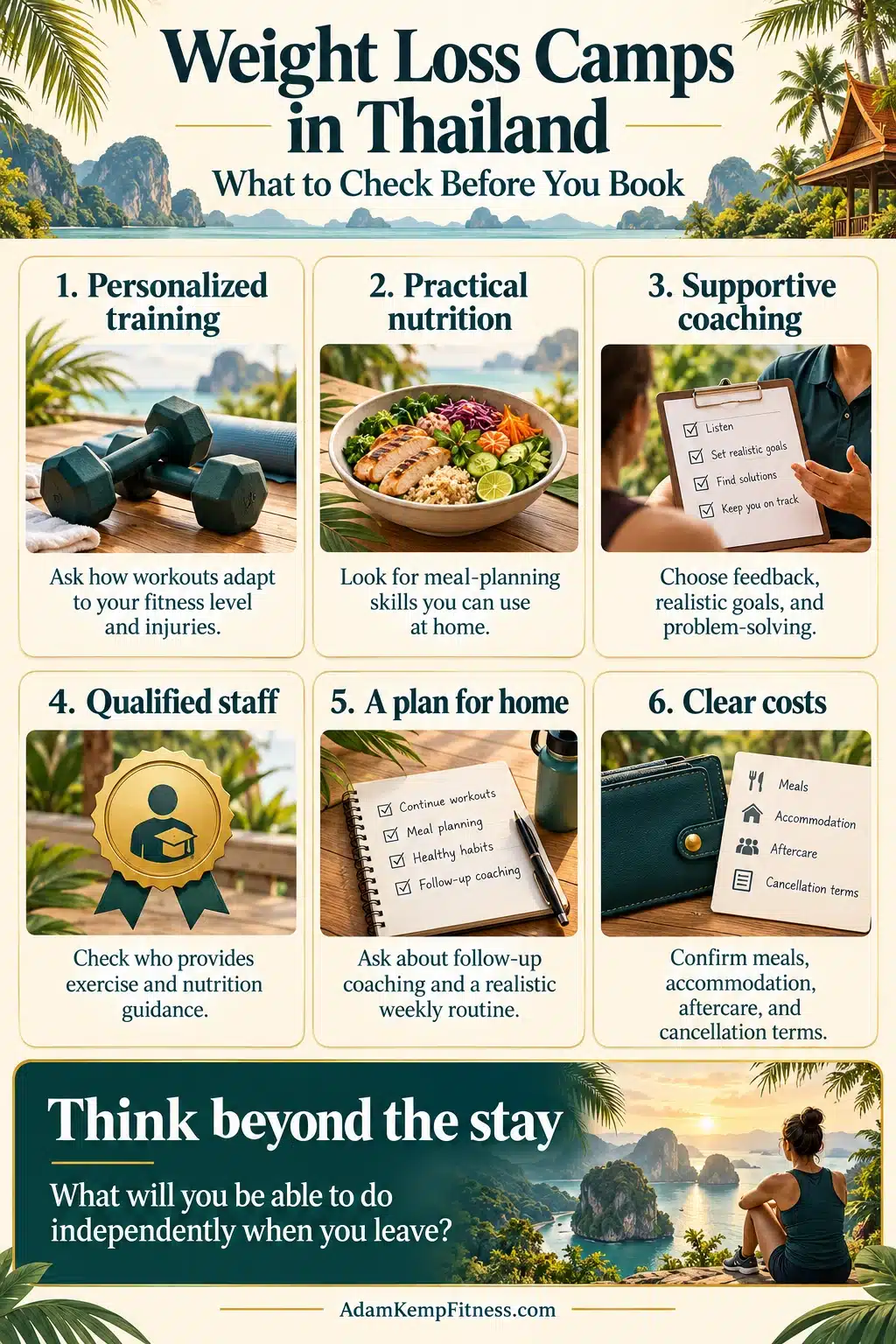
When comparing weight loss camps in Thailand, look closely at how each program fits your fitness level, nutritional needs, and daily responsibilities.
I would prioritize a camp that explains how it adapts training, teaches practical meal-planning skills, and helps you build a routine you can maintain after you return home.
Training Adapted to Your Starting Point
Before booking, ask how staff assess your current activity level, previous injuries, mobility, and exercise experience.
Request an example of how the schedule changes for a beginner compared with someone who already trains regularly.
I would favor a program that explains its progression clearly, including how it adjusts exercises and schedules recovery.
“Personalized” should describe specific decisions about your training rather than simply appear in the marketing.
For general health, adults should aim for at least 150 minutes of moderate-intensity aerobic exercise per week and muscle-strengthening activities on at least 2 days per week.
These are public-health guidelines, not a guarantee of weight loss or a requirement to begin at the full amount immediately (Centers for Disease Control and Prevention [CDC], 2023).
Why Strength Training Belongs in a Weight Loss Program
Maintaining muscle during weight loss is important, especially when the goal is to feel stronger and improve physical function.
In a randomized trial involving older adults with obesity, resistance training and combined resistance-and-aerobic training reduced lean-mass losses compared with aerobic training during dietary weight loss.
The combined program produced the greatest overall improvement in physical function, although these findings come from a specific older population (Villareal et al., 2017).
From my perspective as an athlete, any weight-loss camp should help you build confidence with resistance training rather than judge every workout by exhaustion or calories burned.
Ask whether you will leave with a training plan that matches the equipment and time available at home.
Nutrition Education You Can Use at Home
A weight management program should provide a reduced-calorie eating plan that fits your health needs and preferences, with enough flexibility to follow it over time (NIDDK, 2024).
Beyond receiving prepared meals, I would want participants to practice building meals themselves.
Useful questions include how to choose portions, plan grocery shopping, order at restaurants, and adapt meals to a normal working day.
Ask to see a sample menu and clarify who provides the nutrition guidance.
Also ask whether the program teaches you to make decisions independently or expects you to keep following a fixed menu after departure.
Coaching That Builds Independence
Regular check-ins should help you understand what is working and where adjustments are needed.
Behavioral support is particularly relevant for teaching problem-solving and strategies to return to your routine after setbacks (NIDDK, 2019).
My preference would be a program that gradually gives participants more responsibility for planning their activities and meals.
By the end of the stay, I would want someone to understand both what to do and how to adapt it.
Weight Loss for Men Thailand: What Does the Program Advertise?
Weight loss camps in Thailand for men describe their program as men-only, personalized, and injury-conscious, with limited participant numbers. Its website emphasizes nutrition, guided exercise, strength training, and sustainable lifestyle changes rather than crash dieting.
These advertised features give prospective participants useful points to investigate.
Before booking, I would ask who designs the exercise and nutrition plans, what qualifications they hold, and what “injury-conscious” means for someone with your specific limitations.
I would also request details about support after departure and typical long-term outcomes.
The provider’s description explains its approach, but it does not, by itself, establish how much weight the average participant loses.
Are Weight Loss Camps in Thailand Worth the Cost?
I would judge a camp’s value by the services you need, the skills you expect to gain, and the total cost.
Compare the retreat with what the same budget could provide at home, such as nutrition appointments, personal training, and several months of follow-up coaching.
A residential experience may appeal to you, but the comparison should include the support available once everyday responsibilities resume.
Before paying a deposit, request written answers to these questions:
- Total cost: Are accommodation, meals, transfers, assessments, and follow-up included?
- Daily schedule: How much individual coaching will you receive?
- Staff qualifications: Who provides training, nutrition advice, and medical care when needed?
- Adaptability: How are sessions modified for injuries or limited fitness?
- Aftercare: What support continues after departure, and does it cost extra?
- Booking terms: What happens if illness, injury, or travel changes interrupt your stay?
If you have a medical condition or take medication that may be affected by changes in eating or activity, discuss the proposed program with your treating clinician before committing (NIDDK, 2024).
How to Maintain Progress After Leaving a Weight Loss Camp in Thailand
Before leaving, ask your coach to help translate the retreat schedule into a realistic week at home.
My recommendation is to base that plan on your actual work hours, family commitments, food preferences, and the training facilities available to you.
For example, your plan might include two scheduled strength sessions, regular walks, several repeatable meals, and a weekly review of progress.
Adjust the activity to your ability and build toward the recommended guidelines over time (CDC, 2023).
Developing healthy habits for weight loss also means planning for imperfect weeks.
Decide in advance how you will handle travel, a demanding workday, or a missed session that disrupts your routine.
Continued self-monitoring, problem-solving, and support are established components of behavioral weight management (NIDDK, 2019).
Use follow-up appointments to address difficulties early and make your plan easier to maintain.
Final Thoughts: Choosing a Weight Loss Camp in Thailand That Prepares You for Home
My recommendation is to evaluate weight loss camps in Thailand by the quality of their coaching, the practicality of their nutrition education, and the clarity of their follow-up plan.
Before booking, ask yourself: “What will I be able to do independently when I leave?”
A clear answer is a stronger reason to invest than an impressive transformation photo or an ambitious short-term weight loss promise.
This website does not provide medical advice. This website site does contain affiliate links, and purchases may earn a commission.
Read my Medical Disclaimer, Review Disclaimer, and Publishing Policies for more details. Use of this site indicates acceptance of these terms.
Check Out Some of My YouTube Videos Below, and Please Follow on YouTube for More Educational Health and Fitness Content!