

An Evidence-Based Guide to Returning to Recreational Sports After an Injury
 Reading Time: 8 minutes
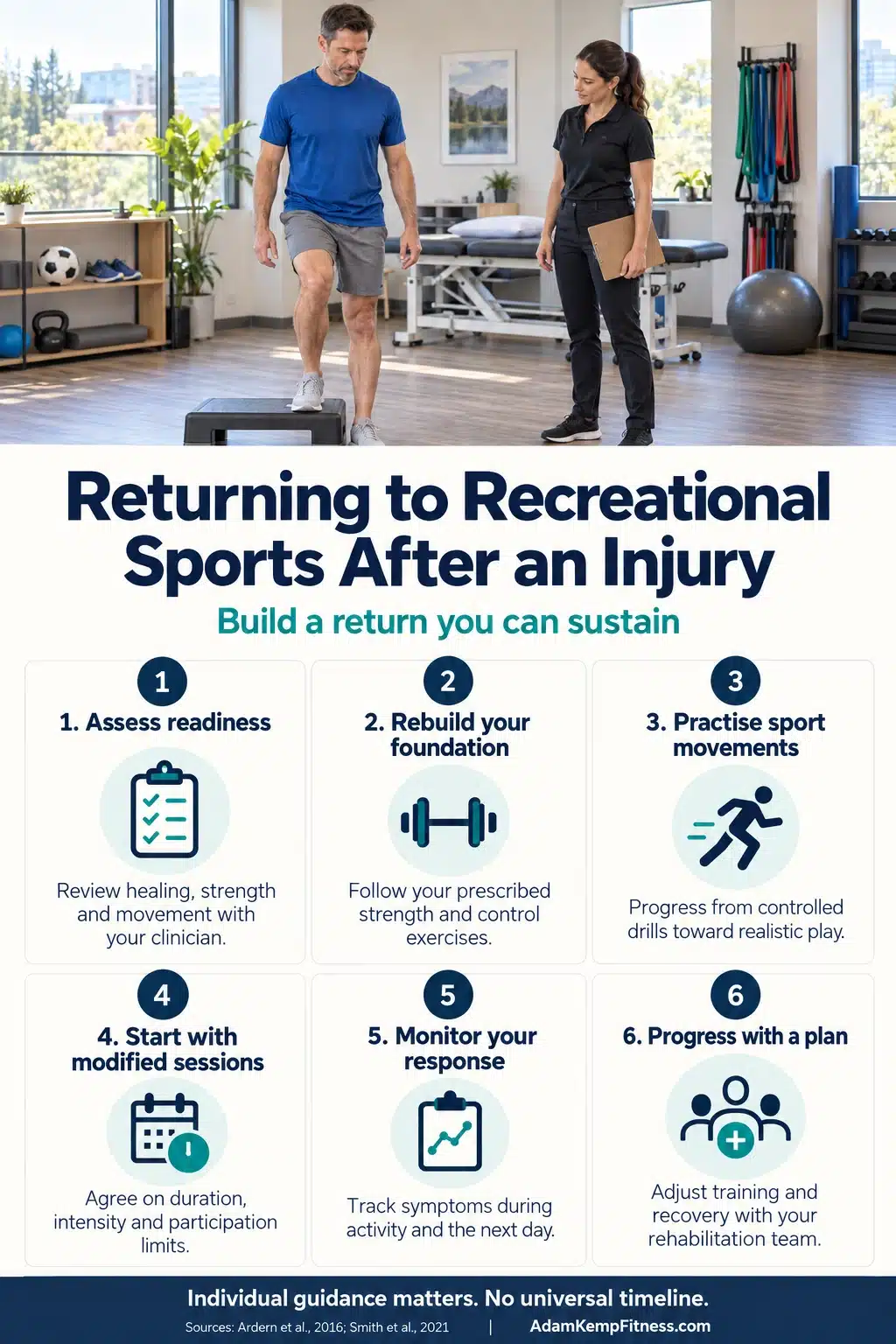
 Returning to recreational sports after an injury takes more planning than waiting until everyday movements feel comfortable.
Walking without a limp is encouraging, but your next basketball game, tennis match, or weekend run will ask different questions of your body.
As a professional basketball player, I understand the desire to return to the activities that make you feel like yourself, but I also know the value of following a structured rehab program to recover from injury and return to sport safely.
My approach is to make the comeback specific: identify what you want to do, what currently limits you, and what you need to practise before participating fully.
From my experience, return-to-sport decisions should consider physical function, psychological readiness, and the demands of the activity, rather than relying on one symptom or test (Ardern et al., 2016).
Whether your goal is a weekly social game or a regular running routine, a progressive, individualized plan should guide your return to recreational sports after an injury.
Disclaimer: I share these principles as a professional basketball player, certified personal trainer, and nutrition educator, not as your treating clinician. Use them to support a conversation with the professional managing your injury.
How to Know When You Are Ready to Return to Recreational Sports After an Injury
Feeling better is a starting point, not automatic clearance for unrestricted sport.
The first question is whether the injured tissue can tolerate the activity you intend to resume.
Use Readiness Criteria Alongside Healing Time
A clinician should explain both your healing restrictions and the functional milestones relevant to your injury.
Ask what you are cleared to do now, what remains restricted, and what needs to change before your next progression.
For example, the PAASS framework for ankle sprains considers pain, ankle function, confidence, balance, and sport-specific performance, including the ability to complete training (Smith et al., 2021).
This framework reflects expert consensus for ankle sprains, not a universal clearance checklist or a guarantee against reinjury.
Its useful lesson is that readiness involves several dimensions, which your clinician must interpret for your situation.
Define What “Back to Sport” Means
The return-to-sport consensus distinguishes returning to participation, returning to sport, and returning to previous performance (Ardern et al., 2016).
Modified practice can therefore be a meaningful milestone even when a full match remains inappropriate.
Make your goal concrete: “join a modified tennis lesson” gives your rehabilitation team more useful information than “get active again.”
Also explain whether you need to sprint, jump, tolerate contact, or play on consecutive days.
How to Build a Rehabilitation Plan Around Your Sport
For the best results when returning to recreational sports after an injury, start by bringing a clear description of your sport and weekly schedule to an assessment.
For more information, my guide to physical therapy explains the broader role of assessment, exercise, and rehabilitation support.
Ask for a Plan You Can Follow Between Appointments
Bring these questions to your physiotherapist or sports medicine clinician:
- Which movements and activities can I perform now?
- What exercises should I prioritize, and how often?
- What symptoms are acceptable for my specific injury?
- What should prompt me to stop or contact you?
- What milestones must I meet before returning to practice or games?
Inspine Therapy physiotherapy services are one option to explore when seeking professional rehabilitation support.
Wherever you receive care, ask how the assessment and treatment plan will connect to your particular sport and goals.
Match Preparation to the Activity
Use the following examples to make your conversation with the clinician more specific. They are planning prompts, not exercise prescriptions or clearance standards.
| Activity | Demands to discuss | Possible practice setting |
|---|---|---|
| Recreational running | Repeated impact, duration, pace, hills | A flat route with easy stopping points |
| Basketball or tennis | Braking, lateral movement, jumping, reactions | Individual drills or a cooperative partner |
| Soccer or other field sports | Sprinting, cutting, ball skills, possible contact | Controlled drills before unrestricted play |
| Swimming | Repeated shoulder movement, stroke choice, session length | Short, planned sets with rest |
You should always describe your actual participation rather than relying on the sport’s label.
Casual shooting practice and a competitive pickup basketball game require very different plans for what to do next.
For more information, my guide on how to prevent sports injuries offers a broader perspective on ongoing preparation.
Rebuilding Strength, Control, and Sport-Specific Movement
Think of this phase as preparing the movements on your own list.
Ask your clinician to connect each exercise to an identified limitation so you understand what the exercise is intended to improve.
Establish a Useful Strength and Movement Baseline
Depending on the injury, your assessment may include range of motion, strength, endurance, balance, or power; these are among the domains recommended for ankle-sprain return decisions (Smith et al., 2021).
Track the tasks your therapist selects, including the resistance, repetitions, and movement quality you can manage.
A short written record makes the next appointment more useful than trying to remember whether the week felt “pretty good.”
Progress Toward the Movements You Will Actually Use
As rehabilitation progresses, your exercises should increasingly reflect the movements your sport requires.
Depending on the activity, this might include repeated running strides, controlled landings, changes of direction, or overhead swings.
Begin with movements you can practise at a manageable pace in a predictable setting.
As your readiness improves, your clinician can help you increase speed, repeat efforts, and react to a ball, partner, or opponent (Ardern et al., 2016).
For example, a runner might progress from walk-jog intervals toward continuous running, while a tennis player might move from controlled footwork to short rallies.
Include Confidence in the Conversation
If you hesitate during a particular movement, identify it precisely: landing on one leg, reaching overhead, or changing direction.
Confidence and psychological readiness are recognized parts of return-to-sport assessment (Ardern et al., 2016; Smith et al., 2021).
Ask to practise that task at a manageable level before adding speed or unpredictability.
You do not need to disguise uncertainty to prove that you are committed to returning.
Plan Your First Sessions Back
I recommend deciding the boundaries of a session before entering the competitive environment.
Write down what you will do, how you will stop, and what you will review afterward.
Set a Participation Limit in Advance
For an athlete already cleared for modified participation, a first session might involve warming up, completing approved drills, and leaving before unrestricted play.
Another athlete might be ready for limited playing time with planned breaks.
Choose an environment that allows those limits.
A cooperative partner or organized practice may be easier to modify than a crowded pickup game where substitutes are scarce.
Tell teammates your plan beforehand: “I am doing drills today, but I am not joining the game.”
Treat completing the agreed session as the achievement, even if you feel tempted to do more.
Increase Training Demands Deliberately
Training load includes more than exercise minutes; competition, psychological demands, and recovery context also matter (Soligard et al., 2016).
A short, intense game should not automatically be considered an easier session than a longer, gentler practice.
My practical suggestion is to change one main variable at a time when possible: duration, intensity, frequency, or movement complexity.
This makes your training record easier to interpret if symptoms change.
For example, discuss whether to extend a controlled practice before adding another weekly session.
Avoid assuming that a universal percentage increase is appropriate for every injury.
Record Your Response Afterward
Keep a simple log of the activity, its duration, how demanding it felt, and any symptoms during or after it.
Write down next-morning changes and bring recurring patterns to your clinician.
Monitoring should support injury-specific decisions, not become a rule that any discomfort is acceptable if it resolves quickly.
Make Recovery Fit Your Actual Week
Schedule rehabilitation and sport around work, family, and sleep commitments. Load-management guidance supports considering well-being alongside training demands, although much of the evidence comes from elite athletes (Soligard et al., 2016).
Sleep recommendations should also account for individual needs rather than assuming one target fits every athlete (Walsh et al., 2021).
Protect a realistic sleep opportunity, especially when an evening game precedes an early workday.
Continue discussing maintenance exercises after your initial comeback.
Frequently Asked Questions About Returning After an Injury
Final Thoughts: Keys to Returning to Recreational Sports After an Injury
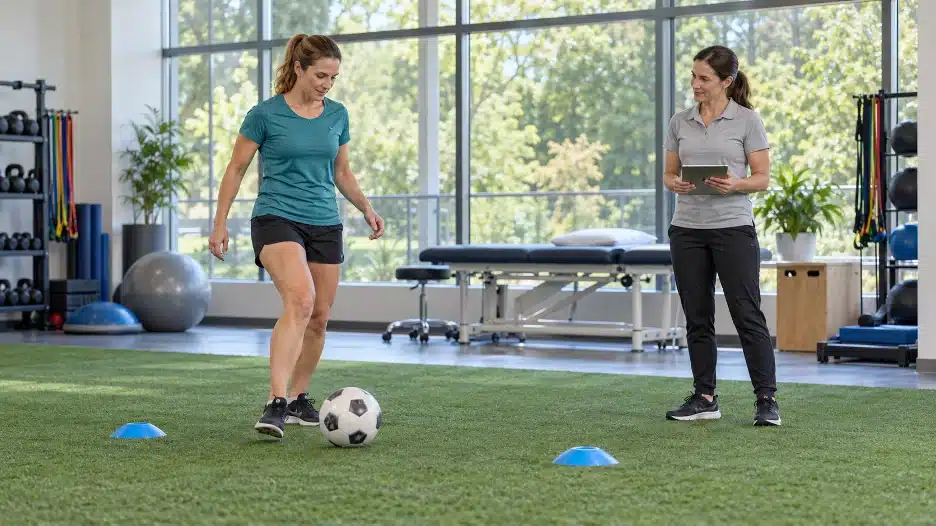
Returning to recreational sports after an injury should support your ability to stay active for the long term.
I encourage you to judge your comeback by the consistency you build across several weeks, rather than how much you accomplish in your first session.
Work with your rehabilitation team to set realistic milestones, prepare for the movements your sport requires, and decide when to increase participation.
- For additional background, explore my guide to common sports injuries.
- If you need help finding professional support, my overview of the best sports medicine clinics provides a starting point for your care search.
Give yourself permission to rebuild gradually, ask questions, and adjust the plan when necessary.
The goal is to return with confidence and a routine that allows you to keep enjoying your sport.
This website does not provide medical advice. This website site does contain affiliate links, and purchases may earn a commission.
Read my Medical Disclaimer, Review Disclaimer, and Publishing Policies for more details. Use of this site indicates acceptance of these terms.
Check Out Some of My YouTube Videos Below, and Please Follow on YouTube for More Educational Health and Fitness Content!
![Subscribe to @AdamKempFitness for more training, general health, recovery, and nutrition tips from a professional basketball player with a master’s degree in Nutrition Education! 🏀💪
Seated Max Vertical Jumps From a Box are one way I train explosive takeoff power with maximum intent on every rep.
Starting seated, with a pause and minimal rocking or dipping, reduces the contribution of a quick countermovement and emphasizes producing force from a relatively static position (National Strength and Conditioning Association [NSCA], 2020).
For athletes, the training goal is explosive lower-body force production and coordinated extension through the hips, knees, and ankles. I use this variation to practice driving hard into the floor and accelerating my body upward.
My preferred setup: 3 sets of 3 reps or 4 sets of 2 reps, supersetted with a strength or power exercise.
I keep the reps low, reset between jumps, and take longer rest periods so I’m ready to attack every takeoff. Even when pairing exercises, I give myself enough recovery to keep the jumps sharp.
Every rep has one goal: jump as high as possible. I focus on an explosive takeoff, a controlled landing, and consistent quality throughout the session.
Save this for your next power workout! 🚀
Reference: NSCA. (2020). Stretch-shortening cycle.
#VerticalJump #JumpTraining #ExplosivePower #AthleticPerformance #BasketballTraining](https://www.adamkempfitness.com/wp-content/plugins/feeds-for-youtube/img/placeholder.png)


