
How to Preserve Strength During Clinician-Supervised Weight Loss
 Reading Time: 5 minutes
 To preserve strength during clinician-supervised weight loss, your plan should account for how you train, eat, and function as your body weight changes.
Losing weight through calorie restriction can reduce muscle mass alongside body fat, which makes muscle preservation an important part of the process.
However, losing some muscle does not automatically mean becoming weaker.
A review published in Advances in Nutrition found that diet-induced weight loss in people with obesity can improve physical function without necessarily reducing muscle strength, highlighting why the scale alone cannot tell you how well your plan is working (Cava et al., 2017).
Resistance training and adequate protein intake serve complementary roles, as protein helps limit muscle loss, while resistance exercise helps preserve muscle and can improve strength during weight loss.
A practical starting point is to include your training goals in conversations with your clinician, including which exercises you do and how your energy and performance change.
Coordinating your nutrition, resistance training, and medical follow-up can help you build a more individualized plan to preserve strength during clinician-supervised weight loss.
Why Is It Important to Preserve Strength During Clinician-Supervised Weight Loss?
Preserving strength during clinician-supervised weight loss helps keep physical ability central to your progress.
Alongside changes in body weight, it is useful to assess how well you perform everyday tasks, such as climbing stairs, carrying groceries, and getting up from a chair.
Calorie restriction can reduce muscle mass alongside body fat, but muscle size and muscle strength are not interchangeable.
The amount of muscle you have is only one factor influencing strength, so losing some muscle does not automatically mean you become weaker.
This distinction matters because successful weight loss can improve mobility and physical function even when some muscle is lost.
Resistance training supports that process by helping preserve muscle mass and improve strength, making it an important complement to an individualized nutrition plan.
Tracking strength also gives you a practical outcome to discuss with your care team.
Recording the weight and repetitions you use for a few consistent exercises, along with how everyday activities feel, keeps the conversation focused on your physical capabilities, not just the number on the scale.
The goal is to support weight loss while maintaining the strength you need for daily life and the activities you enjoy.
Your training and nutrition plan should reflect those priorities throughout clinician-supervised weight loss.
Keys to Preserving Strength During Clinician-Assisted Weight Loss
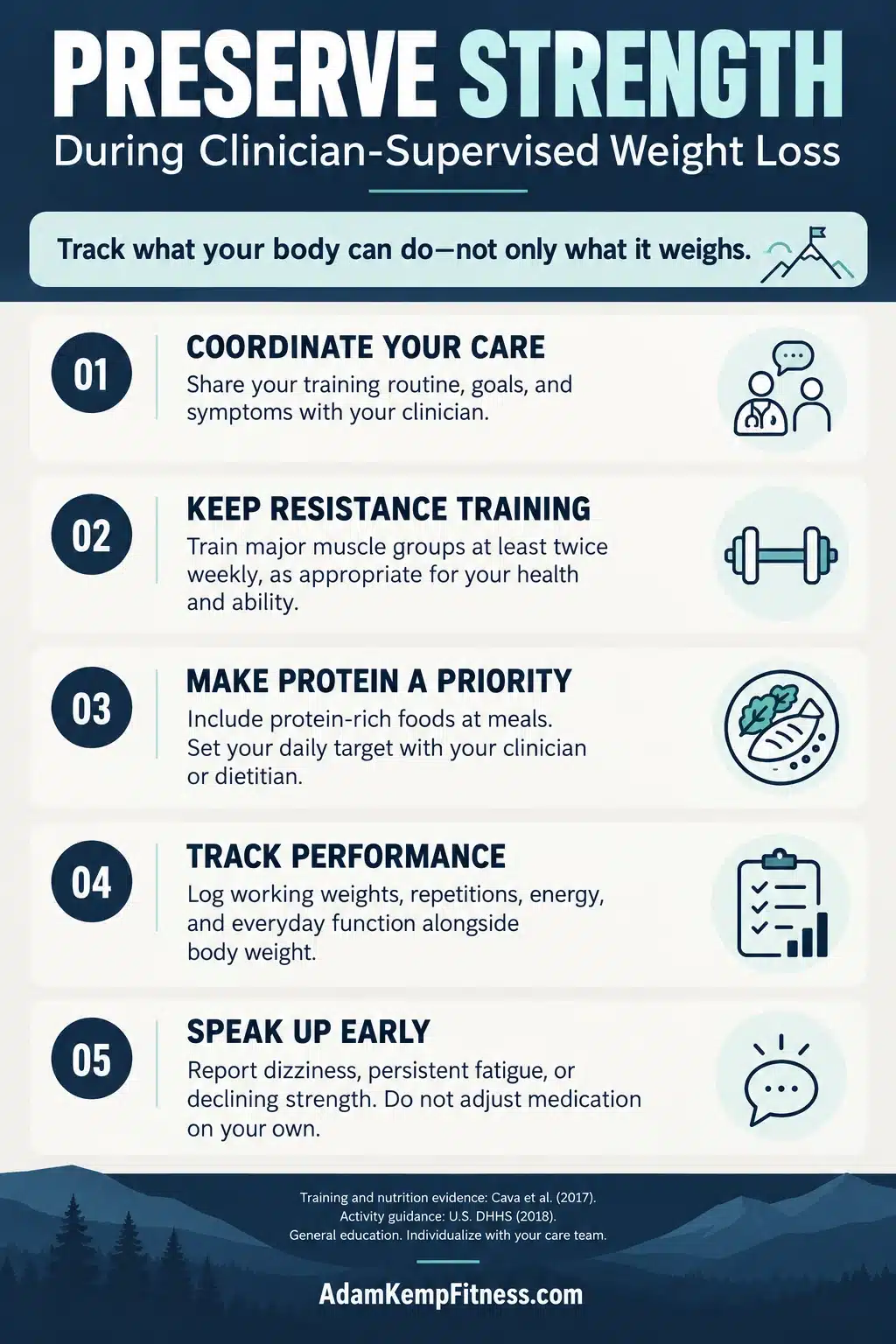
To preserve strength during clinician-supervised weight loss, build your plan around consistent resistance training and adequate protein, two strategies that support muscle retention during calorie restriction.
Coordinate these habits with your care team and track your performance, energy, and everyday functioning so your progress is reflected in more than just changes on the scale.
Coordinate Your Care
Optimize 360 runs its medical weight loss program through telehealth and builds it on lab work: a metabolic panel covering insulin, A1C, thyroid, testosterone, cortisol, and inflammatory markers comes first, and the provider recommends a protocol based on those results, your goals, and your health history.
Regular follow-up labs track how the plan is working.
If you train, say so at the first appointment. Describe a normal week, what you lift and how often.
Your clinician handles the medical side, including any medication decisions, and your coach, or you, handles the training plan. Make sure each knows what the other is doing.
Understand Muscle Preservation
The review, Preserving Healthy Muscle during Weight Loss, found that both endurance and resistance exercise help preserve muscle mass during weight loss, and that resistance exercise also improves muscle strength (Cava et al., 2017).
The authors recommend weight-loss therapy that combines a reduced-calorie diet, adequate but not excessive protein, and increased physical activity, particularly resistance exercise.
For a broader look at combining these strategies, see my guide to how to lose fat and keep muscle.
Lift Twice Weekly (At-Least)
The federal Physical Activity Guidelines for Americans recommend that adults do muscle-strengthening activities of moderate or greater intensity that involve all major muscle groups on two or more days a week.
While you’re losing weight, treat that as your floor.
A simple setup covers it:
- Pick one movement each for squatting, hinging, pushing, pulling and carrying.
- Train each pattern at least twice a week.
- Use loads that make the last reps of each set take real effort.
- Log your main lifts so you can see trends.
Some sessions may feel flat, especially on days with fewer calories.
Keep the intensity and cut the volume: do your main sets with good form and drop the extra accessory work.
If your strength numbers hold steady through a calorie deficit, your training is doing its job.
Prioritize Protein
The review found that high protein intake helps preserve lean body and muscle mass during weight loss, and that spreading protein evenly through the day may help prevent muscle loss during weight-loss therapy.
The authors also caution against excessive intake, so more isn’t automatically better.
In practice, build each meal around a protein source instead of saving most of it for dinner, and when your appetite is lower than usual, eat the protein first.
Your exact daily target depends on body size, kidney function, other conditions and the rest of your plan, so set it with your clinician or a registered dietitian.
Track Beyond the Scale
The scale can’t separate fat from muscle, so keep a few other numbers alongside it:
- Working weights on your main lifts.
- Waist measurement, taken the same way every two weeks.
- Body composition, if your clinician offers a scan or another consistent method.
- Everyday function, like climbing stairs or getting up from the floor.
If the scale drops fast while every strength number falls with it, take that to your next appointment so the plan can be adjusted.
For practical ways to make progress tracking part of your routine, explore my guide to healthy habits for weight loss.
Report Symptoms Early
Report it if workouts start to feel unusually hard, if you get dizzy or lightheaded while training, or if your energy stays low for more than a few days.
Don’t change a medication on your own to fit your training schedule.
Any adjustment to food, training or treatment should go through the person supervising your care.
This article is general information and isn’t a substitute for individual medical advice.
Final Thoughts: Making Strength Preservation a Part of Your Clinician-Supervised Weight Loss
To preserve strength during clinician-supervised weight loss, include resistance training, adequate protein intake, and regular communication with your care team in your plan from the start.
A custom weight loss plan should account for your medical history, training experience, food preferences, and recovery needs.
If you are comparing weight loss clinics, ask how they individualize nutrition guidance, support exercise, and respond when patients report fatigue or declining performance.
My perspective as a professional athlete is that what your body can do deserves a place in how you measure progress.
Keep your strength, energy, and everyday function in the conversation as you work toward your weight-loss goals.
This website does not provide medical advice. This website site does contain affiliate links, and purchases may earn a commission.
Read my Medical Disclaimer, Review Disclaimer, and Publishing Policies for more details. Use of this site indicates acceptance of these terms.
Check Out Some of My YouTube Videos Below, and Please Follow on YouTube for More Educational Health and Fitness Content!
![Subscribe to @AdamKempFitness for more training, general health, recovery, and nutrition tips from a professional basketball player with a master’s degree in Nutrition Education! 🏀💪
Seated Max Vertical Jumps From a Box are one way I train explosive takeoff power with maximum intent on every rep.
Starting seated, with a pause and minimal rocking or dipping, reduces the contribution of a quick countermovement and emphasizes producing force from a relatively static position (National Strength and Conditioning Association [NSCA], 2020).
For athletes, the training goal is explosive lower-body force production and coordinated extension through the hips, knees, and ankles. I use this variation to practice driving hard into the floor and accelerating my body upward.
My preferred setup: 3 sets of 3 reps or 4 sets of 2 reps, supersetted with a strength or power exercise.
I keep the reps low, reset between jumps, and take longer rest periods so I’m ready to attack every takeoff. Even when pairing exercises, I give myself enough recovery to keep the jumps sharp.
Every rep has one goal: jump as high as possible. I focus on an explosive takeoff, a controlled landing, and consistent quality throughout the session.
Save this for your next power workout! 🚀
Reference: NSCA. (2020). Stretch-shortening cycle.
#VerticalJump #JumpTraining #ExplosivePower #AthleticPerformance #BasketballTraining](https://www.adamkempfitness.com/wp-content/plugins/feeds-for-youtube/img/placeholder.png)