
Intermittent Fasting for Athletes: Benefits, Risks & Best Timing
 Reading Time: 15 minutes
 I have learned that intermittent fasting for athletes generally fits better in the offseason than during the competitive season.
In the offseason, you have more control over your schedule, fewer urgent recovery demands, and more freedom to place training inside or near your eating window.
A missed meal is not automatically a performance strategy, but intermittent fasting can be a genuinely useful tool when it is matched to an athlete’s goals, schedule, and training demands.
I have used intermittent fasting at different points in my professional basketball career, and it played an important role during some of my leanest periods and times when I felt in my best overall shape.
When I was focused on following the IF lifestyle, I strongly believe intermittent fasting helped me control unnecessary snacking, organize my meals, and maintain a lower body-fat percentage without feeling as though I was constantly dieting.
I also enjoyed the mental clarity and simplicity of completing a morning walk or low-intensity workout before eating.
In season, the situation changes.
Practices, games, travel, strength training, and injury management require substantial nutrition in limited time windows, so reducing opportunities to eat can make recovery unnecessarily difficult.
That does not mean an athlete can never fast during the season.
I may occasionally use a shorter fasting period on a rest day, a recovery day, or a morning without demanding activity, but I don’t force a fasting schedule when eating would better support performance.
My experience has convinced me that using intermittent fasting as an athlete is neither a miracle nor a mistake.
It is a flexible meal-timing strategy that can work well for certain athletes, especially during lower-volume phases, but it should never become more important than adequate energy, protein, carbohydrates, hydration, or recovery.
What Is Intermittent Fasting?
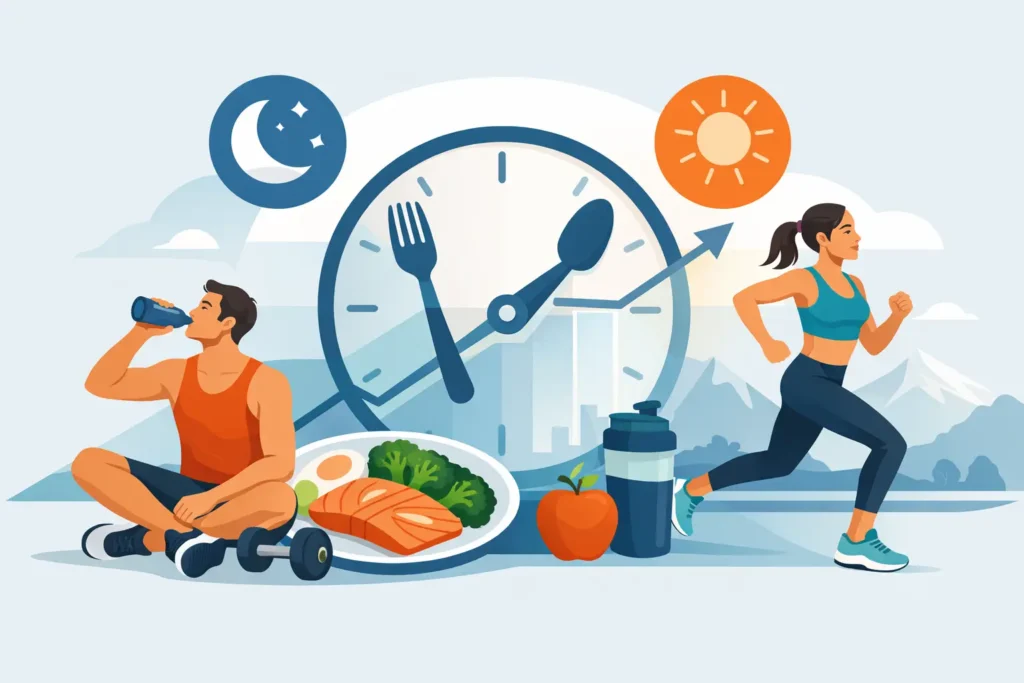
Intermittent fasting is an eating pattern that alternates between periods of eating and fasting.
It determines when you eat, but not what you eat or how much.
The most common form used by athletes is time-restricted eating, in which the day’s meals are consumed within a defined window.
Popular variations include:
- 12:12: A 12-hour eating window followed by a 12-hour overnight fast
- 14:10: A 10-hour eating window and 14-hour fast
- 16:8: An 8-hour eating window and 16-hour fast
- 5:2: Normal eating on five days and substantial calorie restriction on two nonconsecutive days
- Alternate-day fasting: Alternating normal-intake days with fasting or very-low-calorie days
- One meal a day: Consuming nearly all daily calories in one meal
Athletes generally have the strongest practical case for using moderate time-restricted eating rather than full-day fasting or one-meal-a-day plans.
Longer fasts leave fewer opportunities to consume the energy and nutrients necessary for training adaptation.
You can learn more about the different methods in my complete guide to the benefits and risks of intermittent fasting.
Does Intermittent Fasting for Athletes Work?
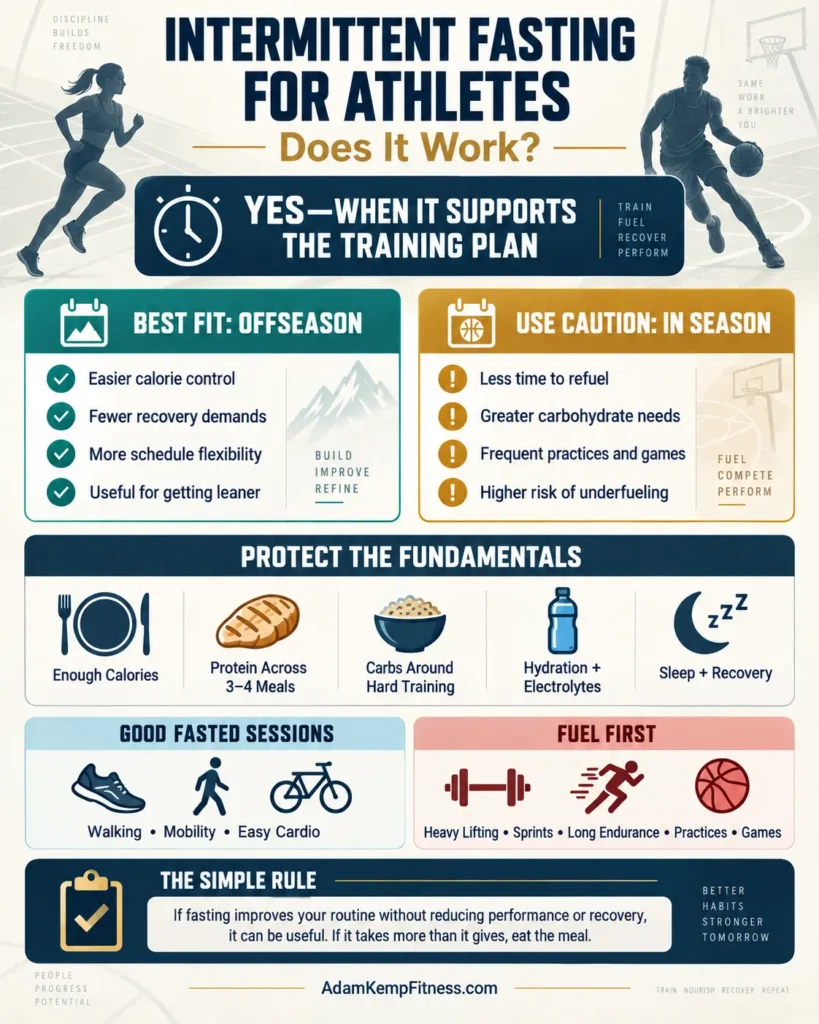
Yes, intermittent fasting for athletes can work, but “work” needs to be defined carefully.
If the goal is to simplify eating, reduce excess calorie intake, or improve body composition while preserving performance, time-restricted eating can be effective for some athletes.
If the goal is to improve strength, speed, endurance, or recovery beyond what an appropriately designed conventional diet provides, the evidence is much less convincing.
A systematic review examining intermittent fasting and sports performance concluded that fasting generally did not impair strength, power, or aerobic performance when athletes still consumed adequate energy and nutrients.
However, the authors also noted substantial differences across studies, protocols, sports, and participant populations, making it difficult to guarantee the same results for every athlete (Conde-Pipó et al., 2024).
That distinction matters because many fasting studies are conducted under controlled conditions where participants receive sufficient calories and protein.
In real life, athletes often struggle to replace everything they cut out during the fasting window.
Intermittent fasting for athletes seems to work best when it changes eating patterns without unintentionally causing chronic underfueling.
Potential Benefits of Intermittent Fasting for Athletes
Intermittent fasting can offer athletes several practical benefits when it is carefully matched to their training schedule and nutritional needs.
Its greatest value is not that fasting produces a unique metabolic advantage, but that a structured eating window may simplify meal planning, limit unnecessary snacking, and make body-composition goals easier to manage.
Research suggests that time-restricted eating can reduce fat mass while preserving lean mass and athletic performance when total calories, protein, and carbohydrates remain sufficient (Conde-Pipó et al., 2024; Moro et al., 2020).
In my experience, these benefits are most useful during the offseason or lower-volume training phases, when there is more flexibility to organize workouts and recovery meals around the eating window.
Easier Body-Composition Management

The biggest advantage I have experienced from intermittent fasting is simpler body-composition management.
A defined eating window naturally removes some opportunities for unnecessary snacking and can make a modest calorie deficit feel less complicated.
In one study involving resistance-trained men, an eight-hour eating window reduced fat mass while maintaining muscle mass and strength when calorie and macronutrient intake remained appropriate (Moro et al., 2016).
Research involving elite cyclists has also found that an eight-hour eating window can reduce body weight and fat mass without impairing measured performance.
The researchers concluded that time-restricted eating could potentially serve as one component of a periodized endurance-nutrition plan rather than a year-round requirement (Moro et al., 2020).
These findings match my experience.
Fasting didn’t make me lean simply because I spent more hours without food; it helped me set boundaries that made my overall diet easier to control.
For a broader examination of this distinction, read my guide to intermittent fasting for weight loss.
A Simpler Daily Eating Routine
Athletes already manage training, treatment, work, travel, sleep, and family responsibilities.
Having fewer planned meals can reduce decision fatigue and make a nutrition routine easier to follow.
This simplicity can be especially valuable in the offseason, when the primary goal may be improving body composition while maintaining strength.
Removing late-night grazing or delaying breakfast on a low-intensity morning can create useful structure without compromising an important session.
Fasting should reduce dietary stress rather than add another set of rigid rules.
If you spend the whole morning thinking about food or compensating with uncontrolled eating at night, the schedule probably isn’t helping.
Better Awareness of Hunger and Eating Habits
A reasonable fasting routine can help distinguish habitual eating from physical hunger.
Many people eat late at night because food is available, not because their bodies need additional energy.
I have found that structured fasting periods can improve my awareness of when I am actually hungry and when I am simply eating out of habit.
That awareness can make it easier to maintain a healthy body composition over the long term.
However, athletes should not use this idea to dismiss legitimate post-training hunger.
Hunger following a hard practice, demanding lift, or high-volume conditioning session is often an important sign that the body needs additional energy.
Greater Fat Oxidation During Low-Intensity Exercise
Exercising before breakfast increases fat oxidation during that particular session, meaning the body obtains a greater proportion of its energy from stored fat.
This can be useful for athletes who enjoy easy morning walks, light cycling, mobility sessions, or low-intensity aerobic work.
However, burning more fat during one workout does not automatically produce greater long-term fat loss.
Total energy intake and expenditure across days and weeks remain more influential than which fuel source dominates a single session.
My preferred approach has generally been fasted walking rather than hard fasted training.
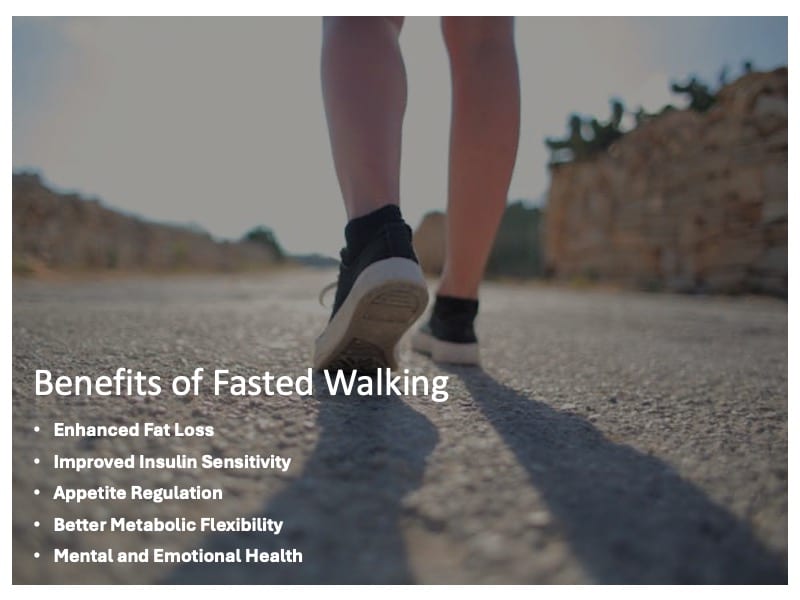
Walking has a low recovery cost, helps me stay active, and fits naturally into an offseason fasting schedule.
You can also read my detailed analysis of fasted cardio and weight loss for a closer look at the difference between increased fat oxidation and actual body-fat reduction.
Why I Prefer Intermittent Fasting in the Offseason as an Athlete
The offseason is normally the best time for athletes to experiment with intermittent fasting because the nutritional margin for error is larger.
Training may still be difficult, but there are usually fewer games, flights, late-night arrivals, team practices, and back-to-back high-output days.
This gives an athlete more freedom to organize training around the eating window.
For example, I can complete fasted walking or mobility work in the morning, eat my first substantial meal before strength training, and still have multiple meals available afterward.
That structure can support fat loss while preserving the nutrition needed for muscle maintenance and recovery.
The offseason also provides time to evaluate whether fasting is actually helping.
Changes in body composition, strength, energy, mood, sleep, and hunger can be monitored without risking an important competition period.
A practical offseason approach might include a 14:10 or 16:8 schedule on rest days and low-intensity days, with a longer eating window around hard basketball workouts, sprint sessions, or heavy lower-body training.
Why Intermittent Fasting Is Harder During the Season
In-season athletes have to fit more recovery into less time.
After an evening game, for example, delaying food because an eating window has closed makes little physiological or practical sense.
Muscle glycogen must be replenished, damaged tissue must be repaired, and the nervous system must recover before the next practice or game.
This process requires sufficient calories, carbohydrates, protein, fluids, electrolytes, and micronutrients.
The problem is not that fasting immediately destroys performance.
The concern is that repeatedly eliminating eating opportunities may cause an athlete to fall slightly behind on recovery each day.
That deficit can accumulate across a demanding week.
What begins as a harmless skipped breakfast can eventually contribute to lower training output, persistent soreness, poor sleep, irritability, or difficulty maintaining body weight.
For that reason, I consider intermittent fasting an occasional in-season option rather than a fixed rule.
I might use a modest overnight fast on a rest day, but I would break it without hesitation if I needed to train, recover, or prepare for competition.
This flexibility aligns with the principles in my sports nutrition guide: nutrition should change with training load rather than remain the same every day.
The Main Risk: Low Energy Availability
Low energy availability occurs when too little dietary energy remains after exercise to support normal physiological functions.
It can affect athletes of any sex, sport, body type, or competitive level.
The International Olympic Committee identifies low energy availability as the underlying cause of Relative Energy Deficiency in Sport, or REDs.
Possible consequences include reduced performance, impaired recovery, menstrual or reproductive disruption, poorer bone health, weakened immunity, mood changes, and an increased risk of injury (Mountjoy et al., 2023).
Intermittent fasting does not automatically cause REDs.
The risk develops when the shortened eating window makes it difficult to consistently consume enough energy for the athlete’s workload.
This is why the success of intermittent fasting for athletes cannot be judged only by weight loss.
An athlete who becomes lighter while also becoming weaker, slower, more injury-prone, or chronically fatigued is not improving body composition successfully.
How Intermittent Fasting Can Affect Training Performance
The effect of fasting depends heavily on the type, intensity, and duration of the session.
| Training session | Compatibility with fasting | Practical recommendation |
|---|---|---|
| Walking or light mobility | Generally high | Usually reasonable after an overnight fast |
| Easy Zone 2 cardio | Moderate to high | May work if the session is short and hydration is maintained |
| Technique or light skill work | Moderate | Individual tolerance matters |
| Hypertrophy training | Moderate | Prefer a meal before or shortly after training |
| Heavy strength or power training | Low to moderate | Pre-training carbohydrates and protein are usually more useful |
| Sprint or interval training | Low | Fuel beforehand when performance is the priority |
| Long endurance training | Low | Carbohydrate intake may be needed before and during exercise |
| Team practice or competition | Low | Performance nutrition should take priority |
| Two-a-day training | Very low | Frequent fueling is normally more practical |
A fasted athlete may still complete a difficult workout, but completion does not prove that the session was optimal.
Power output, concentration, technical execution, total work, and subsequent recovery all matter.
How to Optimize Protein Intake During Intermittent Fasting
Protein is one of the first nutritional challenges that athletes encounter with a compressed eating window.
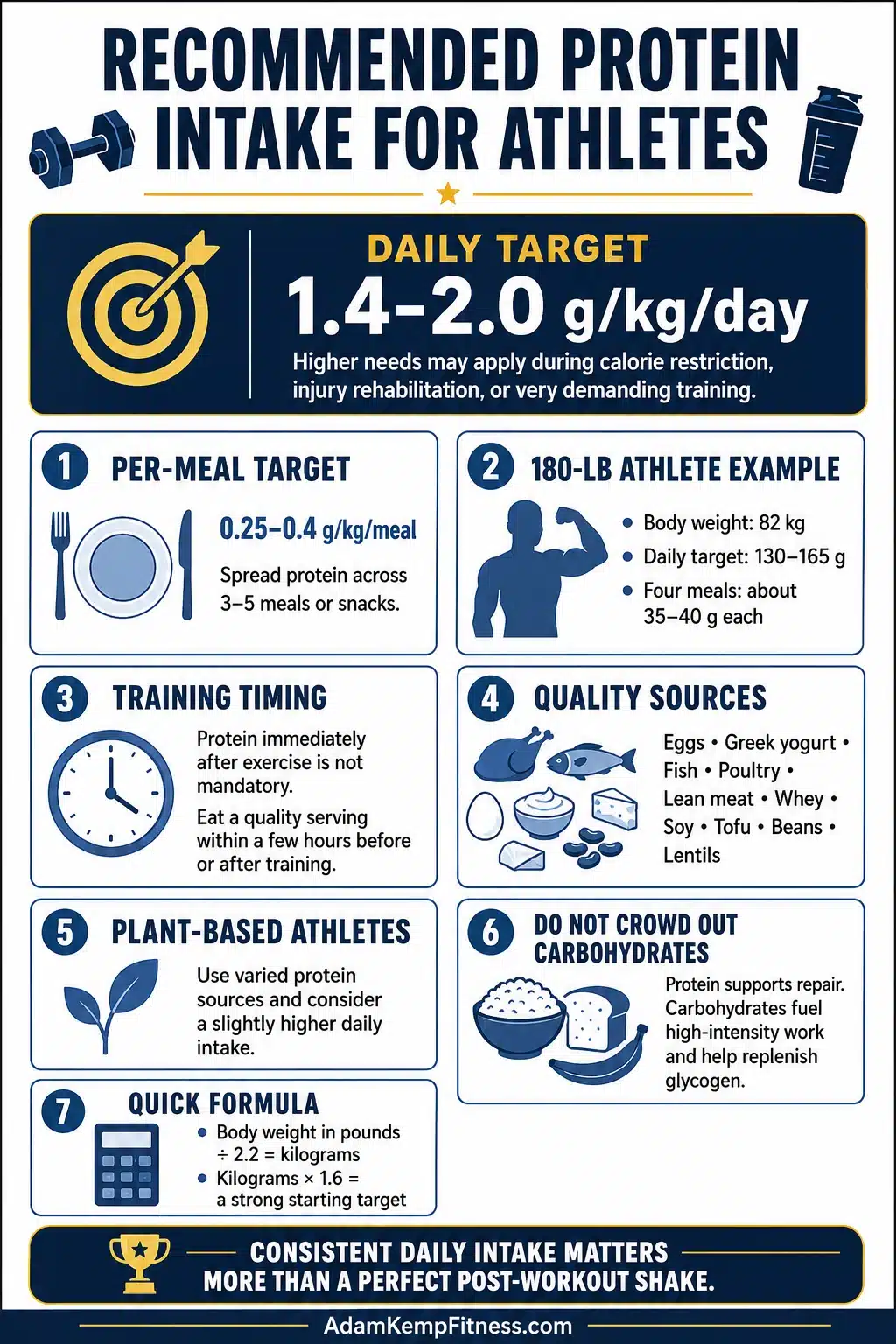
A reasonable general range for athletes is approximately 1.4–2.0 grams of protein per kilogram of body weight per day, although athletes dieting aggressively or attempting to preserve lean mass may sometimes benefit from more (Jäger et al., 2017).
Total daily protein is important, but distribution also matters.
Consuming several protein-rich meals gives the body multiple opportunities to stimulate muscle protein synthesis.
For most athletes, three or four quality protein feedings are more practical than attempting to consume nearly all daily protein in one enormous evening meal.
This is one reason I do not recommend one-meal-a-day fasting for serious strength, power, or team-sport athletes.
A useful fasting-day structure could include:
- A protein-rich first meal
- A pre- or post-training meal with protein and carbohydrates
- A complete dinner
- A protein-rich snack before the eating window closes, if needed
For more individualized guidance, see my article on recommended protein intake for athletes.
Carbohydrates Still Matter
Fasting may increase fat oxidation, but that does not make carbohydrates unnecessary.
Carbohydrates support repeated sprinting, jumping, intense lifting, hard conditioning, and high-volume sport practice.
These are precisely the activities that define basketball and many other competitive sports.
If training occurs later in the day, a fasting schedule can work because the athlete has time to eat carbohydrates before the session and replenish glycogen afterward.
Fasted high-intensity morning training is more difficult to justify when maximum performance is the goal.
Athletes interested in concentrating carbohydrates around later training can read my guide to combining intermittent fasting and carb backloading.
This combination may work for some schedules, but it still requires adequate total calories and carbohydrates.
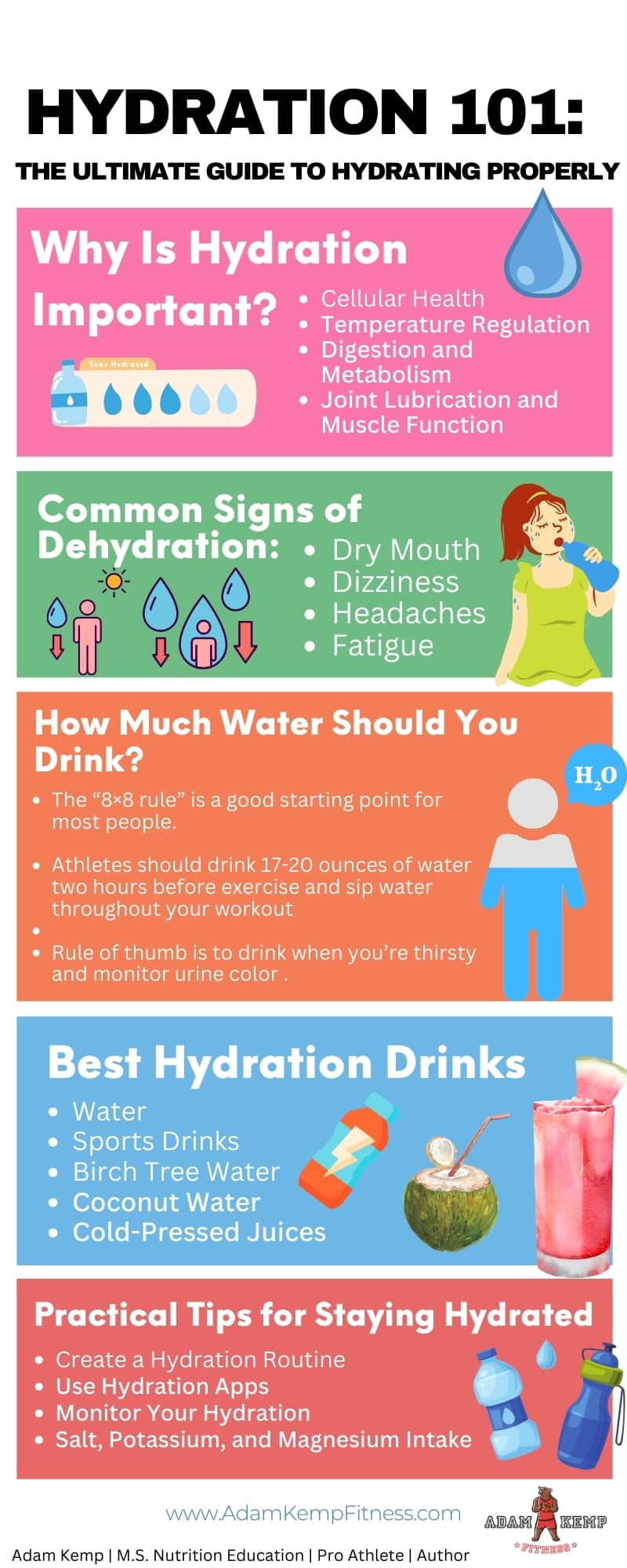
Hydration and Electrolytes While Fasting
A traditional time-restricted eating schedule normally permits water, black coffee, and unsweetened tea during the fasting period.
Athletes must remember that avoiding food can also reduce fluid and sodium intake.
Water is usually sufficient during a short overnight fast without demanding exercise.
An athlete training hard, sweating heavily, or fasting for religious reasons without fluids requires a more individualized hydration strategy.
Coffee can make fasting feel easier, but caffeine should not be used to conceal persistent exhaustion or inadequate nutrition.
Feeling stimulated is not the same as being properly fueled.
A Practical Offseason Intermittent Fasting Schedule for Athletes
A moderate schedule is usually more sustainable than jumping directly into a 16- or 18-hour fast.
Example 14:10 Training Day
- 7:00 a.m.: Water, coffee, or tea
- 8:00 a.m.: Walking, mobility, or light aerobic work
- 10:00 a.m.: First meal with protein, carbohydrates, fruit, and healthy fat
- 1:30 p.m.: Pre-training meal
- 3:00 p.m.: Strength or basketball training
- 5:00 p.m.: Post-training meal
- 7:30 p.m.: Dinner or final protein-rich snack
- 8:00 p.m.: Eating window closes
This schedule provides the behavioral structure of fasting while preserving several opportunities to fuel training and recovery.
An athlete training early in the morning could instead move the eating window forward.
The best fasting window is not automatically noon to 8 p.m.; it is the window that best supports the training schedule.
How to Test Intermittent Fasting Safely
Begin with a 12-hour overnight fast for two weeks. Finishing dinner at 8 p.m. and eating breakfast at 8 a.m. creates structure without significantly limiting fueling opportunities.
If training quality, sleep, mood, recovery, and food intake remain strong, experiment with a 13- or 14-hour fast on rest days or low-intensity days. A 16-hour fast should be viewed as an option, not a required destination.
Track the following markers:
- Strength, speed, endurance, and concentration during training
- Body-weight and body-composition trends over several weeks
- Sleep quality and morning readiness
- Muscle soreness and recovery between sessions
- Mood, motivation, and irritability
- Evening cravings or uncontrolled eating
- Menstrual regularity in female athletes
- Libido and general hormonal-health indicators
- Frequency of illness or injury
If multiple markers worsen, shorten the fast, increase food intake, or move meals closer to training. A productive nutrition plan should improve the entire system, not only the number on the scale.
Who Should Avoid Intermittent Fasting?
Aggressive fasting is usually inappropriate for young athletes who are still growing, pregnant or breastfeeding athletes, and people with a current or previous eating disorder.
People with diabetes, hypoglycemia, gastrointestinal disorders, or medical conditions requiring food with medication should consult a qualified healthcare professional before fasting.
Athletes recovering from injury should also be cautious.
Tissue repair increases the importance of sufficient energy, protein, vitamins, minerals, and regular recovery nutrition.
Female athletes experiencing irregular or absent menstrual periods should not interpret that change as a normal consequence of becoming leaner.
It may indicate inadequate energy availability and should be discussed with a sports dietitian or physician.
Intermittent Fasting vs. a Conventional Athletic Diet
Intermittent fasting is not inherently superior to a conventional meal schedule when calories and nutrients are matched.
A 12-month randomized trial found that adding an eight-hour eating window to calorie restriction did not produce significantly greater weight loss than calorie restriction alone (Liu et al., 2022).
This supports the view that fasting is primarily a structure for controlling intake rather than a metabolic shortcut.
The advantage is adherence.
Some athletes prefer three larger meals in a shorter window, while others perform and recover better with breakfast, lunch, dinner, and strategically placed snacks.
Both approaches can work.
My diet plans hub can help you compare intermittent fasting with other sustainable eating patterns.
Frequently Asked Questions About Intermittent Fasting for Athletes
Final Thoughts: Is Intermittent Fasting Good for Athletes?
Intermittent fasting for athletes can be effective, especially during the offseason when training and recovery demands are easier to organize.
It has helped me reach some of the leanest and best-conditioned points of my career while simplifying my eating routine.
However, the value came from structure, consistency, and improved calorie control—not from treating hunger as proof of discipline.
During the season, I use fasting much more selectively because recovery demands increase while the time available to eat often decreases.
On practice days, game days, travel days, and demanding training days, proper fueling takes priority.
The fairest conclusion is that intermittent fasting is a useful tool but not a universal athletic advantage.
If it helps you maintain a healthy body composition while eating enough protein, carbohydrates, micronutrients, and total calories, it may deserve a place in your plan.
If it reduces training quality, sleep, mood, recovery, or health, the answer is simple: shorten the fast, widen the eating window, and eat the meal.
For a broader approach to fueling performance and long-term well-being, explore my sports nutrition articles and health and fitness tips.
This website does not provide medical advice. This website site does contain affiliate links, and purchases may earn a commission.
Read my Medical Disclaimer, Review Disclaimer, and Publishing Policies for more details. Use of this site indicates acceptance of these terms.