Garden of Life Protein and Greens Review: Is it Worth Buying?
 Reading Time: 17 minutes
 As a professional basketball player with a master’s degree in Nutrition Education, I have tested many protein powders throughout my career.
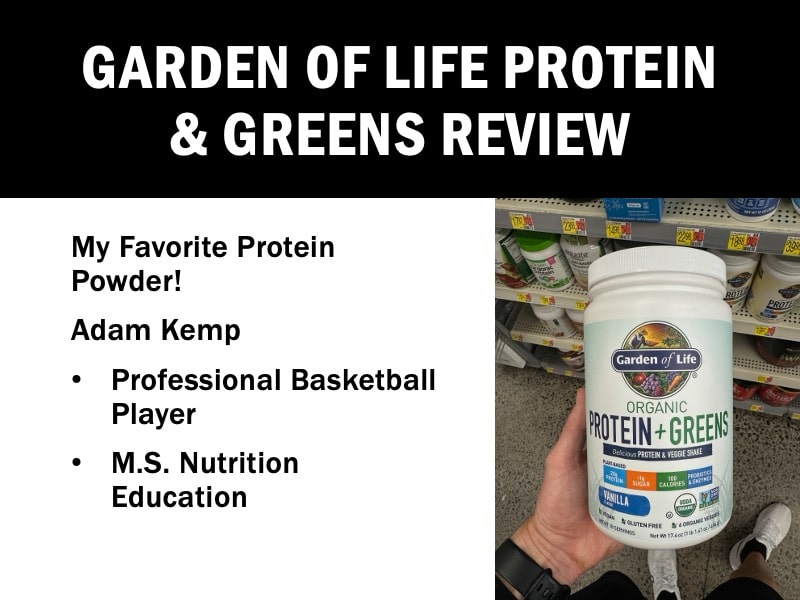
In this Garden of Life Protein and Greens review, I’ll explain why this affordable plant-based protein has remained one of my favorite options for approximately five years, even though it is far from the best-tasting protein powder I have tried.
I originally discovered Garden of Life Protein and Greens at Walmart while looking for a cost-effective plant protein I could use during my summers in the United States.
Its combination of 20 grams of plant protein, six organic greens and vegetables, three grams of fiber, probiotics, and digestive enzymes made it considerably more interesting to me than a basic protein powder.
I generally use one or two scoops once or twice per day, depending on how much protein I receive from the rest of my diet.
Most often, I blend it into a breakfast or post-workout smoothie with approximately 500 milliliters of water or almond milk.
After several years of intermittent use, my honest verdict is that Garden of Life Protein and Greens offers excellent nutritional value and has been easy on my digestive system.
The chocolate and vanilla flavors are not particularly impressive, but the low price, convenient availability, and added ingredients make it a product I continue buying.
Quick verdict: Garden of Life Protein and Greens is one of my favorite affordable plant-based protein powders because it combines 20 grams of protein with fiber, vegetables, probiotics, and digestive enzymes. I recommend it most for smoothies, but its earthy flavor and slightly gritty texture will not appeal to everyone.
- Overall rating: 4.3/5
- Best for: Affordable plant protein, smoothies, and digestive comfort
- Best flavor: Vanilla
- Primary drawback: Mediocre taste when consumed by itself
- Where I buy it: Walmart or Target
- Would I buy it again? Yes
- Typical price: Around $18. Verify current price before publishing
Disclosure: This article may contain affiliate links. If you purchase through one of these links, I may earn a commission at no additional cost to you.


Last update on 2026-09-14 / This article includes affiliate links/Images via Amazon Product Advertising API. I may earn commissions on purchases made through these links.
For more first-hand supplement reviews, athlete nutrition information, basketball training, and strength-and-conditioning advice, subscribe to the Adam Kemp Fitness YouTube channel.
How I Tested Garden of Life Protein and Greens
I have used Garden of Life Protein and Greens on and off for approximately five years. I primarily use it during the offseason when I am home in the United States because this particular product is not readily available where I play basketball in Europe.
Depending on my diet and training schedule, I use one or two scoops once or twice per day.
This is not a dosage recommendation for everyone; it is simply how I use the powder when I need additional dietary protein.
I have tested both the chocolate and vanilla flavors in water, almond milk, smoothies, and simple shakes sweetened with honey or maple syrup.
I usually mix it with approximately 500 milliliters of liquid.
Most often, I use it in one of two situations:
- In a breakfast smoothie
- After basketball or strength training
I evaluated it based on its ingredients, protein content, taste, texture, mixability, digestibility, versatility, availability, and cost per serving.
| Category | Score |
|---|---|
| Ingredients | 4.7/5 |
| Protein content | 4.3/5 |
| Taste | 4.1/5 |
| Texture and mixability | 4.0/5 |
| Digestibility | 4.6/5 |
| Value | 4.7/5 |
| Overall | 4.5/5 |
Garden of Life Protein and Greens vs. Garden of Life Raw Organic Protein and Greens
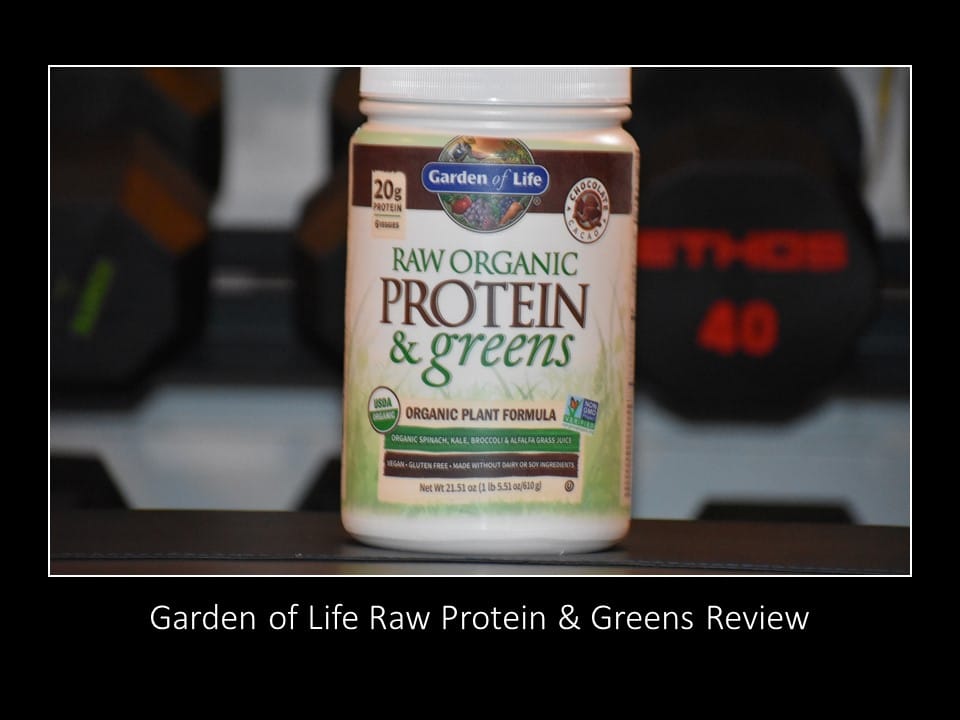
Garden of Life Protein and Greens and Garden of Life Raw Organic Protein and Greens may appear to be the same product in different packaging, but they are separate formulas.
The standard Protein and Greens powder is widely available at Walmart and Target, while the Raw Organic version is primarily sold on Amazon and other online supplement retailers.
I discuss both products in this Garden of Life Protein and Greens review because each offers 20 grams of plant-based protein alongside greens, probiotics, and digestive enzymes.
However, my Garden of Life Protein and Greens review focuses primarily on the Walmart and Target versions because I have purchased them most often and consider them the better overall value.
How Are the Two Formulas Different?
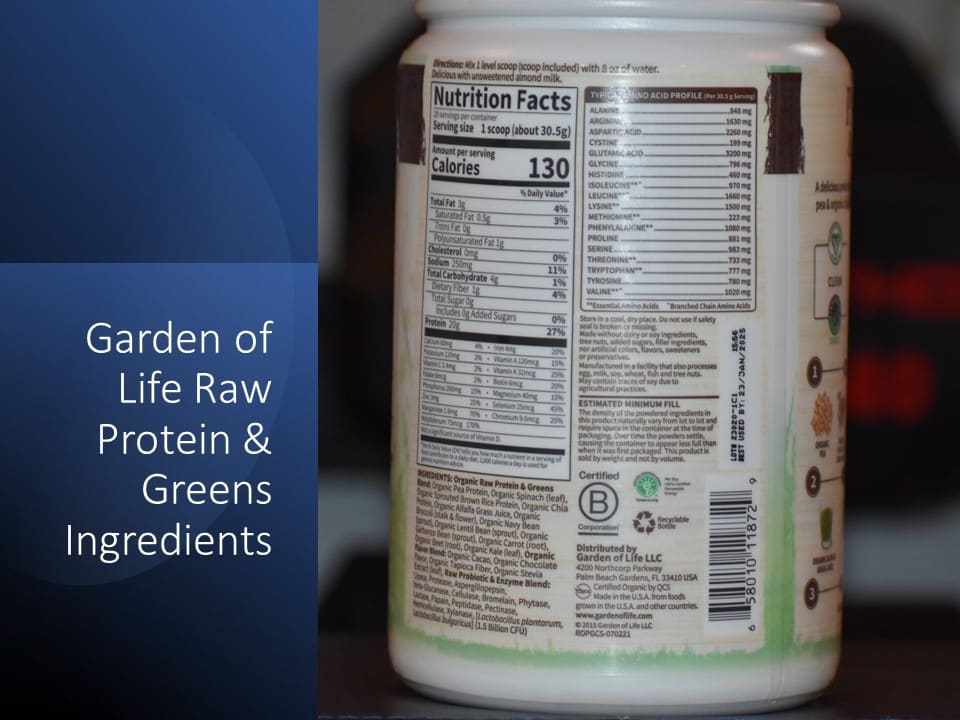
The standard Protein and Greens formula uses a relatively straightforward combination of pea, sprouted brown rice, chia, navy bean, lentil, and garbanzo bean proteins.
It also contains alfalfa grass juice, spinach, kale, broccoli, carrots, and beets.
One serving of the vanilla Walmart and Target formula provides 20 grams of protein, three grams of fiber, and 1.5 billion CFU of probiotics.
It contains approximately 100 calories per serving, although nutritional values can vary slightly between flavors.
Garden of Life Raw Organic Protein and Greens has a more complex protein blend containing additional sprouted grains, seeds, and legumes.
Depending on the specific flavor and listing, these ingredients may include amaranth, buckwheat, millet, quinoa, flaxseed, sunflower seed, pumpkin seed, sesame seed, and adzuki bean.
The Raw Organic formula sold online also lists three billion CFU of probiotics and a wider variety of probiotic strains.
This makes it a genuinely different formula, not just an online version of the Walmart and Target products.
| Feature | Walmart/Target Protein and Greens | Amazon Raw Organic Protein and Greens |
|---|---|---|
| Protein | 20 grams | 20 grams |
| Primary protein sources | Pea, brown rice, chia, navy bean, lentil, and garbanzo bean | Pea and brown rice with a wider variety of sprouted grains, seeds, and legumes |
| Greens | Alfalfa, spinach, kale, broccoli, carrots, and beets | Formula varies; commonly includes alfalfa, spinach, kale, and broccoli |
| Probiotics | 1.5 billion CFU | Up to 3 billion CFU, depending on the formula |
| Fiber | Approximately 3 grams | Approximately 2 grams |
| Calories | Approximately 100–120 | Approximately 110–120 |
| Formula advantage | Simpler formula and better value | More diverse sprouted-ingredient blend |
| Availability | Walmart and Target stores or websites | Primarily Amazon and specialty retailers |
| Best for | Regular, cost-conscious use | People interested in a more complex sprouted formula |
Because Garden of Life has updated its products and packaging over time, Amazon may contain listings for more than one version of Raw Organic Protein and Greens.
Check the Supplement Facts panel and ingredient list on the exact container before purchasing.
Which Garden of Life Protein and Greens Product is Better?
For most people, I recommend the Protein and Greens formula sold at Walmart and Target.
It delivers the core features I want, including 20 grams of plant protein, organic vegetables, fiber, probiotics, and digestive enzymes, at a much more accessible price.
This is the version I have purchased repeatedly during my summers in the United States.
Its affordability and in-store availability make it more practical for regular use, especially if I consume one or two servings a day.
However, Garden of Life Raw Organic Protein and Greens is not simply an overpriced duplicate.
Its combination of sprouted grains, seeds, and legumes gives it a unique formula that may appeal to someone who values ingredient diversity and a higher listed probiotic count.
I believe the Raw Organic version is worth trying at least once, especially if you can find it on sale through Amazon. Nevertheless, the additional ingredients have not convinced me that it is worth paying significantly more for routine use.
My recommendation: Buy Garden of Life Protein and Greens from Walmart or Target for the best everyday value. Consider the Raw Organic version from Amazon if you want its more diverse sprouted-protein formula or find it at a competitive price.
Product formulas can change. Confirm the current label, serving size, ingredients, certifications, and probiotic count before purchasing.
Last update on 2026-09-14 / This article includes affiliate links/Images via Amazon Product Advertising API. I may earn commissions on purchases made through these links.
Garden of Life Protein and Greens Nutrition Facts
The exact nutritional information varies slightly by flavor and product version. According to the current vanilla label, one 27.5-gram serving provides the following:
| Nutrient | Amount per serving |
|---|---|
| Calories | 100 |
| Protein | 20 grams |
| Carbohydrates | 3 grams |
| Fiber | 3 grams |
| Total sugar | 1 gram |
| Added sugar | 0 grams |
| Fat | 1 gram |
| Sodium | 140 milligrams |
| Iron | 4 milligrams |
| Phosphorus | 200 milligrams |
Each serving also contains six organic greens and vegetables, 1.5 billion colony-forming units of probiotics, and a digestive-enzyme blend.
The formula is certified organic, vegan, gluten-free, and Non-GMO Project Verified.
Formulas can change, so check the container you are purchasing rather than relying entirely on an online review.
Ingredients: What is In Garden of Life Protein and Greens?
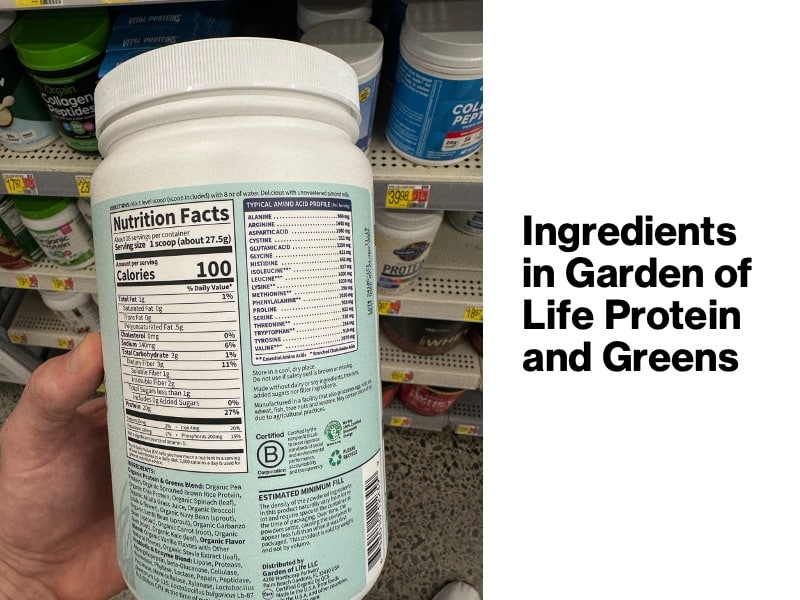
Garden of Life Protein and Greens combines several plant proteins with powdered vegetables, probiotics, and digestive enzymes.
That combination is the primary reason I choose it over many similarly priced protein powders.
Plant-Based Protein Blend
The protein blend in Garden of Life Protein and Greens includes:
- Organic pea protein
- Organic sprouted brown rice protein
- Organic chia protein
- Organic navy bean sprouts
- Organic lentil bean sprouts
- Organic garbanzo bean sprouts
Combining different plant proteins can create a more balanced essential-amino-acid profile than relying on one plant source alone.
However, Garden of Life does not list the complete amino acid or leucine content for this product on the retail label, so I would not claim it produces the same muscle-building response as an equivalent serving of whey protein.
One serving still provides 20 grams of protein, making it a convenient way to increase total daily protein intake.
Adequate daily protein intake is particularly important for athletes and people who perform resistance training (Jäger et al., 2017).
Greens and Vegetable Blend
Garden of Life Protein and Greens contains:
- Organic alfalfa grass juice
- Organic spinach
- Organic broccoli
- Organic carrots
- Organic beets
- Organic kale
I appreciate having these ingredients included, but the product does not disclose the individual amount of each vegetable.
Therefore, I view the greens blend as a nutritional bonus, not a replacement for eating vegetables and fruit.
The powder has been helpful during busy offseason days when my meals are less structured, but I still build my overall diet around whole foods.
Probiotics and Digestive Enzymes
Each serving contains 1.5 billion CFU ofthe probiotics Lactobacillus plantarum and Lactobacillus bulgaricus at the time of expiration.
It also contains enzymes such as protease, lactase, lipase, bromelain, papain, and cellulase.
These ingredients do not guarantee better digestion for everyone.
However, I have found this powder easy to digest, and it has not caused the bloating I sometimes experience with other protein products.
In my experience, it actually improves how my digestive system feels when I use it consistently.
Does Garden of Life Protein and Greens Taste Good?
Honestly, neither the chocolate nor vanilla flavor tastes especially good by itself. If taste is your most important consideration, there are more enjoyable plant-based protein powders available.
The vanilla flavor is my preference because it blends more naturally with fruit, peanut butter, honey, maple syrup, and other smoothie ingredients. It is also more versatile than chocolate.
The chocolate flavor is drinkable, but I would not describe it as rich or dessert-like. Its plant-based and slightly earthy character remains noticeable, especially when mixed only with water.
My Flavor Ratings
| Flavor | Taste | Versatility | My verdict |
|---|---|---|---|
| Vanilla | 3.5/5 | 4.5/5 | Best overall choice |
| Chocolate | 3/5 | 3.5/5 | Better in a flavored smoothie |
Although neither flavor is excellent, they are acceptable once blended with the right ingredients.
I continue buying the product because its value and nutritional profile matter more to me than having a protein powder that tastes like a milkshake.
Garden of Life Protein and Greens: Pros and Cons
Pros
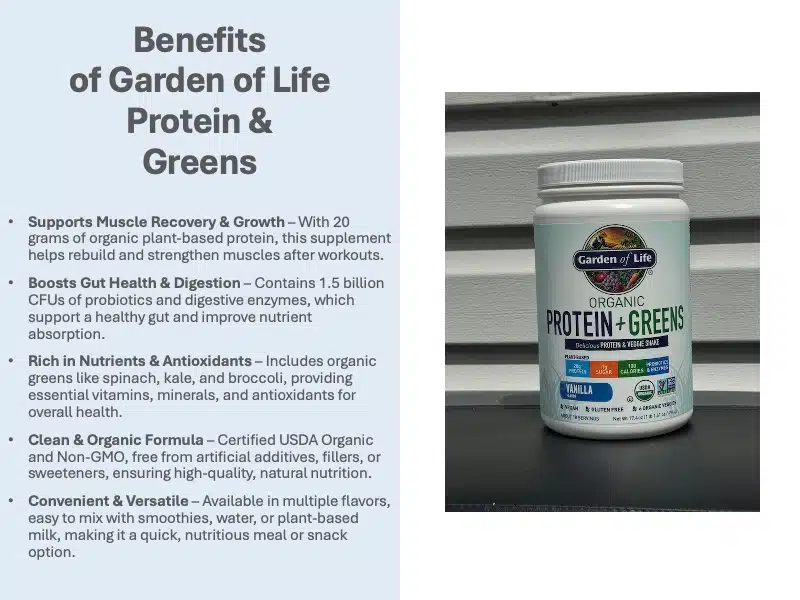
- Provides 20 grams of plant-based protein
- Uses several complementary plant-protein sources
- Includes six organic greens and vegetables
- Contains three grams of fiber
- Includes 1.5 billion CFU of probiotics
- Contains a digestive-enzyme blend
- Certified USDA Organic
- Non-GMO Project Verified
- Vegan and dairy-free
- Has never caused bloating for me
- Helps me feel full
- Easy to find at Walmart and Target
- Excellent cost per serving
- Works well in smoothies
Cons
- Neither chocolate nor vanilla tastes particularly good alone
- Grittier than most whey protein powders
- Performs better in a blender than a shaker
- The quantity of each vegetable is not disclosed
- Not a complete meal by itself
- Can be more expensive than unflavored bulk pea protein
- The standard formula is not NSF Certified for Sport
- Availability may be limited outside the United States
Is Garden of Life Protein and Greens Safe for Drug-Tested Athletes?
The standard Organic Protein and Greens vanilla product is USDA Organic, Non-GMO Project Verified, and certified gluten-free, but Garden of Life states that it is not NSF Certified.
Organic and non-GMO certifications do not provide the same protection as a sport-specific prohibited-substance testing program.
Athletes subject to drug testing should check the certification displayed on their exact container and confirm that it meets their league’s or governing body’s requirements.
Garden of Life sells other products designed specifically for athletes, including its SPORT Plant-Based Protein.
The company describes that formula as a tested option for athletes, but it is a separate product from the standard Protein and Greens reviewed here.

Last update on 2026-09-14 / This article includes affiliate links/Images via Amazon Product Advertising API. I may earn commissions on purchases made through these links.
As a professional athlete, I never assume that every product from a familiar brand has the same certification.
Certifications must be verified for the exact supplement and formula being used.
Is Garden of Life Protein and Greens Expensive?
Garden of Life Protein and Greens is one of the more affordable organic plant-based protein powders I have found at a major retailer.
As of September 2026, the vanilla container was listed at Target for $18.99 and contained approximately 18 servings, although prices and availability can change.
At that price, one serving costs approximately $1.06.
That is competitive for an organic product combining 20 grams of protein with fiber, vegetables, probiotics, and digestive enzymes.
I can sometimes purchase unflavored pea or vegan protein in bulk for less money.
However, the added ingredients, acceptable flavors, and ability to buy Garden of Life Protein and Greens easily at Walmart often justify the difference for me.
Who Should Buy Garden of Life Protein and Greens?
Garden of Life Protein and Greens is best suited for someone who:
- Wants an affordable plant-based protein
- Avoids dairy
- Regularly makes smoothies
- Values organic and non-GMO certification
- Wants fiber, probiotics, and greens in the same product
- Prefers a less aggressively sweet protein powder
- Needs a convenient way to increase daily protein
- Shops at Walmart or Target
It is particularly useful for people who care more about ingredients, digestion, and value than having the smoothest or sweetest protein shake.
Who Should Not Buy It?
This may not be the right protein powder if you:
- Want a smooth, milkshake-like texture
- Plan to mix it only with water
- Strongly dislike earthy plant-protein flavors
- Need a certified meal-replacement product
- Prefer an inexpensive unflavored bulk protein
- Need a product carrying a specific sport-testing certification
- Are sensitive to legumes, stevia, probiotics, or certain enzymes
People with food allergies, gastrointestinal disorders, kidney disease, or other conditions affected by protein intake or supplement ingredients should discuss the product with their physician or registered dietitian.
Frequently Asked Questions About Garden of Life Protein and Greens
Final Verdict: Is Garden of Life Protein and Greens Worth Buying?

After using Garden of Life Protein and Greens for about five years, I consider it one of the best-value protein powders at Walmart.
Its combination of 20 grams of protein, fiber, greens, probiotics, and digestive enzymes gives it advantages over many basic powders at a similar price.
However, its flavor is not a major selling point.
Neither chocolate nor vanilla tastes especially good on its own, and the texture retains some of the grittiness associated with plant protein.
Nevertheless, vanilla works well in my breakfast and post-workout smoothies, particularly when combined with banana, peanut butter, almond milk, honey, or maple syrup.
It has also been filling, easy to digest, and useful for supporting my protein intake during the offseason for basketball and strength training.
Cheaper bulk protein is sometimes available, and athletes who require sport-specific certification may need another formula.
However, for general use, Garden of Life Protein and Greens remains a product I buy with my own money and confidently recommend to people who understand its limitations.
Overall, my Garden of Life Protein and Greens review earns the product a 4.6 out of 5 rating.
It is not the tastiest protein powder, but its nutritional profile, digestive comfort, availability, and price make it one of my favorite plant-based options.
Read Next: Whey vs. Plant Protein: Which is Better for You?
This website does not provide medical advice. This website site does contain affiliate links, and purchases may earn a commission.
Read my Medical Disclaimer, Review Disclaimer, and Publishing Policies for more details. Use of this site indicates acceptance of these terms.