CBD for Wrinkles: Can CBD Prevent or Reduce Skin Aging?
 Reading Time: 7 minutes
 Using CBD for wrinkles has become increasingly popular as creams, serums, oils, and supplements containing cannabidiol are marketed as natural solutions for fine lines and premature skin aging.
These claims generally focus on CBD’s potential antioxidant and anti-inflammatory properties, which could theoretically help protect the skin from processes involved in collagen breakdown and photoaging.
However, wrinkles develop through a complex combination of declining collagen production, reduced skin hydration, ultraviolet radiation, oxidative stress, inflammation, genetics, and repeated facial movements.
For CBD to meaningfully prevent wrinkles, it would need to protect the skin from these influences or improve its structural integrity, not simply reduce temporary redness or dryness.
How you use CBD for wrinkles also matters.
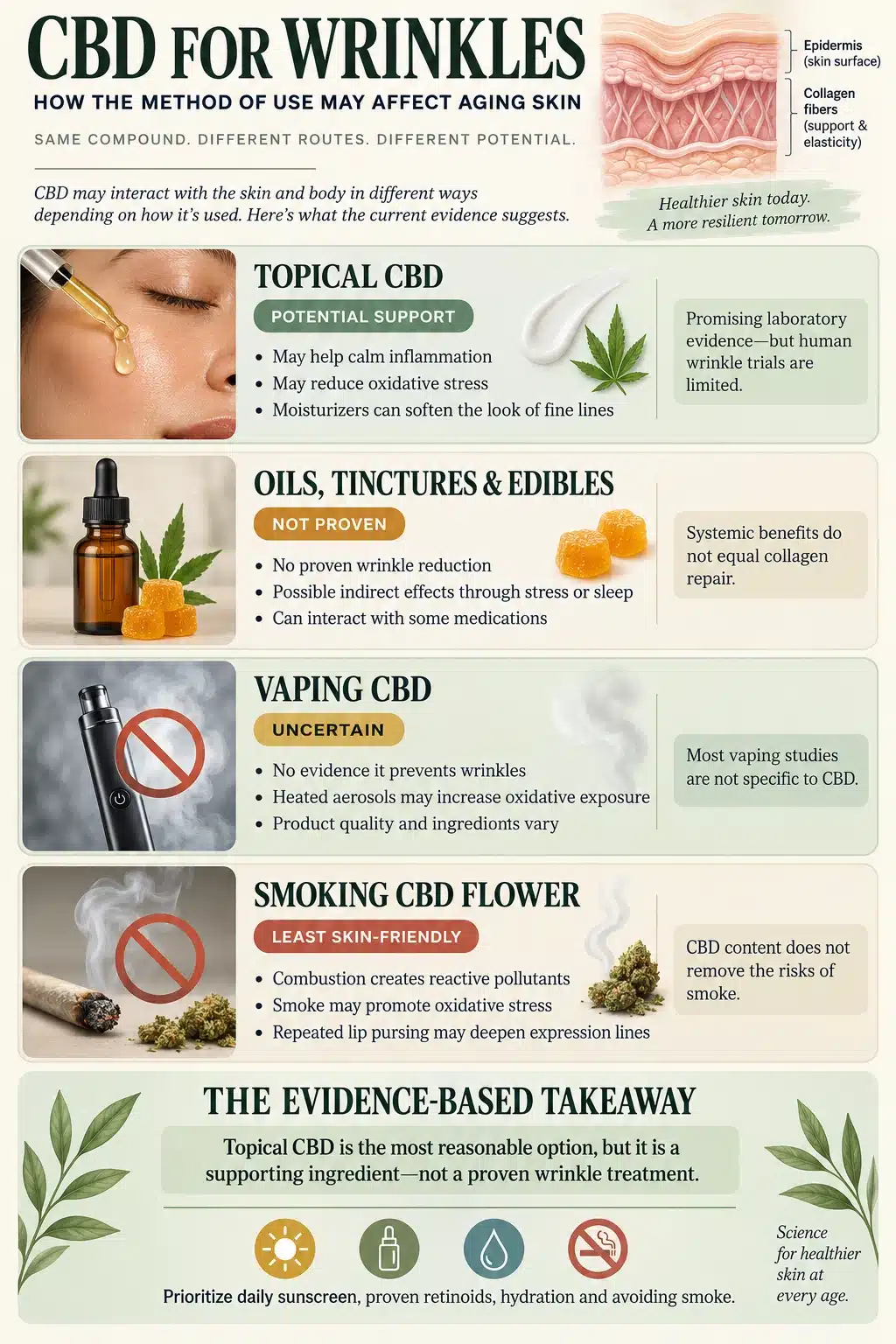
Topical CBD may provide localized benefits, but most supporting evidence comes from laboratory research rather than human clinical trials; oral CBD has no established anti-wrinkle effect, and smoking or vaping may expose the body to compounds that promote oxidative stress.
At best, CBD should be viewed as a potentially supportive skincare ingredient, not a proven replacement for sunscreen, retinoids, or other evidence-based treatments.
Read the rest of my article to learn more about CBD’s potential benefits and risks for wrinkles!
What Causes Wrinkles?
Wrinkles develop through a combination of natural aging and environmental damage.
As people age, collagen production gradually declines, elastic fibers become less organized, and the skin retains less moisture.
Ultraviolet radiation is one of the most important preventable causes of premature wrinkles.
UV exposure promotes oxidative stress, inflammation, collagen-degrading enzymes, and structural damage collectively known as photoaging (Parrado et al., 2019).
Smoking, air pollution, insufficient sleep, repeated facial movements, genetics, and poor nutrition may also influence how quickly wrinkles become visible.
Consequently, CBD would need to meaningfully affect one or more of these processes to prevent or reduce wrinkle development.
Can Topical CBD Help With Wrinkles?
Topical CBD is the most biologically plausible form for supporting aging skin because it places CBD directly on the area being treated.
Laboratory research suggests that CBD can influence oxidative stress and inflammatory signaling in human skin cells.
In a one-cell study, CBD protected human keratinocytes against hydrogen peroxide-induced oxidative stress by affecting inflammatory pathways and cellular survival mechanisms (Liu et al., 2021).
Other laboratory research found that CBD altered proteins involved in inflammation, oxidative stress, and cellular protection in keratinocytes exposed to ultraviolet radiation (Atalay et al., 2021).
These findings matter because chronic oxidative stress and inflammation contribute to collagen breakdown and photoaging.
Nevertheless, protecting isolated skin cells in the lab is not the same as showing fewer wrinkles on a human face.
A review of CBD in cosmetic dermatology concluded that CBD has potential antioxidant, anti-inflammatory, moisturizing, and anti-aging applications but emphasized the need for better clinical trials, standardized formulations, and long-term safety data (Kuzumi et al., 2024).
Some CBD creams may still make fine lines appear temporarily softer by improving skin hydration.
However, that effect may come primarily from ingredients such as glycerin, oils, ceramides, or hyaluronic acid in the product’s base, not necessarily from CBD itself.
Does CBD Increase Collagen Production?
Claims that CBD “boosts collagen” should be treated cautiously.
No convincing human evidence shows that topical or oral CBD increases facial collagen enough to prevent wrinkles.
In fact, experimental research investigating fibrosis found that CBD inhibited fibroblast activity and reduced collagen gene expression under certain abnormal, pro-fibrotic conditions (Del Río et al., 2022).
This does not mean CBD destroys healthy facial collagen, because fibrotic disease differs significantly from normal skin aging.
However, it demonstrates why CBD should not automatically be described as a collagen-building ingredient.
Its effects seem to depend on cell type, concentration, skin condition, and the biological environment.
Can CBD Reduce Wrinkles by Calming Inflammation?
Persistent, low-grade inflammation can contribute to skin aging by increasing enzymes that degrade collagen and other components of the extracellular matrix.
CBD’s anti-inflammatory activity could therefore provide an indirect protective effect.
This theory is biologically reasonable, but researchers have not yet demonstrated that CBD’s anti-inflammatory effects translate into clinically meaningful wrinkle prevention.
A reduction in redness or irritation should not automatically be interpreted as collagen repair or wrinkle reversal.
CBD might be more useful as a supportive ingredient for people whose skin cannot tolerate stronger products.
Even then, fragrance, botanical extracts, carrier oils, or other ingredients in CBD cosmetics can cause irritation or allergic contact dermatitis.
Do CBD Oils, Tinctures, or Edibles Prevent Wrinkles?
No controlled human trials have shown that CBD tinctures, capsules, gummies, or other edible products prevent or reduce wrinkles.
Although oral CBD enters systemic circulation, only a portion of the consumed dose reaches the bloodstream because its oral bioavailability is relatively low and variable (Millar et al., 2018).
Oral CBD could theoretically affect the skin by influencing inflammation, stress, or sleep.
These remain indirect possibilities rather than established anti-aging effects, and improvements in relaxation or sleep should not be presented as evidence that CBD rebuilds collagen.
CBD can also interact with medications by affecting liver enzymes involved in drug metabolism.
Anyone taking prescription medication, particularly anticoagulants, seizure medications, sedatives, or drugs with a narrow therapeutic range, should consult a qualified healthcare professional before regularly ingesting CBD (Brown & Winterstein, 2019).
Does Smoking CBD Cause Wrinkles?
Smoking CBD flower is unlikely to be a skin-friendly delivery method.
Burning cannabis produces smoke containing fine particles, carbon monoxide, reactive chemicals, and polycyclic aromatic hydrocarbons, even when the product contains mostly CBD rather than THC.
Cannabis smoke and tobacco smoke are not identical, and studies have not directly established that smoking CBD flower causes facial wrinkles.
Nevertheless, combustion-derived pollutants can increase oxidative stress and inflammation, which also drive collagen degradation and premature skin aging.
An observational study found an association between cumulative marijuana use and markers of accelerated epigenetic aging, with the researchers suggesting that hydrocarbon exposure from smoke may help explain the relationship (Allen et al., 2022).
This study did not specifically examine CBD, visible wrinkles, or prove that cannabis caused faster aging, so its findings should not be overstated.
Repeated squinting and pursing of the lips while smoking may also contribute to expression lines over time.
More importantly, inhaling smoke introduces skin-aging exposures that are absent when CBD is used topically.
Does Vaping CBD Cause Wrinkles?
There is no direct evidence that vaping CBD causes or prevents wrinkles. However, vaporizing does not make CBD an anti-aging treatment.
Heating vape liquids can generate reactive chemicals, while unregulated CBD cartridges may contain solvents, flavorings, contaminants, or inaccurate cannabinoid concentrations.
Experimental evidence concerning electronic cigarettes also indicates that aerosol exposure can promote oxidative stress and impair processes involved in vascular function and tissue repair (Benowitz & Fraiman, 2017).
Most vaping research has examined nicotine products rather than CBD-specific vaporizers.
Therefore, the evidence cannot establish the precise risk of wrinkles from vaping CBD, but inhalation remains a less logical choice for skin health than a properly formulated topical product.
Can CBD Make Wrinkles Worse?
CBD itself has not been shown to directly cause wrinkles when applied appropriately.
However, a CBD product could indirectly worsen skin appearance if its other ingredients cause irritation, allergic dermatitis, excessive dryness, or increased sun sensitivity.
Smoking CBD-rich cannabis may be more concerning because combustion exposes the body to oxidative pollutants.
Vaping avoids combustion but still introduces heated aerosols and uncertain ingredients without providing a demonstrated anti-wrinkle benefit.
Poorly regulated CBD products may also contain less CBD than advertised or traces of pesticides, heavy metals, residual solvents, or THC.
Choosing products with accessible third-party certificates of analysis can reduce, although not eliminate, these risks.
How to Use CBD in an Anti-Aging Skincare Routine
If you want to try CBD for wrinkles, a topical cream or serum is more reasonable than smoking, vaping, or ingesting CBD.
Select a fragrance-free product from a transparent manufacturer, patch-test it first, and evaluate the complete formula rather than focusing exclusively on the amount of CBD.
CBD should be considered an optional supporting ingredient, not the foundation of an anti-aging routine.
Daily broad-spectrum sunscreen, avoiding intentional tanning and smoke exposure, and using evidence-based ingredients such as topical retinoids have substantially stronger support for preventing or improving photoaging (Mukherjee et al., 2006).
A CBD moisturizer might help calm or hydrate the skin, but it should not replace sunscreen, adequate nutrition, sleep, or clinically established wrinkle treatments.
Final Thoughts: Does CBD Help With Wrinkles?
CBD may support aging skin through antioxidant, anti-inflammatory, and moisturizing effects, particularly when included in a well-formulated topical product.
However, current clinical evidence is insufficient to conclude that CBD prevents wrinkles, stimulates healthy collagen production, or reverses existing lines.
Oral CBD has no proven anti-wrinkle benefit, while smoking or vaping CBD may introduce oxidative exposures that conflict with the goal of protecting the skin.
For anyone interested in using CBD for wrinkles, topical use is the most reasonable option, but expectations should remain modest until stronger human trials are available.
This website does not provide medical advice. This website site does contain affiliate links, and purchases may earn a commission.
Read my Medical Disclaimer, Review Disclaimer, and Publishing Policies for more details. Use of this site indicates acceptance of these terms.