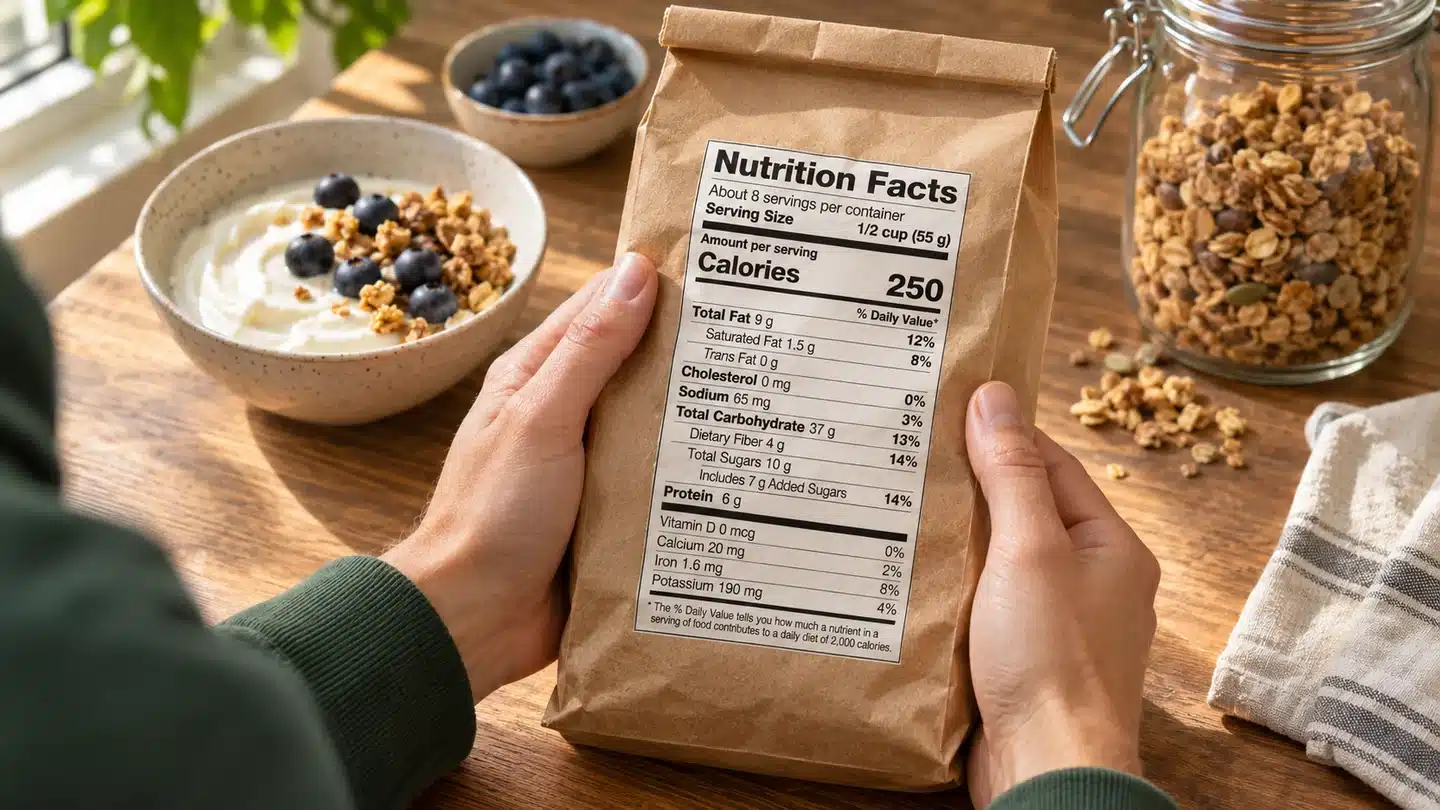
How to Read Nutrition Labels for Better Results
 Reading Time: 8 minutes
Learning how to read nutrition labels influences dozens of small choices I make every day, from the cereal I pour at breakfast to the snack I pack for a road game.
I read the label on every processed food I buy, and I start with three questions:
- How much will I actually eat?
- What do I need this food to do for me?
- Which number on the package will help me decide?
When I’m buying whole foods like apples, avocados, or fresh broccoli, I can see exactly what I’m getting.
But when I’m comparing two bags of granola, I want to know how much fiber and added sugar I’ll get from the handful I actually put on my Greek yogurt.
As a professional basketball player, I regularly help my teammates make these decisions, too.
You can use those same questions to choose a more filling breakfast, get enough protein after lifting, or see how much added sugar your usual pour of coffee creamer contributes.
That’s the everyday value of knowing how to read nutrition labels.
If you change the creamer you use every morning or the yogurt you buy every week, one comparison at the grocery store keeps paying off long after you get home.
Why Should You Read Nutrition Labels?
You should read nutrition labels because they show how much energy, protein, fiber, added sugar, and sodium you’ll get from the portion you actually eat.
If your usual bowl of cereal holds two servings, you’ll get twice the calories and nutrients listed for one serving (U.S. Food and Drug Administration, n.d.).
For most people, the biggest payoff comes from checking foods they buy every week.
If yogurt is part of your daily breakfast, compare two cups of the same size for protein and added sugar.
One quick look in the dairy aisle can help you choose a breakfast that fits your goals all week.
Important Tips for Reading Nutrition Labels Properly
When I compare two foods at the grocery store, I start with the portion I expect to eat and the reason I’m buying it.
Those two details help me decide which numbers deserve a closer look.
The tips below walk you through checking serving sizes, interpreting percent Daily Value, and recognizing added sugars by their different names.
You can use the same approach whether you’re choosing a cereal for everyday breakfasts or a snack to eat before practice.
Start With the Serving You Actually Eat

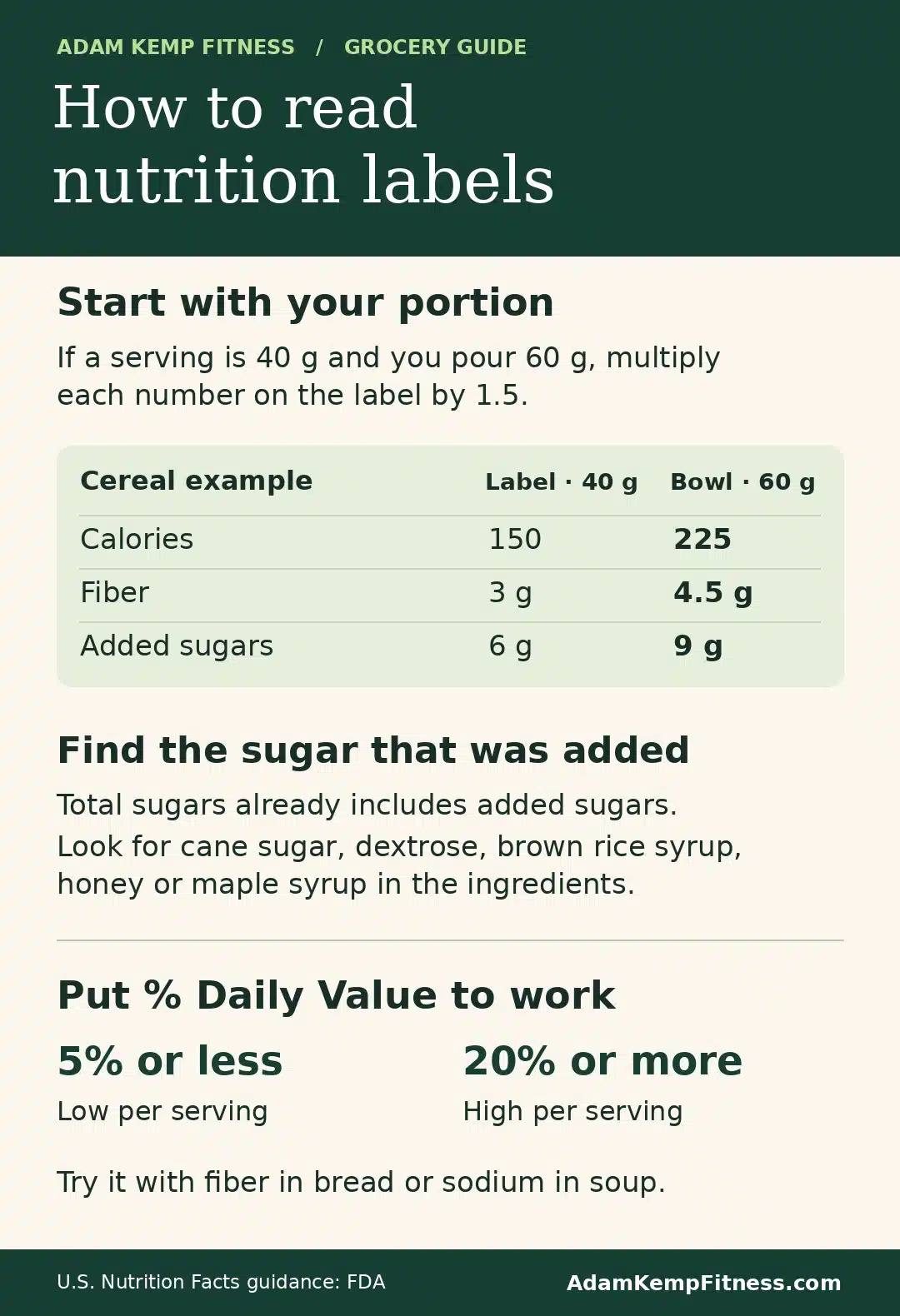
On a U.S. Nutrition Facts label, read servings per container and serving size together. A labeled serving reflects how much people typically consume, while your portion is the amount you put on your plate (U.S. Food and Drug Administration [FDA], n.d.-c).
Suppose your cereal lists 150 calories, 3 grams of fiber, and 6 grams of added sugar per 40 grams.
If your usual bowl holds 60 grams, multiply each number by 1.5, and you get 225 calories, 4.5 grams of fiber, and 9 grams of added sugar before you pour the milk.
You can do this once with your favorite bowl and a kitchen scale, then use the fill level as a reference.
For foods like boxed macaroni, also check whether you’re reading the values for the dry mix or for the meal prepared with butter and milk.
If a package shows a whole-container column, it has already done the multiplication for you (FDA, n.d.-b).
Read Calories Alongside Protein, Carbohydrates, and Fat
Calories tell you how much energy your portion supplies.
A sustained energy deficit supports fat loss, while consistently getting too little energy for your training can compromise recovery and performance (FDA, n.d.-b; Thomas et al., 2016).
Consider peanut butter on toast.
If you’re working on fat loss, measuring your usual spoonful can show you where a small adjustment would fit.
If you struggle to eat enough between practices, that same spoonful is an easy way to add energy without making another meal.
Protein for Muscle Repair and More Satisfying Meals
When I want protein after training, I look at the grams in the amount I’ll actually eat.
A 200-calorie yogurt with 20 grams of protein gives me twice as much protein as a 300-calorie bar with 10 grams, and I can add a banana or oats if I need more carbohydrates.
Protein supplies amino acids for muscle repair, and distributing protein across meals gives you several opportunities to support recovery throughout the day (Thomas et al., 2016).
If a breakfast cereal advertises protein, check whether the prominent number includes the milk pictured on the box.
That changes what you’ll get if you eat it dry or use a different milk.
Carbohydrates and Fiber for Everyday Eating and Training
On U.S. labels, total carbohydrate includes starch, fiber, and sugars.
When I compare breads for an everyday sandwich, I check how much fiber I’ll get from two slices and whether whole wheat, whole rye, or another whole grain appears near the beginning of the ingredient list (FDA, n.d.-b; American Heart Association, 2024).
A bread with 3 grams of fiber per slice gives you 6 grams in that sandwich.
Beans, oats, fruit, and vegetables offer other ways to add fiber to meals, especially if you prefer a lower-fiber bread.
My priorities change close to a game.
If I have a short window to eat, toast with honey or a banana gives me readily available carbohydrate, and a lower-fiber snack may sit more comfortably during warmups (Thomas et al., 2016).
Timing is one of the most practical parts of applying sports nutrition basics to your own schedule.
Total Fat and Saturated Fat Answer Different Questions
Read total fat to see how much fat a serving contributes, then check the saturated fat line.
Replacing some saturated fat with unsaturated fat from foods such as olive oil, walnuts, seeds, or fish can support heart health (American Heart Association, n.d.).
Salad dressing is a good place to practice.
Compare the saturated fat in equal portions of a creamy dressing and an olive oil vinaigrette, then consider how much of each you enjoy using.
If you usually pour three tablespoons, comparing just one tablespoon gets you partway there.
Recognize Added Sugar by Its Many Names
The total sugars line already includes added sugars.
If a yogurt lists 15 grams of total sugars and says it includes 8 grams of added sugars, you’re eating 15 grams of sugar altogether.
The remaining roughly 7 grams come from sugars naturally present in ingredients such as milk or fruit (FDA, n.d.-a).
The ingredient list tells you what supplied the sweetness.
These are names you may see when comparing cereals, flavored oatmeal, sauces, coffee creamers, and snack bars (American Heart Association, 2024; FDA, n.d.-a).
| What you might see | Examples on an ingredient list |
| Granulated or specialty sugars | Cane sugar, brown sugar, coconut sugar, turbinado sugar |
| Names ending in “-ose” | Sucrose, dextrose, glucose, fructose, maltose |
| Syrups | Corn syrup, high-fructose corn syrup, brown rice syrup, maple syrup, agave syrup |
| Other sweetening ingredients | Honey, molasses, fruit juice concentrate used to sweeten a food |
The “-ose” ending signals a type of sugar.
Lactose occurs naturally in plain milk, and fructose occurs naturally in whole fruit.
For the added-sugars line, what matters is how the sugar got into the food (FDA, n.d.-a).
Ingredients generally appear in descending order by weight, and a product can contain several different sweeteners.
If an oat bar lists brown rice syrup, cane sugar, and honey in different places, the added sugars per serving tells you their combined contribution more reliably than guessing from their positions (American Heart Association, 2024; FDA, n.d.-a).
I like raw honey and maple syrup, and I’d still count either one if I stirred it into plain Greek yogurt.
The advantage of adding my own is that I can taste the yogurt with blueberries first and decide how much sweetness I actually want.
Use Percent Daily Value to Make a Quick Comparison
On a U.S. label, 5% Daily Value (%DV) or less is low, and 20% or more is high for a nutrient in one serving.
Those percentages use common reference values so you can compare foods, even when your energy needs differ from the 2,000-calorie reference on the package (FDA, n.d.-b).
For a breakfast cereal, I’d use %DV to compare fiber or iron.
For a frozen dinner, I’d check sodium and saturated fat.
Calcium, vitamin D, and potassium are also worth comparing when you’re choosing a food you buy every week (FDA, n.d.-b).
Sodium deserves context.
If two soups have 15% and 35% of the sodium Daily Value per cup, a two-cup bowl gives you 30% or 70%, respectively.
That difference can be more useful than the word “light” on either can.
During a long, sweaty practice, sodium replacement serves a different purpose.
Sweat loss, session length, and conditions all affect when an electrolyte drink makes sense.
If your clinician has given you a sodium target, compare the milligrams in your usual portion directly with that target (Thomas et al., 2016).
Compare Choices You Would Actually Buy
Imagine choosing between these two yogurts for breakfast.
The values are illustrative, and both cups weigh 170 grams, so you can compare them directly.
| Per 170-gram cup | Plain Greek yogurt | Strawberry yogurt |
| Calories | 120 | 150 |
| Protein | 17 g | 8 g |
| Total sugars | 6 g | 18 g |
| Includes added sugars | 0 g | 10 g |
If I’m making a breakfast bowl with oats, walnuts, and blueberries, I’d choose the plain Greek yogurt.
Its 9 extra grams of protein matter more to that meal than the 30-calorie difference, and the blueberries already give me the flavor I want.
If you prefer the strawberry cup, you can use the same numbers to build breakfast around it.
Pair it with eggs for more protein, or mix it with plain yogurt to keep the strawberry flavor while reducing the added sugar per spoonful.
Apply the same test to front-label claims.
“Multigrain” tells you to turn the loaf over and check which grains the baker used.
“No added sugar” on applesauce can be useful, but if you’re packing it for halftime, you may actually want to look at total carbohydrates per pouch (American Heart Association, 2024; FDA, n.d.-b).
Final Thoughts: Nutrition Labels Reading Guide for Better Choices
The next time you shop, start with one food you eat often.
If it’s bread, compare the fiber in the two slices you use for lunch.
If it’s yogurt, compare the protein and added sugar in the cup you finish.
That’s how I use nutrition labels as a basketball player and as a parent.
Once I know what our usual groceries contribute, I can spend less time reading packages and more time putting together meals that work for the day ahead.
This website does not provide medical advice. This website site does contain affiliate links, and purchases may earn a commission.
Read my Medical Disclaimer, Review Disclaimer, and Publishing Policies for more details. Use of this site indicates acceptance of these terms.
Check Out Some of My YouTube Videos Below, and Please Follow on YouTube for More Educational Health and Fitness Content!