

How to Improve Focus at Work
 Reading Time: 10 minutes
Learning how to improve focus at work starts with noticing what happens in the minute before you lose it.
If you open your inbox because you’re unsure what to write next, you need a clearer starting point.
If you know exactly what to write but keep reading the same sentence after a short night of sleep, you need a different solution.
As a professional basketball player who also writes about fitness and nutrition, I spend part of my workday in a gym and on the basketball court, and part of it at a keyboard.
Also, as someone living with Tourette Syndrome and ADHD, it would be easy for me to let my mind wander and not focus on my work, whether it’s watching film and preparing for my next opponent, or trying to write a new article or research a current health or fitness topic.
If you want to learn how to improve focus at work, start with a task you can finish, protect it from avoidable interruptions, and pay attention to whether you’re rested enough to do it well.
After that, there are many other ways to improve focus at work, but we will get to those later!
Common Reasons You Can’t Focus at Work
When you can’t focus at work, one of the most useful questions to ask is when the problem shows up.
Losing your train of thought after three messages interrupt a report is a different experience from struggling to follow a conversation, remember an appointment, or enjoy a book on your day off.
Interruptions and Competing Priorities
You might sit down to finish a proposal while part of your attention is still on a difficult email you answered ten minutes ago.
Researchers call this attention residue, and experiments suggest it can interfere with your performance when you switch away from unfinished work (Leroy, 2009).
A useful question is, “Can I concentrate when I have one clear task and twenty quiet minutes?”
If you can, look first at what happens during a typical workday, especially which interruptions you can silence and which responsibilities need a clearer order of priority.
Too Little Sleep or Poor Sleep Quality
Several short nights can gradually weaken sustained attention, even when you feel like you’ve adjusted to getting less sleep.
In a controlled study, participants limited to six hours in bed each night accumulated performance deficits over two weeks, while their own ratings of sleepiness changed much less (Van Dongen et al., 2003).
Pay attention to how you feel after a full night in bed, too.
If you regularly struggle to stay alert at work and someone has noticed loud snoring, gasping, or pauses in your breathing, discuss those details with a healthcare professional, as they may be signs of sleep apnea (National Heart, Lung, and Blood Institute, n.d.).
Nutrient Deficiencies
Iron-deficiency anemia is worth considering when trouble concentrating comes with unusual fatigue or shortness of breath during activities that normally feel easy.
Heavy menstrual bleeding and frequent blood donation are useful details to mention to a clinician, who can use blood tests to check for anemia and low iron stores before recommending an iron supplement (National Heart, Lung, and Blood Institute, n.d.).
Vitamin B12 deficiency can also cause fatigue and poor memory, sometimes alongside numbness or tingling in the hands and feet.
If you eat a fully plant-based diet, it’s worth checking whether you regularly get B12 from fortified foods or a supplement, since unfortified plant foods don’t naturally provide it (National Institutes of Health, Office of Dietary Supplements, n.d.).
Anxiety, Depression, or ADHD
With anxiety, you may know exactly what a meeting is about but miss part of the conversation because you’re replaying a mistake or anticipating a difficult question.
Depression can make familiar tasks feel mentally demanding, including remembering instructions or making routine decisions.
A change in concentration is especially worth discussing if it comes with persistent low mood or a loss of interest in things you usually enjoy outside work (National Institute of Mental Health, n.d.).
With adult ADHD, the history matters.
Clinicians look for symptoms that began in childhood and interfere with life in more than one setting, so longstanding difficulties organizing schoolwork, keeping track of bills, and meeting deadlines are more informative than one unusually hectic month at the office (National Institute of Mental Health, n.d.).
If difficulty concentrating is new, keeps getting worse, or regularly interferes with daily life, bring a few specific examples to a healthcare professional.
Being able to say when it started, whether it happens outside work, and what else changed around the same time gives you a clearer place to begin.
Best Ways to Improve Focus at Work
The best ways to improve focus at work depend on what pulls your attention away.
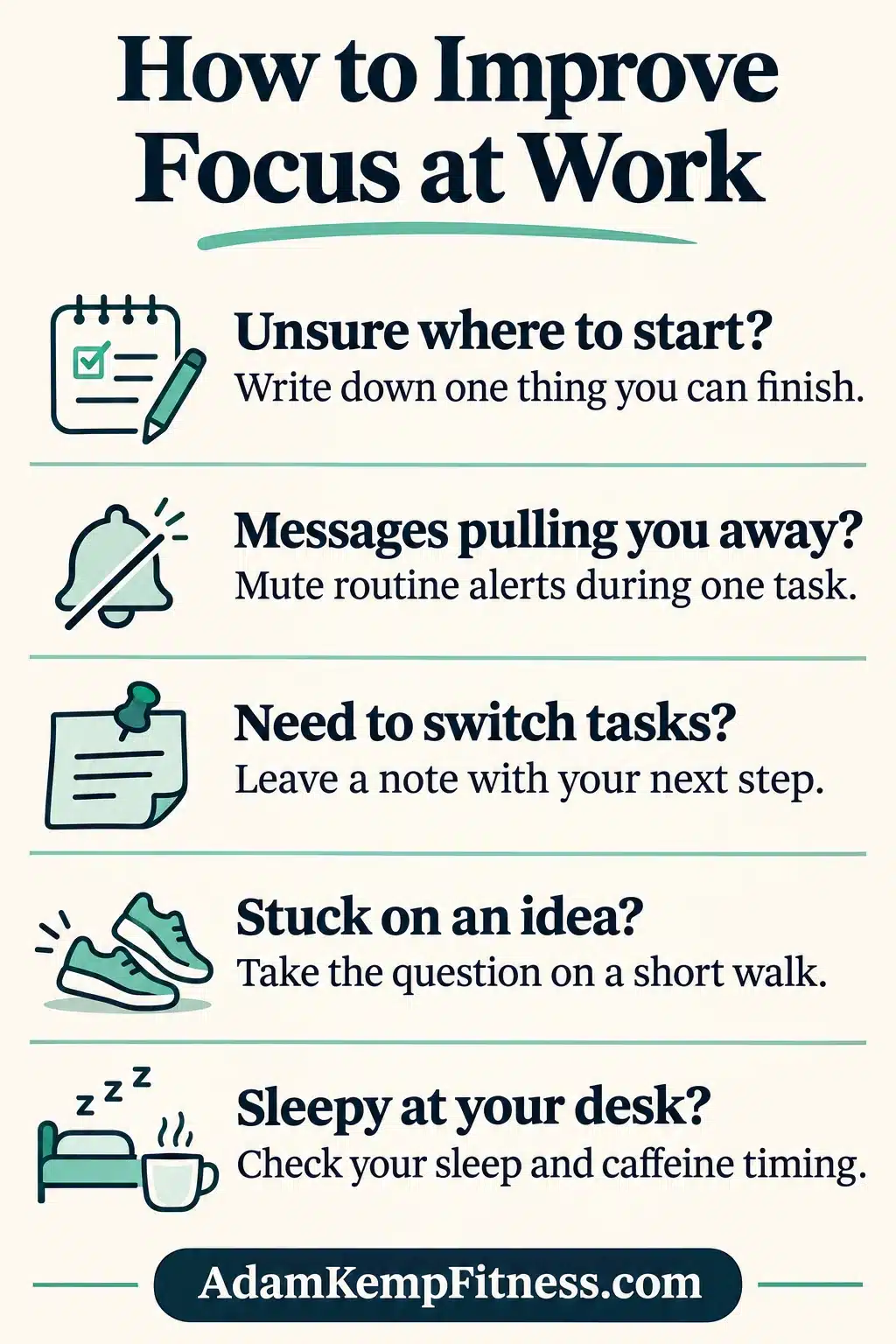
If you sit down with thirty minutes to finish a report and spend the first ten deciding where to begin, write down one question the report needs to answer.
If you already know what to say but lose your place every time a message arrives, start by silencing routine alerts until you finish that section.
When I fit writing around basketball practice, I like to give each stretch of time a job I can realistically finish, even if it’s just explaining one study in a paragraph.
Think about where your last work session went off track, then try the strategy below that best fits that moment.
Decide What You Want to Finish Before You Open Your Inbox
Look at an item on your to-do list and ask yourself what someone could see when you’re finished.
“Work on the presentation” leaves nearly every decision open, while “draft the slide that explains why our costs increased” gives you a question to answer and a place to stop.
I’d apply the same thinking to an article on sports nutrition.
In half an hour, I could reasonably expect to read one study and explain what its findings mean for someone planning a pregame meal.
Expecting me to research, write, and edit the whole article within that window gives me little guidance on where to begin.
Choose one piece of work that fits the time you actually have, then open the document, spreadsheet, or reference you need to do it.
If a missing fact sends you down a research trail, leave yourself a short note like “verify the June figure” and continue with the parts you can complete.
Reduce the Interruptions You Can Control
Have you ever glanced at a message during a meeting and spent the next few minutes composing a reply in your head?
Researchers call this attention residue.
In two experiments, people who switched away from unfinished work had difficulty disengaging from it, and their performance on the next task suffered (Leroy, 2009).
Even an unanswered alert can interrupt concentration. In a laboratory study, participants who received phone notifications performed worse on a demanding attention task despite having no direct interaction with the device (Stothart et al., 2015).
Start with the alerts you routinely dismiss anyway.
Silence those during one demanding task, close the inbox tab, and let calls from anyone who genuinely needs an immediate response come through.
If your job involves customer service, caregiving, or managing a team, being available is part of doing good work.
Ask a colleague to cover ten minutes while you verify an invoice, or agree on one channel for urgent requests so you can review routine messages together afterward.
Leave Yourself a Note Before Switching Tasks
One of the more interesting findings about interruptions concerns the work you switch to.
Across four studies, people who expected to return to an unfinished task under time pressure had trouble giving the interruption their full attention.
Briefly planning how to resume the original task reduced that effect (Leroy & Glomb, 2018).
Imagine a coworker calls just as you spot a discrepancy in a budget.
Before picking up, type one line beside the numbers you’re checking, such as “April totals match.
Check whether the May invoice was entered twice.”
That note takes a few seconds, gives you a starting point when the call ends, and frees you to listen to the person who needs you now.
I especially like this approach for workdays broken up by appointments, because it gives you a way to use the time on either side of them.
Match Your Break to the Work in Front of You
When your concentration slips, consider what you need from the next five minutes.
A meta-analysis of 22 study samples found that short breaks modestly reduced fatigue and helped people feel more energetic, although the researchers found no significant improvement in overall task performance (Albulescu et al., 2022).
If you’re stuck coming up with ideas, try taking the question on a short walk.
In experiments comparing walking and sitting, walking helped people generate more creative possibilities, with much less benefit on a task that required finding one correct answer (Oppezzo & Schwartz, 2014).
I’d use a walk to think of three ways to explain a confusing topic to a reader, then return to my desk to check which explanation the evidence supports.
If you’ve spent the morning checking figures and simply want a few quiet minutes, leave the problem at your desk and enjoy the walk.
Check Your Sleep Before Changing Your Morning Routine
How alert you feel can be a poor guide to how consistently you’re paying attention.
In a controlled study, participants limited to six hours in bed each night for two weeks accumulated measurable performance deficits, while their reported sleepiness changed much less after the first few days (Van Dongen et al., 2003).
For adults ages 18 to 60, the American Academy of Sleep Medicine and Sleep Research Society recommend regularly getting at least seven hours of sleep (Watson et al., 2015).
If your alarm goes off at 6 a.m. and you routinely take your laptop to bed at 11 p.m., your schedule leaves little room to meet that recommendation.
For a few workdays, note when you put work away, roughly how long you slept, and when you first catch yourself rereading or making careless errors.
If the same pattern follows shorter nights, try moving one evening task to the following day and use that time to build a more consistent sleep routine.
Use Caffeine With Tomorrow’s Focus in Mind
I enjoy coffee and matcha, and I also use caffeine before some workouts. For a workday, the benefits I look for are fairly specific.
Research supports caffeine’s ability to improve alertness, vigilance, and reaction time, while its effects on complex judgment are less consistent (McLellan et al., 2016).
Timing deserves as much attention as the drink itself.
A systematic review estimated that a coffee containing 107 mg of caffeine would need to be consumed about nine hours before bedtime to avoid reducing total sleep time on average, although individual responses vary (Gardiner et al., 2023).
For an 11 p.m. bedtime, that puts a useful trial cutoff around 2 p.m.
If you have coffee at breakfast, an energy drink at lunch, and pre-workout after your shift, consider all three when deciding which serving to move earlier or skip.
My guide to caffeine sources, benefits, and dosages can help you compare what you drink across the day.
Are Nootropics Worth Taking for Work?
Before buying a supplement marketed for focus, ask what researchers measured.
Remembering a list of words, responding quickly to a signal, and catching an error in a contract are different skills, even if a product label describes all three as “brain performance.”
A systematic review of dietary supplement ingredients marketed for cognitive performance in healthy adults found substantial limitations in the available research (Crawford et al., 2021).
When reading about common nootropics and their proposed benefits, look for studies that tested the actual ingredient and dose in people like you, on a task that resembles what you want to improve.
My first question would be whether you can identify a problem the product could reasonably address.
If your best writing time disappears into a standing meeting every morning, moving the meeting is a more direct experiment.
Final Thoughts: How to Improve Focus at Work
To figure out how to improve focus at work, pick one task you do several times a week.
If you regularly proofread client proposals, notice how far you get before your attention shifts and which errors you only catch on a second pass.
On Monday, work as usual and jot down what pulled you away.
If routine messages were your biggest interruption, mute them while you review the next few proposals and keep your coffee, lunch, and break schedule roughly the same.
By Friday, look at the work itself.
Did you catch a pricing error on the first pass, finish a proposal before lunch, or find your place more easily after a call?
The habit I’d start with tomorrow is writing one sentence before I open my inbox that says exactly what I want to finish.
On a morning when I’m writing between practices, that might be as simple as “Finish the paragraph explaining what this study means for an athlete.”
When I close my laptop, I can look at that paragraph and tell whether I did what I sat down to do.
This website does not provide medical advice. This website site does contain affiliate links, and purchases may earn a commission.
Read my Medical Disclaimer, Review Disclaimer, and Publishing Policies for more details. Use of this site indicates acceptance of these terms.
Check Out Some of My YouTube Videos Below, and Please Follow on YouTube for More Educational Health and Fitness Content!