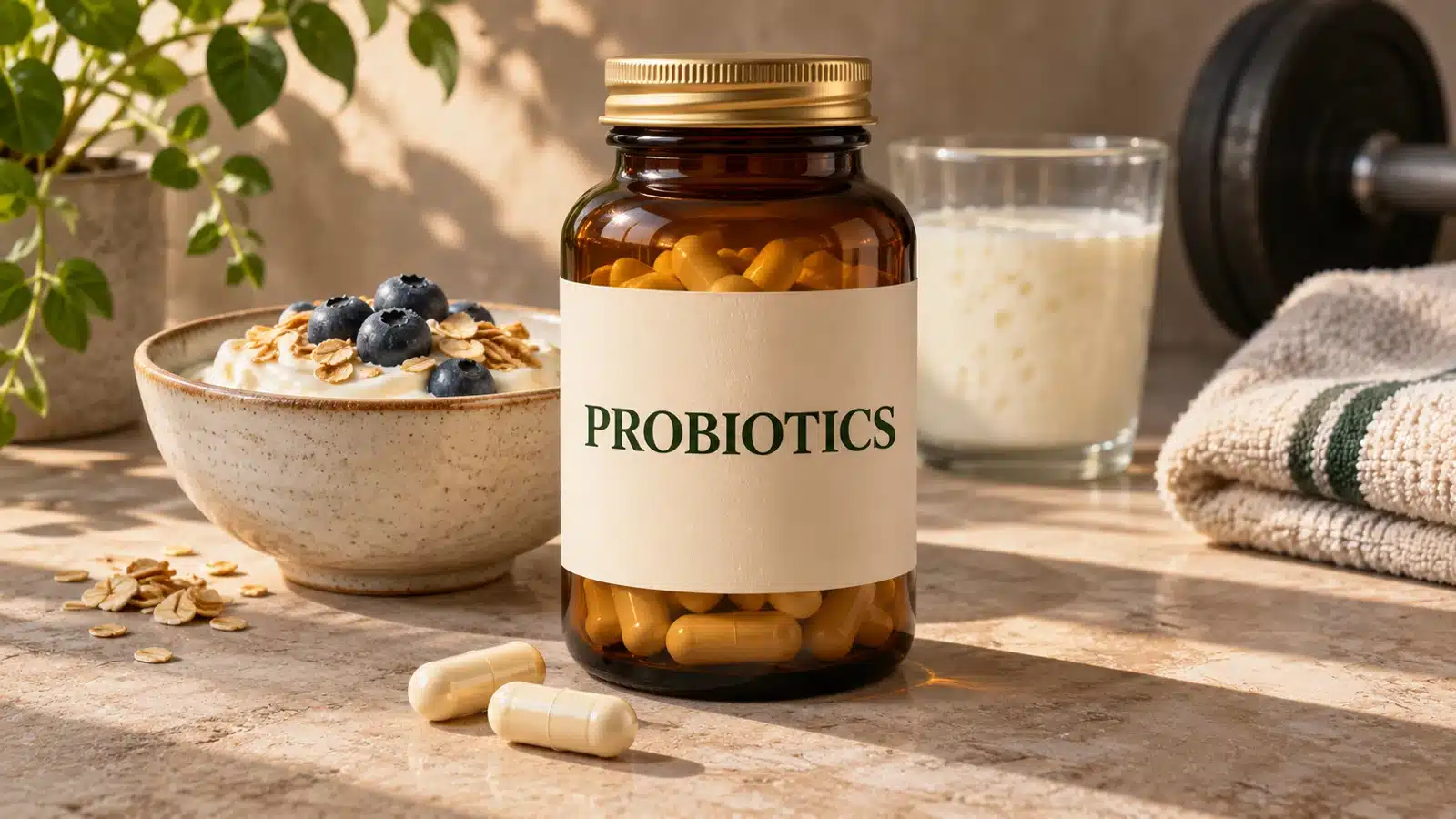
Probiotic Supplements Review: What Actually Matters
 Reading Time: 10 minutes
My probiotic supplements review starts with the question I’d ask before spending money on a bottle with “50 billion CFUs” on the label: What do I want this supplement to help me do?
If my goal is to reduce the risk of diarrhea while taking antibiotics, I want to see which strains researchers studied for that outcome, what dose they used, and whether the label guarantees that amount through the expiration date.
Playing professional basketball in Europe has given me a practical reason to care about digestion.
When I’m eating on a packed bus schedule or planning my last meal before tipoff, “better gut health” is too vague to be useful.
I care about whether I can eat enough to fuel the game and feel comfortable when I step on the court.
I bring that same standard to this probiotic supplements review.
By the time you finish, you should be able to turn a bottle around, judge whether the strain and dose fit your goal, and decide whether a daily probiotic deserves a place in your budget.
What Are Probiotics, and How Do They Work?

Probiotics are live microorganisms that provide a health benefit when consumed in adequate amounts.
Most familiar probiotics are bacteria, including members of the Lactobacillus and Bifidobacterium groups, although Saccharomyces boulardii, a yeast, is another common example (National Institutes of Health Office of Dietary Supplements, 2025).
Different strains can work in different ways.
Some compete with other microbes for nutrients, some produce compounds that influence the intestinal environment, and others interact with the cells lining your gut as they pass through your digestive tract (National Institutes of Health Office of Dietary Supplements, 2025).
That’s why a claim like “supports gut health” tells you so little when you’re comparing supplements.
A study showing that one strain helps reduce diarrhea during antibiotic treatment doesn’t tell you whether another strain will ease bloating after dinner.
What’s the Difference Between Probiotics, Prebiotics, and Synbiotics?
Probiotics are living organisms.
Prebiotics are substances that beneficial microbes can use in ways that support health.
A synbiotic combines live microorganisms with a substance that beneficial microbes can use (National Institutes of Health Office of Dietary Supplements, 2025).
The distinction matters when you’re trying to figure out what agrees with your stomach.
If you start a probiotic that also contains inulin from chicory root or Jerusalem artichoke, you’ve introduced both live microbes and a fermentable fiber.
If you experience more gas, the added fiber is worth considering when you look back at the label.
What Are the Best-Supported Benefits of Probiotic Supplements?
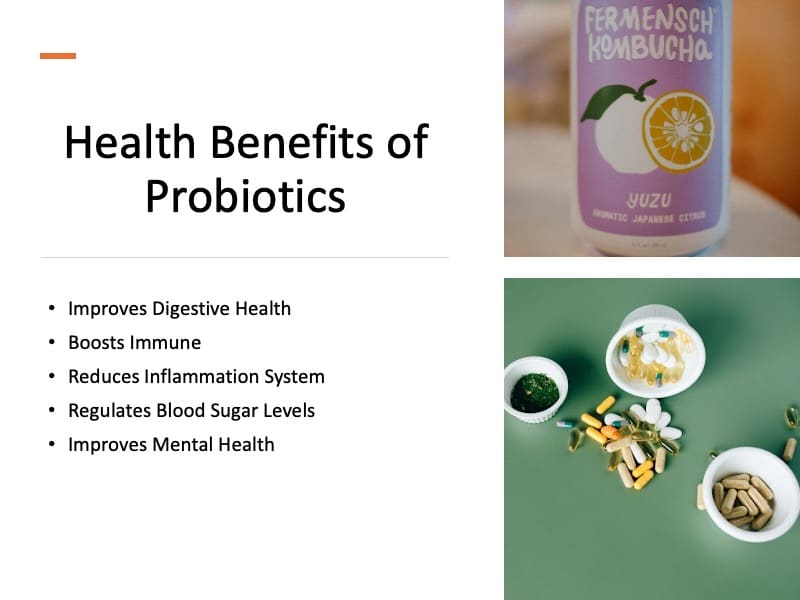
The benefits of probiotic supplements depend on the strain you take and the reason you’re considering it.
Some uses have stronger evidence than others, and a product that helps with one digestive concern may offer little benefit for another (National Institutes of Health Office of Dietary Supplements, 2025).
I find it easier to weigh the research when I start with a practical question: What difference would I hope to notice in my daily life?
Can Probiotics Help When You Take Antibiotics?
Reducing the risk of antibiotic-associated diarrhea is one of the better-supported reasons to consider a probiotic.
A review of 42 randomized trials involving more than 11,000 adults found that taking probiotics alongside antibiotics reduced the risk of diarrhea overall, although the benefit was less clear for people whose risk was low to begin with (Goodman et al., 2021).
If you’re starting an antibiotic, ask your pharmacist or prescriber which product, dose, and schedule fit your situation.
This is one purchase where I’d put more weight on whether the formula matches the research than on brand recognition or the number of strains in the bottle.
Do Probiotics Help With Bloating, Constipation, or IBS?
Some probiotic strains have been studied for stool frequency, bloating, and abdominal discomfort, but those are different outcomes.
Someone who has a comfortable bowel movement only twice a week has a different goal from someone who goes daily but feels uncomfortably full after meals (National Institutes of Health Office of Dietary Supplements, 2025).
For people with irritable bowel syndrome (IBS), the American College of Gastroenterology suggests against routinely using probiotics for overall symptom relief because the evidence is highly uncertain.
For adults with IBS who choose to try one, UK guidance recommends taking the manufacturer’s suggested dose for at least four weeks while monitoring symptoms (Lacy et al., 2021; National Institute for Health and Care Excellence, 2017).
Can Probiotics Prevent Travelers’ Diarrhea?
The CDC considers the evidence insufficient to recommend probiotics for preventing travelers’ diarrhea, including familiar options such as S. boulardii and L. rhamnosus GG.
When traveling, handwashing and careful food and water choices are more dependable precautions (Centers for Disease Control and Prevention, 2025).
Can You Get Probiotics From Food?
Yogurt with live starter cultures is one of the clearest examples of a food with a specific, demonstrated benefit.
The cultures can help people who have difficulty digesting lactose break down the lactose in the yogurt itself (Marco et al., 2021).
Kefir, kimchi, and unpasteurized sauerkraut can also supply live microbes.
When you’re shopping, check for wording such as “contains live cultures,” since heat treatment after fermentation can kill the organisms before the food reaches your plate (Marco et al., 2021).
For an everyday breakfast, I like plain Greek yogurt or kefir with oats, blueberries, and walnuts.
I get live cultures alongside protein and fiber in a meal I enjoy, which makes it an easy habit to keep whether or not I’m using a supplement.
How to Read a Probiotic Supplement Label
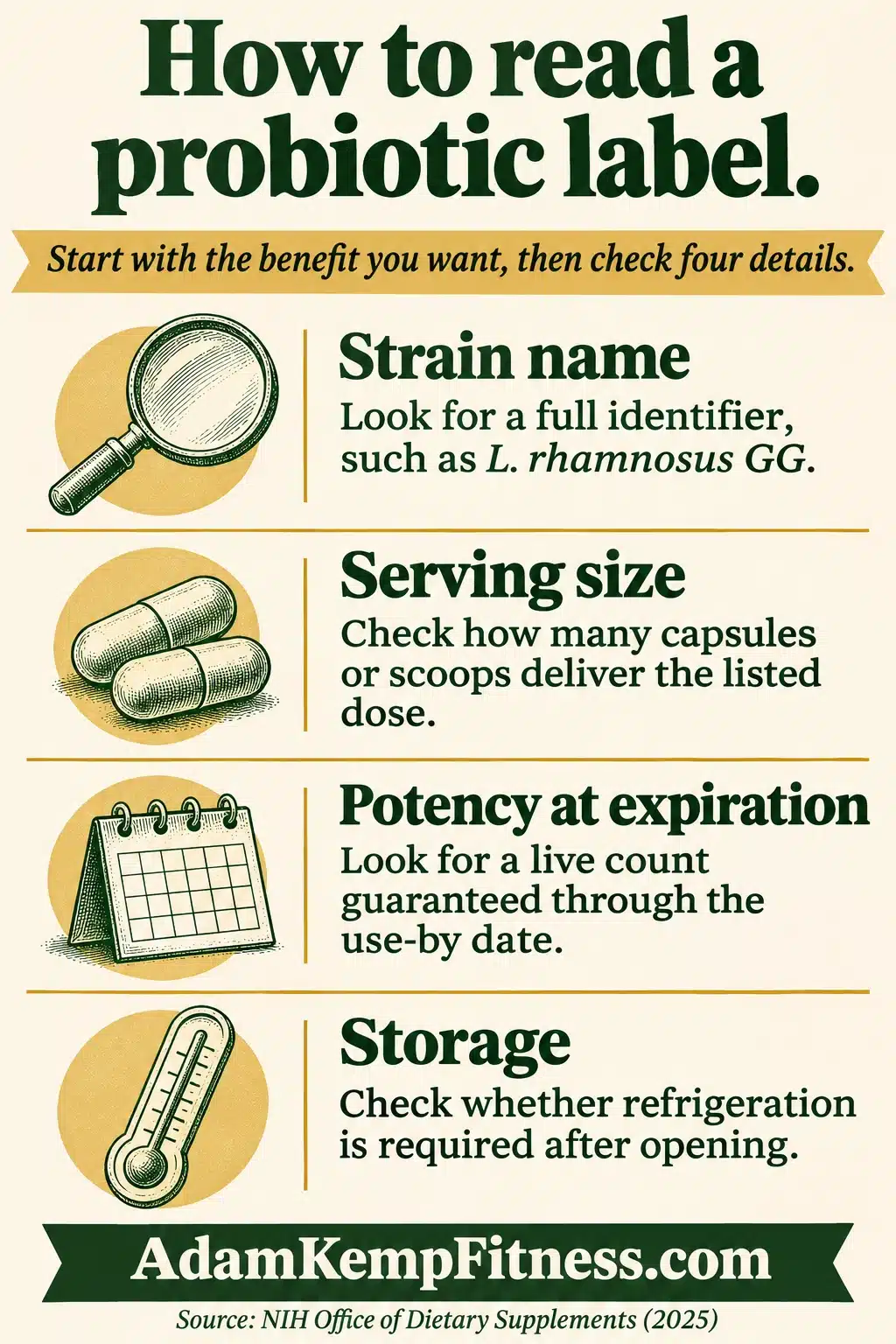
When I compare two probiotics, I turn the bottles around.
Four details help me decide whether the formula fits my goal and whether I can store and take it as directed (National Institutes of Health Office of Dietary Supplements, 2025).
| What to check | What it tells you |
|---|---|
| Full strain name | Look for an identifier such as GG in Lacticaseibacillus rhamnosus GG. Those final letters let you match the strain to research on a particular outcome. |
| Amount per serving | Check how many capsules or scoops make up a serving. A single count for a multi-strain blend tells you the total but leaves the individual doses unclear. |
| Potency through expiration | Look for a viable count guaranteed through the use-by date. A count measured at manufacture tells you how the product started, while an expiration guarantee tells you what to expect later. |
| Storage directions | Check whether the product needs refrigeration, including after opening. This matters if you’ll be packing it for work, a flight, or a weekend tournament. |
How Many Billion CFUs Do You Need?
CFU stands for colony-forming unit, a measure used to estimate the number of viable microorganisms in a serving.
There’s no universal daily CFU target, so a bottle advertising 100 billion CFU gives you no reason, by that number alone, to choose it over one with 10 billion (National Institutes of Health Office of Dietary Supplements, 2025).
I’d choose the lower-count product if it identified the strain studied for my goal and supplied the relevant dose through expiration.
That gives me a better basis for spending money than the largest number on the shelf.
When Should You Take a Probiotic, and How Do You Know It’s Working?
Follow the instructions for the exact product you choose.
For example, Ora recommends taking its two Daily Essential capsules together with food or just before eating, so breakfast would make sense for someone who eats it consistently (Ora Organic, n.d.).
Before your first dose, write down the outcome you care about.
If bloating is the issue, record how many evenings it makes dinner uncomfortable; if irregularity is the issue, track how often you have a comfortable bowel movement.
I’d also keep my usual meals, caffeine, and other supplements fairly consistent during the trial.
If I introduce a new protein powder, double my fiber intake, and start a probiotic in the same week, I’ll have a hard time deciding which change deserves the credit or the blame.
Should Healthy Adults or Athletes Take Probiotics Every Day?
There’s no general recommendation that healthy adults take a daily probiotic.
If your digestion is comfortable and you can consistently eat the foods you need, you may have little reason to add one (National Institutes of Health Office of Dietary Supplements, 2025).
As an athlete, if my stomach feels off during an evening game, I’d first look at when I ate, how much I drank, and whether I tried something unfamiliar on the bus.
Moving a large pregame meal an hour earlier gives me a specific adjustment I can test at practice.
Can Probiotics Cause Side Effects?
Gas is a possible side effect in otherwise healthy adults.
If the same product repeatedly makes you feel worse, stop taking it and reassess rather than assuming the discomfort means it’s working (National Institutes of Health Office of Dietary Supplements, 2025).
People who are severely ill, have a weakened immune system, or have a central venous catheter should get medical guidance before using a live probiotic because rare bloodstream infections have occurred in higher-risk patients (National Institutes of Health Office of Dietary Supplements, 2025).
Seek prompt medical attention for diarrhea accompanied by bloody or black stools, severe abdominal pain, high fever, or signs of dehydration (National Institute of Diabetes and Digestive and Kidney Diseases, n.d.).
Probiotic Supplements Review: My Top 5 Picks
Seed DS-01 Daily Synbiotic is my top overall pick for its clearly identified strains, Ora Organic is my choice for a vegan capsule with potency guaranteed through expiration, and BIOHM is my favorite option for someone who already drinks a greens powder.
Here’s how all five compare and what would make me choose each one.
1.) Seed DS-01 Daily Synbiotic: Best Overall
Seed DS-01 combines 24 identified probiotic strains with a pomegranate-derived prebiotic in a capsule-within-a-capsule design.
It earns the top spot for me because its product guide lets me look up the individual strains and see how the company measures potency (Seed Health, 2024).
One detail is easy to miss: Seed reports 53.6 billion active fluorescent units (AFU) per serving.
AFU and CFU use different counting methods, so comparing Seed’s 53.6 billion with another brand’s 50 billion won’t tell you which product is stronger (Seed Health, 2024).


Last update on 2026-11-26 / This article includes affiliate links/Images via Amazon Product Advertising API. I may earn commissions on purchases made through these links.
2.) Ora Organic Trust Your Gut: Best Vegan Daily Capsule
Ora’s Trust Your Gut Daily Essential capsules deliver 16 billion CFU across six strains, along with prebiotic fiber from organic Jerusalem artichoke.
Ora identifies strains such as Lactobacillus acidophilus LA-14 and guarantees potency through expiration, two details that make this formula easier to evaluate (Ora Organic, n.d.).
I’d choose Ora for someone who wants a shelf-stable vegan probotic capsule and already knows they tolerate added prebiotic fiber.
Pay attention to the format when ordering because the Trust Your Gut powder has a different formula and lists 20 billion CFU per serving.

Last update on 2026-11-26 / This article includes affiliate links/Images via Amazon Product Advertising API. I may earn commissions on purchases made through these links.
3.) Garden of Life Dr. Formulated Probiotics: Best for a Once-Daily Routine
Garden of Life’s Dr. Formulated line includes several products with similar names.
The Once Daily 30 Billion CFU formula lists 14 strains, while the Once Daily Men’s Shelf-Stable formula lists 15 strains, 50 billion CFU, and no refrigeration requirement.
For a basketball road trip, the storage instructions would influence my choice more than the difference between 30 and 50 billion CFU.
I can plan around one capsule a day, and an explicit shelf-stable claim means I don’t have to count on finding a refrigerator in every hotel room.

Last update on 2026-11-26 / This article includes affiliate links/Images via Amazon Product Advertising API. I may earn commissions on purchases made through these links.
4.) Kimberly Snyder’s Solluna SBO+ Probiotics: Best for a Bacillus Blend
Kimberly Snyder SBO Probiotics is my pick for those specifically interested in Bacillus strains commonly marketed as soil-based probiotics.
The company identifies several by name, including Bacillus subtilis DE111 and Bacillus coagulans MTCC 5856 (Solluna, n.d.).
The potency statement is what keeps Solluna fourth on my list. Its Supplement Facts panel lists 16 billion CFU per two capsules at the time of manufacture, which leaves the viable count at expiration and the dose of each organism unclear (Solluna, n.d.).
5.) BIOHM Super Greens With Probiotics: Best Greens Powder Option
BIOHM earns the fifth spot because it fits a habit I already have.
I’ve bought it more than once, and at $19.97 for 30 servings, it came out to about $0.67 per scoop.
I still prefer Bloom Greens & Superfoods for flavor, but BIOHM tastes mild enough to drink with plain water and mixes well in a smoothie.
If you already use a greens powder, that’s the most practical reason to choose it.
BIOHM lists 15 billion live cultures per scoop across three bacterial species and the probiotic yeast Saccharomyces boulardii.
I’d buy it again for the greens and probiotics in one scoop, but the single count for the blend makes it difficult to match its S. boulardii dose to a clinical study (BIOHM Health, n.d.).
Final Thoughts: Is a Probiotic Supplement Worth Buying?
Before buying a probiotic, I’d finish this sentence: “I’ll know this was worth the money if…”
Fewer evenings when bloating interrupts dinner are specific enough to track.
For a digestive concern, choose a strain and dose that fit the outcome you care about, then judge the purchase by what changes in your daily life.
If your digestion already feels good and yogurt or kefir fits comfortably into your diet, you can put the bottle back on the shelf.
This website does not provide medical advice. This website site does contain affiliate links, and purchases may earn a commission.
Read my Medical Disclaimer, Review Disclaimer, and Publishing Policies for more details. Use of this site indicates acceptance of these terms.
Check Out Some of My YouTube Videos Below, and Please Follow on YouTube for More Educational Health and Fitness Content!