
Best Equipment for Outdoor Workouts: A Full-Body Training Guide
 Reading Time: 8 minutes
 Buying a few pieces of the best equipment for outdoor workouts can change a basic outdoor training session into a complete workout that develops strength, power, conditioning, balance, and mobility.
Although outdoor workouts can be as simple as walking, running, or completing a circuit of bodyweight exercises, adding variety to your workouts can help produce better results!
Also, you don’t need to recreate an entire commercial gym at the park either!
The most valuable outdoor fitness equipment is durable, versatile, easy to transport, and capable of supporting multiple movement patterns.
Keep reading below to learn more about the best equipment for outdoor workouts!
What Are the Benefits of Outdoor Workouts?
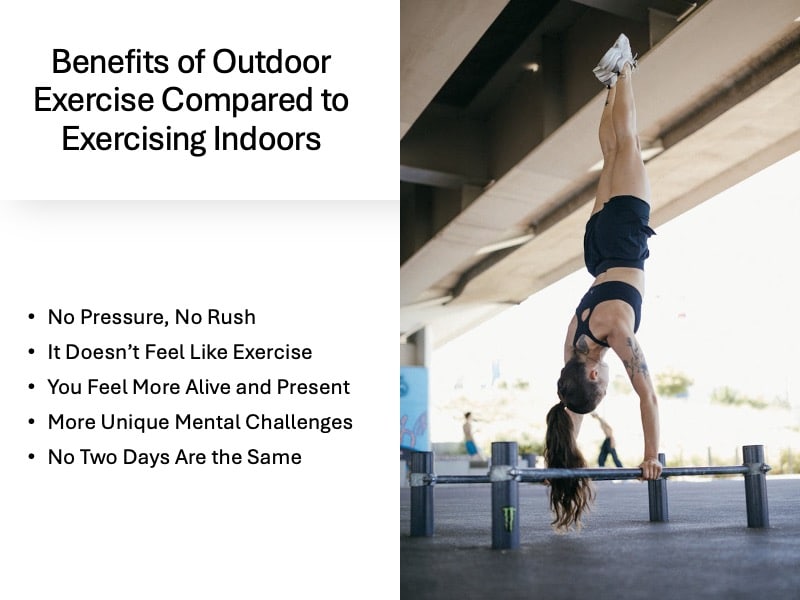
The primary benefit of outdoor exercise and training is accessibility.
Parks, trails, playgrounds, athletic fields, and outdoor fitness areas can provide enough space for effective workouts without a gym membership or a crowded indoor environment.
Outdoor exercise may also provide psychological benefits beyond the effects of exercise alone.
For example, a systematic review found that exercising in natural environments was associated with greater feelings of revitalization, increased energy, and reduced tension than exercising indoors, although the researchers noted methodological limitations in the available studies (Thompson Coon et al., 2011).
Training outdoors can also introduce natural variety.
Running hills and stairs, grass, sand, trails, and uneven terrain can change the physical demands of walking, sprinting, jumping, carrying, and other familiar movements.
However, outdoor exercise is not automatically better than indoor training.
Its greatest advantage is that it can make physical activity more enjoyable, affordable, and convenient, which may improve consistency over time.
You can learn more about the mental and physical benefits of outdoor exercise before deciding how outdoor training should fit into your routine.
What Should Outdoor Workout Equipment Help You Train?
A well-designed full-body workout should include most of the following movement categories:
- Upper-body pushing
- Upper-body pulling
- Squatting or lunging
- Hip-dominant movements
- Core stabilization
- Cardiovascular conditioning
- Mobility, balance, or athletic movement
These categories matter more than owning a particular brand or piece of outdoor workout equipment.
What is the Best Outdoor Workout Equipment?
The best equipment for outdoor workouts helps you cover movements that bodyweight exercises alone may not train as effectively, especially pulling, loaded leg exercises, and progressive resistance.
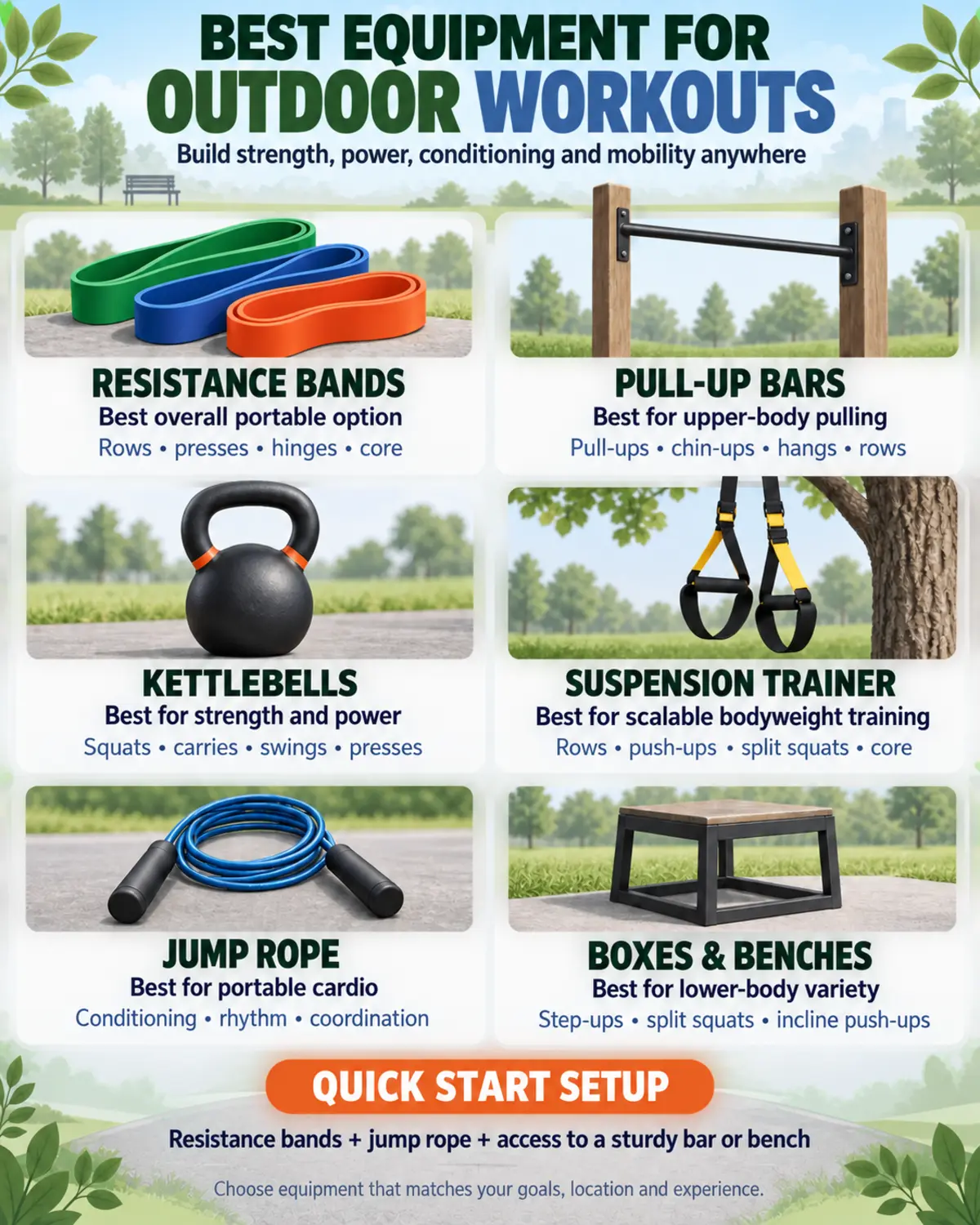
1.) Resistance Bands: The Best Overall Portable Option
Resistance bands are arguably the best overall equipment for outdoor workouts because they are inexpensive, lightweight, and easy to carry.
A small collection of loop bands and long resistance bands can replace several pieces of conventional gym equipment.
- Long bands can be anchored around a sturdy pole or approved park structure for rows, chest presses, pulldowns, face pulls, Pallof presses, and rotational exercises.
- Smaller loop bands work well for lateral walks, glute activation, shoulder warm-ups, and lower-body accessory exercises.
Resistance bands are especially valuable because they let you do pulling exercises where you don’t have pull-up bars.
They also allow you to easily adjust resistance by changing band thickness, band length, or your distance from the anchor point.
If you are unsure how to structure a session, try this full-body resistance band workout as a starting point.
Always inspect bands for cracks, thinning, or tears before training, and secure them around smooth, stable structures because rough surfaces and sharp edges can damage the material and cause a band to snap.
2.) Pull-Up Bars and Outdoor Bar Structures
Upper-body pulling is one of the hardest movement patterns to train without equipment.
Push-ups cover horizontal pressing, and pike push-ups add a vertical pressing challenge, but your back and biceps need something to pull against.
Fixed bars at outdoor fitness parks can support pull-ups, chin-ups, hanging knee raises, dead hangs, inverted rows, and grip-strength exercises.
Parallel bars can also be used for dips, supported leg raises, and modified push-up variations.
Public parks and purpose-built fitness spaces now offer a wide range of outdoor workout equipment, including pull-up stations, parallel bars, balance structures, and resistance stations.
Beginners who cannot perform an unassisted pull-up can loop a resistance band around the bar for assistance.
Inverted rows from a lower bar are another scalable option, and this guide to inverted rows, pull-ups, and chin-ups can help you select the right exercise for yourself.
Before using a public structure, check that it is stable, dry, and designed for exercise, and avoid improvising with tree branches, damaged playground equipment, or loose bars.
3.) Kettlebells or Adjustable Dumbbells
Resistance bands are convenient, but free weights provide a more consistent external load and make progressive overload easier to measure.
A single kettlebell or pair of adjustable dumbbells can support dozens of full-body exercises.
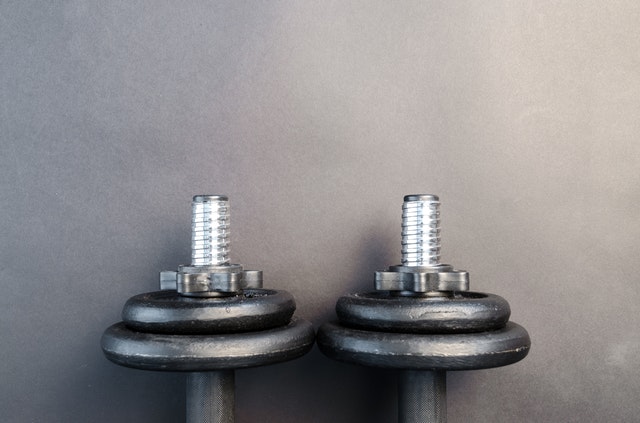
Useful outdoor exercises include:
- Goblet squats
- Romanian deadlifts
- Reverse lunges
- Overhead presses
- Bent-over rows
- Farmer carries
- Kettlebell swings
- Turkish get-ups
A kettlebell is often the more practical choice because it is compact, durable, and designed for both traditional strength exercises and dynamic movements.
For example, kettlebell swings can build hip power and muscular conditioning without taking up much space.
Choose a load that is challenging but light enough to carry safely to your training location.
A heavy kettlebell may be effective, but it is not practical if transporting it discourages you from working out.
4.) Suspension Trainers
A suspension trainer, such as the TRX, provides many of the benefits of gymnastic rings in a more portable package.
You can use it for rows, assisted squats, split squats, push-ups, hamstring curls, fallouts, and rotational core exercises.
Suspension trainers are especially useful because changing your body angle quickly adjusts the difficulty.
Standing more upright generally makes an exercise easier, while positioning your body closer to horizontal increases the percentage of body weight you must control.
The anchor point is the most important safety consideration.
Attach the trainer only to a stable structure that can safely support more than your body weight, and gradually test the setup before starting a challenging set.
Suspension exercises can increase stabilization demands, but instability is not automatically beneficial.
For strength development, the setup should remain stable enough for you to produce force, maintain good technique, and progressively increase the challenge.
5.) Jump Rope for Portable Cardio
A jump rope is one of the most affordable and portable conditioning tools available because it can be used for warm-ups, short intervals, footwork drills, or longer aerobic exercise sessions.
Jumping rope also develops rhythm, coordination, lower-leg stiffness, and repeated ground-contact efficiency.
These qualities can make it especially useful for athletes, although beginners should gradually increase their training volume to avoid irritating the calves, Achilles tendons, or feet.
A basic rope is sufficient for most people, while weighted ropes increase upper-body demand, and speed ropes are better suited for fast intervals and advanced skills like double-unders.
My jump rope workout provides a practical way to include this tool in an outdoor conditioning session.
6.) Plyometric Boxes, Benches, and Steps
A sturdy box, park bench, or concrete step can dramatically expand your exercise selection.
Depending on its height and stability, you can use an elevated surface for step-ups, split squats, incline push-ups, decline push-ups, calf raises, box squats, and controlled jumps.
Beginners should start with slower strength exercises before progressing to explosive movements.
Step-ups and Bulgarian split squats generally present less landing stress than repeated box jumps while still providing a substantial lower-body challenge.
Never assume that a bench is suitable for jumping.
Check for moisture, loose boards, uneven footing, and nearby obstacles before doing any exercise involving speed or impact.
7.) Battle Ropes for Full-Body Conditioning
Although they aren’t as portable or as common as some other options on this list of the best equipment for outdoor workouts, battle ropes can deliver a challenging mix of cardiovascular work, upper-body endurance, grip strength, and trunk stabilization.
Waves, slams, circles, and lateral patterns can be organized into short intervals or incorporated into a larger circuit.
However, because battle ropes are heavier and less portable than resistance bands or a jump rope, they make the most sense for a permanent outdoor training area, a backyard gym, or a park with an appropriate anchor point.
They should complement, not replace, progressive strength training.
Although rope intervals feel intense, intensity alone does not ensure that every major muscle group receives enough resistance.
Learn more about the specific benefits of battle rope exercises before adding them to your program.
8.) Exercise Mats and Small Accessories
An exercise mat is not essential, but it can make ground-based training cleaner and more comfortable.
It is useful for planks, dead bugs, glute bridges, mobility drills, stretching, and cooldown work.
Other helpful accessories include agility cones, sliders, mini hurdles, and a timer.
These tools are inexpensive and useful for organizing footwork drills, shuttle runs, circuits, and athletic movement exercises.
Still, accessories should solve a specific training problem.
Buying more equipment does not improve a workout unless each item supports your goals and is used consistently.
How to Choose the Best Equipment for Your Outdoor Workouts
Start by considering where you train and what the location already provides.
A park with pull-up bars and benches may only require resistance bands and a jump rope, while an open field may require more portable equipment to create a complete session.
Your training goals should guide the final decision:
- General fitness: Resistance bands, a jump rope, and an exercise mat
- Strength development: A kettlebell or adjustable dumbbells, resistance bands, and a pull-up bar
- Athletic performance: Cones, mini hurdles, a jump rope, and portable resistance
- Calisthenics: Pull-up bars, parallel bars, and a suspension trainer
- Conditioning: A jump rope, battle ropes, hills, stairs, or open sprinting space
- Beginner workouts: Resistance bands, a mat, and access to a stable bench
Weather resistance and transportation also matter.
Equipment that absorbs water, rusts quickly, or requires a complicated setup is less suitable for frequent outdoor use.
Example Full-Body Outdoor Workout
Here is a simple session using a resistance band, pull-up bar, bench, and jump rope:
- Jump rope: 60 seconds
- Pull-ups or band-assisted pull-ups: 5–10 repetitions
- Push-ups: 10–20 repetitions
- Bulgarian split squats: 8–12 repetitions per leg
- Resistance-band rows: 10–15 repetitions
- Banded Romanian deadlifts: 10–15 repetitions
- Plank: 30–45 seconds
Complete three to five rounds while maintaining controlled technique.
Adjust the repetitions, resistance, range of motion, and rest periods according to your current fitness level.
Final Thoughts: What Is the Best Equipment for Outdoor Workouts?
For most people, resistance bands are the best equipment for outdoor workouts because they are affordable, portable, and can train nearly every major muscle group.
I always suggest checking out online marketplaces for buying used fitness equipment to save money.
When combined with a pull-up bar, bench, jump rope, or kettlebell, they can support a well-rounded outdoor training program.
The right outdoor workout fitness equipment should help you train consistently, not complicate exercise.
Select a few versatile tools, build sessions around fundamental movement patterns, and gradually increase resistance, repetitions, range of motion, or training density as your fitness improves.
This website does not provide medical advice. This website site does contain affiliate links, and purchases may earn a commission.
Read my Medical Disclaimer, Review Disclaimer, and Publishing Policies for more details. Use of this site indicates acceptance of these terms.