Moringa Powder vs. Capsules: Which Option is Better for You?
 Reading Time: 13 minutes
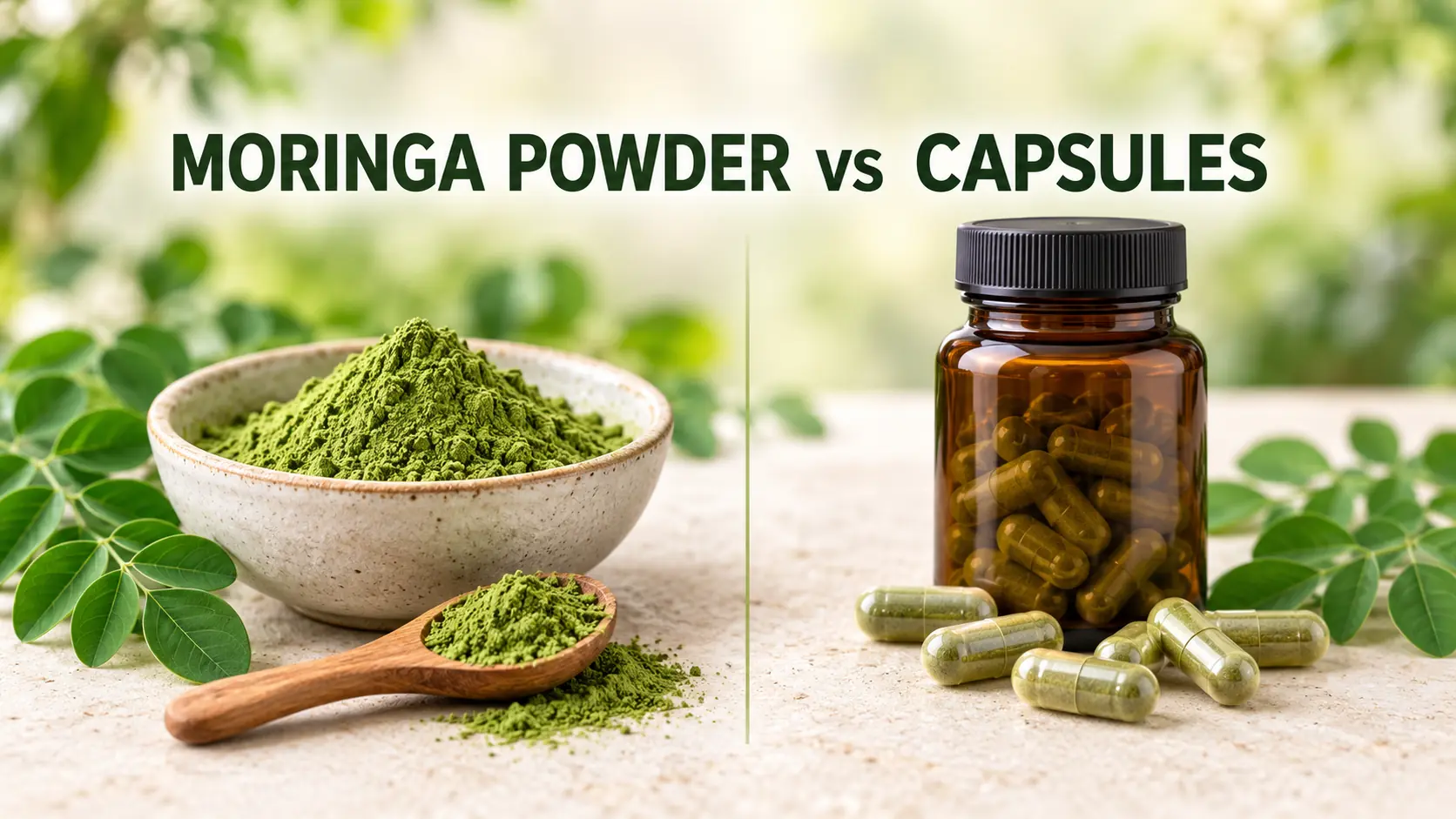
 Debating whether it is better to buy moringa powder vs capsules is less a contest between two different supplements than a choice between two ways of consuming the same plant.
If both products contain only dried Moringa oleifera leaf, the main differences are usually serving size, taste, convenience, cost, and how easily each format fits your routine.
- Moringa powder works well in smoothies, yogurt, oatmeal, soups, and sauces, but its earthy flavor and required preparation can make consistency difficult.
- Moringa capsules hide the taste and travel well, though reaching the same gram amount as a spoonful of powder may take several capsules.
If you are taking the time to compare moringa capsules vs. moringa powder for your diet, you should also take the time to double-check whether you actually need moringa supplements in your diet.
Moringa leaves contain nutrients and potentially useful plant compounds, but research has not established moringa as a treatment for weight loss, high blood sugar, inflammation, or other medical conditions (Pareek et al., 2023).
For most people, the best choice between moringa powder and capsules is a tested, clearly labeled product they can use consistently without mistaking it for a replacement for a balanced diet.
What Is Moringa?
Moringa comes from Moringa oleifera, a tree native to South Asia that is now cultivated in tropical and subtropical regions.
Its leaves and immature pods have a culinary history, while modern supplements are commonly made from dried leaves, extracts, seeds, or combinations of plant parts.
Moringa leaves provide protein, fiber, carotenoids, minerals, and polyphenols, but the amounts in a finished product are not fixed.
Plant variety, soil, harvest timing, drying temperature, storage, and extraction can all influence the final composition (National Institutes of Health Office of Dietary Supplements [NIH ODS], n.d.-a).
That variability is one reason to identify exactly what a label contains.
Whole-leaf powder, capsules filled with whole-leaf powder, and a standardized moringa extract are related products, but you shouldn’t treat them as interchangeable gram for gram.
Moringa Powder vs Capsules at a Glance
| Factor | Moringa powder | Moringa capsules |
|---|---|---|
| Ingredients | Often dried, ground moringa leaf | May contain leaf powder or an extract, plus the capsule shell and possible excipients |
| Typical use | Mixed into food or drinks | Swallowed with water |
| Serving flexibility | Easy to increase or decrease gradually | Limited to the amount in each capsule |
| Taste | Earthy, grassy, and sometimes bitter | Little or no taste |
| Convenience | Requires measuring and mixing | Fast, portable, and easy to pack |
| Amount per serving | Often several grams, depending on the label | Frequently less per capsule; several capsules may equal one powder serving |
| Cost per gram | Often lower | Often higher because of encapsulation and packaging |
| Nutritional contribution | Potentially greater if the serving supplies more whole leaf | Often modest if the total leaf dose is small |
| Best fit | Smoothie users, home routines, and people who want flexible portions | Travelers, busy schedules, and people who dislike moringa’s flavor |
The most important comparison is not one scoop versus one capsule.
For the best moringa supplement, compare the total grams of moringa per labeled serving, whether it is leaf powder or an extract, the number of servings in the container, and the cost per gram.
Are Moringa Powder and Capsules Equally Effective?
If a capsule simply contains the same dried moringa leaf powder sold in a bag, there is no strong reason to assume that one form is inherently more effective at an equivalent dose.
The capsule mainly changes how the powder is delivered, not what the powder is.
However, real products are rarely identical.
One serving of moringa powder might provide several grams of whole leaf, while a moringa capsule might provide only a fraction of that per capsule; conversely, a capsule may contain a concentrated extract that cannot be compared by weight alone to leaf powder.
There is also no strong body of human research showing that moringa capsules produce better outcomes than moringa powder.
A 2025 umbrella review found that moringa research used inconsistent plant parts, preparations, doses, and chemical markers, and that the quality of the underlying reviews was generally low (da Silva Parente et al., 2025).
The practical conclusion is simple: format alone does not determine effectiveness.
The ingredient, dose, processing method, product integrity, and consistency of use matter more than whether the moringa comes from a pouch or a bottle.
Benefits of Moringa Powder
The benefits of moringa powder mainly come from its versatility, adjustable serving size, and ability to function as a food ingredient rather than another pill.
Although it isn’t inherently more effective than an equivalent amount of moringa leaf in capsules, powder may offer better value and make it easier to add larger servings to smoothies, yogurt, oatmeal, soups, and other meals.
It Is Easy to Add to Food
Moringa powder functions like a food ingredient.
You can blend it into smoothies, stir it into yogurt or oatmeal, or add it near the end of cooking to soups and sauces.
Fruit, cocoa, yogurt, nut butter, citrus, ginger, or other strongly flavored ingredients can soften its grassy taste.
Start small so the flavor does not overwhelm the meal.
Powder Makes Serving Size More Flexible
A measured powder allows small adjustments instead of forcing every serving into fixed capsule increments.
This can be useful for a new user who wants to begin with less than the full labeled serving and assess digestive tolerance.
Use an actual measuring spoon or gram scale when precision matters. A loosely filled teaspoon and a packed teaspoon can contain different amounts.
It May Offer Better Value Per Gram
Powder is often less expensive per gram because the manufacturer does not have to fill individual capsules.
This is not guaranteed, so divide the price by the total grams of moringa in the package before deciding which product offers better value.
Larger Servings May Contribute More Nutrients
Because powder servings often contain more total leaf material than capsule servings, they may contribute more fiber and micronutrients.
That advantage depends entirely on the serving size and label; moringa should not be assumed to provide a clinically meaningful dose of every nutrient merely because it is described as nutrient-dense.
Negatives of Moringa Powder
The primary drawback of using moringa powder is adherence.
A format that requires measuring, mixing, and cleaning can be easy to abandon on busy mornings, during travel, or on days when you aren’t making smoothies.
Taste is another legitimate concern.
Moringa’s earthy bitterness can limit how much powder you enjoy using, and adding it to every recipe can make food less appealing rather than more nutritious.
Powder also creates more direct opportunities for contamination after opening if the package is handled with a wet or dirty utensil.
Keep it sealed, dry, and stored according to the manufacturer’s instructions.
Benefits of Moringa Capsules
The benefits of moringa capsules mainly stem from their convenience, portability, and the ability to consume moringa without its naturally earthy taste.
Although capsules are not inherently more effective than an equivalent amount of moringa leaf powder, they may be easier to use consistently for people with busy schedules, frequent travel, or little interest in preparing smoothies and recipes.
Capsules Are Convenient and Portable
A primary benefit is that moringa capsules require no measuring or recipe preparation.
They are easy to take to work, keep in a gym bag, or pack for travel.
That convenience can be meaningful because a theoretically ideal product has little value if it is rarely used.
Capsules may be the better choice for people whose routines make powder impractical.
They Avoid the Taste
Capsules allow you to consume moringa without tasting its grassy or bitter notes.
This is their clearest advantage for people who dislike greens powders.
The Portion Is Predetermined
Each capsule contains a stated amount, which makes portions repeatable.
You still need to read the serving directions carefully because one serving may require two, four, or more capsules.
Drawbacks of Moringa Capsules
Capsules frequently cost more per gram and may deliver less moringa in a practical serving.
For example, if a capsule contains 500 milligrams of leaf powder, six capsules would equal 3 grams; this is only an illustration, so use the numbers on the actual label.
Some products also include flow agents, fillers, or capsule materials that a powder-only user may prefer to avoid.
These ingredients are not inherently harmful, but they should be clearly disclosed.
Capsules can also make a small dose look more substantial than it is.
A bottle with a high capsule count is not necessarily a high-dose or better-value product.
Moringa Powder vs Capsules: Which Should You Choose?
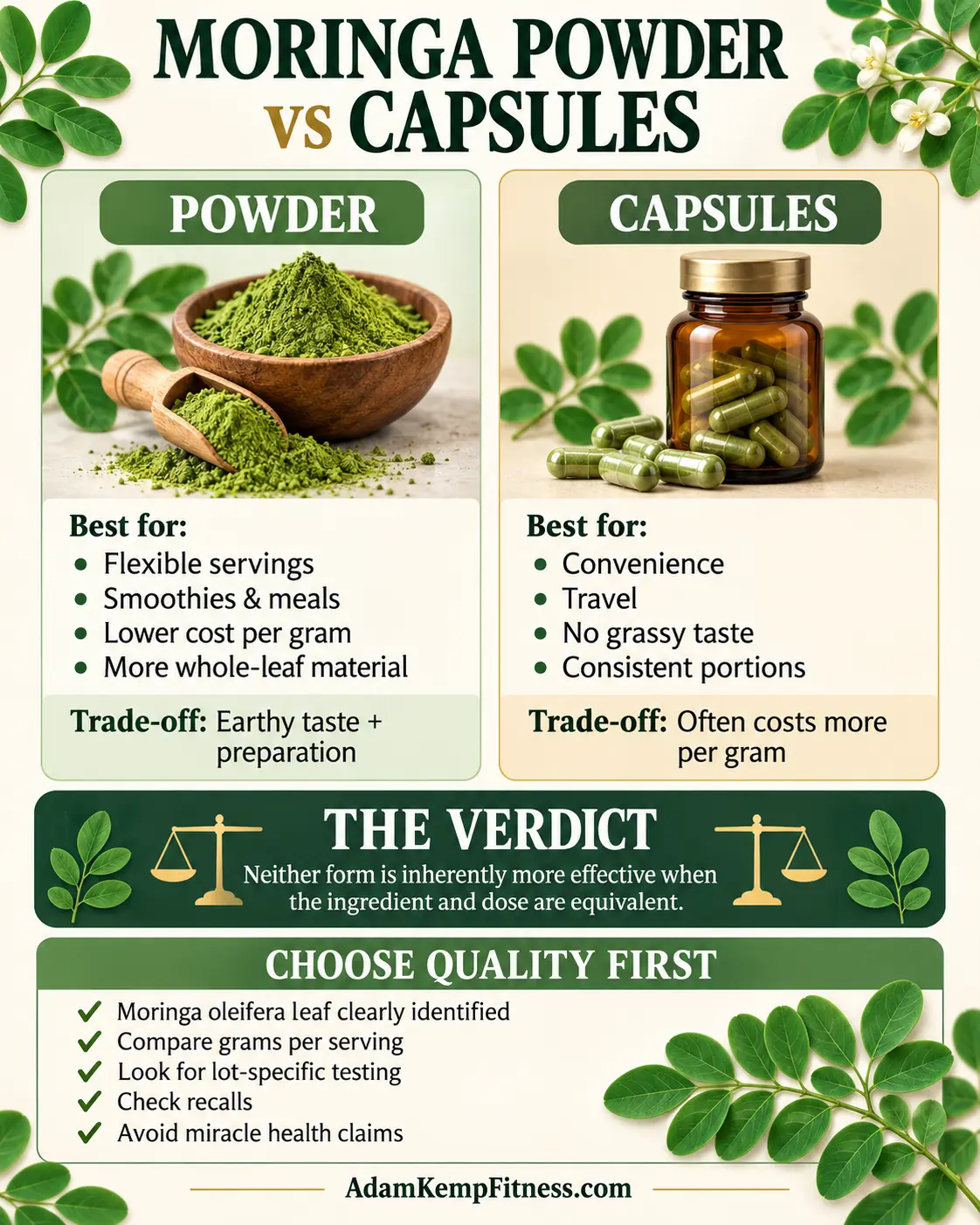
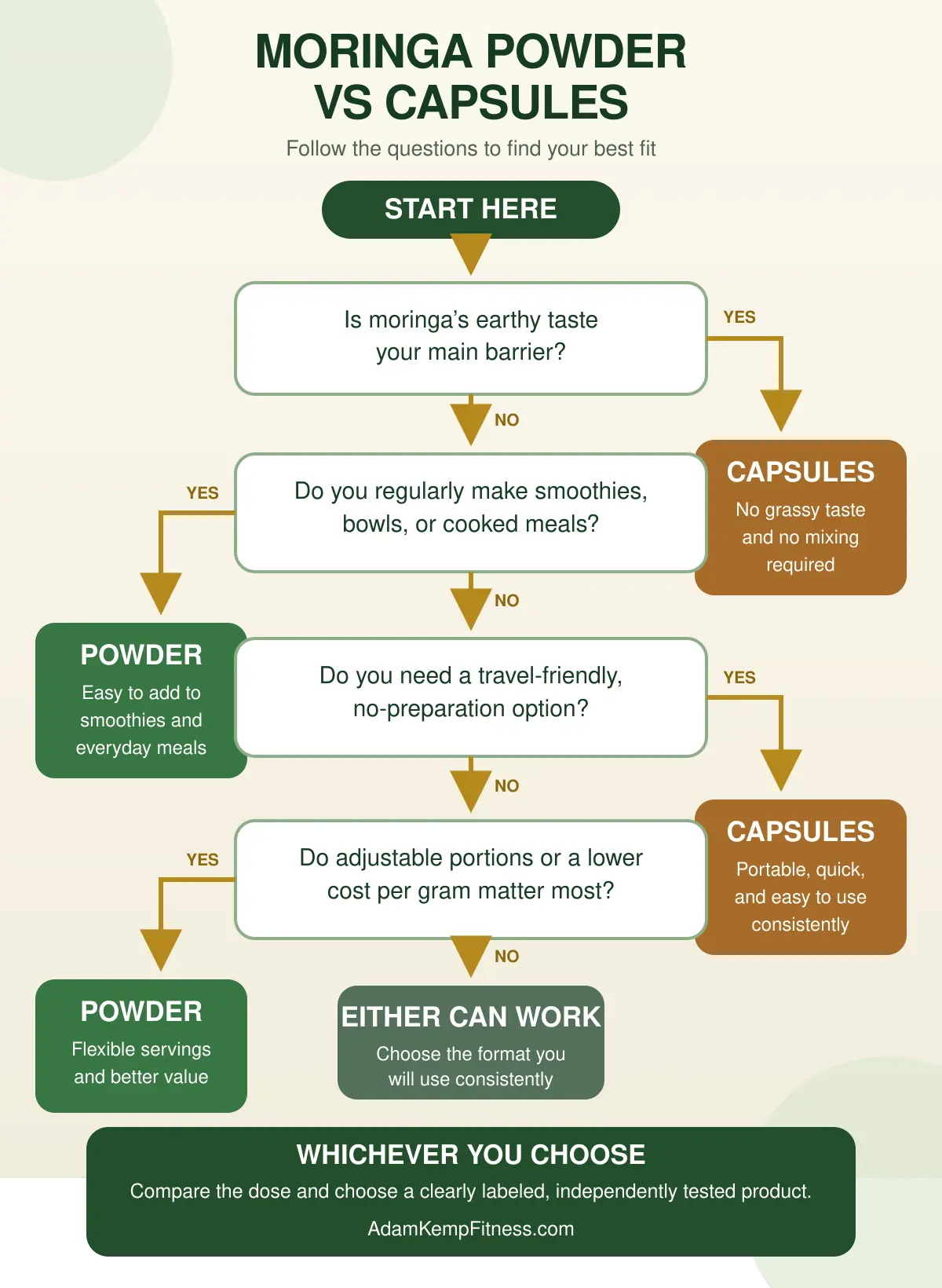
Choose moringa leaf powder if you already make smoothies or bowls, tolerate the flavor, want adjustable portions, or prioritize a lower cost per gram.
Powder is also the more natural culinary fit if you view moringa as an occasional plant-food ingredient rather than a daily pill.
Choose moringa capsules if taste is the main barrier, you travel frequently, or a no-preparation supplement is more likely to remain part of your routine.
Check how many capsules constitute a serving before assuming the product is convenient.
Neither format is objectively better for everyone. If two products use equivalent amounts of the same tested whole-leaf powder, your choice can reasonably come down to adherence, taste, portability, and price.
Is Moringa Good for You & Does Moringa Have Proven Health Benefits?
Moringa contains biologically active compounds, including polyphenols and glucosinolate-derived compounds, which help explain scientific interest in its antioxidant, metabolic, and anti-inflammatory potential.
Biological plausibility, however, is not the same as a demonstrated benefit in people.
Human trials remain limited, often small, and difficult to compare because they use different preparations and doses.
A 2025 systematic review and meta-analysis found no consistent significant effect across most cardiometabolic outcomes studied, while a separate umbrella review judged much of the broader evidence to be methodologically weak (Crișan et al., 2025; da Silva Parente et al., 2025).
Moringa, therefore, should not be marketed or used as a substitute for treating diabetes, high cholesterol, hypertension, obesity, or inflammatory disease.
It is more defensible to describe whole-leaf moringa as a plant-derived food or supplement with an interesting nutrient and phytochemical profile whose clinical benefits remain uncertain.
Is Moringa a Superfood?
“Superfood” is a marketing term, not a regulated scientific category.
It can signal that a food contains useful nutrients or phytochemicals, but it does not establish disease-preventing or therapeutic effects.
Moringa can add variety to a nutritious eating pattern, especially where fresh moringa leaves are unavailable.
It cannot replace the broader nutritional range supplied by vegetables, fruits, legumes, whole grains, nuts, seeds, and adequate protein sources.
How to Compare Moringa Products
1.) Confirm the Plant Part and Form
Look for the full botanical name, Moringa oleifera, and the part used.
A label should distinguish leaf powder from seed, root, bark, or an extract.
For an extract, look for the extraction ratio or a clearly identified standardized constituent.
Do not compare “1,000 mg equivalent” of an extract with 1,000 mg of leaf powder unless the manufacturer explains how that equivalence was calculated.
2.) Compare Grams Per Serving
Convert milligrams to grams when necessary: 1,000 milligrams equals 1 gram.
Then compare total moringa per serving, required capsules per serving, servings per container, and cost per gram.
This exposes a common weakness in moringa powder vs capsule comparisons.
A capsule may look less expensive until you calculate how many are needed to match the labeled powder serving.
3.) Look for Independent Testing
Prefer products that can provide recent, lot-specific testing for identity, microbial contamination, heavy metals, pesticides, and other relevant contaminants. Independent seals from organizations such as NSF or USP can indicate that a product met that program’s quality criteria, but they do not prove that moringa is effective for a health condition (NIH ODS, n.d.-b).
“Made in a GMP facility” is useful context but not the same as publishing a certificate of analysis for the lot you are buying.
Likewise, “standardized” does not have a single legally defined meaning that guarantees product consistency (NIH ODS, n.d.-b).
4.) Treat “Organic” as One Quality Attribute
Certified organic sourcing may address certain production practices, but it does not by itself confirm the amount of moringa, potency, microbial safety, or freedom from heavy metals.
Verify the certification and evaluate testing separately.
5.) Check Recalls and Outbreak Notices
Product traceability matters for both powders and capsules.
In 2026, the Centers for Disease Control and Prevention linked a multistate Salmonella outbreak to multiple moringa leaf products, demonstrating that a natural plant powder can still carry a food-safety risk (Centers for Disease Control and Prevention [CDC], 2026).
Before using a product involved in a current recall, follow the public-health agency’s disposal or return instructions.
Do not assume that transferring powder into another container, cooking it casually, or placing it inside capsules makes a recalled product safe.
6.) Be Skeptical of Dramatic Claims
Avoid products promising detoxification, rapid fat loss, disease treatment, or guaranteed improvements in blood sugar or cholesterol.
In the United States, supplements are regulated differently from medications and the FDA does not review them for effectiveness before marketing (NIH ODS, n.d.-b).
How to Use Moringa Powder
The best advice is to follow the product’s labeled serving directions, as there is no universally established dose for general wellness.
Begin with a smaller amount if the label permits, particularly if you are sensitive to fiber-rich or unfamiliar plant products.
Try moringa powder in:
- Smoothies with banana, berries, mango, cocoa, or nut butter
- Plain or Greek yogurt
- Oatmeal or overnight oats
- Soups, stews, curries, and sauces
- Hummus, pesto, or savory dips
Avoid assuming that more is better.
Using a larger quantity can intensify the taste and may increase the chance of gastrointestinal discomfort without producing greater benefits.
How to Use Moringa Capsules
Again, the best advice is to follow the serving directions and confirm whether the label’s listed dose refers to one capsule or a multi-capsule serving.
Take the capsules with water and follow any food-related instructions provided by the manufacturer.
Do not open capsules and estimate the contents visually if precise dosing matters. If swallowing capsules is difficult, powder may be the simpler format.
Moringa Safety and Side Effects
Food-like amounts of moringa leaf have a history of use, but that does not make every plant part, concentrated extract, or dose equally safe.
Research on long-term supplementation and medication interactions remains incomplete.
Possible adverse effects include nausea, abdominal discomfort, or diarrhea, particularly when someone begins with a large amount.
Stop using the product and seek appropriate medical advice if you develop persistent symptoms or signs of an allergic reaction.
Speak with a qualified healthcare professional before using moringa if you are pregnant or breastfeeding, have a medical condition, are preparing for surgery, or take prescription medication.
This is especially important when taking medication that affects blood glucose or blood pressure because preliminary research has examined moringa for effects in those same areas, even though clinical benefits remain uncertain.
Use particular caution with products made from moringa root or bark rather than the leaf.
Plant-part identification matters, and the safety history of a commonly eaten leaf should not be generalized to the entire tree.
Where Moringa Supplements Fit in a Balanced Diet
Moringa supplements are best viewed as a minor supplement, not a nutritional safety net.
A spoonful of green powder or a few capsules cannot compensate for chronically low vegetable intake, inadequate protein, insufficient energy, poor sleep, or an otherwise inconsistent diet.
For active people, it is also not a replacement for the fundamentals of sports nutrition.
Adequate total energy, carbohydrate around demanding training, sufficient protein, fluids, electrolytes, and recovery habits will have a more direct influence on performance than choosing moringa capsules over powder.
Frequently Asked Questions About Moringa Powder and Capsules
Final Verdict: Moringa Powder or Capsules?
Moringa powder is the better overall value for people who enjoy smoothies or cooking, tolerate its flavor, and want a flexible serving with more whole-leaf material.
Capsules are the more practical choice for people who prioritize portability, speed, and a taste-free routine.
Product quality can outweigh format preference, so choose clearly identified moringa leaf, compare grams per serving, look for credible lot-level testing, check active recalls, and be cautious of disease or weight-loss claims.
The smartest decision in the debate between moringa powder vs capsules is the safest, most transparent option you can find that fits your routine while supporting, not replacing, a varied and balanced diet.
This website does not provide medical advice. This website site does contain affiliate links, and purchases may earn a commission.
Read my Medical Disclaimer, Review Disclaimer, and Publishing Policies for more details. Use of this site indicates acceptance of these terms.