Lateral Step-Ups (Side Step-Ups): Benefits, Muscles Worked, How to Do & More!
 Reading Time: 9 minutes
 Lateral step-ups are a variation of the traditional step-up exercise, which involves stepping onto a bench or box sideways rather than forward, adding an extra layer of challenge to your workout.
The step-up exercise is widely recognized as one of the most effective leg exercises, offering an accessible learning curve compared to exercises such as squats, deadlifts, or Bulgarian split squats.
Despite requiring balance control, step-ups generally aren’t significantly more challenging than ascending a flight of stairs.
To increase the intensity of your workout, consider trying lateral step-ups!
Although lateral step-ups aren’t performed much differently than traditional step-ups, they are a different exercise with different benefits.
By altering your movement direction from forward to sideways, lateral step-ups add a unique layer of complexity to the exercise.
This shift not only amplifies balance and control demands but also emulates real-world movements, thereby boosting your functional fitness.
What is the Lateral Step Up Exercise?
The lateral step-up is a lower-body strength and stability exercise that involves stepping sideways onto a raised surface, such as a bench or box.
Unlike traditional step-ups, which focus on vertical movement, this variation incorporates a lateral component, challenging balance, coordination, and muscle activation in a unique way.
This exercise mimics real-life lateral movements and sports-specific actions, making it highly functional for athletes and fitness enthusiasts alike.
By engaging muscles from a different angle, it strengthens underutilized stabilizers, enhances joint health, and contributes to overall athleticism.
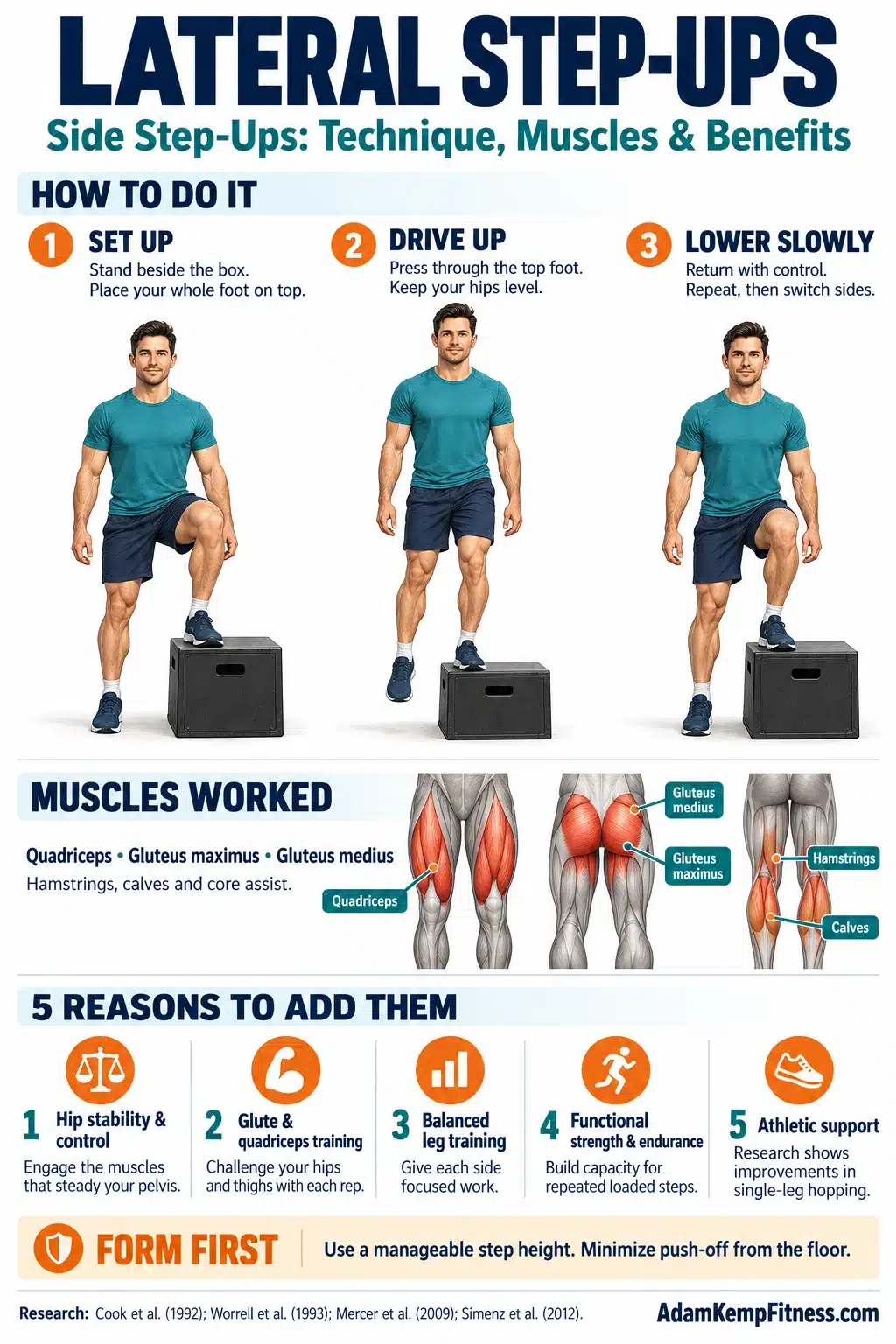
How to Do Lateral Step Ups
Generally speaking, the lateral step-up is a simple single-leg exercise. Here is a quick exercise demonstration and a step-by-step guide below:
- Step 1.) Position Yourself: Stand beside a sturdy bench or box with your feet shoulder-width apart. Keep your posture upright and engage your core.
- Step 2.) Place Your Foot: Lift the foot closest to the bench and place it firmly on the surface. The other foot stays on the ground.
- Step 3.) Step Up: Push through the heel of the foot on the bench to lift your body. Focus on using the leg on the bench, not the one on the ground.
- Step 4.) Balance: At the top, both legs should be straight. Hold briefly, keeping your chest up and core engaged.
- Step 5: Step Down: Lower yourself slowly with control, keeping your foot on the bench in place. Repeat the movement on the other side for balance.
Now you know how to do lateral step ups!
Lateral Step Ups Muscles Worked
Lateral step-ups are an effective lower-body exercise that targets multiple muscle groups, offering both strength and stability benefits.
For example, research indicates that lateral step-ups elicit significantly greater activation of the rectus femoris and vastus medialis muscles compared to stepping machine exercises, highlighting their effectiveness for strengthening key lower-body muscles.
By incorporating lateral movement, this variation activates muscles that traditional step-ups might miss, making it a valuable addition to any workout routine.
Here’s a breakdown of the primary and secondary muscles engaged during this exercise.
- Quadriceps: This group of muscles at the front of your thigh is instrumental in extending the knee during the stepping-up movement.
- Glutes: These are the powerhouse muscles in your buttocks that drive your hip extension when you step up and help maintain your balance.
- Hamstrings: Located at the back of your thigh, these muscles work in tandem with your glutes to support hip extension and control the lowering phase of the step-up.
- Calves: These muscles are key for stabilizing your ankle throughout the movement, especially when you push off from the ground.
- Rectus Abdominis: Your ‘six-pack’ muscle, this supports your spine and helps maintain a steady and upright posture throughout the exercise.
- Transverse Abdominis: This deep abdominal muscle contributes significantly to your core stability, helping you maintain balance during the lateral step-up.
- Obliques: These side abdominal muscles are engaged to stabilize your torso and assist with balance as you step sideways onto the platform.
Benefits of Lateral Step Ups
Lateral step-ups combine lower-body muscle engagement with the challenge of controlling your body one leg at a time.
These five lateral step-up benefits make them a useful addition to strength and athletic training routines:
Supports Hip Stability and Control
Lateral step-ups engage the gluteus medius, a hip muscle involved in keeping your pelvis steady during single-leg movement.
Research in older adults found greater activation during several phases of lateral step-ups compared with forward step-ups, highlighting their value for training hip stabilizers (Mercer et al., 2009).
Targets the Glutes and Quadriceps
Stepping sideways onto a platform recruits the glutes and thigh muscles as you lift and lower your body.
Researchers found that lateral step-ups produced greater activation of two quadriceps muscles than stepping-machine exercise, supporting their use in a lower-body strengthening routine (Cook et al., 1992).
Encourages Balanced Leg Training
As a single-leg exercise, lateral step-ups give you an opportunity to train each side deliberately and pay attention to differences in control or effort.
Their unilateral loading pattern makes them a practical complement to squats and other exercises that train both legs together (Simenz et al., 2012).
Builds Functional Strength and Muscular Endurance
Lateral step-ups can improve your capacity to repeatedly lift your body against resistance.
In a four-week training study, participants improved both leg-press performance and the number of weighted step-ups they could complete (Worrell et al., 1993).
Supports Athletic Performance
Lateral step-ups can contribute to the single-leg abilities used in athletic movement.
The same study found improvements in hopping distance and timed hopping performance, making this exercise a promising addition to an overall strength-and-jumping program (Worrell et al., 1993).
How to Add Lateral Step-Ups to Your Workout Program
Lateral step-ups are a great assistance exercise that you can do on both lower-body and full-body workout days.
You might be wondering: should I replace conventional step-ups with lateral ones?
From my experience, having both in your workout routine gives you the best of both worlds, as they’re unique exercises with distinctive benefits.
For example, research indicates that although lateral step-ups are highly effective for quadriceps engagement, they may not generate significant increases in peak power or thigh-muscle development in short-term protocols, emphasizing their utility for functional movement over hypertrophy.
Let me share how I usually incorporate lateral step-ups into my regimen:
Sets & Reps
You can use several different sets and rep ranges for lateral step-ups.
One option is to do your lateral step-ups at the beginning of your workout to activate your lower body and core muscles, using higher sets and reps such as four sets of 20 reps.
I normally choose this option, and I feel like it is an especially great exercise before lower-body intensive workout days, such as when I do 20 rep squats.
After doing my lateral step-ups, my knees and hips are always completely warmed up and activated for heavier exercises.
However, if you want to use this exercise towards the end of your workout, feel free to add more weight and lower reps. For example, you could do three sets of 5 reps (on each leg) with heavy dumbbells or kettlebells.
Although you can use a barbell to add weight to this exercise, I prefer dumbbells or kettlebells because it puts less pressure on your spine and it helps develop grip strength.
When I do heavy lateral step ups, I usually pair this exercise with a lighter lower-body exercise, such as the goblet squat or jump squats, instead of heavy back squats.
If I decide to do heavy lateral step-ups, I don’t often do it on the same day as other heavy compound exercises.
Progression and Regression Options
- Beginner Version: For beginners or those with balance issues, start with a lower step and work your way up. Alternatively, use a handrail or wall for support until your strength and balance improve.
- Advanced Version: For a more challenging version, hold dumbbells or kettlebells in your hands while performing the exercise to increase resistance, and consider using weight on only one side of your body to challenge your balance.
Safety Tips for the Side Step Up Exercise
When performing lateral step-ups, stay safe and avoid as many potential injuries as possible. Here are a few tips:
- Watch Your Form: Always maintain a straight back and engage your core for stability. Avoid leaning to the side or hunching over, as these can put unwanted strain on your spine.
- Slow and Steady: This exercise is not about speed. Move in a slow, controlled manner to ensure correct form and balance.
- Avoid Overextension: When stepping up, your knee should be in line with your ankle. Don’t allow it to extend past your toes, as this can cause undue stress to the knee joint.
- Soft Landing: When lowering your body back to the ground, make sure it’s a soft landing. Avoid jumping or making any sudden movements.
Are Lateral Step Ups a Good Exercise?
Lateral step-ups are an excellent addition to any workout program, offering unique benefits that go beyond traditional step-ups.
Their ability to target multiple muscle groups, improve balance, enhance coordination, and strengthen stabilizers makes them a highly functional exercise.
Whether you’re an athlete aiming to improve performance or someone looking to boost lower-body strength and mobility, lateral step-ups provide a versatile and effective option.
By incorporating lateral step-ups into your routine, you can enhance joint health, prevent injuries, and develop muscle symmetry.
With options to modify or progress the exercise, they are accessible for all fitness levels.
Lateral step-ups are a powerful tool for improving overall fitness and functional movement patterns.
Frequently Asked Questions About Lateral Step Ups
Are lateral step-ups worth your time? Absolutely!
Here is a bit more information before you add them to your routine and start doing lateral step-ups!
Final Thoughts: Should You Add Lateral Step-Ups to Your Workout Routine?
Lateral step-ups are absolutely worth adding to your routine if you want to train each leg individually and add variety to your lower-body workouts.
They engage the quadriceps and glutes, with the direction of the step influencing how these muscles contribute (Simenz et al., 2012).
In my training, I like using lighter lateral step-ups to prepare for lower-body exercises or adding resistance when I want them to be a strength-focused movement.
The goal is to make the working leg do the lifting and maintain control throughout each repetition.
Start with a sturdy, manageable step height, use support if needed, and prioritize smooth movement before adding weight.
Consistent technique and gradual progression make lateral step-ups a practical addition to a well-rounded workout routine!
Read Next: Reverse Slide Lunge Exercise Benefits
This website does not provide medical advice. This website site does contain affiliate links, and purchases may earn a commission.
Read my Medical Disclaimer, Review Disclaimer, and Publishing Policies for more details. Use of this site indicates acceptance of these terms.
Check Out Some of My YouTube Videos Below, and Please Follow on YouTube for More Educational Health and Fitness Content!
![Subscribe to @AdamKempFitness for more training, general health, recovery, and nutrition tips from a professional basketball player with a master’s degree in Nutrition Education! 🏀💪
Seated Max Vertical Jumps From a Box are one way I train explosive takeoff power with maximum intent on every rep.
Starting seated, with a pause and minimal rocking or dipping, reduces the contribution of a quick countermovement and emphasizes producing force from a relatively static position (National Strength and Conditioning Association [NSCA], 2020).
For athletes, the training goal is explosive lower-body force production and coordinated extension through the hips, knees, and ankles. I use this variation to practice driving hard into the floor and accelerating my body upward.
My preferred setup: 3 sets of 3 reps or 4 sets of 2 reps, supersetted with a strength or power exercise.
I keep the reps low, reset between jumps, and take longer rest periods so I’m ready to attack every takeoff. Even when pairing exercises, I give myself enough recovery to keep the jumps sharp.
Every rep has one goal: jump as high as possible. I focus on an explosive takeoff, a controlled landing, and consistent quality throughout the session.
Save this for your next power workout! 🚀
Reference: NSCA. (2020). Stretch-shortening cycle.
#VerticalJump #JumpTraining #ExplosivePower #AthleticPerformance #BasketballTraining](https://www.adamkempfitness.com/wp-content/plugins/feeds-for-youtube/img/placeholder.png)