Reverse Slide Lunge Exercise: Benefits, How to Do, Muscles Worked
 Reading Time: 11 minutes
 The reverse slide lunge is one of the most functional and effective lower-body exercises for developing single-leg strength, improving joint stability, and enhancing total-body coordination.
Unlike traditional bilateral movements like squats and deadlifts, reverse slide lunges train each leg independently, helping address imbalances, improve balance, and reinforce proper movement mechanics.
While back squats and deadlifts are essential for overall strength development, single-leg exercises are crucial because many daily activities and sports require more refined single-leg strength.
The reverse slide lunge requires you to slide one foot backward while maintaining control through your front leg, engaging the quads, hamstrings, glutes, and core with every rep.
Because of the sliding action, it minimizes joint impact and places a greater emphasis on muscular tension, making it especially valuable for injury prevention and athletic performance.
As a professional basketball player competing internationally for over a decade, I’ve consistently relied on this movement, along with other types of lunges, to protect my knees, strengthen my hips, and maintain functional mobility throughout long seasons.
It’s a joint-friendly, travel-friendly, and results-driven exercise I recommend for anyone serious about building strong, balanced legs.
Whether you’re training for sports, general fitness, or long-term health, adding the reverse slide lunge to your routine can transform how your body moves and performs.
What is the Reverse Slide Lunge Exercise?
The reverse slide lunge is a single-leg lower-body exercise that combines strength, balance, and mobility into one smooth movement.
It involves stepping one foot backward while keeping it in contact with a sliding surface, such as a glide disc, towel, or slideboard, while the front leg remains planted and performs most of the work.
What sets this variation apart from a standard reverse lunge is the continuous tension and control required throughout the entire movement.
Instead of lifting the back foot off the ground, the sliding action demands more eccentric strength from the glutes, hamstrings, and adductors, while also engaging the core to maintain alignment and stability.
The reverse slide lunge is particularly effective for developing functional leg strength, improving hip mobility, and correcting muscular imbalances, making it an ideal choice for athletes, active lifestyle advocates, and anyone focused on long-term joint health.
How to Do the Reverse Slide Lunge Exercise
The reverse slide lunge exercise can be performed with minimal equipment and is suitable for all fitness levels.
All you need is a smooth surface and a sliding tool, such as a glide disc, towel, paper plate, or slideboard, under your back foot.
Step-by-Step Instructions:
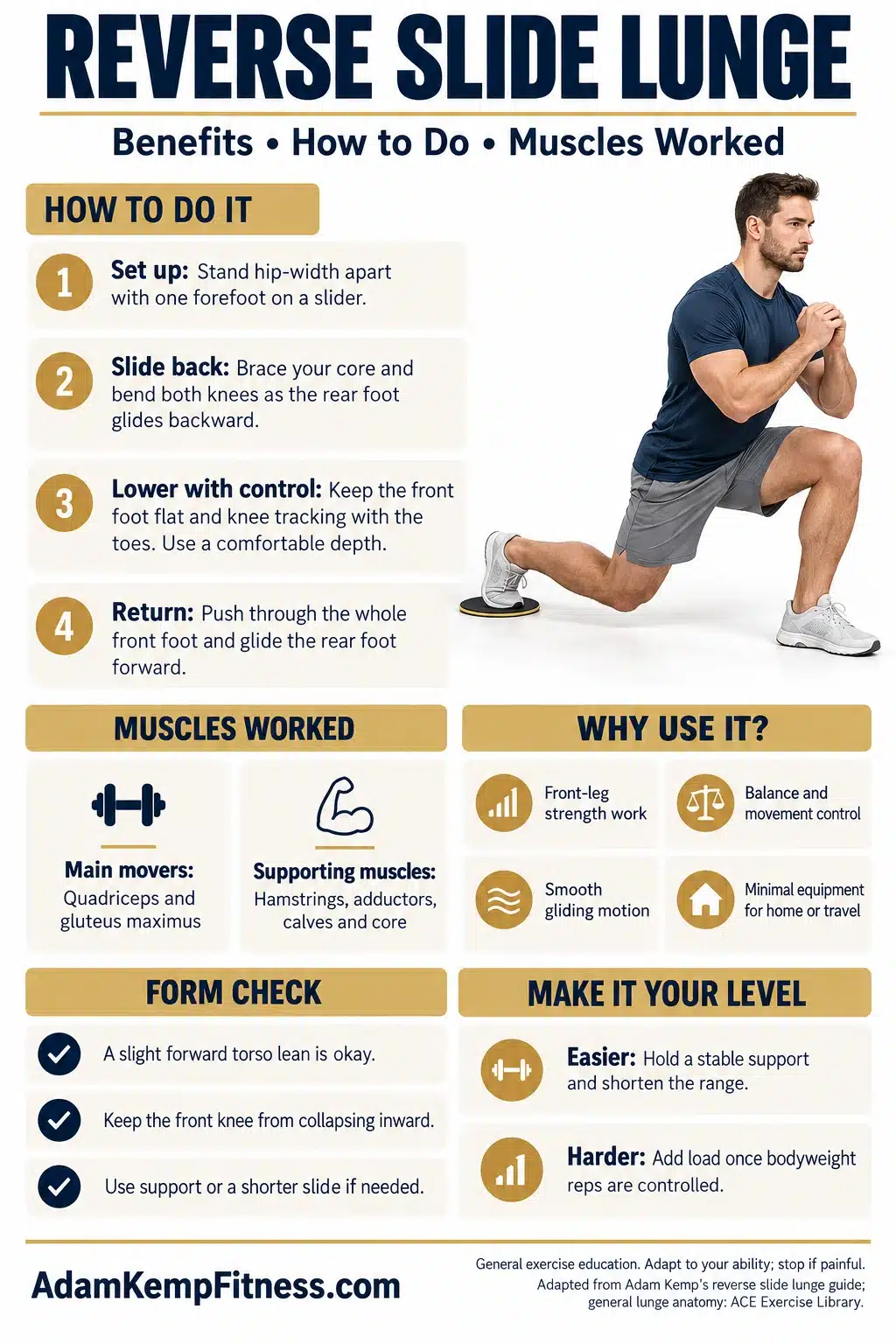
- Take the Start Position: Stand tall with your feet hip-width apart. Place one foot on a glide disc or towel and keep the other foot firmly planted on the floor.
- Engage Your Core & Initiate the Lunge: Brace your abdominal muscles and keep your torso upright to maintain proper spinal alignment. Slowly slide the back foot straight behind you, bending both knees as you lower your body into a lunge. Your front knee should remain aligned with your toes, forming a 90-degree angle.
- Control the Descent: Keep tension in your front leg while your back knee hovers just above the floor. Focus on maintaining balance and moving smoothly.
- Return to Start: Press through your front heel to engage your glutes and hamstrings as you slide the back foot forward, returning to the standing position.
- Repeat: Perform 6–12 reps on each leg, depending on your fitness level and training goals.
Here’s a video of me demonstrating the reverse slide lunge exercise at home using only glide discs on carpet:
Once you’ve mastered the traditional reverse slide lunge, you can challenge yourself further with these five reverse slide lunge variations, designed to build strength, mobility, and athletic performance.
Form Tips:
The reverse slide lunge exercise emphasizes control, coordination, and muscular endurance, making it a smart addition to nearly any strength or athletic training program.
Here are a few tips for proper form you should be contious of:
- Avoid letting your front knee collapse inward.
- Keep your torso vertical and avoid leaning forward.
- Move slowly and with intention—rushing through reps reduces the effectiveness.
Reverse Slide Lunge Muscles Worked
The reverse slide lunge is a compound movement that activates multiple major muscle groups across the lower body and core.
Because it requires both stability and strength, it not only builds muscular endurance but also enhances movement coordination.
Understanding which muscles are targeted can help you execute the exercise more effectively and maximize its performance benefits.
The primary muscles worked in the reverse slide lunge include:
- Quadriceps: The front thigh muscles are heavily engaged as they work to extend the knee during the lunge movement.
- Hamstrings: These muscles at the back of the thigh help stabilize the movement and control the descent into the lunge position.
- Glutes: The gluteus maximus is particularly activated during hip extension, helping to drive the body back up to the starting position.
- Adductors: The inner thigh muscles assist in stabilizing the legs during the sliding motion.
- Calves: The calves provide support and balance during the lunge.
- Core: The core muscles, including the abdominals and obliques, are engaged to maintain stability and balance throughout the movement.
- Hip Flexors: These muscles stretch during the backward sliding motion, helping to improve flexibility and mobility.
Reverse slide lunges provide a comprehensive lower-body workout while also developing core stability and balance.
Benefits of the Reverse Slide Lunge Exercise
The reverse slide lunge is a unilateral, multi-joint movement that challenges lower-body strength and neuromuscular coordination.
It emphasizes control through the front leg as the opposite foot slides back and forth.
Unlike bilateral lifts, this exercise allows you to practice loading each side separately, making differences in strength, balance, and movement control easier to notice.
It can complement squats and deadlifts for athletes and active individuals seeking more complete lower-body strength.
Biomechanically, the movement combines a controlled lowering phase with hip and knee extension during the return.
Research comparing slideboard exercises with the same movements on regular ground found greater quadriceps activation during the slideboard variations, including back lunges (Demir & Harput, 2023).
The sliding motion also eliminates the need to lift and replant the rear foot, creating a smooth transition between positions.
However, reduced foot impact should not be interpreted as proof of lower compressive forces inside the knee.
Here are several practical benefits of the reverse slide lunge exercise:
Gluteal Recruitment and Control
The reverse slide lunge engages the gluteus maximus as the front hip extends during the return to standing.
Moving deliberately also gives you an opportunity to control the lowering phase and maintain muscular effort throughout each repetition.
An electromyographic study documented gluteus maximus and gluteus medius activity during bodyweight reverse lunges, supporting their role in this movement pattern (Hoogenboom et al., 2024).
For the sliding variation, the practical goal is controlled posterior-chain engagement rather than simply moving the rear foot.
Whether a slider increases glute activation beyond a traditional reverse lunge remains uncertain, and time under tension depends on your tempo rather than the equipment alone.
Improved Hip Flexibility
During the reverse slide, the trailing hip moves into extension, which can create a stretch through the iliopsoas and surrounding hip flexor complex.
Maintaining a controlled pelvis helps you explore this position without simply arching your lower back.
Over time, progressively training through a comfortable range may help develop hip mobility alongside strength.
A systematic review and meta-analysis found no significant difference between strength training and stretching in improving range of motion (Afonso et al., 2021).
Knee Strength and Stability
The reverse slide lunge emphasizes loading through the front leg while you control the knee, hip, and foot position.
This makes it a practical exercise to strengthen the quadriceps and practice knee alignment during a single-leg movement.
In a study of 30 healthy adults, slideboard exercises increased quadriceps activity compared with regular-ground variations, supporting their use as a progression in lower-body strengthening programs (Demir & Harput, 2023).
That muscle activity provides a useful training stimulus, but the study did not establish that reverse slide lunges prevent ACL injuries or treat patellar tendinopathy.
If you are working to manage jumper’s knee, the exercise should fit your individual tolerance and rehabilitation plan.
Support for Running Performance
Lower-body strength is an important component of running performance, and the reverse slide lunge offers a way to train force production and control with an emphasis on one leg at a time.
The slide phase encourages controlled lowering, followed by a deliberate return to standing.
A systematic review and meta-analysis found that both unilateral and bilateral resistance training can improve athletic performance, without establishing an overall advantage for unilateral training (Liao et al., 2022).
For athletes seeking better linear speed or deceleration, reverse slide lunges can serve as an accessory strength exercise within a larger program.
Their specific effect on sprint speed remains unclear, so they should simply complement running and sport-specific practice.
Better Movement Quality
The reverse slide lunge provides an opportunity to practice movement quality and motor control by coordinating the hip, knee, and ankle while keeping the trunk steady.
The main movement occurs in the sagittal plane, while you also resist unwanted sideways movement and rotation.
Research on a nine-week bodyweight neuromuscular training program that included lunges found improvements from baseline in dynamic balance.
Because the program included several exercises, those changes cannot be attributed to lunges alone (Gonçalves et al., 2020).
Consistent practice gives you a repeatable way to work on balance, alignment, and smooth transitions.
Improvements in other movements, such as walking or squatting, depend on the individual and the rest of the training program.
Versatile and Portable
One practical advantage of the reverse slide lunge is its adaptability.
You can do it in limited space using a slider or towel on a suitable surface, making it convenient for home workouts, workouts while traveling, or minimalist training environments.
This accessibility can make it easier to build a routine around your schedule and support exercise consistency.
In a four-week pilot trial, older adults completing brief, remotely supported home resistance sessions achieved high adherence, demonstrating the feasibility of a simple home-based approach (Fyfe et al., 2022).
Although that study did not test reverse slide lunges, it supports the practical value of accessible resistance exercise.


Last update on 2026-09-25 / This article includes affiliate links/Images via Amazon Product Advertising API. I may earn commissions on purchases made through these links.
How Often Should You Do Reverse Slide Lunges?
The optimal frequency for performing reverse slide lunges depends on your training experience, recovery capacity, and specific goals.
As a unilateral, compound movement, this exercise places moderate stress on the neuromuscular system and should be integrated strategically into your weekly programming.
General Guidelines:
- Beginners: 2–3 times per week on non-consecutive days is sufficient to build foundational strength, improve motor control, and avoid excessive fatigue.
- Intermediate to Advanced Trainees: 3–4 sessions per week may be appropriate if you’re rotating movement variations or emphasizing different training loads (e.g., bodyweight, dumbbells, tempo reps).
- Athletes in Season: 1–2 times per week may suffice to maintain lower-body strength and mobility without compromising recovery or performance in games or practices.
Key Considerations:
Incorporating reverse slide lunges consistently, while respecting your body’s recovery needs, can yield long-term improvements in strength, balance, and athletic movement patterns.
- Volume and Intensity: If you’re performing multiple sets close to failure, limit frequency to allow for full recovery. For lighter, mobility-focused reps, higher frequency may be tolerated.
- Training Split: Integrate reverse slide lunges into leg day, functional training sessions, or movement quality workouts depending on your program structure.
- Recovery: Monitor for delayed onset muscle soreness (DOMS), especially in the glutes and hamstrings. If soreness persists beyond 48 hours, reduce frequency or intensity.
Differences Between Reverse Lunges and Reverse Slide Lunges
Although the reverse lunge and reverse slide lunge appear similar at first glance, their biomechanics and muscular demands differ significantly due to the presence or absence of a sliding surface.
| Feature | Reverse Lunge | Reverse Slide Lunge |
|---|---|---|
| Motion Type | Step-back | Gliding slide |
| Impact Level | Moderate | Low |
| Muscle Activation | Balanced | Emphasized posterior chain |
| Stability Demand | Dynamic balance | Isometric control |
| Joint Stress | Higher (especially knee/ankle) | Lower |
| Equipment Needed | None | Slide disc or towel |
Ground Contact vs. Gliding Motion
In a standard reverse lunge, the rear foot is lifted off the ground and stepped backward, requiring greater coordination and dynamic balance.
This movement generates a brief impact when the back foot contacts the floor, which can stress the knee or ankle in some individuals—especially if form is compromised.
By contrast, the reverse slide lunge uses a continuous gliding motion, allowing for smoother transitions and more controlled eccentric loading.
This reduces joint impact while increasing time under tension, especially for the glutes, hamstrings, and hip stabilizers.
Stability and Muscle Engagement
Traditional reverse lunges challenge overall balance and proprioception, particularly in free-weight or bodyweight variations.
However, the reverse slide lunge demands greater isometric stability from the core and front leg, as the sliding limb is less involved in weight-bearing and more involved in controlled deceleration.
Because the sliding action limits momentum, the reverse slide lunge often leads to higher muscle activation in the posterior chain and can more effectively isolate movement in the sagittal plane.
Joint Stress and Accessibility
For individuals with joint sensitivity or limited mobility, the reverse slide lunge can be more joint-friendly due to its reduced impact and smoother motion.
It’s also easier to scale for beginners or those in rehabilitation settings.
Is the Reverse Slide Lunge a Good Exercise?
Yes, the reverse slide lunge is not just a good exercise; it’s an exceptionally effective tool for building functional lower-body strength, improving movement quality, and supporting joint health.
Its low-impact, high-control design makes it accessible to beginners while still offering enough progression potential for advanced trainees and athletes.
Because it trains the body unilaterally, the reverse slide lunge helps correct muscular imbalances that often go unnoticed with bilateral movements.
It also challenges stability and coordination, engaging the core and supporting muscles in ways that improve both athletic performance and daily movement patterns.
Whether you’re recovering from an injury, trying to prevent one, or simply looking to upgrade your lower-body training, the reverse slide lunge offers unmatched versatility and value as part of a well-rounded fitness program.
Final Thoughts: Should You Add the Reverse Slide Lunge to Your Workout Routine?
The reverse slide lunge is worth adding to your workout routine if you want a versatile lower-body exercise that emphasizes control through one leg at a time.
Its simple setup makes it easy to fit into gym sessions, home workouts, or travel training.
Throughout my professional basketball career, I’ve valued this exercise as a way to challenge my legs without needing a complicated setup, and it remains one of my favorite reverse lunge variations because I can adjust the range, tempo, and resistance to suit the session.
Research comparing slideboard and regular-ground exercises supports the sliding variation as a useful option for challenging the quadriceps, although its long-term benefits depend on how you train and progress it (Demir & Harput, 2023).
Start with a range you can control, keep your front foot firmly planted, and add resistance when your repetitions feel consistent.
Final Statement: The reverse slide lunge exercise can be a practical addition to a balanced routine built around your goals, experience, and recovery.
This website does not provide medical advice. This website site does contain affiliate links, and purchases may earn a commission.
Read my Medical Disclaimer, Review Disclaimer, and Publishing Policies for more details. Use of this site indicates acceptance of these terms.
Check Out Some of My YouTube Videos Below, and Please Follow on YouTube for More Educational Health and Fitness Content!