How to Support Brain Health as You Age
 Reading Time: 5 minutes
 Your brain naturally changes throughout your life, but there are practical steps you can take to support brain health as you age.
While some changes in memory, processing speed, and cognitive function are a normal part of aging, your daily habits can significantly influence how well your brain continues to function.
Much like caring for your cardiovascular or physical health, protecting your brain involves consistent attention to exercise, nutrition, sleep, mental stimulation, social connection, and preventive healthcare.
These strategies do not guarantee that you will avoid cognitive decline, but they can help preserve cognitive function, promote independence, and improve your overall quality of life.
Fortunately, supporting your brain does not require a complete lifestyle overhaul.
Small, sustainable changes practiced consistently can make a meaningful difference, so let’s explore some practical ways to support brain health as you age.
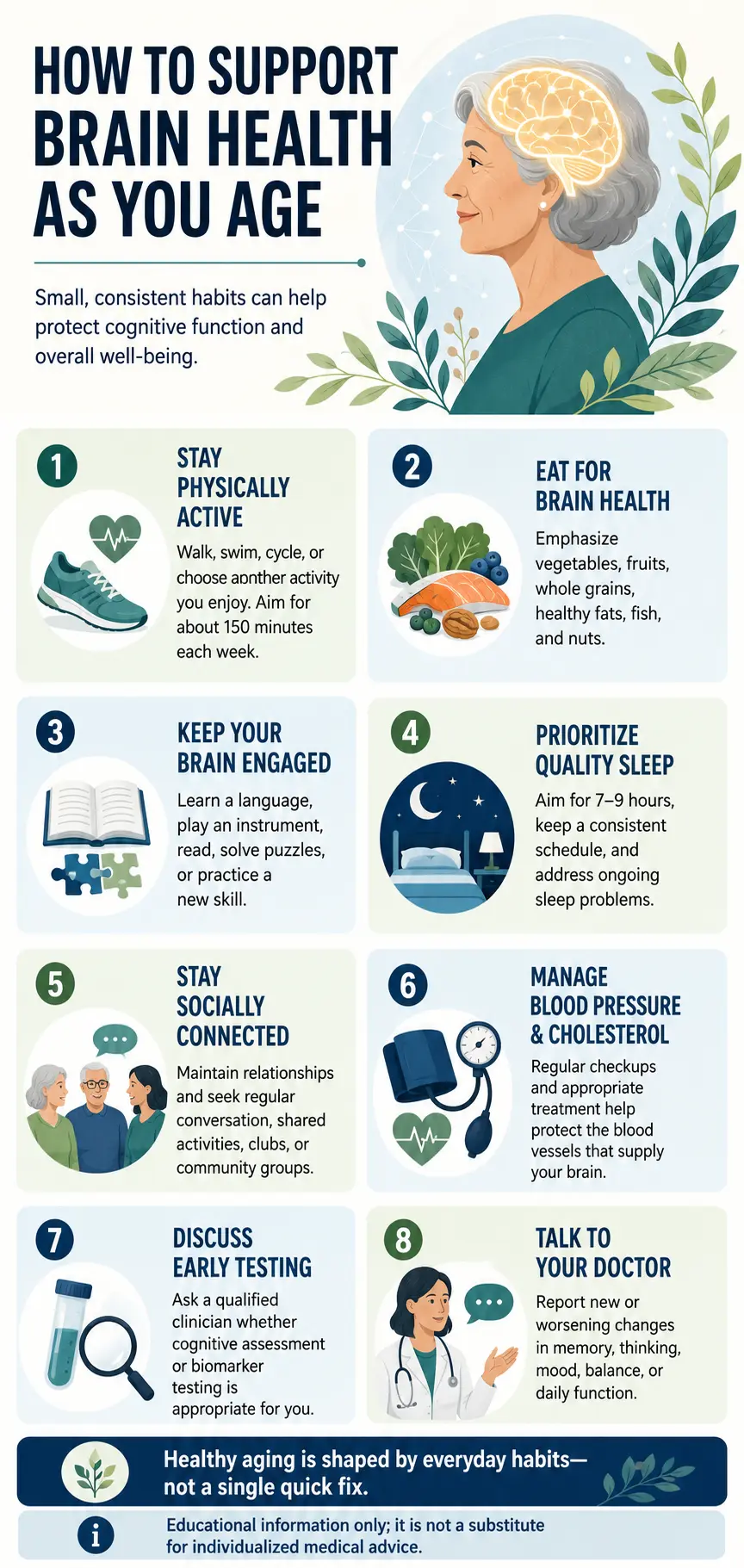
Stay Physically Active
Regular physical activity increases blood flow to the brain and has been linked in research to a lower risk of cognitive decline over time.
It doesn’t need to be vigorous gym workouts every day, but it does need to get your blood pumping and raise your pulse even slightly on a regular basis.
Activities like walking, swimming or cycling for at least 150 minutes a week are enough.
You can spread this out over 7 days if you wish and do a little each day.
This will support ongoing cardiovascular and brain health without the need for intense training unless you want to go down that route. It’s the consistency you’re looking for here.
That will matter just as much.
Eat a Diet to Support Brain Health
What you eat is important for brain health (Gomez-Pinilla, 2010).
You need a diet rich in fruits, vegetables, whole grains, and healthy fats, such as the Mediterranean or MIND diet patterns.
Research has associated these with a reduced risk of cognitive decline compared to diets high in processed foods and saturated fats.
Good tips include reducing your intake of processed foods while increasing foods rich in omega-3 fatty acids, like oily fish and nuts.
These foods support long-term vascular and cellular health that benefits the brain over time.
You don’t need to completely overhaul your diet; just make small, sustainable food swaps.
Keep the Brain Engaged
Learning something new is a great way to keep your brain healthy.
When it’s an instrument, a new skill, a new language, or anything really, learning something new builds and strengthens neural connections in a way that repeating familiar tasks doesn’t.
Even short regular sessions spent on a new skill rather than long infrequent ones will build this kind of engagement more consistently over time.
Think puzzles, reading, and strategy games for some low-effort options that still give you benefits and require sustained effort and genuine novelty.
These activities will provide a challenge compared to tasks that have become repetitive and automatic over time.
Prioritize Sleep
The thing with sleep is that more isn’t always better.
It’s the quality of the sleep you’re getting, not always the amount.
You can sleep for 9 hours a night and still not have a decent night’s sleep.
The reason you need to focus on sleep quality is that sleep plays a huge part in clearing waste products from the brain, and this includes proteins that are associated with cognitive decline.
If you’re not getting enough sleep, you’re inadvertently contributing to a decline in your brain health.
Aim for 7-9 hours of sleep per night and go to sleep and wake up at consistent times.
Address any sleep concerns you might have, such as sleep apnea, if applicable, as the more restorative sleep you get, the better your brain can carry out essential functions.
Tips for a better night’s sleep include reducing screen time and caffeine in the hours before bed so you can fall asleep more easily, or creating a sleep routine that signals to your brain it’s time to go to sleep.
Stay Socially Connected
Social isolation has been linked to a higher risk of cognitive decline, while regular social interactions appear to offer protective effects (Guarnera et al., 2023).
Maintaining relationships with friends and family, joining community groups or clubs, and staying engaged in conversations and shared activities all provide the kind of mental stimulation and emotional support that contribute to long-term cognitive health.
If you live alone or have lost close relationships over time, it might be a good idea to seek out new social connections deliberately rather than waiting for opportunities to arise naturally so you get the stimulation from social connections.
Manage Blood Pressure and Cholesterol
The brain relies heavily on a healthy blood supply, and conditions like high blood pressure and high cholesterol can damage vessels in ways that affect cognitive function over time.
Regular checkups to monitor these numbers, along with any lifestyle changes or medication a doctor can prescribe or recommend, will help protect the blood vessels that supply the brain and reduce the risk of vascular contributions to cognitive decline.
Even if you don’t have any obvious symptoms, both should be checked anyway just to be sure.
Consider Early Biomarker Testing
Changes associated with cognitive decline can begin in the brain years before symptoms become noticeable.
This has led to growing interest in tests that can detect changes earlier.
P-tau217 biomarker testing measures a specific protein associated with early brain changes, providing individuals and their doctors with information to support earlier conversations about brain health and long-term planning.
This allows you to start making changes before you get any symptoms that would otherwise spark a visit to the doctor.
While testing like this doesn’t provide a diagnosis on its own, it can be a useful test, especially if you have a family history of certain health conditions.
Talk to Your Doctor
One of the best things you can do regarding your brain health is talk to your doctor.
You can open up the floor to note symptoms and changes and have them on record so they can be tracked over time if you’re concerned about anything in particular.
From here, they can assess whether you need medical intervention or can manage things yourself by incorporating some of the tips in this post and making other beneficial lifestyle changes.
This website does not provide medical advice. This website site does contain affiliate links, and purchases may earn a commission.
Read my Medical Disclaimer, Review Disclaimer, and Publishing Policies for more details. Use of this site indicates acceptance of these terms.
Check Out Some of My YouTube Videos Below, and Please Follow on YouTube for More Educational Health and Fitness Content!
![Subscribe to @AdamKempFitness for more training, general health, recovery, and nutrition tips from a professional basketball player with a master’s degree in Nutrition Education! 🏀💪
Seated Max Vertical Jumps From a Box are one way I train explosive takeoff power with maximum intent on every rep.
Starting seated, with a pause and minimal rocking or dipping, reduces the contribution of a quick countermovement and emphasizes producing force from a relatively static position (National Strength and Conditioning Association [NSCA], 2020).
For athletes, the training goal is explosive lower-body force production and coordinated extension through the hips, knees, and ankles. I use this variation to practice driving hard into the floor and accelerating my body upward.
My preferred setup: 3 sets of 3 reps or 4 sets of 2 reps, supersetted with a strength or power exercise.
I keep the reps low, reset between jumps, and take longer rest periods so I’m ready to attack every takeoff. Even when pairing exercises, I give myself enough recovery to keep the jumps sharp.
Every rep has one goal: jump as high as possible. I focus on an explosive takeoff, a controlled landing, and consistent quality throughout the session.
Save this for your next power workout! 🚀
Reference: NSCA. (2020). Stretch-shortening cycle.
#VerticalJump #JumpTraining #ExplosivePower #AthleticPerformance #BasketballTraining](https://www.adamkempfitness.com/wp-content/plugins/feeds-for-youtube/img/placeholder.png)