How to Exercise with Erb’s Palsy: Build Strength and Train
 Reading Time: 6 minutes
Learning how to exercise with Erb’s palsy begins with understanding how the condition affects your arm’s strength and movement.
Erb’s palsy results from damage to the upper nerves of the brachial plexus, a network that carries signals between the spinal cord and arm, and commonly develops when these nerves are stretched during childbirth.
Approximately one to two babies out of 1,000 births experience a brachial plexus birth injury, with Erb’s palsy involving the upper portion of this nerve network.
Although many infants recover movement and sensation, more severe injuries can leave lasting weakness or restricted movement, making individual assessment essential when planning exercise (American Academy of Orthopedic Surgeons, n.d.).
For anyone living with these limitations, the practical starting point is a training plan that reflects their current abilities and the activities they want to improve.
Professional guidance, appropriate exercise modifications, and realistic goals provide a foundation for learning how to exercise with Erb’s palsy.
What is Erb’s Palsy?
Erb’s palsy is weakness or paralysis of the shoulder and upper arm caused by damage to the upper portion of the brachial plexus, the network of nerves that carries movement and sensory signals between the spinal cord and arm.
Depending on the injury, lifting the arm, bending the elbow, or rotating the shoulder may be difficult, even when finger movement remains intact (American Academy of Orthopaedic Surgeons [AAOS], n.d.; Johns Hopkins Medicine, n.d.).
The condition is commonly associated with an injury during childbirth, when stretching between the neck and shoulder damages these nerves.
However, similar upper brachial plexus injuries can also occur later in life following trauma, including falls, vehicle accidents, or sports injuries (Johns Hopkins Medicine, n.d.).
The severity of nerve damage determines how much movement is affected and how much recovery is possible.
Some stretch injuries heal well, while torn nerves or nerves pulled away from the spinal cord can cause lasting limitations and may require surgery (AAOS, n.d.).
For someone learning how to exercise with Erb’s palsy, the starting point is understanding their available movement, muscle function, and joint limitations.
Because these vary among individuals, exercise should be guided by an individualized assessment rather than assuming that everyone with the diagnosis can safely perform the same movements (AAOS, n.d.; Johns Hopkins Medicine, n.d.).
How Brachial Plexus Injury Affects Movement
The deltoid, biceps, brachialis, and rotator cuff are the primary muscles that are affected by a brachial plexus injury.
These muscles let us raise our arms, bend our elbows, and rotate our palms upward.
Fortunately, our bodies develop ways to compensate for the lack of range of motion.
Our shoulder blades rise toward our ears; we lean forward and use our good arm to complete tasks.
While it may seem effective, it leads to tightening of the upper trapezius, shoulder rounding, and overuse on the good side.
How to Train and Build Strength with Erb’s Palsy
Building strength with Erb’s palsy starts with understanding which movements your affected arm can control and choosing exercises that match your muscle function and joint mobility (American Academy of Orthopaedic Surgeons, n.d.).
With guidance from a physiotherapist, use these principles to structure your training around supported movement, appropriate resistance, and progress that reflects your abilities.
Get Assessed Before You Load
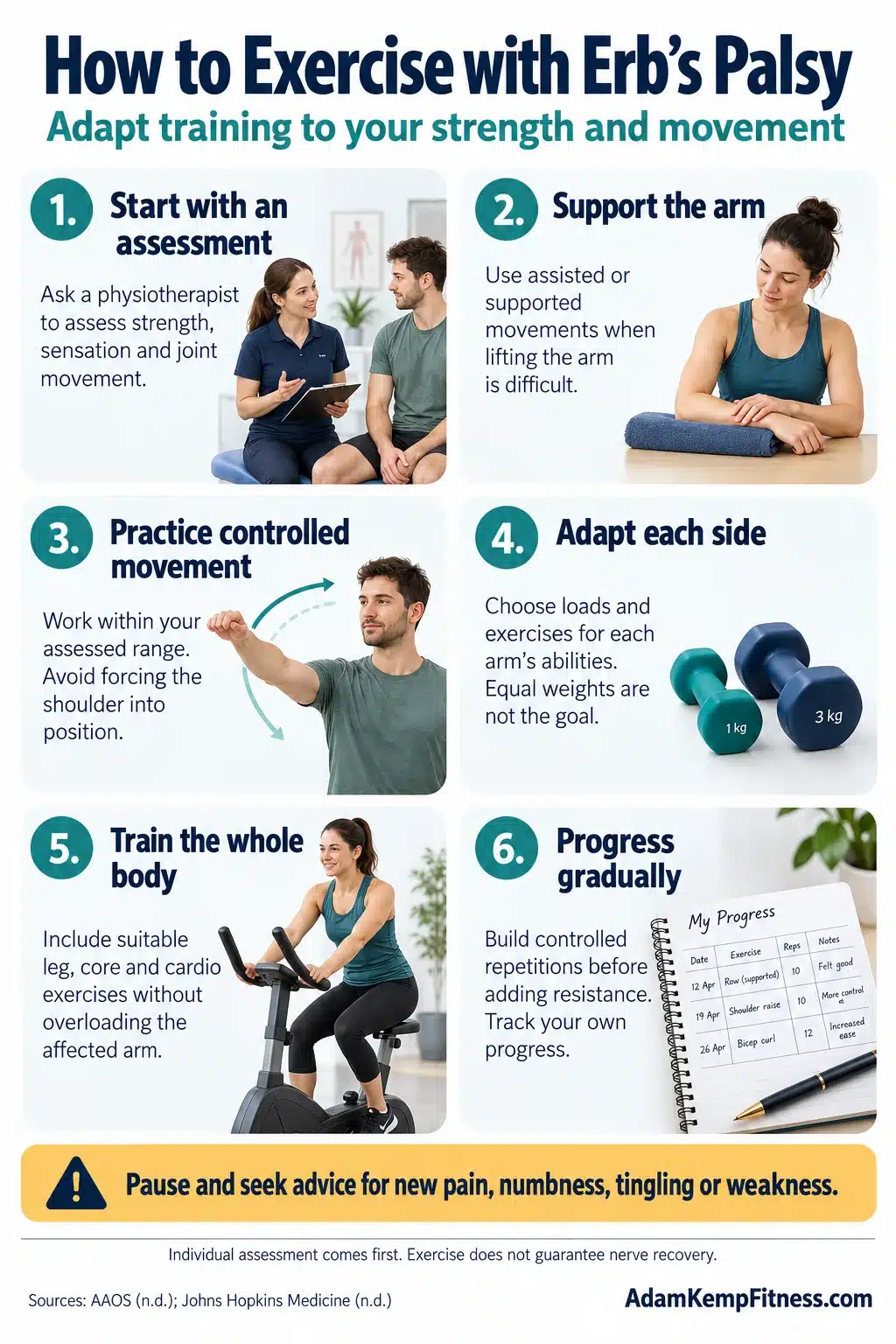
Before starting weight training, see a physiotherapist or occupational therapist experienced with individuals who have brachial plexus injuries.
Bring any medical records related to the birth or surgery, as these documents tell the therapist how the injury occurred and which nerve roots were injured.
Also request a manual muscle testing assessment of all shoulder muscles.
Without this plan of action, you will simply further reinforce the compensatory mechanisms.
Creating a Personalized Training Program
Creating a personalized training program begins by translating your assessment into practical decisions about exercises, resistance levels, and the amount of assistance your affected arm needs.
Use the following principles to build a routine around your current abilities, with goals that reflect the movements you want to improve in daily life and training.
Establishing Scapular Stability
Scapular stability is essential to performing virtually all movements involving lifting or carrying objects with your arms.
Some of the best at-home shoulder exercises that target scapular stabilization include:
- Inclined prone Y raises
- Wall slides
- Band serratus punches
Perform two to three sets of ten repetitions at a slow tempo. Record video footage from behind while performing these exercises. If one shoulder elevates towards your ear, stop immediately.
Reduce the Effects of Gravity
Muscles that cannot support their own arm weight require assistance.
Water provides an environment where gravity is eliminated.
Side-lying external rotations with a dumbbell reduce gravity’s effects, and a cable row machine set to shoulder height allows unweighted rows and presses.
Once strength returns, transition to standing band exercises, then free weights.
Train All Sides Equally
Provide both sides of the body with an equal number of sets regardless of whether you are utilizing a much lighter load on the weaker side.
Training only the good side creates a larger difference.
Everyone should perform squatting, hinging, and carrying heavy loads, as these activities do not affect the legs or core.
Progress Strength Gradually
Once strength begins to improve, increase repetitions before increasing the load.
Pain in front of your shoulder, numbness, tingling, or decreased strength indicate you should return to previous training levels.
Recovery Requires Extra Attention
Recovery requires more than the normal exercise recovery processes after training.
Consuming sufficient protein is especially important as it supports rebuilding damaged muscle tissue.
A meta-analysis published in the British Journal of Sports Medicine found that the rate of gain slows down once resistance-trained individuals consume approximately 1.6 grams/kg/day of protein.
Adequate sleep is also crucial, as the body repairs damage primarily while you sleep.
Aim for seven to nine hours of sleep per night.
Example Weekly Schedule for Exercising with Erb’s Palsy
Most individuals find success with three training days per week.
- Monday includes lower body exercises plus scapular exercises, including deadlifts using a trap bar, split squats, and prone Y raises.
- Wednesday focuses on upper body exercises such as single-arm dumbbell rows, incline push-ups, and side-lying external rotations.
- Friday consists of carries, cable rows, band pull-aparts, and various forms of core exercises including dead bugs.
Each session should last less than 60 minutes, as fatigue tends to encourage compensation in place of controlled repetition.
Unspoken Practicalities of Living with Erb’s Palsy
Living with Erb’s Palsy is costly.
Even with Erb’s Palsy compensation, medical bills for therapy services, nerve grafts, tendon transfers, and various adaptive equipment continue to accumulate throughout a patient’s life.
Families may also pursue legal action against healthcare providers responsible for a poorly managed birth resulting in an Erb’s Palsy diagnosis.
An experienced personal injury attorney determines whether a viable claim exists.
Whether or not a claim exists, accurate, dated documentation of treatment history, assessments, and strength measurements can help patients seek financial assistance.
Final Thoughts: Practical Tips for How to Exercise with Erb’s Palsy
Learning how to exercise with Erb’s palsy starts with understanding your individual nerve injury and working with a physiotherapist to identify suitable movements, support, and resistance.
The extent of nerve damage and any lasting joint limitations influence what your affected arm can do, so your training plan should reflect your assessment (American Academy of Orthopedic Surgeons [AAOS], n.d.).
Keep your approach practical: choose exercises you can control, adapt the demands placed on each arm, and discuss progression with your physiotherapist.
Set goals around meaningful tasks, such as reaching more comfortably, carrying a manageable object, or completing your exercise routine with greater confidence.
Track those goals alongside your exercises, assistance, and resistance so you have useful information to review as your program develops.
When deciding how to exercise with Erb’s palsy, let your individual abilities and daily needs guide what progress looks like.
This website does not provide medical advice. This website site does contain affiliate links, and purchases may earn a commission.
Read my Medical Disclaimer, Review Disclaimer, and Publishing Policies for more details. Use of this site indicates acceptance of these terms.
Check Out Some of My YouTube Videos Below, and Please Follow on YouTube for More Educational Health and Fitness Content!