
Beyond Routine Medical Checks: When Additional Diagnostic Tests May Be Needed
 Reading Time: 7 minutes
Routine medical checks help identify common health risks, but they are not a comprehensive assessment of every possible condition.
However, knowing what a medical check measures can help you have a more useful conversation with your doctor about whether further investigation is needed.
In England, the NHS Health Check focuses on cardiovascular risk through measurements such as blood pressure, cholesterol, and weight, alongside a discussion of lifestyle and family history (NHS, n.d.).
Eligible adults aged 40–74 are generally invited every five years, rather than receiving an automatic annual blood panel.
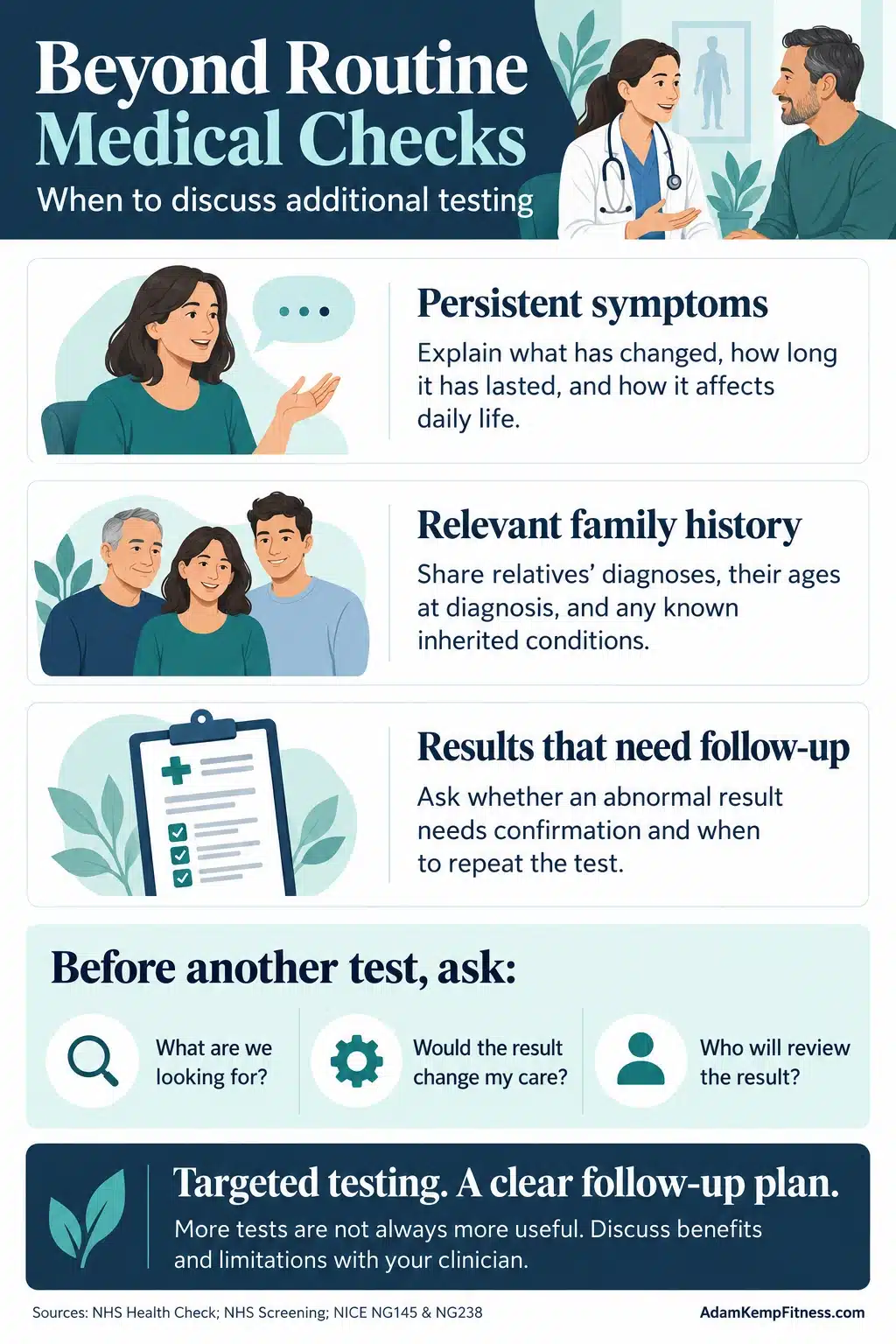
If you have ongoing symptoms, a relevant family history, or questions about a previous result, make those concerns the starting point of your appointment.
Ask what your existing tests can explain and whether a targeted investigation would help guide your care.
The most useful question is: “What would this additional test tell us, and how would the result change the next step?”
That conversation helps you make informed decisions about when to look beyond routine medical checks.
Why Routine Medical Checks Have Limits
Routine medical checks assess particular aspects of health, so their usefulness depends on what is measured and why.
In England, the NHS Health Check focuses on cardiovascular risk by measuring blood pressure, cholesterol, and body measurements, and by discussing lifestyle and family history, with blood sugar testing when appropriate (NHS, n.d.).
There is no single blood testing panel that everyone receives at every GP appointment. Before interpreting a “normal” result, ask which conditions the tests were intended to investigate and what the results mean for your circumstances.
Screening and Diagnostic Testing Answer Different Questions
Screening looks for signs of increased risk in people who appear healthy, while diagnostic testing investigates a suspected condition.
An abnormal screening result may require further testing to establish whether a condition is present (NHS, n.d.).
This distinction matters when symptoms develop between routine appointments.
A previous reassuring screening result shouldn’t be a reason to dismiss a new concern or delay discussing it with your doctor.
When Additional Diagnostic Tests May Be Needed
The starting point for further testing is a clinical question: What might explain this symptom or result, and would another test change the next step?
Bring your concerns to the appointment so your clinician can decide whether examination, monitoring, targeted testing, or specialist assessment is appropriate.
Persistent or Unexplained Symptoms
Fatigue that lasts several weeks, affects daily life, or occurs alongside symptoms such as weight loss deserves a GP assessment.
Depending on the findings, investigations may include blood tests for anaemia, diabetes, or thyroid disease (NHS, 2023).
For active people, it is also useful to describe recent changes in training, sleep, and food intake.
My approach to managing workout fatigue starts by reviewing daily demands and recovery habits, which can provide helpful context for the appointment.
However, ongoing fatigue does not automatically call for a comprehensive thyroid panel.
NICE generally recommends thyroid-stimulating hormone, or TSH, as the initial test in adults with suspected thyroid dysfunction when pituitary disease is not suspected, with additional thyroid measurements guided by the result (NICE, 2023b).
A Relevant Family Health History
Tell your clinician which relatives were affected by a condition and approximately how old they were when diagnosed.
For inherited cholesterol disorders, NICE recommends considering family history alongside clinical findings and a full lipid profile, rather than relying on a cholesterol threshold alone (NICE, 2023a).
Try to bring specific information rather than simply saying that heart problems “run in the family.”
A relative’s diagnosis, age at diagnosis, and any known genetic test results give your clinician more useful details to work with.
Abnormal Results or Changing Symptoms
An unexpected result may require confirmation, but the timing and type of follow-up depend on the test and clinical circumstances.
For thyroid testing, for example, NICE advises considering repeat tests when symptoms worsen or new symptoms develop, generally no sooner than six weeks after the previous test (NICE, 2023b).
Ask whether your result needs repeating, what could affect its interpretation, and when you should return if symptoms continue.
This creates a clear follow-up plan instead of leaving you to interpret an isolated number.
Menopause Symptoms and Other Life Changes
Changes in menstrual patterns, sleep, or temperature regulation are worth discussing, but they do not always require hormone testing.
In otherwise healthy people aged 45 or older with typical symptoms, NICE recommends identifying perimenopause or menopause clinically, without laboratory confirmation (NICE, n.d.).
Testing may be appropriate in selected younger people or when another explanation needs investigation.
A change in life stage is therefore a reason for an individual assessment, rather than an automatic reason to purchase a broad hormone panel.
Cholesterol Testing: How Follow-Up Can Add Useful Information
Cholesterol testing illustrates how routine medical checks can lead to a more focused assessment.
The next step depends on the lipid results, overall cardiovascular risk, and relevant personal or family history.
What a Full Lipid Profile Measures
A full lipid profile measures total cholesterol, HDL cholesterol, and triglycerides, and usually includes calculated LDL and non-HDL cholesterol.
Fasting is not routinely required, although certain results may warrant a repeat test with fasting (NICE, 2023a).
If results are abnormal, your clinician may also investigate contributing conditions such as uncontrolled diabetes, hypothyroidism, or liver disease.
This helps establish why cholesterol is elevated and what treatment or follow-up is appropriate (NICE, 2023a).
When Lipoprotein(a) Testing May Be Relevant
Lipoprotein(a), usually written as Lp(a), is an inherited cardiovascular risk factor that is not routinely included in a standard cholesterol test.
A family history of elevated Lp(a) or premature cardiovascular disease can make it a useful topic to discuss with your clinician (Centers for Disease Control and Prevention, 2025).
Ask whether measuring it would change your risk assessment or prevention plan.
The goal is to identify information that guides care, not simply add more markers to the report.
Screening Participation: Understanding the Numbers
A January 2025 UK National Screening Committee article reported that NHS screening programmes in England invite around 15 million people annually, with approximately 10 million taking up the invitation.
These were broad figures presented alongside a summary of 2021–2022 program data, rather than a current measure of attendance at routine GP checks (Mitra, 2025).
These figures also do not describe attendance for cholesterol tests, thyroid investigations, or private health assessments.
Keeping those categories separate makes the statistics more useful and avoids suggesting that every missed screening invitation represents the same clinical situation.
Making an Informed Screening Decision
When you receive an invitation, read what the screening test can detect, its limitations, and what would happen after an abnormal result.
NHS guidance emphasises that participation is a personal choice and that questions about benefits and risks can be discussed with a healthcare professional (NHS, n.d.-b).
If practical concerns make attendance difficult, contact the service to ask about rescheduling or available support.
Use the conversation to address uncertainty about the procedure as well as the appointment itself.
Working With Your GP and Private Health Clinics
Start by explaining the concern you want investigated and reviewing any tests you have already had.
If you are considering private testing, discuss how the results would fit into your existing care.
Evaluate the Tests and the Follow-Up
A larger package is not automatically a more useful health assessment.
The NHS notes that some commercially available screening tests are not recommended by the UK National Screening Committee because it is unclear whether their benefits outweigh their harms (NHS, n.d.-b).
Before booking a private assessment, ask:
- Why is each test appropriate for me?
- Who will interpret the results alongside my symptoms and medical history?
- What happens if a result is abnormal or uncertain?
- Are consultations and follow-up investigations included in the price?
- Can I receive a complete report to share with my GP?
Choose a service based on the clinical relevance of its assessment and the quality of its follow-up.
Having a clear plan for results is as important as arranging the appointment.
Understand the Limits of Reassurance
Screening can produce false-positive results that lead to unnecessary investigations, or false-negative results that miss a problem.
Results can also cause anxiety, which is one reason the expected benefits and harms need consideration before testing (NHS, n.d.-b).
Before agreeing to another test, ask how either a normal or abnormal result would influence your care.
If the answer is unclear, discuss whether monitoring or a different assessment would be more useful.
Final Thoughts: Getting More Value From Routine Medical Checks
To get more value from routine medical checks, arrive with a clear account of your concerns and leave with a clear follow-up plan.
Bring a short symptom timeline, relevant family history, previous results, and a list of medicines and supplements.
Use these questions to guide the conversation:
- What do my existing results help explain?
- Is there a specific condition we still need to investigate?
- Would another test change treatment or monitoring?
- When should I return if symptoms continue?
- Who will review the results and contact me?
You do not need to arrive knowing which test to request.
Describing what has changed, asking focused questions, and agreeing on the next step can help you make better use of routine medical checks.
This website does not provide medical advice. This website site does contain affiliate links, and purchases may earn a commission.
Read my Medical Disclaimer, Review Disclaimer, and Publishing Policies for more details. Use of this site indicates acceptance of these terms.
Check Out Some of My YouTube Videos Below, and Please Follow on YouTube for More Educational Health and Fitness Content!