How to Ease Anxiety Naturally and Improve Your Wellbeing
 Reading Time: 7 minutes
If you’re wondering how to ease anxiety naturally, start with what you notice first. Gentle breathing can help when your shoulders tense and your breath quickens, while writing down your opening question for tomorrow’s meeting gives a recurring worry somewhere to go (National Health Service, 2026a; National Health Service, n.d.).
As a professional basketball player and a dad, I gravitate toward stress relief practices I can use in more than one place.
Breathing exercises are part of my evening routine, and I can use them just as easily in a hotel room after a road game as I can at home.
For everyday anxiety, it helps to have one thing you can do in a difficult moment and one habit that supports you across the week.
Which one to start with depends on when worry shows up and what it gets in the way of.
What Are Common Causes and Triggers of Anxiety?
Anxiety can be an understandable response to uncertainty.
Money concerns, conflict at home, a health scare, or the responsibility of caring for someone can leave you on edge, and sometimes several pressures arrive together (National Health Service, 2026b).
A trigger is something that brings on anxiety or makes it stronger.
The reasons someone develops an anxiety disorder can be more complex, involving family history, biology, stressful environments, or traumatic experiences (National Institute of Mental Health, 2025).
Anxiety can also show up in ways that are easy to overlook.
You might notice muscle tension, trouble concentrating, irritability, or difficulty falling asleep before you realize how much time you’ve spent worrying (National Institute of Mental Health, 2025).
If a pattern is hard to spot, think back to the last time you felt anxious.
Write down what was happening, what you felt in your body, and what you did next.
“I reread my manager’s email six times after my second coffee” gives you more to work with than “Tuesday was stressful.”
How to Ease Anxiety Naturally in the Moment
When anxiety rises, notice what feels hardest right now.
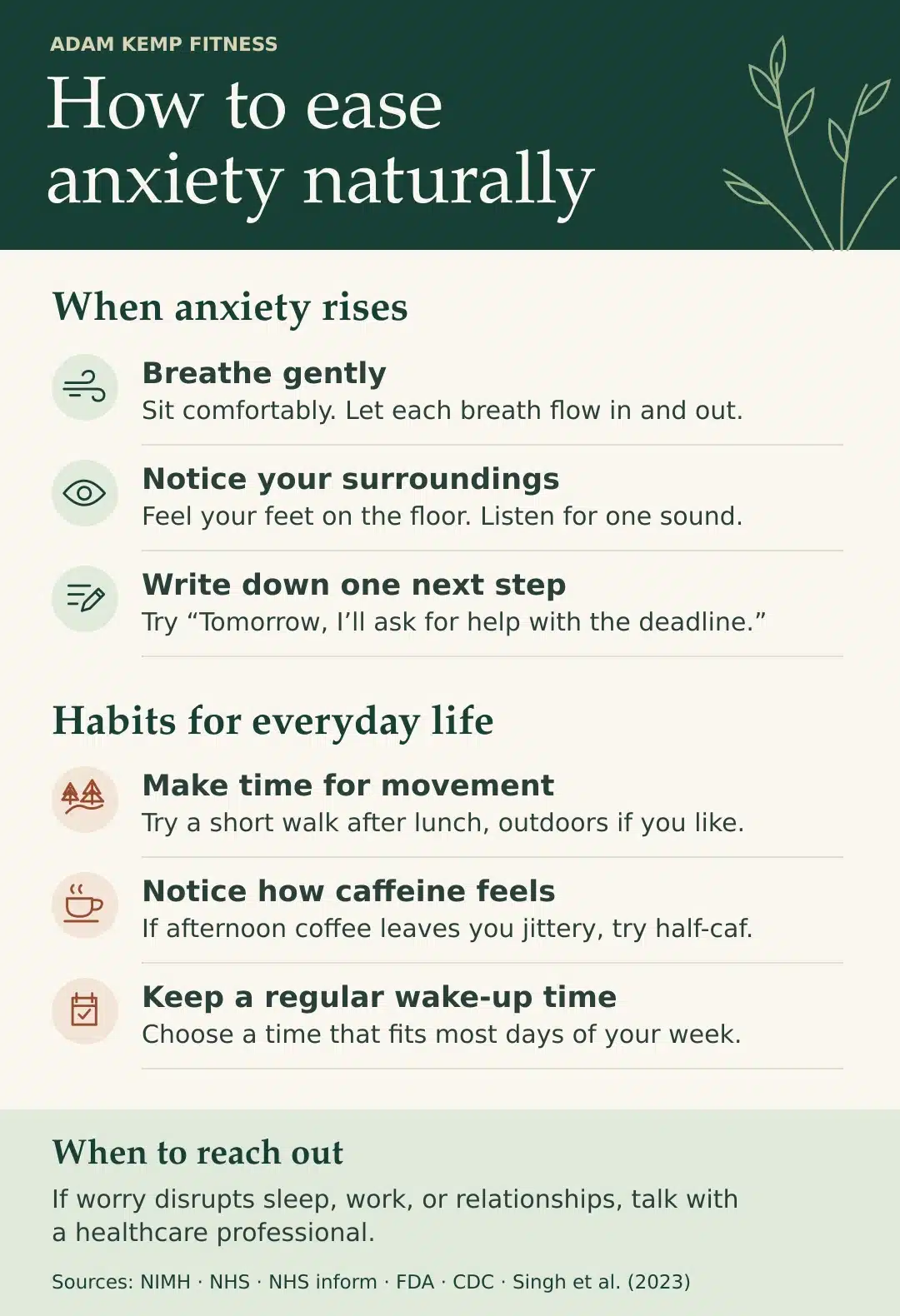
If your jaw is tight and your breathing feels rushed, take a few gentle breaths or focus on your feet on the floor.
If your mind keeps rehearsing a difficult conversation, it may help to write down the first thing you want to say.
You can take that small step even while you still feel nervous (National Health Service, n.d.).
Practice Gentle Breathing When Your Body Feels Tense
Sit comfortably with your feet on the floor and let your shoulders settle.
Breathe in gently through your nose and out through your mouth, keeping each breath easy enough that you never have to gulp for air (National Health Service, 2026a).
If counting feels helpful, count slowly on the inhale and again on the exhale, using a number you can reach comfortably.
Try it for about five minutes, perhaps before a difficult call or after you close your laptop for the day (National Health Service, 2026a).
Across 20 randomized trials, researchers found a modest average reduction in self-reported anxiety with breathwork.
Because the studies used different techniques, the findings don’t establish an ideal breathing count (Fincham et al., 2023).
Use Your Sense When Focusing on Your Breath Feels Uncomfortable
If paying attention to your breathing makes you more uneasy, try giving your attention to the room around you.
Feel where your shoes meet the floor, look for a detail on the wall, and listen for the farthest sound you can hear.
For a more structured grounding exercise, identify five things you can see, four you can feel, three you can hear, two you can smell, and one you can taste. You can do this quietly in a waiting room or on public transportation (NHS inform, n.d.).
Give a Recurring Worry One Concrete Next Step
Suppose you’re lying awake thinking, “What if tomorrow’s meeting goes badly?”
Write down the part you can act on, such as “At 9 a.m., I’ll check the figures and write down the question I need answered.”
Some worries have no immediate answer, especially when you’re waiting for news.
If the same thought keeps interrupting the day, jot it down and give yourself 10 to 15 minutes later to consider it, an approach known as scheduled worry time (National Health Service, n.d.).
Everyday Habits That Can Help Reduce Anxiety
Some of the most practical ways to ease anxiety naturally start with things you already do most days.
Regular movement, enough sleep, and paying attention to how caffeine affects you can all support anxiety management (National Institute of Mental Health, 2025).
Start with one change that fits the part of your day when worry tends to build.
That might mean taking a walk with a friend after work, switching your afternoon coffee to half-caf, or setting aside an evening to cook a meal you’ve been looking forward to.
Move Regularly, and Take a Walk Outdoors When You Can
A large overview of research found that physical activity can reduce anxiety symptoms in adults on average.
The studies included different populations and types of exercise, so there’s room to choose movement that suits your fitness level, schedule, and preferences (Singh et al., 2023).
Walking is an accessible place to start for many people.
Try taking a ten-minute walk after lunch, walking a few blocks with a friend, or putting on music and moving at home on a rainy day.
If you enjoy spending time in nature, take the route past the trees or sit in the garden after your walk.
A review found that structured outdoor activities, including gardening and exercising in green spaces, improved anxiety outcomes on average, although the programs varied and often combined several activities (Coventry et al., 2021).
Look at Caffeine and Sleep Together
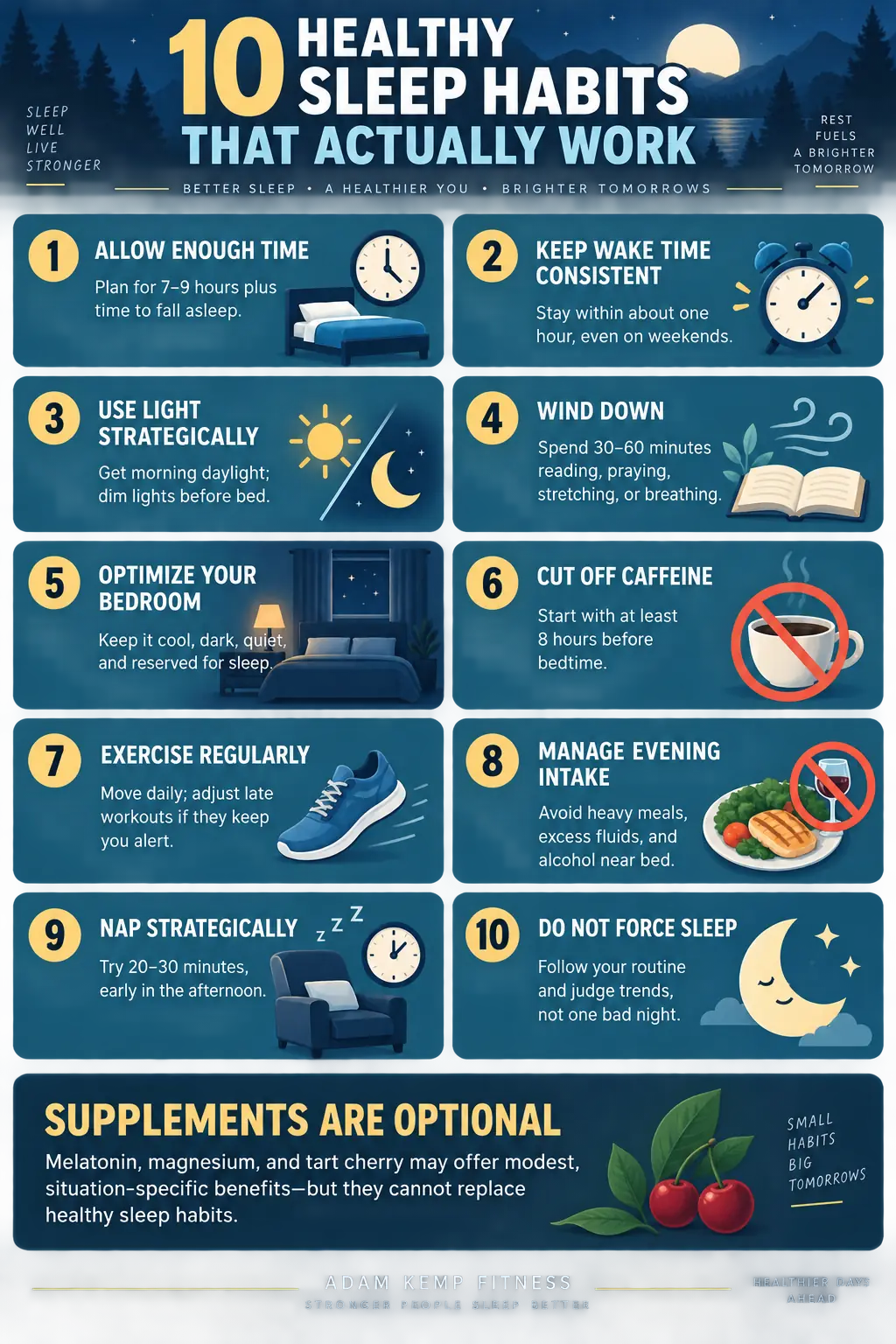
If you feel jittery by late afternoon and wide awake at bedtime, look at what you drank and when.
Coffee, energy drinks, and caffeinated pre-workout supplements can add up, and the amount that brings on anxiety or disrupts sleep varies from person to person (U.S. Food and Drug Administration, 2024).
A simple experiment is to swap your afternoon coffee for half-caf for a few days and notice whether you feel less keyed up or fall asleep more easily.
If you consume caffeine daily and want to cut back, reducing it gradually can make withdrawal symptoms less uncomfortable (U.S. Food and Drug Administration, 2024).
For sleep, choose one part of your day to keep reasonably consistent, such as your wake-up time.
A regular sleep schedule and avoiding caffeine later in the day are both recommended healthy sleep habits (Centers for Disease Control and Prevention, 2024).
Try a Weighted Blanket to Wind Down
If you find the steady pressure of a heavy quilt comforting, you might enjoy using a weighted blanket for anxiety relief while reading or listening to music before bed.
A review of randomized trials found a small average reduction in anxiety among people with mental health conditions, though the studies were small and varied, so it’s unclear how much benefit to expect for everyday worry (Zhao et al., 2024).
Try resting the blanket across your lap while you’re awake to gauge how the pressure feels.
Choose one you can easily remove yourself, and check with a healthcare professional first if you have a condition that affects your breathing or mobility (Royal College of Occupational Therapists, 2023).
Return to a Hobby You Look Forward To
Think of something you used to enjoy before every free evening filled up.
You might grow basil on the kitchen windowsill, draw with your child, or learn to cook a dish you miss from home.
Choose a version you can finish or put down in one sitting.
Watering a pot of herbs and picking a few leaves for dinner can be the whole activity, and inviting someone to cook with you gives you a chance to talk while your hands are busy.
You can explore weed seeds and their varieties, as growing them can help you create a garden that becomes a source of relaxation in your everyday life.
Ask for the Kind of Support You Need
Sometimes the most useful way to ease anxiety is to change one of the demands behind it.
If a packed evening is weighing on you, “Could you handle dinner while I make this call?” gives someone a clear way to help.
Other times, you might simply want company.
Asking, “Would you take a walk with me while I talk through tomorrow’s appointment?” can start an honest conversation with someone you trust (National Institute of Mental Health, 2025).
When to Seek Help for Anxiety
If worry is repeatedly disrupting sleep, making it difficult to work, or leading you to avoid activities or people you care about, reach out to a primary care clinician or mental health professional.
You can ask for help as soon as anxiety starts interfering with daily life (National Institute of Mental Health, 2025).
Tell the clinician what has changed in practical terms, such as “I’ve started canceling plans because I’m anxious about leaving home.”
They can assess your symptoms, consider possible physical contributors, and discuss options such as cognitive behavioral therapy (CBT), medication, or both (National Institute of Mental Health, 2025).
Final Thoughts on Easing Anxiety Naturally
If you’re deciding how to ease anxiety naturally, start with the moment in your day when you most want things to feel different.
That might mean taking a short walk between work and dinner, switching the timing of your second coffee, or writing down tomorrow’s first step before you turn out the light.
Give yourself a practical way to judge whether it helps.
Being able to enjoy dinner with your family or make the phone call you’ve been putting off can be a meaningful improvement, even on a day when you still feel some anxiety.
This website does not provide medical advice. This website site does contain affiliate links, and purchases may earn a commission.
Read my Medical Disclaimer, Review Disclaimer, and Publishing Policies for more details. Use of this site indicates acceptance of these terms.
Check Out Some of My YouTube Videos Below, and Please Follow on YouTube for More Educational Health and Fitness Content!