Pre Workout Supplements: Benefits, Safety, Best Ingredients

Pre-workout supplements are designed to improve exercise performance by supporting energy, focus, strength, power, endurance, or blood flow before and during training.
I have used a wide range of pre-workout supplements throughout more than a decade of professional basketball, from simple coffee and beetroot products to stimulant-free formulas and high-caffeine multi-ingredient supplements.
That experience has taught me that the effectiveness of a pre-workout depends much more on its ingredients and dosages than the marketing on the label.
Some pre-workout ingredients have strong research behind them, while others are underdosed, unnecessary, or included primarily to make a product look more impressive.
This guide explains how pre-workout supplements work, which ingredients are worth considering, how to choose between stimulant and non-stimulant formulas, and how to use them safely.
What Are Pre-Workout Supplements?
Pre-workout supplements are products intended for consumption before exercise to support one or more aspects of training performance (Navarro et al., 2025).
They are commonly sold as powders, capsules, ready-to-drink beverages, or concentrated shots.
Most formulas combine several ingredients that target different aspects of exercise, such as:
- Energy
- Mental focus
- Strength
- Power
- Muscular endurance
- Blood flow
- Hydration
- Perceived fatigue
Research suggests that combining multiple ingredients can produce better results.
However, “pre-workout” is a marketing category rather than a single type of supplement.
A cup of coffee can function as a pre-workout because caffeine can improve alertness and exercise performance, while beetroot juice can be used before training because dietary nitrate may support blood flow and endurance.
Similarly, creatine may appear in a pre-workout formula even though its benefits come primarily from consistent daily use rather than taking it specifically 20 minutes before exercise.
Do Pre-Workout Supplements Work?
Some pre-workout supplements can improve performance, but the answer depends on what is actually inside the product.
Ingredients such as caffeine, creatine, beta-alanine, nitrate, and sodium bicarbonate have substantial evidence supporting specific performance applications.
Other common ingredients have weaker or more inconsistent evidence, and multi-ingredient formulas can be difficult to evaluate because several compounds are taken together.
Research on multi-ingredient pre-workout supplements has produced mixed results.
Some studies show improvements in subjective energy, force production, sprint performance, or repeated high-intensity exercise, while others find relatively little improvement beyond the effects expected from individual ingredients such as caffeine (Martos-Arregui et al., 2025).
The best approach is to judge a pre-workout by its formula rather than assuming every product marketed as a pre-workout works equally well.
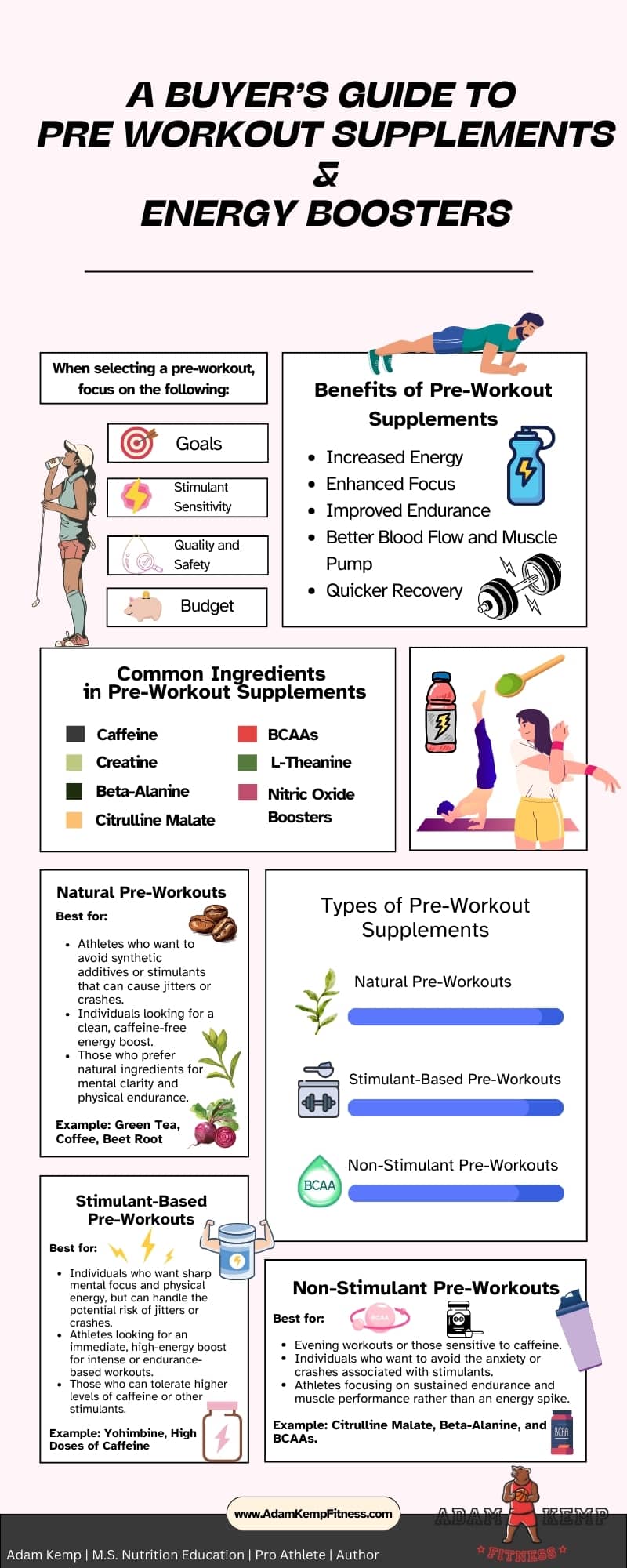
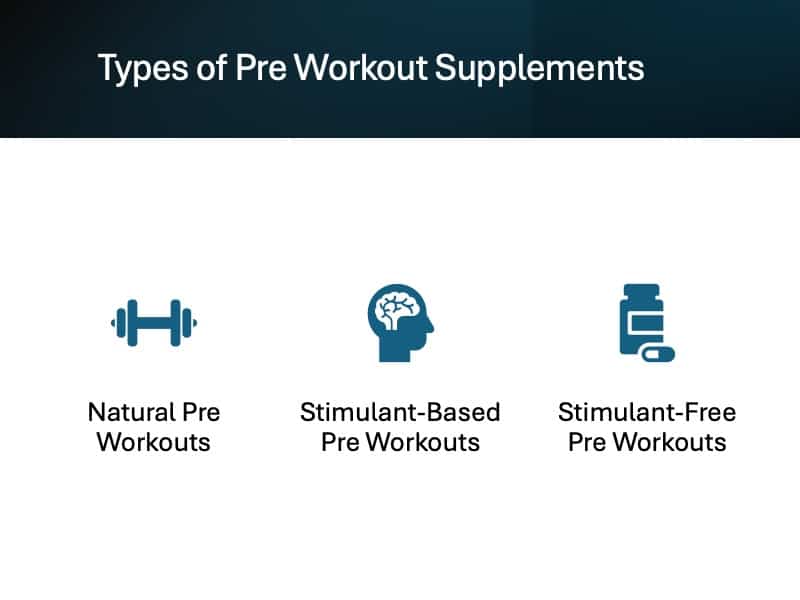
Types of Pre-Workout Supplements
Pre-workout products can generally be divided into several categories based on their primary purpose.
Stimulant-Based Pre-Workouts
Stimulant pre-workouts usually rely on caffeine as the main ingredient responsible for increasing energy and alertness.
Caffeine can reduce perceived effort, improve vigilance, and enhance performance across several types of exercise.
Many formulas contain approximately 150–300 mg of caffeine per serving, although some products contain considerably more.
Higher doses are not automatically better.
Large amounts of caffeine can increase the likelihood of:
- Jitters
- Anxiety
- Rapid heartbeat
- Gastrointestinal discomfort
- Difficulty sleeping
- Dependence or tolerance
For athletes, sleep disruption can easily outweigh the benefits of an aggressive stimulant dose.
Non-Stimulant Pre-Workouts
Stimulant-free pre-workouts are designed to support performance without caffeine or other central nervous system stimulants.
These products commonly emphasize:
- Citrulline
- Dietary nitrate
- Beetroot
- Beta-alanine
- Electrolytes
- Betaine
- Creatine
They can be useful for evening training, caffeine-sensitive individuals, or athletes who already consume caffeine elsewhere.
A non-stimulant pre-workout will not usually create the immediate feeling of energy that caffeine provides, but it can still support blood flow, repeated high-intensity exercise, hydration, or muscular endurance depending on the formula.
Natural Pre-Workout Alternatives
You do not need a commercial powder to create an effective pre-workout routine.
Useful natural pre-workout alternatives include:
- Black coffee
- Beetroot juice or beetroot powder
- Carbohydrate-rich foods
- Electrolyte drinks
- Green tea
- Fruit
- Sodium
- Water
For many athletes, a simple combination of carbohydrates, hydration, caffeine, and dietary nitrate can provide most of what they actually want from a pre-workout.
High-Stimulant Pre-Workouts
Some pre-workout products contain 300 mg or more of caffeine per serving along with additional stimulants.
These formulas can create a strong perception of energy, but they are not automatically better for performance.
The more stimulants a product contains, the more carefully I evaluate whether the potential benefit is worth the increased likelihood of anxiety, elevated heart rate, digestive discomfort, disrupted sleep, or a post-workout energy crash.
For most training sessions, I would rather use the lowest effective stimulant dose than chase the strongest possible sensation.
Benefits of Pre-Workout Supplements
The potential benefits of a pre-workout depend on the ingredients it contains.
Increased Energy
Caffeine is the primary ingredient responsible for the noticeable energy boost associated with many pre-workouts.
It works largely by blocking adenosine receptors in the brain, which reduces feelings of fatigue and increases alertness.
Caffeine can improve endurance, repeated high-intensity exercise, attention, and certain aspects of strength and power.
However, caffeine sensitivity varies considerably.
The amount that makes one athlete feel sharp and focused may make another feel anxious or overstimulated.
Improved Mental Focus
Training quality depends partly on your ability to concentrate.
That becomes particularly important during technical movements, heavy strength training, sprint work, basketball drills, or any exercise where coordination and decision-making matter.
Caffeine can improve alertness, while ingredients such as L-theanine are sometimes combined with caffeine in an attempt to provide smoother mental stimulation.
The caffeine/L-theanine combination has more evidence for cognitive performance than it does specifically for exercise performance, so I view L-theanine primarily as a potentially useful addition rather than a required pre-workout ingredient.
Improved Strength and Power
Creatine is one of the strongest evidence-based supplements for improving high-intensity exercise performance and long-term strength and power development.
However, creatine is often misunderstood when included in pre-workout formulas.
Its effects come from gradually increasing muscle phosphocreatine stores through consistent supplementation.
You do not receive a meaningful extra creatine benefit simply because you consume it 20 minutes before training.
If a pre-workout contains an effective daily dose of creatine, that can be convenient, but I generally think of creatine as a daily supplement rather than an acute pre-workout ingredient.
Improved Muscular Endurance
Beta-alanine can improve performance during repeated high-intensity exercise by increasing muscle carnosine concentrations.
Carnosine helps buffer hydrogen ions that accumulate during hard exercise and contribute to declining muscular function.
Beta-alanine does not work by immediately removing lactic acid from your muscles.
Like creatine, beta-alanine works primarily through consistent supplementation over time.
That means taking beta-alanine only on workout days is less useful than achieving an appropriate daily intake.
Increased Blood Flow
Citrulline and dietary nitrate are common pre-workout ingredients used to support nitric oxide production and blood flow.
L-citrulline and citrulline malate can increase circulating arginine and support nitric oxide production.
Dietary nitrate from foods and beetroot supplements follows a different pathway that can also increase nitric oxide availability.
Improved nitric oxide signaling may support blood flow, exercise efficiency, and performance in certain types of training.
Better Training Quality
The most valuable benefit of a pre-workout may simply be that it helps you perform a better training session.
If caffeine allows you to maintain focus, carbohydrates provide fuel, sodium supports hydration, and citrulline improves exercise tolerance, you may be able to perform more high-quality work.
Over time, consistently higher-quality training can contribute to better adaptations.
The supplement itself does not create those adaptations independently.
Training still does the work.
Best Pre-Workout Ingredients
Instead of choosing a pre-workout based on the number of ingredients on the label, I prefer to look for a smaller number of ingredients with clear evidence and useful dosages.
Caffeine
Caffeine is one of the most reliable acute performance-enhancing ingredients.
Common effective doses in sports research are approximately 3–6 mg/kg of body weight, although lower doses can still improve alertness and performance.
I do not think most people need to start anywhere near the upper end of that range.
For many athletes, approximately 100–200 mg provides enough stimulation to improve a workout without creating unnecessary side effects.
Large athletes may tolerate more, but tolerance should not be confused with need.
Caffeine can also remain in the body for hours, so afternoon and evening doses can interfere with sleep.
Since sleep is one of the strongest recovery tools available, I would rather sacrifice some pre-workout stimulation than routinely compromise nighttime recovery.
Creatine
Creatine monohydrate is one of the most thoroughly researched sports supplements.
It helps increase phosphocreatine availability, supporting rapid ATP regeneration during short-duration, high-intensity exercise.
Creatine can improve:
- Strength
- Power
- Repeated sprint performance
- Training capacity
- Lean mass gains when combined with resistance training
A common maintenance dose is approximately 3–5 grams per day.
Timing is relatively unimportant compared with consistency.
If your pre-workout contains a full daily creatine dose, it can be convenient.
If it contains only one gram, I would not consider that a meaningful reason to choose the product.
Beta-Alanine
Beta-alanine supplementation increases muscle carnosine, which helps buffer acidity during intense exercise.
It can be particularly useful for repeated high-intensity efforts lasting roughly one to several minutes or training that repeatedly challenges glycolytic energy production.
Typical research protocols use approximately 3.2–6.4 grams per day, divided into smaller doses when necessary.
Beta-alanine can cause temporary tingling known as paresthesia.
The sensation is harmless at typical doses but can be uncomfortable.
This tingling is not evidence that the supplement has suddenly “kicked in.”
Beta-alanine requires repeated use to increase muscle carnosine stores.
L-Citrulline and Citrulline Malate
L-citrulline can increase arginine availability and support nitric oxide production more effectively than taking oral arginine itself in many circumstances.
Citrulline may support:
- Blood flow
- Muscle pump
- Exercise tolerance
- Repeated-set performance
- Perceived fatigue
Common supplemental doses are approximately 3–6 grams of L-citrulline or around 6–8 grams of citrulline malate, although the actual citrulline content of citrulline-malate products can vary.
This is one ingredient where underdosing is common in proprietary pre-workout formulas.
Dietary Nitrate and Beetroot
Dietary nitrate can increase nitric oxide availability through the nitrate-nitrite-nitric oxide pathway.
Beetroot supplements are one of the most common ways athletes increase nitrate intake.
Nitrate supplementation has evidence supporting endurance exercise, exercise efficiency, and some forms of repeated high-intensity performance.
It can be particularly useful for athletes who want a non-stimulant performance aid.
Unlike caffeine, nitrate does not provide a noticeable stimulant sensation.
The benefits are physiological rather than psychological.
Sodium and Electrolytes
Pre-workout hydration is often overlooked.
Athletes training in hot environments, sweating heavily, or completing long sessions may benefit more from adequate fluid and sodium than from adding another stimulant.
Sodium helps maintain blood volume and fluid balance and can be especially useful before long practices, games, conditioning sessions, or training in the heat.
A pre-workout containing electrolytes can therefore make sense, but the amount should be meaningful relative to your sweat rate and training conditions.
Carbohydrates
Carbohydrates are technically not a pre-workout “supplement ingredient” in the way caffeine or citrulline are, but they may be more important than most ingredients found in pre-workout powders.
Carbohydrates help maintain blood glucose and muscle glycogen, particularly during long or high-intensity training sessions.
For athletes, eating an appropriate meal or snack before training can often improve performance more than adding additional stimulants.
A banana, oatmeal, toast, rice, fruit, sports drink, or another easily digested carbohydrate source can be a powerful part of a pre-workout strategy.
Ingredients I Do Not Prioritize in Pre Workout Supplements
Some ingredients appear frequently in pre-workout formulas even though I do not consider them major reasons to purchase a product.
BCAAs
BCAAs include leucine, isoleucine, and valine.
Although leucine helps stimulate muscle protein synthesis, BCAAs alone do not provide all nine essential amino acids required to maximize that process.
For someone already consuming enough protein, adding BCAAs to a pre-workout generally provides limited additional value.
I would rather prioritize adequate total protein, carbohydrates, hydration, and ingredients with clearer acute performance benefits.
Arginine
Arginine is involved in nitric oxide production, but oral L-citrulline generally raises circulating arginine more effectively because more arginine is metabolized before reaching systemic circulation.
For that reason, I normally prefer citrulline over arginine when evaluating a pump or nitric-oxide formula.
Proprietary Blends
A proprietary blend lists a total amount for a combination of ingredients without clearly showing how much of each ingredient is present.
I generally avoid them.
Without individual dosages, it is difficult to determine whether the formula contains meaningful amounts of evidence-based ingredients.
Transparent labeling makes it much easier to evaluate whether a product is actually well formulated.
When Should You Take Pre-Workout?
The ideal timing depends on the ingredients.
Caffeine is commonly consumed approximately 30–60 minutes before exercise, although individual responses vary.
Citrulline is also commonly consumed within roughly an hour before training.
Creatine and beta-alanine are different.
Their primary effects depend on muscle saturation, so taking them at a specific time before training is much less important than consuming them consistently.
Nitrate timing can require a longer lead time than caffeine, particularly when using concentrated beetroot products.
This is why the generic instruction to “take your pre-workout 20 minutes before exercise” does not apply equally to every ingredient.
Should You Take Pre-Workout Every Day?
You do not need a pre-workout supplement for every training session.
I prefer to use stimulants strategically rather than feeling dependent on them every time I exercise.
Frequent caffeine use can increase tolerance, meaning you may gradually need larger doses to produce the same noticeable effect.
More importantly, relying on caffeine to compensate for inadequate sleep, poor nutrition, dehydration, or accumulated fatigue can hide problems rather than solve them.
Creatine and beta-alanine are different because they are normally taken consistently to maintain elevated muscle stores.
A useful strategy might be:
- Daily creatine
- Daily beta-alanine when appropriate
- Strategic caffeine
- Nitrate for selected sessions
- Carbohydrates and hydration according to training demands
That approach allows each ingredient to be used for the reason it actually works.
Benefits and Risks of Pre-Workout Supplements for Athletes
Competitive athletes need to evaluate supplement safety differently from recreational gym users.
A product can be legal to sell and still create a doping risk if it contains a prohibited ingredient or becomes contaminated during manufacturing.
For professional and tested athletes, I strongly prefer products verified through reputable third-party sport certification programs.
NSF Certified for Sport® is one of the most recognized programs for reducing supplement contamination risk among athletes.
The program tests certified products and manufacturing processes and is recognized or recommended by several major professional sports organizations and anti-doping bodies.
Third-party certification does not guarantee that a supplement will improve performance, but it provides an additional layer of quality control that is particularly valuable for drug-tested athletes.
Pre-Workout Safety
Pre-workout supplements can be useful, but they are not risk-free.
Potential problems include:
- Excessive caffeine
- Multiple stimulants
- Undisclosed ingredients
- Proprietary blends
- Contamination
- Gastrointestinal discomfort
- Sleep disruption
- Elevated heart rate
- Anxiety or jitteriness
Avoid combining multiple high-caffeine products without calculating your total intake.
For example, using a 300 mg pre-workout alongside coffee and an energy drink can quickly produce a much larger caffeine dose than intended.
People with cardiovascular conditions, hypertension, significant anxiety, stimulant sensitivity, or other medical concerns should be especially careful with stimulant-heavy formulas.
How to Choose a Pre-Workout Supplement
I evaluate pre-workouts based on five main factors.
1. Identify What You Actually Need
Do you want:
- More energy?
- Better focus?
- More blood flow?
- Better repeated-sprint performance?
- Greater muscular endurance?
- Better hydration?
You may not need a multi-ingredient product.
If you only want energy, coffee or caffeine may be enough.
If you only want better blood flow, citrulline or beetroot might make more sense.
2. Check the Ingredient Dosages
Look beyond the front label.
A product advertising creatine or citrulline means very little if the dose is far below what has been used successfully in research.
I prefer fully disclosed labels that show the exact amount of each active ingredient.
3. Consider Your Caffeine Tolerance
More caffeine does not necessarily mean better performance.
Start conservatively and increase only when necessary.
If caffeine affects your sleep, reduce the dose or use a stimulant-free product later in the day.
4. Look for Third-Party Testing
This is particularly important for competitive athletes.
Programs such as NSF Certified for Sport® can reduce the risk associated with contaminated sports supplements.
5. Consider Cost Per Effective Dose
A cheap pre-workout is not necessarily inexpensive if you need two scoops to obtain meaningful ingredient doses.
Likewise, an expensive formula may provide little additional value compared with buying caffeine, creatine, or citrulline separately.
Evaluate the actual formula rather than the price of the container.
Pre-Workout vs. Coffee
Coffee vs. pre-workout supplements is a useful comparison because many people primarily want caffeine before training.
Black coffee offers:
- Caffeine
- Low cost
- Minimal ingredients
- Adjustable dosing
- Convenience
A complete pre-workout may additionally provide:
- Citrulline
- Beta-alanine
- Creatine
- Electrolytes
- Nitrate
- Other performance ingredients
If caffeine is the only ingredient you truly need, coffee may be the simpler option.
If you want several properly dosed ergogenic ingredients in one product, a well-formulated pre-workout may be more convenient.
Pre-Workout vs. Energy Drinks
Energy drinks and pre-workout supplements overlap because both often contain caffeine.
However, most energy drinks are primarily designed to provide energy and alertness rather than a complete sports-performance formula.
For example, an energy drink may contain 150–200 mg of caffeine but little or no:
- Creatine
- Citrulline
- Beta-alanine
- Dietary nitrate
- Meaningful electrolytes
That does not mean an energy drink cannot function as a pre-workout.
It simply means you should evaluate it primarily as a caffeine source rather than assuming it provides the same benefits as a complete formula.
Best Pre-Workout Supplements
I prefer separating my general pre-workout education from individual product recommendations because formulas change and different athletes need different things.
My Supplement Reviews examine products based on:
- Ingredient quality
- Effective dosages
- Caffeine content
- Transparency
- Third-party testing
- Value
- How the product actually feels during training
Some of the pre-workouts and alternatives I have tested or reviewed include:
- Optimum Nutrition Gold Standard Pre-Workout
- Alani Nu Pre-Workout
- RSP AminoLean
- Cellucor C4 Sport
- Genius Pre Workout
- Coffee
- Beetroot supplements
- Energy drinks
Rather than declaring one product universally best, I prefer matching the formula to the person, training session, stimulant tolerance, and performance goal.
Can Celsius Be Used as a Pre-Workout?
Celsius can function as a convenient caffeinated pre-workout for people who primarily want energy and alertness.
Most standard Celsius products contain approximately 200 mg of caffeine, making them considerably stronger than a typical cup of coffee.
However, Celsius does not provide the same type of complete performance formula as many powdered pre-workouts.
If I use an energy drink before training, I think of it primarily as my caffeine source rather than expecting it to replace ingredients such as creatine, citrulline, nitrate, carbohydrates, or electrolytes.
Read my full guide on using Celsius before workouts for a more detailed comparison.
Pre-Workout Supplement FAQs
Final Thoughts on Pre-Workout Supplements
Pre-workout supplements can improve training, but they work best when you understand what each ingredient is actually doing.
Caffeine can provide an immediate boost in energy and focus.
Citrulline and nitrate can support blood flow and exercise performance.
Creatine and beta-alanine can improve training capacity over time, but they work through consistent supplementation rather than precise pre-workout timing.
Carbohydrates, sodium, fluids, sleep, and overall nutrition remain just as important and are frequently overlooked in favor of more exciting ingredients.
I have used many pre-workout products throughout my professional basketball career, but I do not judge a supplement by how intensely I can feel it.
I judge it by whether the ingredients and dosages make sense, whether it improves the training session, and whether I can use it without compromising sleep, recovery, or long-term health.