How to Fix Rounded Shoulders Without Guesswork
 Reading Time: 13 minutes
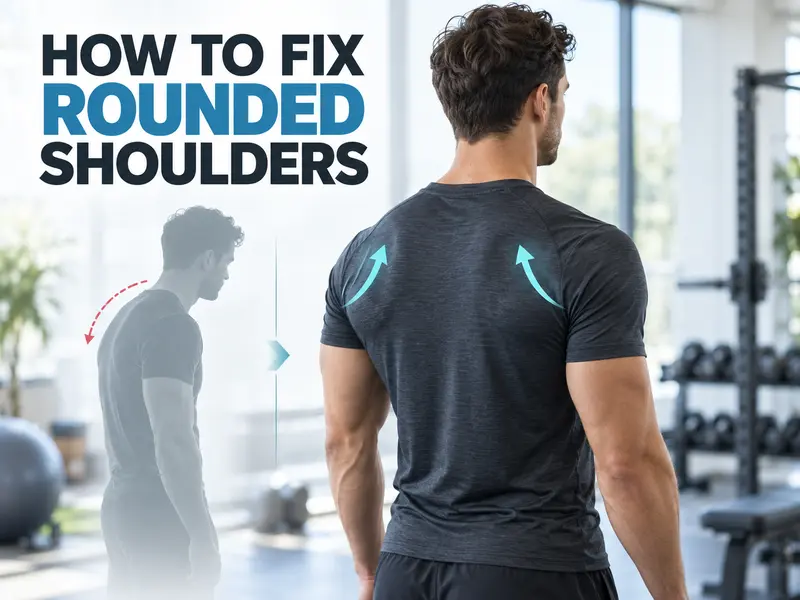
 Learning how to fix rounded shoulders requires more than stretching your chest or reminding yourself to sit upright.
Lasting improvement usually comes from restoring comfortable movement, strengthening the muscles that control your shoulder blades, and changing the training and daily habits that repeatedly pull you forward.
I began taking shoulder health seriously during my junior year of college, when I tore the labrum in my left shoulder.
Since then, I have worked through numerous forms of physical therapy and experimented with soft-tissue work, stretching, mobility exercises, strength training, and different approaches to improving scapular control.
Some methods temporarily reduced tightness, but the most meaningful progress came when I stopped looking for one corrective exercise and started treating the shoulder as part of a larger system.
My thoracic spine, rib cage, shoulder blades, rotator cuff, serratus anterior, and upper-back muscles all needed to work together.
Today, my shoulders are no longer noticeably rounded, my upper back is substantially stronger, and I can maintain good posture without constantly forcing my shoulders backward.
That progress came from consistently training movement quality rather than chasing a perfect static position.
What Are Rounded Shoulders?
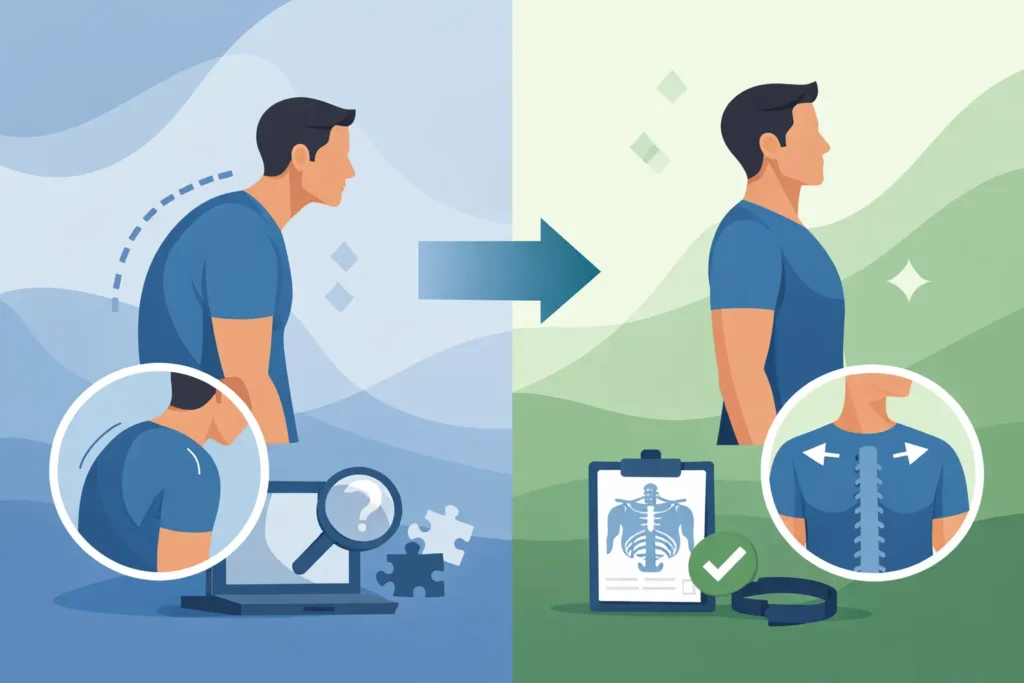
Rounded shoulders describe a resting position in which the shoulders appear to sit forward relative to the rib cage.
This may be accompanied by increased upper-back curvature, forward head posture, internally rotated arms, or tightness across the chest.
One simple sign is the position of your hands when you stand naturally.
If your palms face backward rather than toward your thighs, your upper arms may be resting in greater internal rotation, but this observation alone does not diagnose a problem.
Not every forward shoulder position is dysfunctional.
Your shoulder blades are supposed to protract when you reach, rotate upward when you lift your arms, and move around the rib cage during pushing and pulling exercises.
Rounded shoulders become more relevant when you cannot comfortably move out of the position, your overhead range of motion is limited, or you experience recurring neck, shoulder, or upper-back discomfort.
Appearance should be considered alongside function rather than treated as the only measure of shoulder health.
Research also challenges the idea that posture alone determines whether someone experiences pain.
Thoracic posture can affect immediate shoulder range of motion, but people with shoulder pain do not consistently show greater thoracic kyphosis than those without pain (Barrett et al., 2016).
Therefore, learning how to fix rounded shoulders should not involve blaming every symptom on posture.
A productive plan improves your available positions, strength, endurance, and confidence without convincing you that normal rounding is inherently dangerous.
What Causes Rounded Shoulders?
Rounded shoulders are rarely caused by one short or weak muscle.
They usually reflect a combination of anatomy, training history, previous injuries, repetitive positions, breathing mechanics, movement habits, and the activities your body performs most often.
Common contributing factors include:
- Spending long periods working at a computer or looking down at a phone
- Performing significantly more pressing than pulling exercises
- Limited thoracic extension or rotation
- Poor endurance in the upper-back and posterior shoulder muscles
- Limited control of the shoulder blades during overhead movement
- Stiffness or sensitivity in the pectoralis major, pectoralis minor, or latissimus dorsi
- Weakness or poor coordination in the lower trapezius and serratus anterior
- Guarding after a previous shoulder injury
- Training around pain for months or years
- Avoiding overhead movement and gradually losing confidence in it
My labrum injury likely influenced how I positioned and used my left shoulder for years afterward.
When a movement feels painful or unstable, the body may adopt protective strategies, even after the original injury has healed.
Those compensations are not necessarily harmful, but they can become limiting when they persist.
My experience learning how to fix rounded shoulders was partly about restoring strength and trust in positions I had unconsciously avoided.
Why Stretching Alone Will Not Fix Rounded Shoulders
Stretching the chest can provide short-term relief, particularly after prolonged sitting, driving, or pressing workouts.
However, flexibility does not automatically give your body the strength and coordination needed to control a new range of motion.
This explains why you can stretch every day and still feel rounded by the end of your workday.
If your environment continually pulls you forward and your upper-back muscles fatigue quickly, your body will generally return to its familiar resting position.
Soft-tissue work presented a similar lesson during my rehabilitation.
Massage, manual therapy, foam rolling, and targeted pec release often helped me feel looser, but those changes became more useful when I followed them with controlled movement and progressive strengthening.
Passive treatments can support a program, but they should not become the entire program.
Evidence suggests that scapular-focused exercise may improve shoulder function, while its effects on pain and static scapular positioning are less consistent (Melo et al., 2024).
For those who want to fix rounded shoulders, use strength training to develop the capacity to maintain and control that movement, and use stretching and soft-tissue work to create an opportunity for better movement.
How to Fix Rounded Shoulders: The Four-Part Strategy
The most reliable approach combines thoracic movement, targeted mobility, scapular strength, and better daily habits.
Each component addresses a different part of the problem.
1.) Improve Thoracic Spine Mobility
The thoracic spine is the middle and upper portion of your back.
It provides the foundation for shoulder blade movement, so limited thoracic extension or rotation can make overhead movement feel more difficult.
A more upright thoracic position can immediately increase shoulder range of motion, although this does not prove that thoracic posture is the original cause of pain (Barrett et al., 2016).
I still consider thoracic work valuable because it gives the shoulders more movement options.
Exercises I have used include:
- Thoracic extensions over a foam roller
- Open-book rotations
- Quadruped thoracic rotations
- Bench-supported lat stretches
- Wall-supported overhead reaches
- Controlled thoracic flexion and extension
For foam-roller extensions, support your head and position the roller across your upper back.
Gently extend over the roller without aggressively flaring your ribs or arching your lower back.
Perform six to 10 controlled repetitions at two or three areas of the upper back.
The goal is to make the extension feel gradually more accessible and controlled.
Thoracic rotation is equally important for athletic movement.
Open books and quadruped rotations can help you separate upper-back movement from excessive rotation in the lower back.
2.) Mobilize the Pecs and Lats
If you want to understand how to fix rounded shoulders, you should distinguish useful mobility work from aggressive stretching.
More intensity does not necessarily create a better result.
For a doorway pec stretch, place your forearm against the frame and step forward until you feel a gentle stretch across the chest.
Avoid forcing the shoulder forward or continuing if you feel pinching inside the joint.
The pectoralis minor may be especially relevant because it attaches to the coracoid process of the shoulder blade.
However, trying to “smash” this area with excessive pressure can irritate sensitive structures, so use a ball, massage tool, or manual pressure conservatively.
The lats can also influence overhead motion because they attach to the upper arm and connect with tissues around the trunk.
Bench-supported lat stretches, controlled child’s-pose reaches, and tolerated hanging variations may help you explore overhead range without compensating through the lower back.
Hold mobility positions for approximately 20 to 40 seconds and repeat them once or twice.
Follow the stretches with an active exercise such as a wall slide, Y raise, or light row so your nervous system practices controlling the available range.
3.) Strengthen the Upper Back With Multiple Rowing Angles
Rows were one of the most important parts of my long-term shoulder improvement.
However, simply adding more rows does not guarantee better posture if every repetition involves shrugging, excessive spinal extension, or pulling almost entirely with the arms.
I use multiple rowing angles because the upper back does not perform one single action.
Horizontal rows, high rows, rear-delt rows, and one-arm cable rows challenge the scapular muscles differently.
Effective options include:
- Chest-supported dumbbell rows
- Seated cable rows
- One-arm cable rows
- High cable rows
- Machine rows
- Face pulls
- Reverse fly variations
- Band pull-aparts
Allow the shoulder blade to move forward under control at the beginning of a row.
Pull the elbow back while keeping your neck relaxed, then briefly pause without forcing the shoulder blade into an exaggerated squeeze.
Chest-supported rows are especially useful when your lower back limits bent-over rowing.
They make it easier to train the upper back without using momentum or turning the exercise into a full-body movement.
Start with two to four sets of eight to 15 repetitions two or three times per week.
Use a load that allows you to control both the pulling and lowering phases.
People researching how to fix rounded shoulders are often told to perform twice as much pulling as pressing.
That can be a useful temporary guideline, but it is not a universal rule or a precise biological requirement.
Instead, review your program honestly.
If you do many challenging presses but only a few careless pulling exercises, add high-quality rowing and rear-delt volume to balance your program.
4.)Train the Lower Traps, Serratus Anterior, and Rotator Cuff
Strong rhomboids are helpful, but learning how to fix rounded shoulders is not simply a matter of pinching the shoulder blades together.
Healthy overhead motion requires upward rotation, posterior tilt, protraction, retraction, and coordinated movement between several muscles.
The lower trapezius assists with scapular control and upward rotation.
Prone Y raises, incline-bench Y raises, and the Y portion of I-Y-T-W sequences can train this function with relatively light resistance.
I-Y-T-W exercises became a valuable part of my shoulder training because they strengthen the upper back through several arm positions.
They are humbling exercises, and slow repetitions with very light weights are generally more productive than swinging heavier dumbbells.
You can learn more about the technique through my guide to prone swimmers and related shoulder exercises.
The serratus anterior helps hold the shoulder blade against the rib cage and contributes to upward rotation and protraction.
Push-up-plus variations can produce substantial serratus anterior activation, especially when they are performed with controlled technique (Kang et al., 2019).
Useful serratus exercises include:
- Push-up plus
- Incline push-up plus
- Foam-roller wall slides
- Serratus punches
- Bear-crawl holds
- Quadruped reaches
- Landmine presses
During a push-up plus, complete the push-up and then gently push the floor away at the top.
Let your shoulder blades wrap around your rib cage without shrugging toward your ears or rounding your lower back.
The rotator cuff helps center and control the upper arm during movement.
Cable external rotations, side-lying external rotations, and controlled carries can strengthen these muscles without requiring heavy loads.
Scapular-focused exercise appears to improve pain and function in people with subacromial pain, although study protocols and results vary (Saito et al., 2018; Zhong et al., 2024).
This supports a well-rounded program rather than a promise that one “corrective” exercise will cure every shoulder problem.
The Best I-Y-T-W Technique for Rounded Shoulders
Lie face down on an incline bench or position your torso close to parallel with the floor.
Keep your ribs controlled, your neck long, and your chin gently tucked.
Perform the following sequence:
- I raise: Reach your arms forward in line with your body.
- Y raise: Lift your arms diagonally with your thumbs pointing upward.
- T raise: Extend your arms to the sides and squeeze gently across the upper back.
- W raise: Bend your elbows and draw them toward your back pockets.
Use no weight or very light dumbbells initially.
Complete six to 10 repetitions in each position, stopping before your shoulders begin shrugging or your lower back starts extending.
These exercises helped me build the healthy upper-back musculature that now supports my posture.
They work best as part of a progressive strength program rather than as a daily punishment for sitting.
A 10-Minute Routine to Fix Rounded Shoulders
If you are learning how to fix rounded shoulders, begin with a routine simple enough to repeat three to five times per week.
- Thoracic foam-roller extensions: 60 seconds
- Open-book rotations: Eight repetitions per side
- Doorway pec stretch: 30 seconds per side
- Chest-supported row: Two sets of 12 repetitions
- Incline Y-T-W sequence: Six to eight repetitions per position
- Push-up plus or wall slide: Two sets of 10 repetitions
Move slowly and keep the routine pain-free.
Once your technique improves, gradually increase the resistance for rows, reverse flyes, external rotations, and serratus exercises.
Mobility drills may help you access a position, but progressive resistance is what gives you the capacity to use it.
That distinction is central to understanding how to fix rounded shoulders without wasting months on temporary solutions.
How to Adjust Your Strength-Training Program for Reducing Rounded Shoulders
You do not need to abandon bench presses, push-ups, or overhead presses.
Pressing movements can support healthy shoulders when performed with an appropriate range of motion, sensible volume, and adequate pulling work.
For four to eight weeks, consider matching every primary pressing exercise with at least one rowing or pulling exercise.
You can also add two or three smaller sets of rear-delt, lower-trap, serratus, or rotator-cuff work near the end of your workouts.
An example upper-body structure could include:
- Dumbbell bench press
- Chest-supported row
- Landmine press
- Lat pulldown
- Reverse cable fly
- Serratus wall slide
- External rotation
Do not assume that every shoulder blade must remain “down and back” during every exercise.
The scapula should move during pressing and overhead reaching, particularly through upward rotation and protraction.
Good movement quality is adaptable, as your goal is to control several positions rather than hold your shoulder blades in one artificial position all day.
Daily Habits That Support Better Shoulder Posture
Several daily habits can also support shoulder posture.
A well-designed desk can reduce unnecessary strain, but no ergonomic setup eliminates the need to move.
Even an ideal posture can become uncomfortable when you hold it for several uninterrupted hours.
Position your monitor close to eye level, keep frequently used objects within easy reach, and support your feet.
More importantly, change positions and take a brief movement break approximately every 30 to 60 minutes.
You do not need to perform an entire corrective workout during each break. Stand up, walk, reach overhead, take several relaxed breaths, or complete five controlled shoulder-blade movements.
Breathing can influence how the rib cage and shoulder blades interact. Practice breathing into the sides and back of your rib cage instead of repeatedly lifting your upper chest and tightening your neck.
These habits reinforce the physical work you perform in the gym. Anyone asking how to fix rounded shoulders should examine the other 23 hours of the day, not only the 10 minutes spent performing corrective exercises.
How Long Does It Take to Fix Rounded Shoulders?
There is no universal timeline because rounded shoulders don’t have a single cause.
Mobility may feel better within a single session, but measurable changes in strength, endurance, movement habits, and resting posture generally require consistent training over several weeks or months.
Monitor more than your appearance.
Useful signs of progress include easier overhead reaching, less fatigue between the shoulder blades, improved rowing technique, greater pressing comfort, and less need to consciously correct your posture.
Photographs can help, but take them under similar conditions.
Camera height, arm position, fatigue, and the way you intentionally stand can make posture appear different even when little has changed.
When to See a Physical Therapist or Doctor
Corrective exercises are not a substitute for a diagnosis.
Seek professional evaluation if your symptoms began after an injury or dislocation, pain regularly wakes you at night, or your strength and range of motion continue to decline.
Numbness, tingling, unexplained weakness, visible muscle wasting, instability, or pain that travels down the arm also deserves medical attention.
These symptoms may involve the shoulder joint, cervical spine, nerves, or another condition that posture exercises cannot identify.
My history of a labral tear is one reason I approach shoulder discomfort carefully.
If you have a previous structural injury, a physical therapist can help determine which movements are appropriate and how quickly you should progress them.
Final Thoughts: How to Fix Rounded Shoulders for Lasting Results
My experience taught me that asking how to fix rounded shoulders is the wrong question if you’re looking for one stretch, massage tool, or corrective exercise.
A better question is how to build shoulders that can move freely, tolerate training, and maintain strong positions without constant tension.
Thoracic mobility, pec and lat work, rows, I-Y-T-W exercises, lower-trap training, serratus strengthening, rotator-cuff work, and daily movement breaks all played a role in getting my shoulders to their current healthy position.
No single piece created the result.
Do not force your shoulders backward or treat normal rounding as damage.
Develop more movement options, strengthen those positions progressively, and adjust the habits that repeatedly contribute to stiffness.
That is how to fix rounded shoulders without guesswork: create mobility where you need it, build strength around it, and give the process enough consistency to work.
Frequently Asked Questions About Fixing Rounded Shoulders
This website does not provide medical advice. This website site does contain affiliate links, and purchases may earn a commission.
Read my Medical Disclaimer, Review Disclaimer, and Publishing Policies for more details. Use of this site indicates acceptance of these terms.
Check Out Some of My YouTube Videos Below, and Please Follow on YouTube for More Educational Health and Fitness Content!
![Subscribe to @AdamKempFitness for more training, general health, recovery, and nutrition tips from a professional basketball player with a master’s degree in Nutrition Education! 🏀💪
Seated Max Vertical Jumps From a Box are one way I train explosive takeoff power with maximum intent on every rep.
Starting seated, with a pause and minimal rocking or dipping, reduces the contribution of a quick countermovement and emphasizes producing force from a relatively static position (National Strength and Conditioning Association [NSCA], 2020).
For athletes, the training goal is explosive lower-body force production and coordinated extension through the hips, knees, and ankles. I use this variation to practice driving hard into the floor and accelerating my body upward.
My preferred setup: 3 sets of 3 reps or 4 sets of 2 reps, supersetted with a strength or power exercise.
I keep the reps low, reset between jumps, and take longer rest periods so I’m ready to attack every takeoff. Even when pairing exercises, I give myself enough recovery to keep the jumps sharp.
Every rep has one goal: jump as high as possible. I focus on an explosive takeoff, a controlled landing, and consistent quality throughout the session.
Save this for your next power workout! 🚀
Reference: NSCA. (2020). Stretch-shortening cycle.
#VerticalJump #JumpTraining #ExplosivePower #AthleticPerformance #BasketballTraining](https://www.adamkempfitness.com/wp-content/plugins/feeds-for-youtube/img/placeholder.png)