Around the World Exercise: Build Strong, Healthy Shoulders!
 Reading Time: 7 minutes
The around the world exercise is a light-dumbbell shoulder movement that involves raising your arms through a wide, controlled arc.
It has been part of my routine for years as a professional basketball player, and I believe it is an amazing shoulder exercise for improving comfortable shoulder motion.
After tearing my labrum during my second year of college basketball, shoulder rehabilitation became a regular part of my training.
The around-the-world exercise is one of the exercises I have used in my ongoing effort to build strong, healthy shoulders, and I know it can provide benefits for others as well.
I typically use 10-pound dumbbells for three sets of 15 repetitions, emphasizing smooth movement and control throughout each rep.
However, that is my personal routine, rather than a starting prescription for everyone.
Below, I’ll break down the standing dumbbell around the world exercise, the muscles involved, and how I approach technique and progression.
What is the Around the World Exercise?
The around-the-world exercise is a dynamic, circular movement that targets shoulder mobility, stability, and strength.
This exercise involves moving a pair of light dumbbells in a smooth, controlled arc around your body, mimicking the shape of a circle.
The movement pattern challenges multiple muscles across the shoulders, upper back, and chest, making it an excellent addition to any fitness routine focused on improving shoulder health.
Its name reflects the continuous motion that “travels” around your body, engaging both primary and stabilizing muscles to maintain control.
This exercise not only builds strength but also enhances coordination, flexibility, and body awareness.
As a low-impact movement, it is ideal for athletes rehabbing shoulder injuries or individuals looking to prevent shoulder pain while building functional strength.
Around the World Exercise Muscles Worked
The around the world exercise primarily targets the deltoids (shoulder muscles) and the trapezius (upper back).
The scapula, or shoulder blade, plays a crucial role in the around the world exercise.
Proper scapular movement and stability are essential for maintaining shoulder health and maximizing the benefits of this exercise.
- Scapular Stability: During the around the world exercise, the scapula must remain stable to provide a solid base for shoulder movements. This stability helps prevent excessive strain on the shoulder joint and reduces the risk of injury.
- Scapular Mobility: The scapula needs to move smoothly and in coordination with the arms to allow for the full range of motion required by the exercise. Proper scapular mobility ensures that the shoulder joint can move freely and effectively, enhancing the overall effectiveness of the exercise.
- Muscle Engagement: The muscles that control the scapula, including the serratus anterior, trapezius, and rhomboids, are actively engaged during the around the world exercise. Strengthening these muscles improves scapular control and contributes to better shoulder function.
Additionally, it engages the pectorals (chest muscles), rotator cuff muscles, and the core, including the obliques and the rectus abdominis.
The dynamic nature of this exercise also involves the lower body to a lesser extent, helping to stabilize and balance the movement.
How to Do the Around the World Exercise with Dumbbells
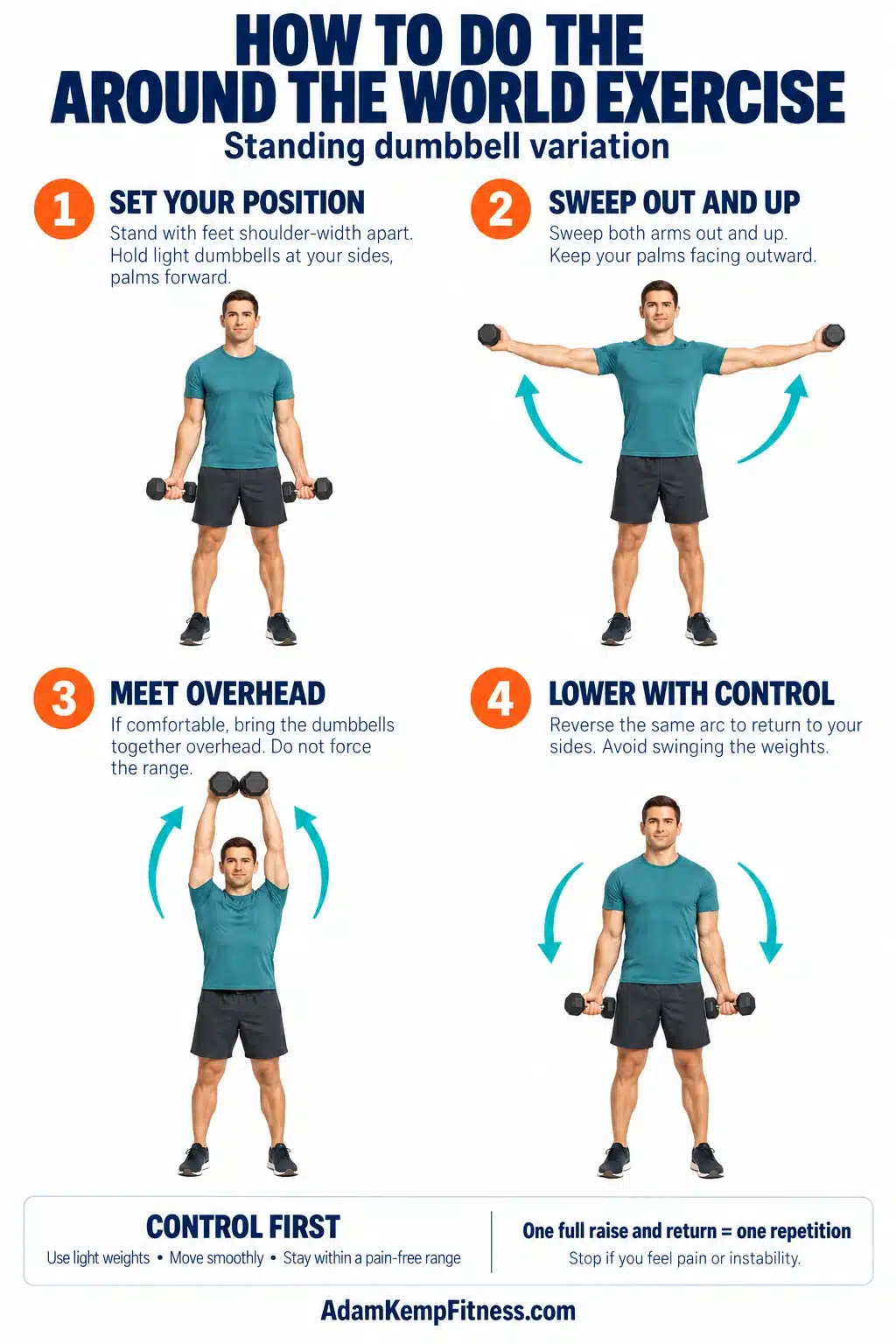
To perform the around the world exercise with light dumbbells, follow these steps:
- Start Position: Stand with your feet shoulder-width apart, holding a light dumbbell in each hand, arms extended down by your sides and having your palms facing forward.
- Movement: Lift both dumbbells simultaneously, bringing them up to the sides of your body and then overhead. Continue the circular motion by moving the dumbbells back down.
- Repetitions: Aim for 10-15 repetitions in each direction, maintaining a controlled and steady pace throughout the movement, especially lowering the weight with a 3-5 count to maximize muscle engagement.
Benefits of the Around the World Exercise
The around the world exercise offers a practical way to practice controlled shoulder movement with light dumbbells.
I include it in my training because it gives me an opportunity to focus on movement quality and a comfortable range of motion.
Research on resistance training provides context for its potential benefits, but the studies discussed below do not establish the effects of this specific exercise.
Its role is best understood as part of a broader shoulder-training routine, but it is certainly an excellent exercise in its own right.
Supports Shoulder Mobility Through Loaded Movement
Around the worlds involve actively moving your arms through a wide arc while controlling an external load.
For me, the goal is to use the range I can manage smoothly, rather than force my shoulders into a larger movement.
A systematic review and meta-analysis of 55 studies found that resistance training improved joint range of motion in healthy participants, with no significant difference between resistance training and stretching overall (Alizadeh et al., 2023).
These findings support the broader idea that strength training and mobility work can and should overlap for people who are trying to improve their shoulder health.
Provides a Simple Way to Practice Shoulder Control
The Around-the-World Exercise gives you a clear movement task: raise and lower both dumbbells while keeping your torso steady and the motion controlled.
I prioritize an even tempo and a comfortable arc over more repetitions or heavier weights, and I use this exercise to practice control through movement, improve proprioception, and help correct shoulder instability.
Adds Variety to Your Shoulder-Strengthening Routine
Around the worlds provide a different movement pattern from presses, rows, and shorter-range raises.
I use them as an accessory exercise, using lighter dumbbells and paying closer attention to how each repetition feels.
A Convenient At-Home Shoulder Exercise
You only need a pair of light dumbbells and enough space to raise your arms, making around the worlds a convenient shoulder exercise to do at home.
That simplicity is one reason I have continued using them over the years.
Easily Fits Into Your Shoulder-Health Routine
After tearing my labrum in college, I learned to view shoulder care as an ongoing part of training.
The around the world is one exercise I use within that process, and they are one of the regular exercises I rely on to prevent another injury.
However, research calls for caution with injury-prevention claims, as a 2025 systematic review of handball shoulder-prevention programs found that some individual trials reported benefits, but the pooled analysis did not show a statistically significant reduction in shoulder injuries (Yonneau et al., 2025).
Those programs included multiple exercises, so their results cannot be attributed to around the worlds.
This exercise should not be presented as a proven way to prevent impingement, dislocations, or shoulder strains.
However, my reason for keeping it in my shoulder health and upper-body exercise routine is straightforward: I value the chance to practice smooth, controlled shoulder movement with a manageable load and it makes my shoulder feel good!
How to Safely Progress with the Around-the-World Exercise
To safely progress with the around the world exercise, follow these steps:
- Start with Light Weights: Begin with light weights to ensure proper form and technique. Focus on mastering the movement before increasing the load.
- Gradually Increase Weight: Once comfortable with the movement, gradually increase the weight in small increments to continue challenging your muscles.
- Incorporate Variations: To add variety and increase difficulty, try performing the exercise in different positions, such as kneeling or in a staggered stance.
- Combine with Other Exercises: Integrate the around the world exercise into a broader workout routine that includes other strength and mobility exercises to ensure balanced muscle development and prevent overuse injuries.
Incorporating the around the world exercise into your fitness regimen can significantly improve your shoulder mobility, strength, and overall athletic performance.
By following the steps and progression tips outlined above, you can safely and effectively make this exercise a staple in your workout routine.
Improving mobility to perform this exercise pain-free should be a primary goal before gradually adding weight to enhance shoulder strength.
Additionally, prone swimmers are a great complementary exercise for the around-the-world shoulder movement.
Is the Around the World Exercise Dangerous?
The around the world exercise is not automatically dangerous, but it is not appropriate for every shoulder.
The research discussed above does not establish its specific injury risk, so neither “completely safe” nor “inherently harmful” is a justified label.
For the standing dumbbell variation, my approach is to prioritize light resistance, smooth movement, and a comfortable range of motion.
General shoulder-conditioning guidance from the American Academy of Orthopedic Surgeons advises against exercising through pain and recommends individualized exercise selection after injury or surgery (AAOS, n.d.-b).
However, improving your range of motion can reduce long-term pain and improve overall function.
Extra care is warranted if your shoulder repeatedly gives way or feels as though it could slip out of place, which are recognized symptoms of shoulder instability.
A clinician can assess these symptoms and help determine appropriate activity modifications and strengthening exercises (AAOS, n.d.-a).
Although I have used around the worlds since my college labrum injury, my experience does not make them a rehabilitation prescription for another person’s injury.
If you have a current labral tear, recent shoulder surgery, or persistent pain, ask your physical therapist whether this movement fits your recovery plan.
Final Thoughts: Should You Add the Around the World Exercise to Your Workout Routine?
The around the world exercise is worth considering if you want a shoulder-focused accessory movement and can perform it comfortably.
After years of managing my shoulder following a college labrum injury, I still include around the worlds in my routine.
My experience is personal, however, and does not establish that the exercise will suit everyone with a shoulder problem.
Start conservatively, prioritize smooth repetitions, and treat overhead dumbbell contact as optional.
If you are recovering from an injury or experience pain during the movement, seek guidance on exercise selection from your physical therapist or physician (American Academy of Orthopedic Surgeons [AAOS], n.d.).
For me, around the worlds earn their place as a part of a routine for building strong, healthy shoulders.
Always remember, the goal is a movement you can control and consistently tolerate, not the biggest possible arc or the heaviest dumbbells.
This website does not provide medical advice. This website site does contain affiliate links, and purchases may earn a commission.
Read my Medical Disclaimer, Review Disclaimer, and Publishing Policies for more details. Use of this site indicates acceptance of these terms.
Check Out Some of My YouTube Videos Below, and Please Follow on YouTube for More Educational Health and Fitness Content!