Whey Isolate vs Concentrate: Which is Better for Your Goals?
 Reading Time: 11 minutes
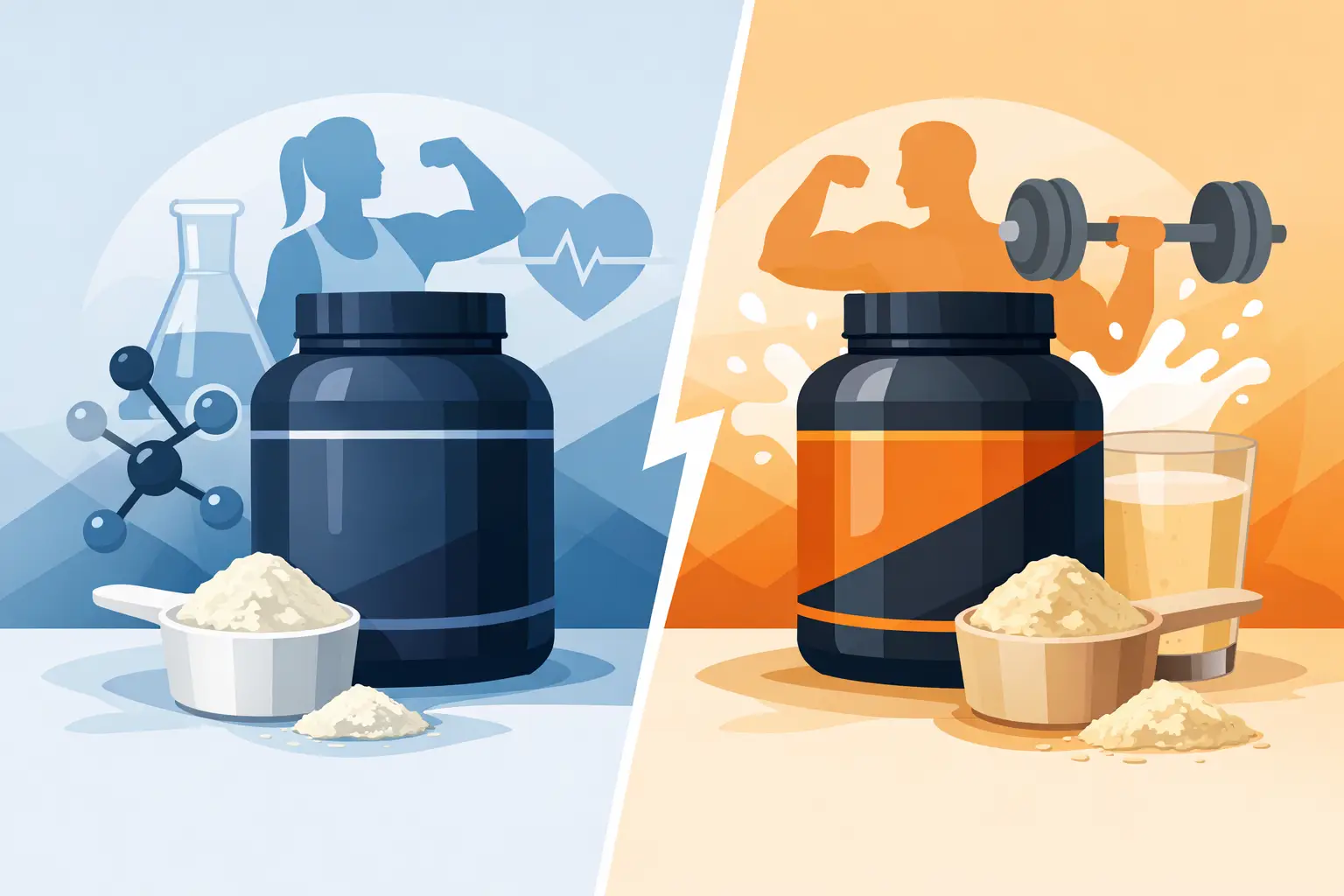
 When comparing whey isolate vs concentrate, neither form is automatically better for building muscle, recovery, or general health.
Whey isolate contains a higher percentage of protein and less lactose, fat, and carbohydrate, while whey concentrate usually costs less and has a creamier taste.
As a professional basketball player with a master’s degree in nutrition education, I have used both forms throughout my career, but now I nearly always choose vegan protein powders.
In general, my choice of protein powder depends on digestion, price, serving size, and how it fits into the rest of my diet.
If you digest dairy comfortably and want an affordable everyday protein powder, whey concentrate is usually sufficient.
Whey isolate may be worth the higher price if you are lactose-sensitive, carefully controlling calories, or prefer a lighter shake.
Read the rest of my whey concentrate vs whey isolate review to learn which is best for your goals!
Whey Isolate vs Concentrate: Quick Comparison
| Feature | Whey Concentrate | Whey Isolate |
|---|---|---|
| Protein concentration | Usually around 70%–80% | Usually 90% or more |
| Lactose | More | Less |
| Fat and carbohydrates | Slightly more | Very little |
| Calories per gram of protein | Slightly higher | Slightly lower |
| Texture | Creamier | Thinner and lighter |
| Price | Usually less expensive | Usually more expensive |
| Best for | Most people who tolerate dairy | Lactose sensitivity or tightly controlled calories |
| Muscle-building potential | Excellent | Excellent |
These are general differences, not guaranteed values.
Always compare the nutrition labels of the specific products you are considering.
What Is Whey Protein Concentrate?
Whey protein is a milk-derived protein separated during cheesemaking.
After filtering and drying the liquid whey, it can be used to make several forms of protein powder.
Whey protein concentrate retains more of the naturally occurring lactose and fat.
Concentrates are available at different protein percentages, but the products used in most protein powders are commonly whey protein concentrate 80, or WPC80, which contains approximately 80% protein by dry weight.
A typical serving provides approximately 20 to 25 grams of protein, although scoop size and formulation vary.
The remaining material consists largely of lactose, fat, minerals, moisture, and other milk components.
Those remaining components do not make concentrate a low-quality protein.
Whey concentrate still supplies all nine essential amino acids and is naturally rich in leucine, one of the primary amino acids involved in stimulating muscle protein synthesis (Jäger et al., 2017).
Whey concentrate also tends to produce a creamier shake and may taste better with fewer flavoring ingredients.
For people who tolerate dairy, it is often the most practical combination of protein quality, taste, and price.
What Is Whey Protein Isolate?
Whey protein isolate begins with the same liquid whey but undergoes additional filtration.
This process removes a larger proportion of its lactose, fat, and other non-protein components.
The finished ingredient generally contains at least 90% protein by dry weight.
As a result, whey isolate usually provides slightly more protein per gram of powder and fewer calories from carbohydrates and fat.
Whey isolate is frequently described as lactose-free, but that claim should not be assumed unless it appears on the product label.
It normally contains much less lactose than concentrate, although trace amounts may remain.
This distinction matters for lactose intolerance, but it does not make isolate appropriate for someone with a milk allergy.
Lactose intolerance involves difficulty digesting milk sugar, whereas a milk allergy is an immune reaction to milk proteins; because whey itself is a milk protein, both concentrate and isolate can trigger an allergic reaction.
What Is the Difference Between Whey Isolate and Whey Concentrate?
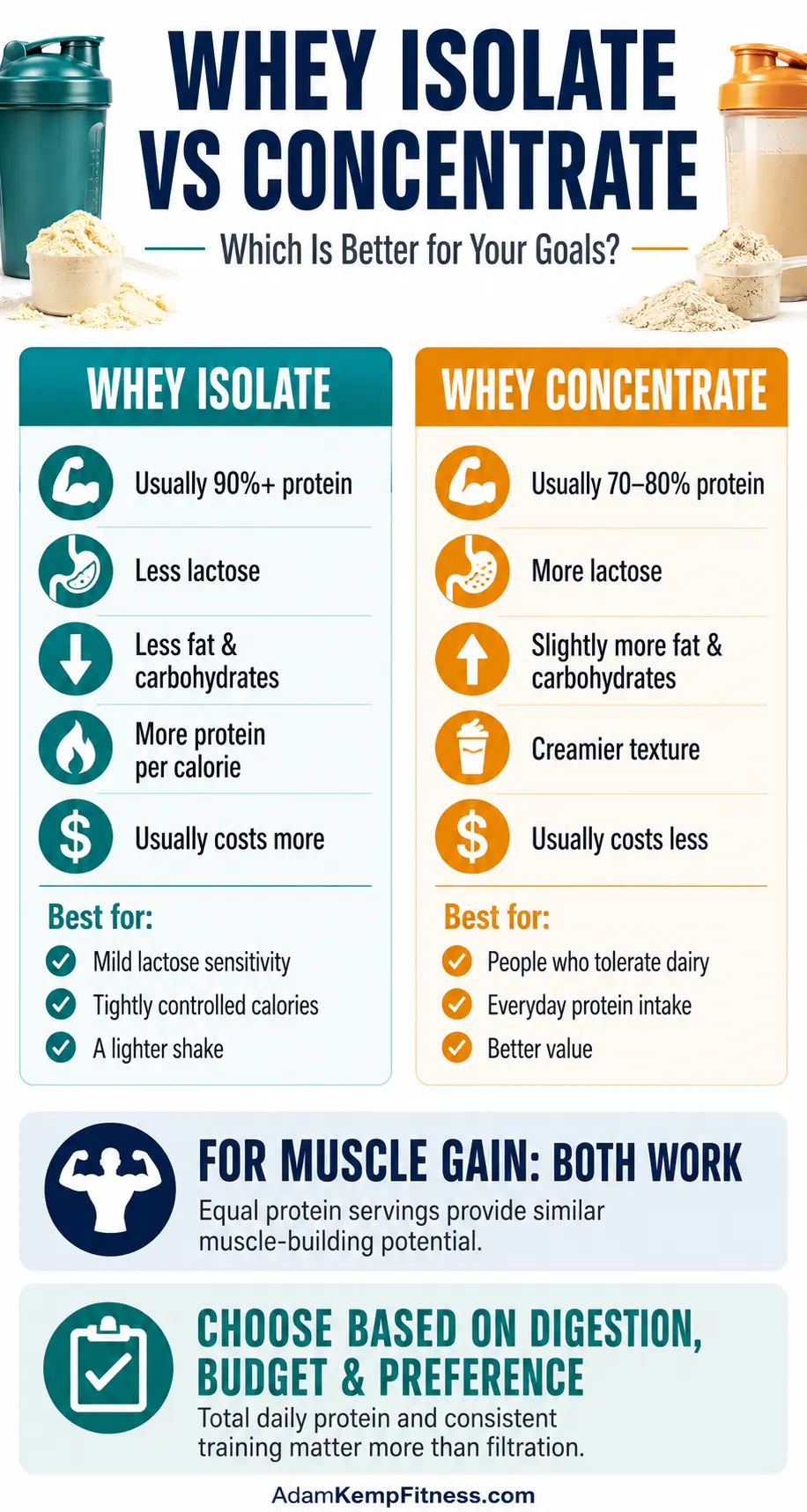
The main difference between whey concentrate vs isolate is how much non-protein material has been removed. Isolate is more filtered, but additional filtration doesn’t make it a more anabolic protein.
Both forms contain the same essential amino acids.
When two servings provide equal amounts of protein, their effects on muscle gain and recovery should be similar within an otherwise adequate diet.
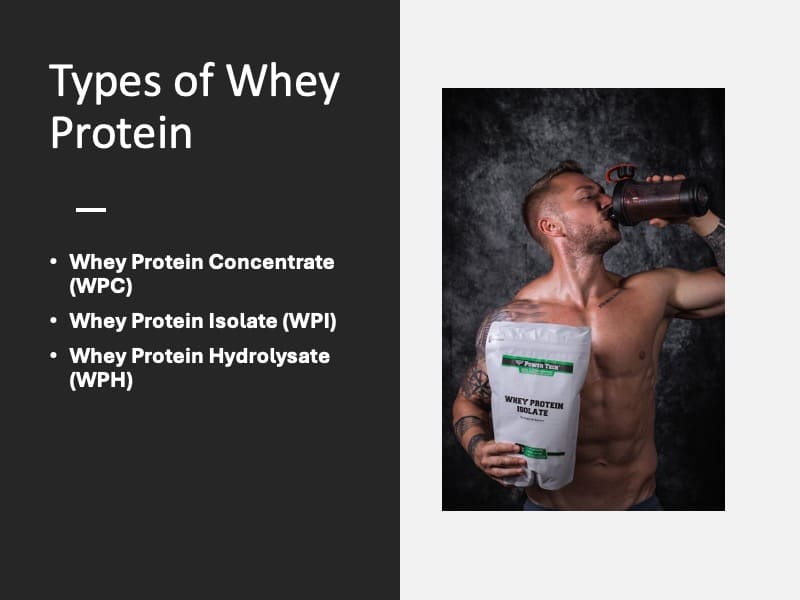
The additional processing primarily changes four practical characteristics:
- Protein concentration
- Lactose content
- Calories from fat and carbohydrates
- Price
That means the choice between whey isolate vs whey concentrate is mainly about nutritional efficiency, digestion, and value. It is rarely the factor that determines whether someone builds muscle successfully.
Is Whey Isolate Better Than Concentrate for Muscle Gain?
Whey isolate is not meaningfully better than concentrate for muscle gain when both products provide the same amount of protein.
Resistance training, total daily protein intake, sufficient calories, sleep, and long-term consistency matter considerably more.
Most exercising adults can support muscle growth and recovery with approximately 1.4 to 2.0 grams of protein per kilogram of body weight per day. Individual needs vary according to training demands, total calorie intake, age, and body-composition goals (Jäger et al., 2017).
That range equals approximately 0.64 to 0.91 grams per pound.
A daily target of about 0.7 to 1 gram per pound is a practical range for many lifters and athletes, but it should not be treated as a requirement for everyone.
If concentrate helps you reach that target comfortably and affordably, changing to isolate is unlikely to create noticeably faster muscle growth.
You may receive more benefit from spending the difference on nutritious meals, carbohydrates that support training, or other recovery needs.
Whey isolate becomes more useful if concentrate causes digestive discomfort or if you need to increase protein without adding as much lactose, fat, or carbohydrate. In that case, its value comes from making your nutrition plan easier to follow.
You can also compare whey with other protein and amino-acid supplements in my guide to essential amino acid supplements.
Is Whey Isolate or Concentrate Better for Weight Loss?
Whey isolate has a small nutritional advantage for weight loss because it generally delivers more protein per calorie.
However, the difference between individual products may be much smaller than their marketing suggests.
Depending on the formulas being compared, isolate may save approximately 10 to 40 calories per serving.
That can be useful if you drink several shakes a day or closely manage your calories, but one scoop alone won’t meaningfully affect fat loss.
Protein can help with fullness and the retention of lean mass during weight loss, particularly when combined with resistance training.
The calorie deficit still determines whether body weight decreases, while protein intake and strength training help influence how much lean tissue is retained (Helms et al., 2014).
Compare the actual labels instead of assuming every isolate is leaner.
An isolate-based powder with added sugar, creamer, cookie pieces, or other ingredients can contain more calories than a simple concentrate.
Concentrate may remain the better choice if it tastes better and helps you follow your plan consistently.
The best option is the one that allows you to reach your protein target while maintaining an appropriate calorie intake.
Which Type of Whey Is Easier to Digest?
Whey isolate is generally easier to digest for people who have difficulty tolerating lactose because most of the lactose has been removed.
However, lactose is only one possible cause of discomfort from a protein shake.
Sugar alcohols, gums, artificial sweeteners, large serving sizes, and mixing whey with milk can also contribute to bloating, gas, or diarrhea.
Drinking a shake too quickly may make these symptoms worse.
If concentrate bothers your stomach, try the following before discarding it:
- Use half a serving.
- Mix it with water instead of milk.
- Choose an unflavored or minimally flavored formula.
- Avoid products containing several gums or sugar alcohols.
- Increase the serving gradually if symptoms do not return.
If discomfort continues, try an isolate with a short ingredient list.
Someone with diagnosed lactose intolerance may also want a product specifically labeled lactose-free rather than relying on the word “isolate.”
People with milk allergies should avoid both forms unless a qualified medical professional advises otherwise.
Pea, soy, rice, egg-white, or blended plant protein powders may be safer alternatives, depending on the allergy and other dietary needs.
Does Whey Isolate Absorb Faster Than Concentrate?
Both whey isolate and concentrate are rapidly digested proteins.
Isolate may be marginally faster because it contains less fat and lactose, but this difference is unlikely to meaningfully affect muscle growth for most people.
You do not need the fastest possible powder immediately after completing your final repetition.
The evidence supports consuming enough high-quality protein throughout the day, with individual servings distributed across meals according to your schedule and overall needs (Jäger et al., 2017).
A shake is helpful after training when your next meal is several hours away.
If you will eat a complete meal shortly after your workout, there is usually no urgent need to add a protein shake.
Whey Concentrate vs Isolate: Which Is More Cost-Effective?
Whey concentrate has historically been the less expensive option, but the most useful comparison is cost per 25 grams of protein, not cost per tub or scoop.
A larger scoop can make a concentrate appear to provide as much protein as an isolate while using more powder.
Conversely, an expensive isolate may offer only a few fewer calories than a cheaper concentrate.
Use this calculation when comparing products:
Product price ÷ total grams of protein in the container × 25
For example, a $40 container with 600 total grams of protein costs approximately $1.67 per 25 grams of protein.
This calculation makes it easier to compare different scoop sizes and container weights.
Also consider whether you enjoy the product. A cheaper powder is not good value if its taste or texture causes it to sit unused.
How to Choose a Quality Whey Protein Powder
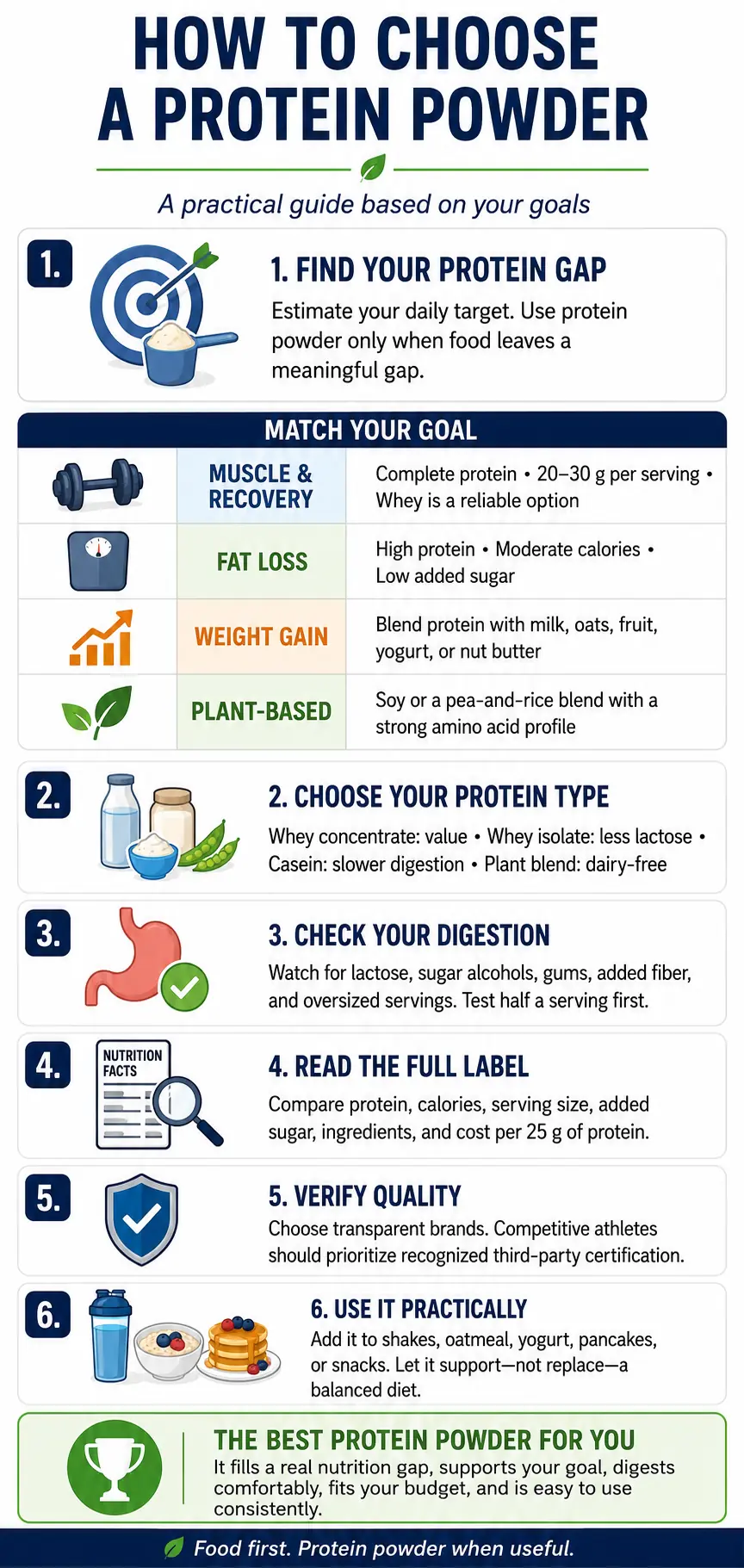
Ignore the claims on the front of the package until you have read the nutrition facts and ingredient list.
The words “premium,” “lean,” and “advanced” do not have much value without numbers behind them.
Consider the following factors:
1.) Check Protein per Serving
Most people should look for approximately 20 to 30 grams of protein per serving. Check the serving weight as well because 25 grams of protein from a 30-gram scoop represents a different concentration than 25 grams from a 45-gram scoop.
2.) Examine Protein-to-Calorie Ratio
Divide the grams of protein by the total calories. A powder that provides 25 grams of protein for 120 calories is more protein-dense than one providing 20 grams for 160 calories.
You do not always need the leanest option, but this comparison shows what you are paying for.
3.) Understand the Ingredient Order
Ingredients appear in descending order by weight. If the product is marketed as an isolate but whey concentrate appears first, concentrate is probably the primary protein source.
A whey blend can still be effective. The label should simply match what you believe you are purchasing.
4.) Be Mindful of Added Ingredients
Flavorings and sweeteners are not automatically harmful, but a longer formula gives you more possible causes to investigate if the powder upsets your stomach.
Pay particular attention to added sugar, sugar alcohols, gums, and unnecessary proprietary blends.
For more help evaluating labels and common retail products, see my guide to choosing the best protein powder at Walmart.
5.) Look for Third-Party Testing
Competitive athletes should prioritize products certified by a reputable testing program.
Certification cannot eliminate every possible risk, but it provides more protection than relying only on a manufacturer’s claims.
USADA recommends NSF Certified for Sport as a risk-reduction measure for athletes who choose to use supplements.
Informed Sport is another program that tests individual product batches for prohibited substances (USADA, n.d.; Informed Sport, n.d.).
Athletes should record the product name, lot number, and certification status for every supplement they use.
Strict-liability rules mean that an athlete can still be responsible for a prohibited substance found in their sample, even when exposure was accidental.
Who Should Choose Whey Concentrate?
Whey concentrate is probably the better choice if you:
- Digest dairy without discomfort
- Want the best value per serving
- Prefer a creamier shake
- Are not tightly restricting carbohydrates or fat
- Use protein powder mainly for convenience
- Can obtain a reputable concentrate with a simple formula
For most healthy adults who tolerate lactose, a well-made concentrate provides everything needed from a whey protein powder.
Who Should Choose Whey Isolate?
Whey isolate may be worth the additional cost if you:
- Have mild lactose sensitivity
- Want the highest protein-to-calorie ratio
- Are following a tightly controlled fat-loss diet
- Prefer a thinner, lighter shake
- Experience discomfort with concentrate
- Need to limit fat or carbohydrate for a specific dietary reason
Isolate is a useful refinement, but it does not compensate for inadequate protein intake or inconsistent training.
Can You Mix Whey Isolate and Concentrate?
Yes.
Many protein powders combine whey isolate and concentrate to balance price, texture, and protein density.
A blend can provide the creamier taste of concentrate with some of the lower-lactose benefits of isolate.
However, people who are sensitive to lactose should check which ingredient appears first because a product marketed around isolate may still contain a substantial amount of concentrate.
There is no special muscle-building benefit to combining the two. A blend is simply another practical formulation.
Frequently Asked Questions ABout Whey Isolate and Whey Concentrate
Final Thoughts: Is Whey Isolate or Concentrate Better for You?
In the whey isolate vs concentrate comparison, isolate is the leaner and lower-lactose option, while concentrate is usually the better value.
Both provide complete, leucine-rich protein that can support muscle growth and recovery.
I recommend whey concentrate for most people who digest dairy well.
I would choose isolate when lactose, digestive comfort, or strict calorie control makes its nutritional profile genuinely useful.
Protein powder should fill a gap rather than become the foundation of your diet.
Build most of your meals around nutrient-rich protein sources, fruits, vegetables, quality carbohydrates, and dietary fats, then use whey when convenience helps you stay consistent.
This website does not provide medical advice. This website site does contain affiliate links, and purchases may earn a commission.
Read my Medical Disclaimer, Review Disclaimer, and Publishing Policies for more details. Use of this site indicates acceptance of these terms.