
Spine Surgery for Active Adults: How Modern Treatments Prioritize Mobility and Function
 Reading Time: 7 minutes
Spine surgery for active adults should address the underlying spinal problem while supporting a return to meaningful movement, whether that means lifting weights, running, playing sports, or keeping up with everyday life.
For someone who values exercise, the treatment conversation should include both symptom relief and what recovery could mean for the activities they enjoy.
After more than a decade of professional basketball, I understand how much an injury can affect your confidence, routines, and sense of independence.
When considering an operation, understanding how treatment aligns with your long-term activity goals matters as much as understanding the procedure itself.
Modern surgical options offer different ways to approach those goals.
For example, cervical artificial disc replacement can preserve movement at the treated spinal level in appropriately selected patients, although suitability depends on factors such as spinal stability, bone health, and the condition of surrounding joints (American Academy of Orthopaedic Surgeons [AAOS], n.d.).
Minimally invasive techniques can also limit disruption to surrounding muscles, but recovery still depends on the underlying condition, the operation performed, and an appropriate rehabilitation plan (AAOS, n.d.).
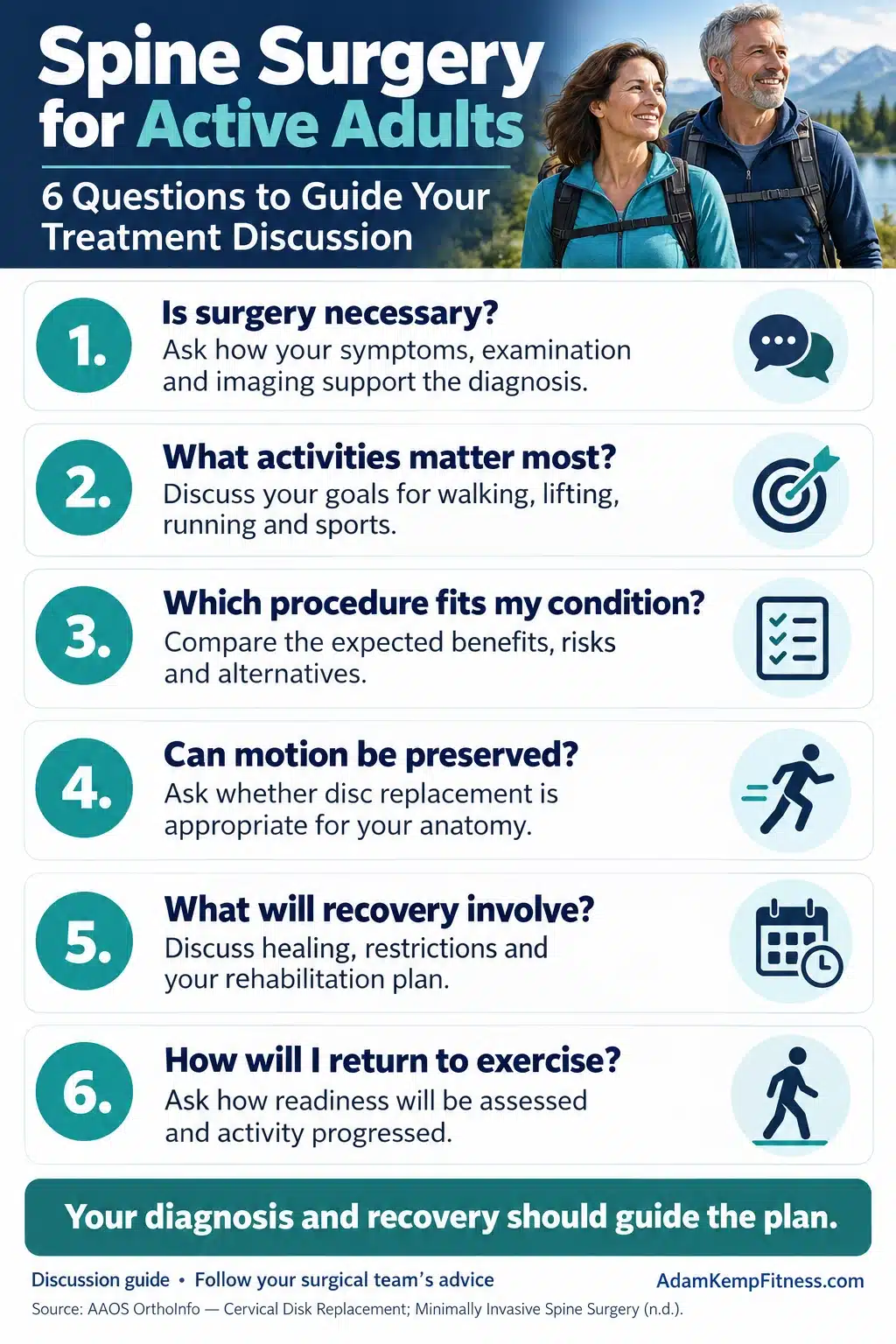
A useful starting point is to discuss whether surgery is necessary, which treatment fits your diagnosis, and how you will progress toward your specific exercise goals.
Those questions help put mobility, function, and lasting participation at the center of decisions about spine surgery for active adults.
Why Activity Goals Matter Before Spine Surgery
Traditional measures of surgical success often focus on pain relief, neurological improvement, and whether the operation corrected the underlying structural problem.
These remain essential, but they do not always capture everything that matters to physically active patients.
Someone who enjoys recreational weightlifting may consider returning to resistance training a major recovery goal.
A runner may be concerned about endurance and impact tolerance, while someone who practices Pilates may prioritize flexibility and comfortable movement.
These differences can influence the treatment discussion.
Surgeons must understand not only what is wrong with the spine, but also which activities the patient hopes to resume and whether those expectations are realistic.
Importantly, an active lifestyle does not automatically make someone a better candidate for surgery.
The structural problem must still correspond with symptoms, and the proposed operation must offer a reasonable likelihood of improvement.
When Does an Active Adult Actually Need Spine Surgery?
Many spinal conditions can initially be managed without an operation.
Physical therapy, activity modification, medication, and other nonsurgical treatments may provide sufficient improvement for patients to continue exercising.
A herniated disc, for example, does not automatically require surgery simply because it appears on an MRI.
Some patients experience significant improvement as inflammation decreases and symptoms resolve.
Surgical evaluation becomes more relevant when persistent nerve compression, neurological deficits, spinal instability, or other structural problems cause significant limitations that have not responded adequately to appropriate treatment.
Research also suggests surgery isn’t always necessary to return to sports.
A 2021 systematic review and meta-analysis of elite athletes with lumbar disc herniation found return-to-play rates of 83% following surgical treatment and approximately 82% following nonsurgical treatment.
The difference was not statistically significant.
Although elite athletes are not directly representative of recreationally active adults, the findings reinforce an important principle: returning to physical activity does not always require an operation.
Motion Preservation Is Changing the Surgical Conversation
One of the most significant developments in modern spine surgery is the availability of procedures designed to maintain movement at certain spinal levels.
Traditional spinal fusion joins adjacent vertebrae to eliminate movement at the treated segment.
Fusion remains necessary for many conditions, particularly when instability or other structural problems require stabilization.
Artificial disc replacement offers a different approach for selected patients.
Rather than permanently fusing the vertebrae, the surgeon replaces the damaged disc with a device that preserves motion at that level.
For active adults, the concept of motion preservation is understandably appealing.
However, preserving movement does not necessarily translate into better athletic performance, and artificial disc replacement is not appropriate for every patient.
A health technology assessment examining cervical artificial disc replacement found that the procedure maintained motion at the treated level and produced outcomes comparable to fusion across several clinical measures.
Some studies also reported advantages in recovery and return-to-work outcomes.
These findings support motion preservation as a legitimate treatment option, but they do not establish that disc replacement is universally superior for athletes or recreational exercisers.
Why the Right Procedure Depends on the Individual
Selecting a spine procedure requires a detailed understanding of the patient’s anatomy, symptoms, neurological findings, and long-term functional goals.
This is particularly important when treating physically active adults, because the desire to preserve mobility must be balanced against the need to address the underlying spinal condition.
Los Angeles spine surgeon Dr. Joel Beckett, whose practice includes artificial disc replacement and advanced cervical and lumbar procedures, works within this individualized approach to spine care.
The relevant surgical question is not simply whether motion can be preserved, but whether preserving motion is appropriate for the condition being treated.
For example, a patient with a damaged disc but otherwise suitable spinal anatomy may have different surgical options from someone with significant instability, advanced facet joint degeneration, or deformity.
A motion-preserving procedure may be appropriate for the first patient, while fusion or another form of stabilization may be necessary for the second.
For active individuals, this distinction matters because the goal is not to maintain movement at any cost. It is to address the spinal problem while preserving as much safe, useful function as possible.
Minimally Invasive Surgery and Recovery
Minimally invasive spine surgery is another development that has changed treatment options for certain spinal conditions.
These procedures use specialized instruments and surgical approaches designed to limit disruption to surrounding muscles and soft tissues. Depending on the operation, this may reduce postoperative discomfort, blood loss, or the length of hospitalization.
However, a smaller incision does not automatically mean that a patient can resume strenuous exercise sooner.
Recovery depends on what was performed internally, how tissues heal, whether fusion is required, and whether neurological symptoms have resolved.
For example, a patient recovering from a lumbar microdiscectomy may face different restrictions from someone recovering from multilevel spinal fusion.
The appropriate rehabilitation plan should therefore be based on the specific procedure rather than the appearance of the incision.
What Research Says About Returning to Sports
Return-to-sport research offers useful guidance, although the evidence varies considerably by procedure and athletic activity.
A systematic review published in the British Journal of Sports Medicine examined athletes returning to sport after lumbar disc surgery compared with conservative treatment.
The researchers found no statistically significant difference in overall return-to-sport rates between the groups and noted limitations in the quality of available evidence.
A separate review in the European Spine Journal examined surgeons’ recommendations after lumbar discectomy. It found considerable variation in return-to-sport advice, with no established consensus rehabilitation protocol.
These findings help explain why recovery timelines should not be treated as universal rules.
Returning to walking, swimming, resistance training, running, and contact sports places different demands on the spine.
The timing and progression of each activity depend on the procedure, healing, symptoms, and individual circumstances.
Strength, Conditioning, and Rehabilitation After Spine Surgery
For active adults, rehabilitation is essential for returning to exercise safely.
Early recovery may focus on walking, basic mobility, and gradually restoring tolerance for everyday activities.
As healing progresses, rehabilitation may incorporate exercises targeting trunk strength, endurance, and movement control, as well as more demanding functional exercises.
Returning to resistance training generally requires attention to exercise selection, load progression, technique, and the ability to tolerate movement without worsening symptoms.
A person who previously performed heavy squats or deadlifts, for example, may need a staged progression before resuming those exercises.
Other patients may require permanent modifications depending on their diagnosis and operation.
Research on returning to athletic activity after lumbar spine surgery emphasizes factors such as symptom resolution, flexibility, endurance, and strength when assessing readiness.
The important distinction is that being cleared for general activity is not necessarily the same as being ready for unrestricted athletic training.
Long-Term Function Matters More Than the Fastest Recovery
Patients understandably want to know how quickly they can return to their normal routines.
However, speed should not be the primary measure of an operation’s success.
Returning to demanding exercise before adequate healing may introduce unnecessary risk.
Similarly, selecting a procedure primarily because it promises a shorter recovery may overlook important anatomical or medical considerations.
The individualized planning associated with practices such as Beckett Spine reflects a broader principle in modern spine care: treatment should address the underlying condition while considering the patient’s long-term function, not simply the earliest possible return to activity.
This includes recognizing when surgery is unnecessary, when a motion-preserving procedure may be appropriate, and when stability must take priority over mobility.
Final Thoughts: Staying Active After Spine Surgery
Modern spine surgery offers more treatment options than in previous decades, but no single procedure guarantees a return to every activity.
For many patients, successful treatment involves a combination of accurate diagnosis, appropriate surgical selection when necessary, structured rehabilitation, and realistic expectations.
Active adults should discuss their specific goals with their surgeon before treatment, particularly if those goals include heavy lifting, competitive sports, running, or other physically demanding activities.
The central objective is not simply to return to exercise as quickly as possible; it is to regain meaningful function while protecting the long-term health and stability of the spine.
This website does not provide medical advice. This website site does contain affiliate links, and purchases may earn a commission.
Read my Medical Disclaimer, Review Disclaimer, and Publishing Policies for more details. Use of this site indicates acceptance of these terms.
Check Out Some of My YouTube Videos Below, and Please Follow on YouTube for More Educational Health and Fitness Content!